
A Guide to 10 Yard Skip Dimensions and Capacity
A Guide to 10 Yard Skip Dimensions and Capacity
When you're sizing up a job, knowing the exact dimensions of your skip is absolutely crucial. A 10 yard skip is a fantastic middle-ground option, perfect for those bigger projects that would quickly overwhelm a smaller domestic skip.
Think of it as being roughly the size of a standard family car. It’s got a hefty capacity but won't take up an unreasonable amount of space on your property or driveway.
Your Quick Guide to 10 Yard Skip Dimensions
Planning a major garden clear-out or gutting an entire kitchen? You need to know the numbers. The 10 yarder really hits that sweet spot, giving you enough room for a serious amount of waste without being too cumbersome to place.
Across the UK, the 10-yard skip is a firm favourite for medium-to-large domestic jobs and light construction work. The dimensions are fairly consistent, usually measuring around 3.7 metres long, 1.8 metres wide, and 1.5 metres high.
This gives you a holding capacity of around 10 cubic yards – which, in practical terms, is enough space for roughly 80-100 standard black bin bags. It's the go-to when you know you'll be generating a lot of bulky waste.
To put these numbers into a clearer perspective, here’s a quick-glance table breaking down what you can expect from a 10 yard skip.
10 Yard Skip Specifications at a Glance
| Specification | Measurement (Approximate) | Real-World Equivalent |
|---|---|---|
| Length | 3.7 metres (12 feet) | Similar to a Ford Focus or VW Golf |
| Width | 1.8 metres (6 feet) | A standard UK parking space width |
| Height | 1.5 metres (5 feet) | About chest-height on an average adult |
| Capacity (Volume) | 10 cubic yards | 80-100 standard black bin bags |
| Capacity (Weight) | 8-10 tonnes | Roughly the weight of 5-6 average cars |
This table should give you a solid idea of whether a 10 yard skip is the right fit for your project's scale.
Key Metrics Visualised
Sometimes, a picture just makes more sense. This handy infographic boils down the most important figures for a 10 yard skip, covering its length, bin bag capacity, and maximum weight limit.
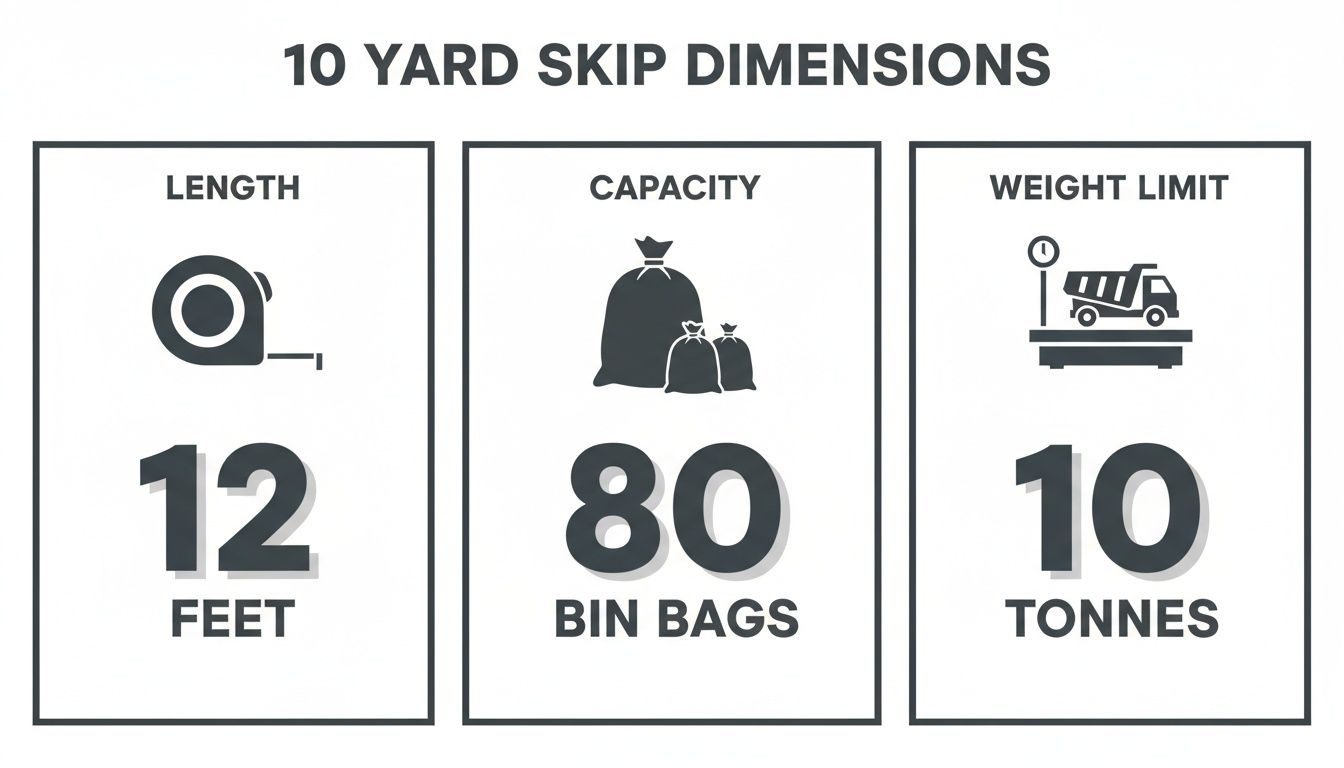
As you can see, it offers a substantial amount of space, making it ideal for bulky waste from house renovations or large-scale clear-outs. If you're wondering how this size stacks up against other options, take a look at our complete guide where all skip sizes are explained.
Getting the measurements right is half the battle for any home project, whether it's waste disposal or fitting new kitchen units, a point well-made in this helpful guide to standard dimensions.
What Actually Fits Inside a 10 Yard Skip
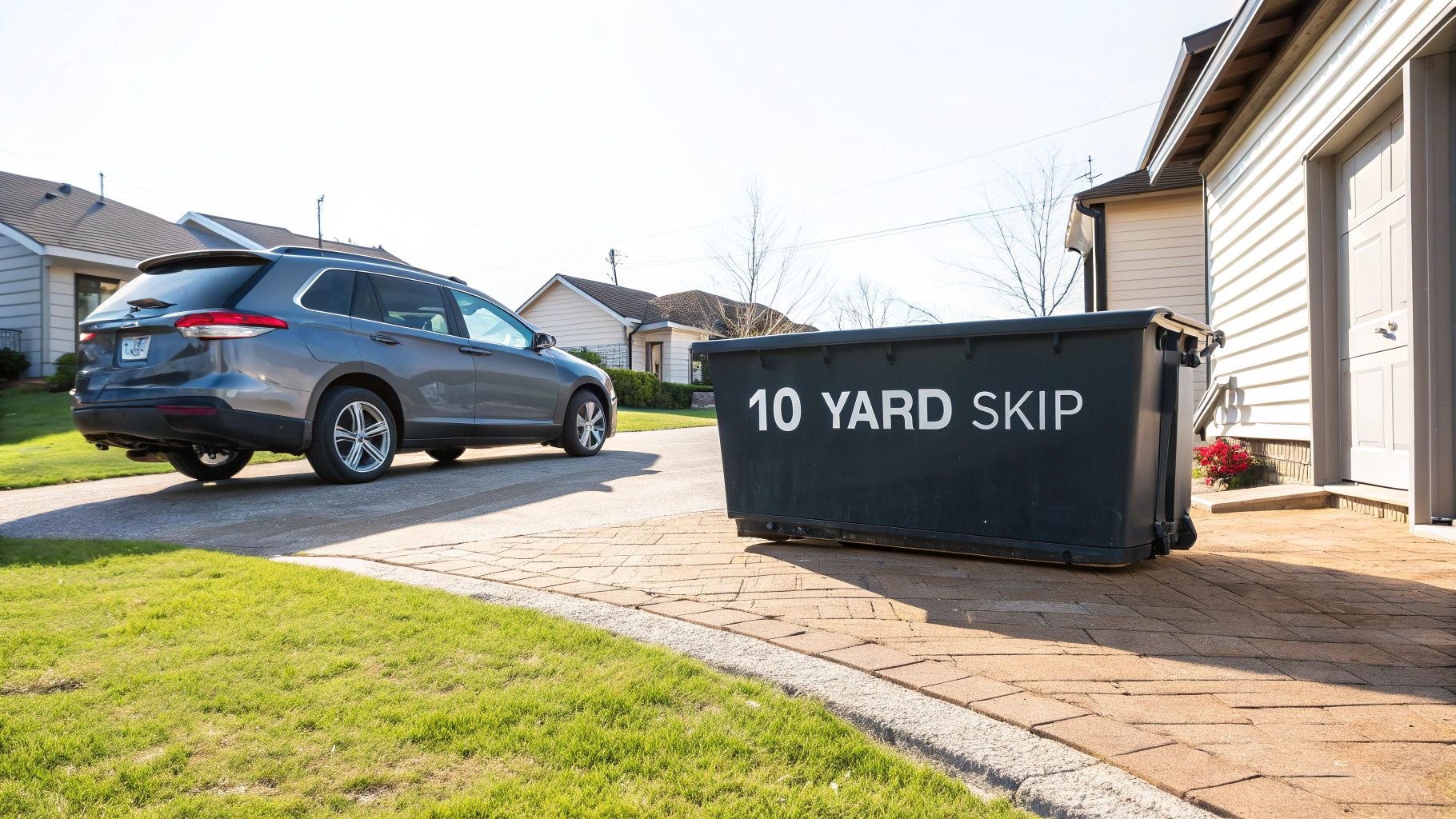
While knowing the exact 10 yard skip dimensions is a great starting point, the real question is: what does that space actually look like on your driveway? Numbers like '10 cubic yards' don't mean much until you can picture them filled with the rubbish from your own project. So, let’s translate those measurements into real-world scenarios you can properly visualise.
Picture a complete kitchen or bathroom renovation. This skip is perfectly sized to swallow all the old units—countertops, cabinets, sinks, and even the bath. It can comfortably handle all the other waste that comes with it, like old flooring, tiles, and plasterboard (just remember this needs to be kept separate!). It’s a genuine single-solution hire for a major interior overhaul.
It’s just as handy for big garden projects. If you're clearing an overgrown jungle or tackling a full landscaping redesign, this skip has the capacity for huge amounts of green waste, soil, and turf. To put it another way, its volume is about the same as 10 standard builder's bags (those big white bags you see full of sand or gravel), which gives you a solid benchmark for outdoor jobs.
Household and Garage Clear Outs
A 10 yard skip is the perfect partner for a proper, top-to-bottom household clear-out. Think about finally tackling that cluttered single garage or attic that’s been a dumping ground for years. This skip has more than enough room for old furniture, broken appliances, worn-out carpets, and all that general household junk.
So, what might a typical garage clearance look like? All of this would fit comfortably:
- Bulky Furniture: An old sofa, a couple of armchairs, and a mattress.
- Appliances: A broken-down washing machine or an old fridge-freezer.
- General Clutter: Piles of boxes filled with old toys, books, and household bric-a-brac.
- Garden Equipment: A rusty, broken lawnmower and other disused tools.
The key takeaway here is its versatility. The 10 yard skip perfectly bridges the gap between smaller domestic skips and the massive bins used on commercial sites, making it the true workhorse for substantial home projects.
This mid-range size has become incredibly popular for a good reason. As the UK skip hire industry has grown, it's clear there's massive demand for versatile options like the 10-yarder, especially with so many people renovating their homes. In fact, domestic projects account for an estimated 17 million skips hired per year in the UK, and a huge chunk of that is for skips in the 6- to 12-yard range. You can delve deeper into the market trends shaping the UK skip hire industry to see the full picture.
Construction and Renovation Projects
For builders and tradespeople, the 10 yard skip dimensions offer a really efficient way to manage waste on medium-sized jobs. It’s the ideal choice for the rubbish generated from a small extension, a shop fit-out, or an office refurbishment.
It handles mixed, lightweight construction waste with ease, including things like:
- Timber offcuts and old floorboards
- Pipes and plastic fittings
- Insulation materials
- Old window frames and doors
- Packaging materials like cardboard and plastics
By understanding these practical applications, you can look beyond the numbers and confidently decide if a 10 yard skip has the right amount of space for your specific job.
Navigating Skip Weight Limits and Material Types
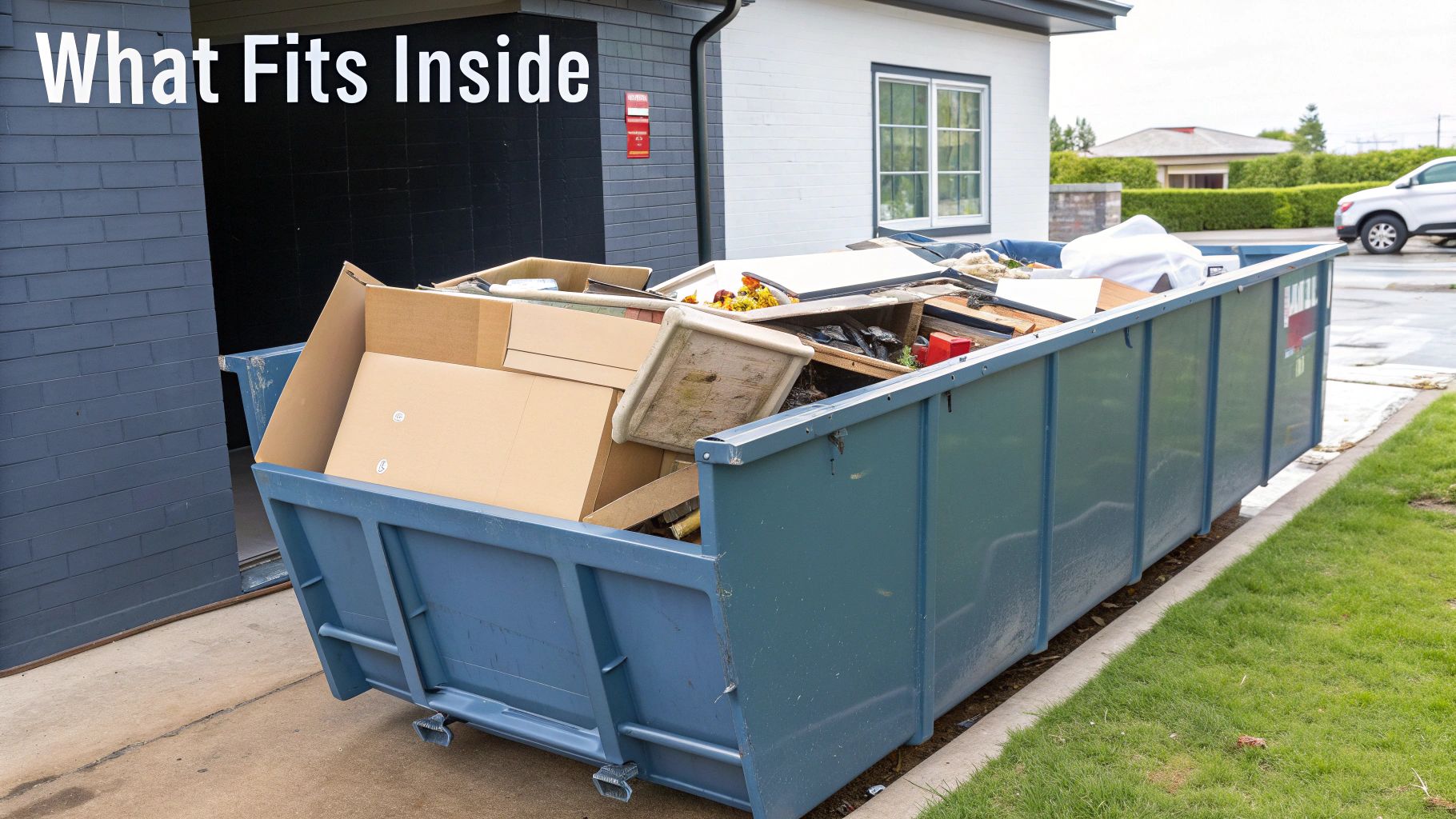
It’s easy to get focused on the 10 yard skip dimensions and think that if your rubbish fits inside, you’re all set. But there’s another crucial factor that often gets missed: the skip's weight limit. Getting your head around the difference between sheer volume and actual weight is the key to a hassle-free hire.
Think of a 10-yard skip as a big moving van. It’s absolutely perfect for those bulky but relatively light jobs – things like ripping out old kitchen cabinets, clearing out furniture, or getting rid of timber and general household clutter. Its generous size is designed precisely for that kind of waste.
The moment you need to be careful is when dealing with heavy, dense materials. You almost certainly can't fill a 10-yard skip to the top with soil, concrete, rubble, or bricks. This isn't because the skip can't handle it, but because of road safety and legal transport limits.
Why Weight Matters More Than Volume
The main reason for this rule comes down to the legal weight limit for our collection lorries. Every skip lorry has a maximum gross weight it can legally and safely carry on the road. A 10-yard skip, filled with heavy soil or rubble, could easily top 10 tonnes, pushing the lorry well over its legal limit.
This creates some serious problems:
- Unsafe Lifting: An overweight skip puts a massive strain on the lorry's lifting gear, which can lead to equipment failure during collection.
- Transport Dangers: Overloaded vehicles are less stable on the road, need much more room to stop, and are a real danger to other drivers.
- Legal Trouble: If one of our lorries gets pulled over at a DVSA weighbridge and is found to be overweight, both the driver and our company can face huge fines and penalties.
Because of this, if our collection team turns up and finds the skip is dangerously heavy, they won't be able to take it. You'll be asked to remove the excess weight before we can try again. Knowing that skips have a weight limit before you even start loading is the best way to avoid delays and potential extra charges on collection day.
Key Takeaway: The 10-yard skip is built for high-volume, low-weight waste. If your project involves shifting a lot of heavy stuff like soil or rubble, it’s often much better (and legally compliant) to hire a couple of smaller skips, like 6 or 8-yarders, instead.
The Business of Waste Management
These rules about weight and materials aren’t just about safety; they're also tied into the economics of managing waste properly. The way UK skip operators use 10-yard skips has changed a lot due to financial and regulatory pressures. With landfill tax always on the rise, skip hire companies use the set dimensions of a 10-yard skip to carefully plan payloads and pull out as much recyclable material as possible, making sure every trip is both profitable and compliant. This smart approach helps manage waste efficiently and keeps costs down for everyone involved.
Planning for Your Skip Delivery and Placement
Knowing the 10 yard skip dimensions is one thing, but making sure you have a safe and accessible spot for it to land is the really crucial part. A smooth delivery is the key to a stress-free skip hire, and a little bit of forward planning can save you from any headaches when our lorry pulls up.
You have to think bigger than the skip itself. Our delivery vehicles are large HGVs that need a surprising amount of room to reverse, line up, and work their hydraulic lifting arms. A good rule of thumb is to make sure the access route is at least 3 metres wide (that's about 10 feet). This gives the lorry enough wiggle room to get in and out safely.
Before you even book, take a quick walk down the path our driver will need to take. Don't forget to look up! Low-hanging tree branches, pesky telephone wires, or even low archways can easily get in the way of the lorry and its lifting gear.
Assessing Your Chosen Location
Once you're happy the lorry can get in, the next thing to check is the ground where the skip will sit. An empty 10-yarder is heavy, but a full one – especially one packed with rubble from a renovation – is a different beast altogether. The spot you pick needs to be able to take that weight without cracking under pressure (literally!).
Here’s a quick checklist to run through for your chosen site:
- Surface Strength: A solid tarmac or concrete driveway is perfect. Putting a skip on soft ground like a lawn or soil is asking for trouble. It can easily sink, especially if it rains, making collection a real nightmare.
- Gateways and Entrances: Get the tape measure out and check the width of your property entrance. If you’ve got gates, make sure they swing open wide enough to give our vehicle that essential 3-metre clearance.
- Underground Services: This is a big one. Never place a skip over manhole covers, inspection drains, or septic tanks. The combined weight could cause serious, and expensive, damage to these vital utilities.
Ticking off these simple checks means you can be confident your property is ready for a seamless delivery, leaving you to get on with the job at hand.
Private Property vs Public Highway Placement
By far the easiest option is to have the skip placed on private land, like your driveway. It keeps the skip close to your project and, most importantly, means you don’t need any permission from the local council. As long as it's completely inside your property boundary, you’re all set.
The moment any part of the skip touches public land—that means the road, pavement, or even a grass verge—you are legally required to have a skip permit from your local council. This isn't optional; it's a matter of public safety.
Sorting out a permit might sound like a hassle, but it's something we handle all the time. Here at The Waste Group, we can manage the entire application process for you. It usually takes a few working days for the council to give it the green light, so make sure to factor this into your project timeline. Permits also have their own set of rules, often requiring safety lights and cones, which we'll provide to make sure you're fully compliant. Just tell us you need to place the skip on the road when you book, and we'll handle the rest.
How to Load Your Skip for Maximum Value

Hiring a skip is only half the story; filling it the right way is how you really get your money's worth. A smartly packed 10-yard skip can hold a surprising amount more than one that's just been filled at random. Think of it like packing a suitcase for a long holiday—a bit of strategy makes all the difference.
By using a few simple techniques, you can make the most of every last bit of those 10 cubic yards. This approach not only helps you fit more waste in but also keeps the skip safe and stable for our collection team. It all starts with building a solid foundation at the bottom.
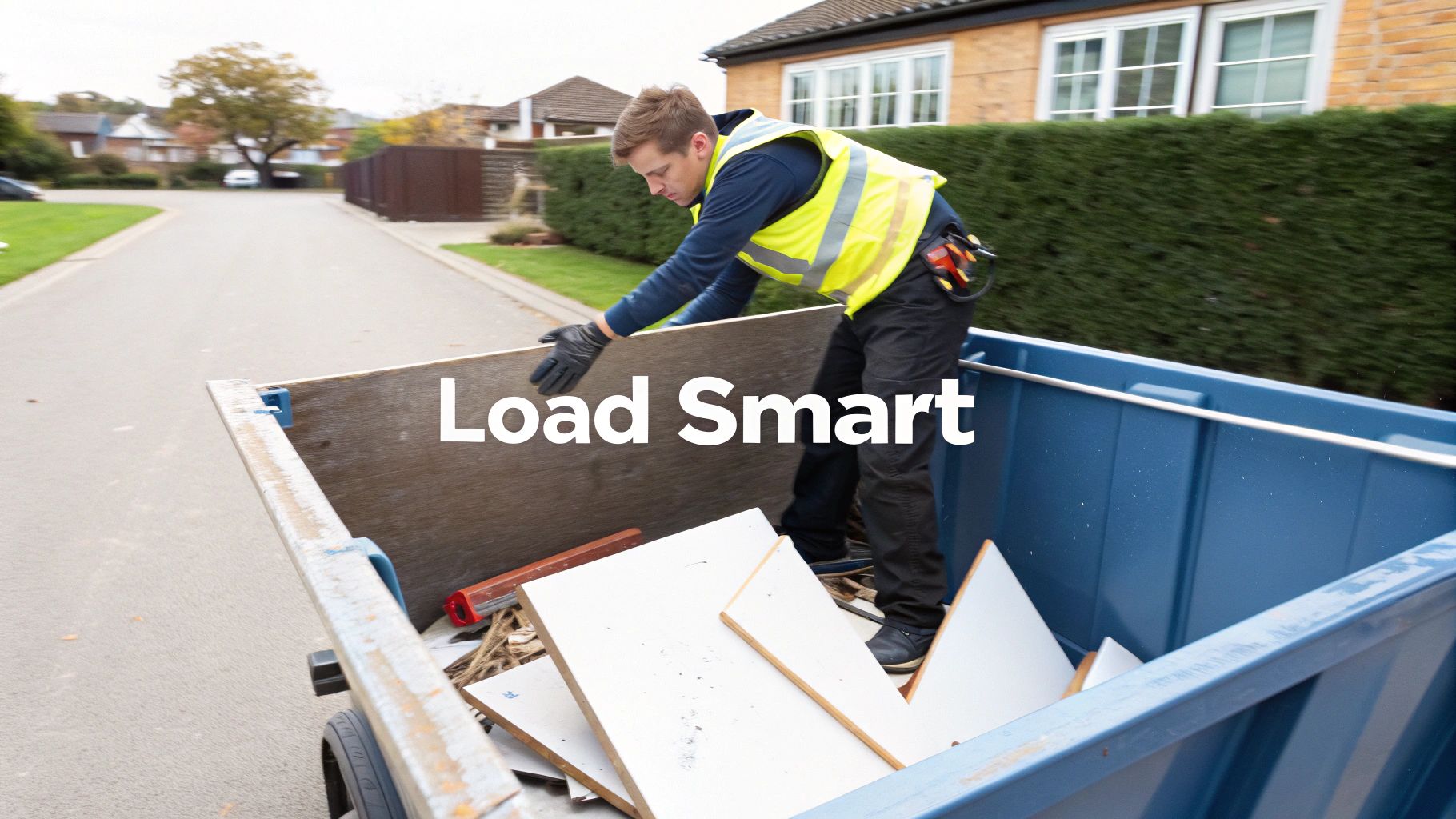
First things first, get any large, flat items in and lay them right at the base of the skip. We're talking about things like old doors, dismantled wardrobes, sheets of plywood, or even fence panels. Getting these in first creates a nice, level surface to build on, a bit like putting down the floor in a new room.
Dismantle Everything and Fill the Gaps
With your flat base in place, it's time to deal with the bulkier stuff. Whatever you do, don't just chuck in furniture or other big objects whole. A little bit of extra effort here will pay you back big time in saved space.
Break down everything you can. Take the legs off tables, pull apart bed frames, and make sure every cardboard box is flattened. Bulky items with hollow spaces inside, like old chests of drawers or cabinets, are notorious space-wasters. Fill these empty voids with smaller, heavier bits before you even lift them into the skip.
As you start to build up the layers, really focus on slotting smaller debris into any gaps you see. This is the secret to stopping "bridging," which happens when large items create big empty pockets of air underneath them. Use rubble, soil, or smaller offcuts to fill every nook and cranny for a really dense, compact load. You can find more great tips in our full guide on how to fill a skip for maximum efficiency.
The Golden Rule: Always respect the "level load" line that's clearly marked on the side of the skip. Overfilling isn't just inefficient, it's also dangerous and illegal for us to transport. If our driver arrives to find an overloaded skip, they'll have to refuse collection until the excess waste is removed.
Loading Safely and Smartly
Your safety should always come first when you're loading a skip. Always handle heavy objects carefully, using proper lifting techniques – that means bending your knees and keeping your back straight. If something feels too heavy, get a friend to help you. It's just not worth risking an injury.
To make it even clearer, thinking about what to do—and what not to do—can be a massive help. Getting it right from the start saves a lot of hassle later on.
Smart Loading Do's and Don'ts
| Best Practice (Do) | Common Mistake (Don't) |
|---|---|
| Start with flat items to create an even base. | Throw bulky items in first, creating awkward voids. |
| Break down furniture and large objects completely. | Leave items whole, wasting huge amounts of space. |
| Fill all gaps with smaller, loose debris. | Allow 'bridging' and large air pockets to form. |
| Keep the load level with the top edge of the skip. | Overfill the skip above the marked fill line. |
By sticking to these simple principles, you'll turn skip-loading into a fine art. It guarantees you get the absolute maximum value from your hire and helps your project run smoothly from beginning to end.
Your 10 Yard Skip Questions Answered
Even after getting to grips with the 10 yard skip dimensions and how best to load it, you might still have a few lingering questions. That's completely normal, especially when you're in the thick of planning a big project. Getting these final queries sorted ensures you can book your skip with complete confidence and sidestep any last-minute hitches.
To help you finalise your plans, we’ve put together the most common questions our customers ask us. Think of it as your quick-fire round of essential info, giving you clear, direct answers so you can crack on with your job.
How Much Does a 10 Yard Skip Cost to Hire?
This is usually the first question on everyone's mind, but the truth is, there's no single fixed price. The final cost of hiring a 10-yard skip really depends on a few key things that can change from one job to the next.
Your location in the UK plays a big part, as local disposal fees and transport costs vary from region to region. The type of waste you're getting rid of and how long you need the skip for will also affect the price.
That being said, a 10-yard skip always offers fantastic value for its size. It’s priced perfectly for those medium-to-large scale projects, making it a really cost-effective choice for anyone with a serious amount of waste. The best way to get a solid figure is to ask for a direct, no-obligation quote based on your specific project.
Do I Need a Permit for a 10 Yard Skip?
Whether you need a permit or not comes down to one simple thing: where you’re going to put the skip. If you've got enough room to place the skip entirely on your own private property—like a driveway, front garden, or other private land—then no permit is required.
You only need to get a council-issued skip permit if any part of the skip is going to be on public land. This means public roads, pavements, or even the grass verge outside your house. It's a legal must-have for public safety and can't be skipped.
The good news is that you don't have to wrestle with the council's application process yourself. A reputable skip hire company, like us, will sort out the permit for you as part of the service, making sure everything is above board before the skip even arrives.
How Long Can I Keep the Skip For?
We know that project timelines can be unpredictable; things don't always go exactly to plan. A standard hire period for a skip is usually around one to two weeks, which gives most people more than enough time for their clear-out or renovation.
Of course, we understand that bigger jobs can sometimes overrun. That’s why most skip hire providers, including us, offer flexible arrangements. If you find you need the skip for a bit longer, you can almost always extend the hire period for a small extra charge. The key is to just let your provider know in advance so they can make the arrangements.
Can I Mix Plasterboard with Other Waste?
This is a really important one, and the answer is a firm no. Due to specific environmental regulations, you can't mix plasterboard (sometimes called gypsum board) with other general waste in a skip. When plasterboard breaks down in a mixed landfill, it can release hydrogen sulphide, which is a toxic gas.
To make sure it's disposed of safely and legally, plasterboard must always be kept separate.
Here are your options for dealing with it:
- Dedicated Plasterboard Bags: Many companies, including The Waste Group, can give you special bags just for your plasterboard waste.
- Separate Collection: You can arrange for a specific collection just for the plasterboard.
- Dedicated Skip: If you have a huge amount, you might want to consider a dedicated skip just for plasterboard.
Always give your skip hire company a heads-up if you've got plasterboard to get rid of. It means you’ll follow the right steps from the get-go and avoid any problems or extra charges later on.
Ready to tackle your project with the perfect waste management solution? For a reliable, transparent, and hassle-free service, trust The Waste Group. We offer competitive pricing and expert advice to ensure you get the right skip for your needs.