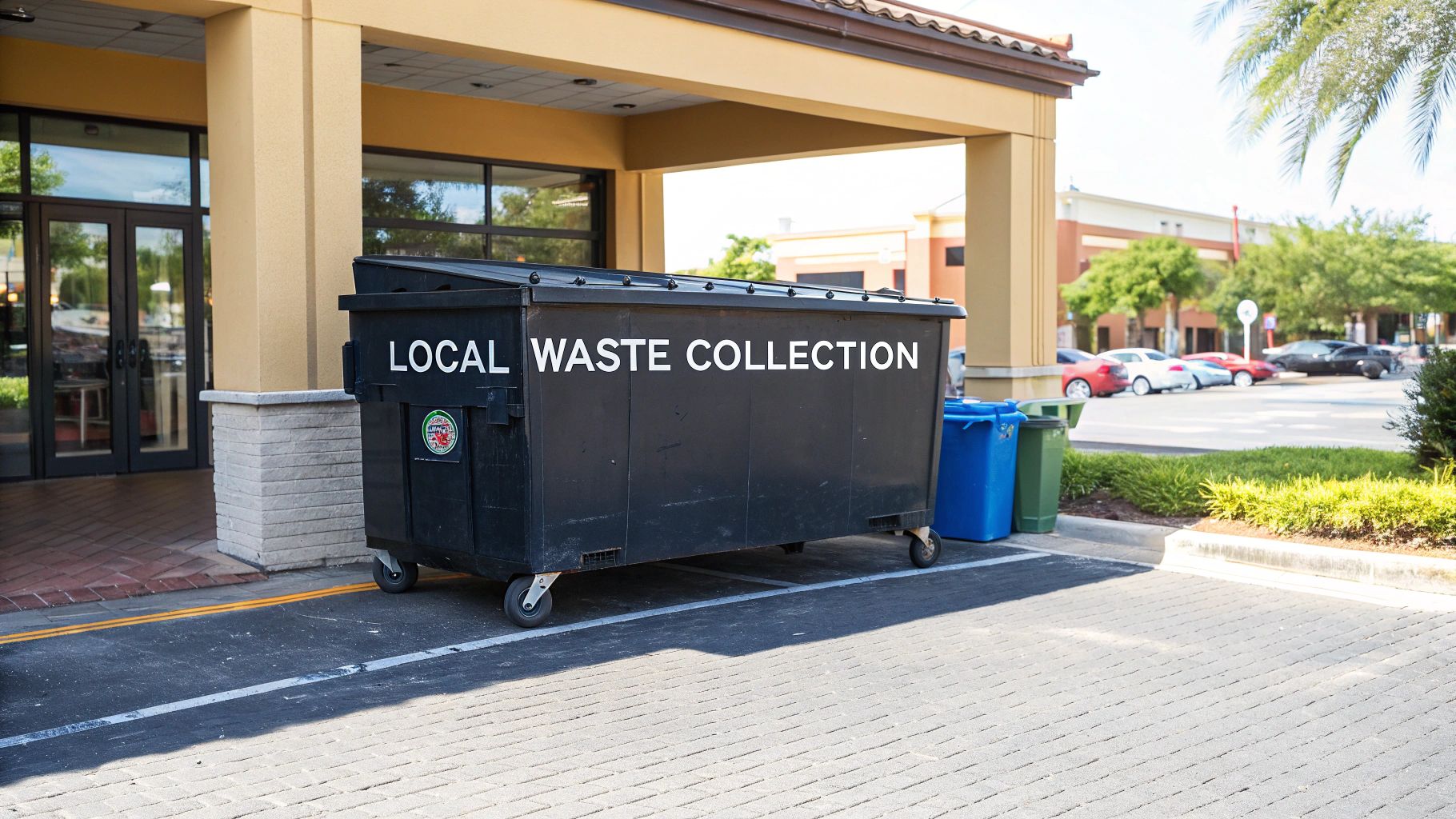
A Complete Guide to Hiring a 20 Yard RoRo Skip
A Complete Guide to Hiring a 20 Yard RoRo Skip
When you're dealing with a serious amount of waste from a big project, your standard builder's skip just won't cut it. This is where the 20 yard RoRo skip comes into its own. It's a heavy-duty container designed for major construction, demolition, and large-scale commercial clear-outs that produce huge volumes of bulky waste.
Think of it less like a skip and more like a portable, single-garage-sized bin for your waste. Its name, "Roll-on/Roll-off" (or RoRo), gives you a clue as to how it operates.
Getting to Grips with the 20 Yard RoRo Skip

Unlike smaller skips that are lifted off a lorry, a RoRo is delivered on a large HGV and, quite literally, rolled off the back of the truck into position. This simple but effective design is what makes it so perfect for handling large quantities of light-to-medium-weight waste that would fill up a traditional skip in no time.
This clever design has made the 20-yarder a staple for specific kinds of large-scale jobs. Its high sides and large rear doors mean you can easily load awkward or cumbersome items, from old shop fittings and office furniture to timber and general construction debris. You can even use a wheelbarrow to load waste directly inside, which is a massive help for site efficiency and safety.
What Is a 20-Yard RoRo Really For?
Across the UK waste management industry, the 20-yard RoRo has become the go-to for medium to large construction and renovation projects, especially in areas like Dorset where we at The Waste Group operate. These containers can hold a massive amount—roughly 150-200 builder's bags—and are built for heavy-duty use on sites with plenty of room for HGV access. To dig deeper into RoRo skips and their role, you can explore our UK waste industry insights.
It's the perfect choice for jobs that generate a high volume of waste but don't involve incredibly dense materials like pure soil or rubble, which come with strict weight limits.
The 20-yard RoRo neatly fills the gap between a large builder's skip and the colossal 40-yard containers. It offers huge capacity for bulky waste without the extreme footprint of its larger cousin, making it an incredibly practical and popular choice for countless commercial and construction sites.
When Does a 20 Yard RoRo Skip Make Sense for Your Project?
Choosing the right skip isn't just about cramming waste into a metal box; it's about being smart with your time and money. Think of it like picking the right tool for a job—you wouldn't use a sledgehammer to hang a picture, would you?
Hiring a massive 20 yard RoRo skip for a small bathroom refit or a bit of a garden tidy-up would be a classic case of overkill. You’d end up paying for a huge amount of empty space. Instead, this skip is designed for jobs that produce a lot of bulky, but not necessarily heavy, waste.
The Best Jobs for a 20 Yard RoRo Skip
You really see the value of a 20-yarder on bigger, more demanding sites. It's the go-to choice for specific commercial and construction projects where smaller skips would be overflowing in hours, leading to frustrating and expensive delays.
Here are a few perfect examples:
- Large Construction Sites: When you're clearing out mixed demolition waste like timber, plasterboard, and old packaging, a 20 yard RoRo gives you the capacity to keep the site clear without constant interruptions.
- Full Retail Fit-Outs: Imagine a shop getting a complete makeover. All the old shelving, display units, flooring, and other large fittings can be loaded straight in, thanks to the RoRo’s large, easy-access rear doors.
- Commercial Clearances: For warehouses or factories dealing with piles of packaging, wooden pallets, or other non-hazardous industrial waste, a RoRo provides a simple, one-container solution.
Making the Right Choice
The common theme here is the combination of high volume and bulky items. When you’re planning a huge job like a new build, figuring out waste management is a massive part of the puzzle. For a deeper look at everything involved in a project like that, this guide on what to know before building a house is a great resource.
The golden rule is simple: if your waste is big and bulky but not excessively heavy, the 20 yard roro skip is likely your most economical choice. It's designed for volume, not sheer weight.
This difference is absolutely crucial. While it's perfect for wood and general mixed waste, filling a 20-yarder with heavy materials like soil, concrete, or rubble would make it far too heavy to be legally moved from your site.
Knowing these limits is key to a hassle-free hire. To help you decide, you can learn more about the different roll-on/roll-off skip sizes and what they're best used for. A bit of homework now can save you from paying for empty space or the unexpected cost of ordering a second skip.
Permitted and Prohibited Materials for Your 20 Yard RoRo
Getting to grips with what you can and can’t throw into your 20 yard RoRo skip is more than just a bit of admin. It’s absolutely essential for keeping your site safe, staying on the right side of environmental rules, and, crucially, avoiding any nasty surprises with extra disposal fees.
Think of it this way: knowing the rules from the get-go means your project can run without a hitch. The guidelines are there for very good reasons, mostly to do with environmental safety and the fact that some materials just need specialist handling.
What Can Go in Your RoRo Skip?
A 20 yard RoRo skip is the perfect workhorse for huge volumes of general and bulky, non-hazardous waste. This makes it the go-to choice for big construction jobs, commercial clear-outs, and major renovations.
As a general rule, you can confidently load it up with materials like these:
- Construction & Demolition Debris: Think wood, timber, metals, and plasterboard (just be sure to keep plasterboard separate).
- Commercial & Shopfitting Waste: Old furniture, office chairs, shelving, and non-electrical fixtures are ideal.
- Bulky Packaging: Perfect for large amounts of cardboard, plastics, and wooden pallets that build up quickly.
- Garden & Green Waste: A great solution for branches, cuttings, and other organic material from large-scale landscaping.
It’s also worth remembering that very heavy materials can be a factor. For example, there are specific guidelines on how to dispose of soil correctly, as dense waste like this can easily push your skip over its weight limit.
This flowchart can help you decide if a large RoRo is the best fit for your job compared to a standard builder's skip.

For large-scale projects with a mix of bulky items, a RoRo is almost always the most efficient and cost-effective way forward.
What Cannot Go in Your RoRo Skip?
Now for the important bit. Certain items are strictly forbidden from being put in any general waste skip, and that includes a 20 yard RoRo. These materials are classed as hazardous and must have a specialist collection to prevent harm to people and the environment.
Trying to hide prohibited items in a skip can lead to the entire load being rejected by the waste transfer station. This will cause major project delays and you will be responsible for the significant extra costs to sort it out.
To make it crystal clear, here’s a quick comparison of what you can and can't load.
What Can and Cannot Go in a 20 Yard RoRo Skip
| Permitted Materials (Examples) | Prohibited Materials (Requires Specialist Disposal) |
|---|---|
| Wood, Timber & Pallets | Asbestos |
| Metal (non-electrical) | Fridges, Freezers & Air-Con Units |
| Plasterboard (kept separate) | TVs & Computer Monitors (WEEE) |
| Bricks, Rubble & Concrete | Batteries of any kind |
| Soil & Hardcore | Paint, Solvents & Oils |
| Bulky Furniture (non-electrical) | Gas Cylinders & Fire Extinguishers |
| Plastics & Cardboard | Tyres |
| Garden & Green Waste | Chemicals & Hazardous Liquids |
The items in the prohibited list pose a real risk at disposal facilities and simply cannot be mixed with general waste.
Under no circumstances should you ever load items like asbestos, electricals (WEEE waste), paints or oils, and tyres or gas cylinders. They all need a dedicated, compliant disposal route.
If you’re ever unsure about a specific item, the best thing to do is ask first. For a more detailed breakdown, you can check out our guide on what can't be put in a skip. It's always better to be safe than sorry.
Understanding the Costs of RoRo Skip Hire
Working out the cost of hiring a 20 yard RoRo skip is a key part of planning your project budget. Nobody likes financial surprises, and the good news is, the final price isn't just a number plucked out of thin air. It’s calculated based on a few straightforward factors.
The price you're quoted isn't just for a big metal box. Think of it as an all-in-one package that covers the delivery to your site, a standard hire period, the collection once you're done, and—most importantly—the responsible disposal of all the waste inside.
Key Factors That Influence the Final Price
So, what actually goes into that final price? A few core things determine the total cost of hiring a RoRo. Knowing what they are helps you manage your budget and can even highlight ways to keep your spending down. The two biggest drivers are what you're throwing away and where your site is.
The main variables are:
- Waste Type: What you're disposing of makes a big difference. Clean, inert waste like wood, for instance, is often cheaper for us to process than mixed general waste which needs a lot more sorting.
- Haulage Distance: How far your site is from our waste transfer station has a direct impact on our fuel and transport costs for both the drop-off and the pick-up.
- Hire Duration: A standard hire period is always included in the price. If you need to keep the skip on-site for longer, there might be an extra weekly rental charge.
- Council Permits: If your 20 yard RoRo skip has to sit on public land, like a roadside, you’ll need a permit from the local council. This comes with its own fee, which we can arrange on your behalf.
The Impact of Landfill Tax and Recycling
One of the biggest, and most-often overlooked, parts of the cost is Landfill Tax. This is a government tax on any waste that gets sent to a landfill. The rates are pretty hefty, and they're set that way to encourage everyone to recycle more.
For the 2024-2025 period, the standard rate of Landfill Tax in England and Northern Ireland is £103.70 per tonne. This means for every single tonne of your waste that we can't recycle, that cost gets added straight to the bill.
This is exactly where choosing a waste company with high recycling rates becomes a really smart move for your wallet. At The Waste Group, we’re committed to recycling as much as we possibly can—not just for the planet, but to deliver real cost savings to you. By diverting your waste away from landfill, we massively cut down the amount of Landfill Tax you have to pay.
Our transparent pricing and super-efficient recycling process mean you get genuine value for money. It helps keep your project on budget and gives you peace of mind that your waste is being handled the right way. If you’d like to get into the nitty-gritty, you can learn more about how skip hire is priced in our detailed guide.
How to Prepare Your Site for a RoRo Delivery
Getting your site ready for a 20 yard RoRo skip is all about groundwork. A smooth, hassle-free delivery really comes down to good preparation, because unlike smaller skips, a RoRo needs a serious amount of space – not just for the container itself, but for the large HGV that delivers it.

It helps to think of the delivery lorry like a very large animal that needs a clear, straight path. The driver has to reverse up to the drop-off spot before using the vehicle's hydraulics to roll the container off the back. This whole manoeuvre needs a long, straight, and completely unobstructed approach – often much more room than you might first guess.
Checking Your Access Route
Before delivery day, it’s worth taking a walk along the exact path the HGV will need to take. Have a good look up and all around for any potential obstacles. A quick check like this can save you the headache and cost of a failed delivery attempt.
Here's what to look out for on your site access checklist:
- Clearance Height: Are there any low-hanging tree branches, overhead cables, or archways in the way? These lorries need a surprising amount of vertical clearance.
- Sufficient Width: Make sure any entrance gates and the access road itself are wide enough for an HGV to get through without a squeeze.
- Turning Space: The driver is going to need enough room to safely manoeuvre the lorry into position for the drop.
A failed delivery due to poor access is one of the most common—and avoidable—extra costs in skip hire. A quick chat with our team at The Waste Group beforehand can confirm if your site is suitable.
Preparing the Drop-Off Area
The ground where the skip will actually sit is just as critical as the route to get it there. A fully loaded 20 yard roro skip is incredibly heavy, so the ground beneath it has to be able to take that weight without shifting or sinking.
The perfect surface is both firm and level. Think concrete, tarmac, or solid, compacted hardcore. You should never plan to place a RoRo on soft ground like grass or soil – it's a recipe for disaster, as the skip can easily get bogged down or cause a lot of damage to the surface. Also, be sure the spot is totally clear of any materials, vehicles, or other equipment.
Once your skip is on-site, just remember to load it safely. Spread the weight of the waste as evenly as you can and never fill the skip past its level load line. Overfilling is not only dangerous but also illegal to transport on the road.
Why The Waste Group Is Your Ideal Partner

Choosing a partner for waste management on a large-scale project is about a lot more than just hiring a 20 yard RoRo skip. It's really about finding a reliable service that keeps your site running smoothly, makes sure you’re fully compliant, and gives you real value for your money. This is where we believe The Waste Group really shines.
We get it – delays on site cost money and cause headaches. That’s why we offer guaranteed next-day delivery right across Dorset. Your RoRo skip will show up exactly when you need it, not a day later. This simple promise means your team can keep up the momentum without having to work around growing piles of waste.
Our whole service is built on trust. With our price-match guarantee, you can feel confident you’re getting a fair, competitive rate without ever compromising on quality or compliance. There are no nasty surprises or hidden fees here; just straightforward, honest pricing that helps you keep your project budget on track.
A Commitment to Sustainability and Service
We believe responsible waste management is a duty we all share. We're passionate about diverting as much waste from landfill as we possibly can, and our industry-leading recycling rates don't just reduce your environmental footprint—they can often lower your costs by keeping Landfill Tax to a minimum.
And our dedication goes even further. Through our ‘a tree for every skip’ initiative, we plant a tree for every single skip hired from us. It means that when you choose The Waste Group, you're actively helping create a greener future for Dorset and the surrounding areas.
This focus on doing things the right way is reflected in our 4.9-star reputation, which we've earned by providing expert, hassle-free solutions for projects of all sizes. Whether it's helping you navigate council permits or advising on different waste types, our team is here to make your life easier.
When you partner with us for your 20 yard RoRo skip hire, you’re not just getting a big metal box; you’re getting a dedicated team that’s fully committed to the success of your project.
Ready to get your project moving? Get a fast, no-obligation quote using our simple online booking portal or give our friendly team a call.
Your Questions Answered
Even the best-laid plans can hit a snag, and it's natural to have a few last-minute questions before hiring a large skip. To help you get everything sorted, we’ve answered some of the most common things we get asked about our 20 yard RoRo skips.
How Much Waste Can I Actually Get in a 20 Yard RoRo?
A 20 yard RoRo holds, you guessed it, 20 cubic yards of waste. To give you a better picture, that’s enough space for around 150-200 standard black builder's bags filled to the top.
It’s the perfect choice for big jobs involving large amounts of bulky but fairly lightweight waste. Think timber, old furniture, plastics, and the general debris from a major site clearance or renovation.
One crucial point to remember is that this skip is built for volume, not sheer weight. It is not designed to be filled completely with heavy materials like soil, rubble, or concrete. A full load of that kind of dense waste would almost certainly be too heavy for the lorry to lift and legally transport.
Will I Need a Permit for the Skip?
You'll only need a permit from your local council if any part of the skip is going to be placed on public land. This means the road, a pavement, or even a grass verge in front of your property.
If you have enough space to place the entire 20 yard RoRo skip on private land—like a large driveway, a designated building site, or a private yard—then you won’t need a permit at all.
If you do need one, don't worry. The Waste Group can sort out the council permit application for you. Just remember to factor in a few extra days before your delivery date to allow time for the paperwork to be processed.
How Long Can I Keep the RoRo Skip For?
We know that big projects don't always run like clockwork. That's why we’re flexible with our hire periods to fit around your schedule.
The standard hire time for a 20 yard RoRo skip is usually between 7 and 14 days. If your project looks like it might overrun and you need it for longer, that’s no problem. Just have a chat with our team when you book, and we can easily arrange an extended hire.
Bear in mind, if your skip is on a public road, the maximum time you can keep it will be limited by the dates on your council permit.
Ready to get your project moving without delays? The Waste Group offers guaranteed next-day delivery on our full range of skips. Get a fast, no-obligation quote today through our simple online booking portal.