
Your Guide to Using an Aggregate Calculator UK for Any Project
Your Guide to Using an Aggregate Calculator UK for Any Project
Ordering the right amount of aggregate shouldn't be guesswork. It's a straightforward process: measure your area in metres, multiply by the depth you need to get the volume in cubic metres (m³), and then convert that volume into tonnes using the material's specific bulk density.
An online aggregate calculator uk can do the maths for you, but really getting to grips with the simple area → volume → weight calculation is the best way to prevent costly mistakes.
Why Guessing Your Aggregate Volume Costs You Money
Before you lay a single stone, let's talk about the real cost of getting your aggregate order wrong. It’s a classic pitfall that catches out everyone from weekend DIYers to seasoned builders. A simple miscalculation doesn't just cause a bit of a headache; it can create major financial and logistical problems that throw your whole project off course.
Over-ordering isn't just a waste of good material; it quickly becomes a disposal problem and a sunk cost. You're left with a heap of MOT or sand you don't need, which then costs you more time and money to get rid of. But under-ordering? That's often even worse.
The True Price of Underestimating
Picture this: your project is in full swing. The digger's been, the ground is prepped, your team is on-site, and then you run out of MOT Type 1 for the sub-base. The fallout is immediate and incredibly frustrating:
- Project Delays: Everything grinds to a halt while you scramble to get another delivery sorted.
- Wasted Labour Costs: You could be paying contractors to stand around, unable to do anything productive.
- Expensive Top-Up Deliveries: A small, last-minute emergency load almost always comes with a premium delivery charge, wiping out any savings you thought you’d made.
Ordering incorrectly is a classic false economy. That little bit of time you spend doing an accurate calculation pays for itself tenfold by preventing expensive delays, wasted materials, and the stress of a last-minute panic.
The UK's appetite for aggregates is massive. In 2024 alone, the construction aggregates market hit a value of USD 19,452.09 million, which shows just how vital it is to our national infrastructure. With demand predicted to climb past 320 million tonnes by 2035, using these materials efficiently is more critical than ever. You can see more on these trends over on the official government statistics page.
This guide is here to demystify the process and put you back in control. We'll walk you through the exact steps suppliers use, from working out your cubic metres to converting that figure into the correct weight for your order. Understanding concepts like bulk density—which we explore in our article explaining how much a tonne of sand covers—is absolutely key. It's the difference between a smooth, on-budget job and one plagued by expensive errors.
The Core Formula for Calculating Aggregates
Moving past the risks of guesswork, let’s get practical with the core formula every UK aggregate supplier uses. This isn’t complex mathematics; it’s a simple, three-stage process that ensures you order the right amount every time.
We'll break down how to measure your space, calculate its volume, and finally convert that into the weight you need to order.
This simple flow visualises the journey from getting the tape measure out to having a delivery lorry arrive with the right amount of material.
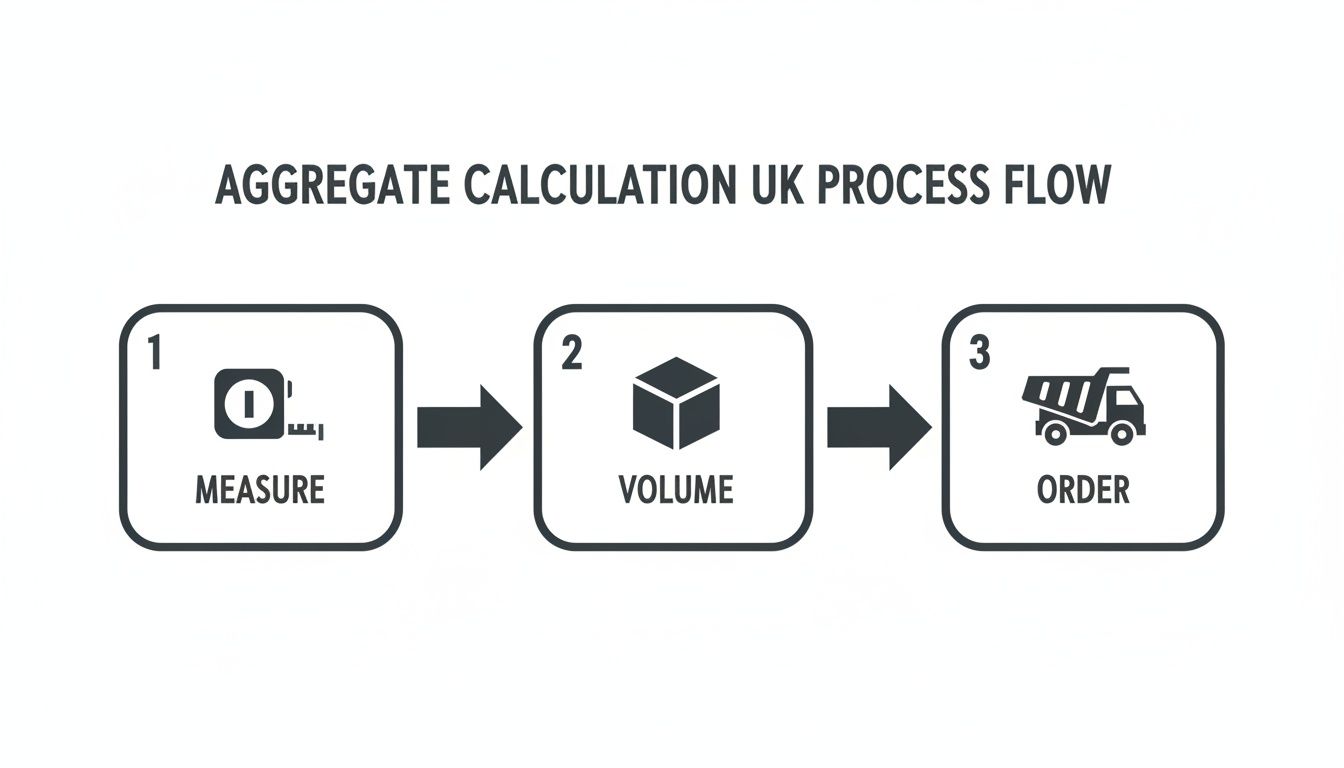
Ultimately, each step builds on the last, turning a simple length and width measurement into a precise order in tonnes.
Measuring Your Project Area
First things first, you need to work out the surface area you’re covering. Precision here prevents headaches down the line, so grab a tape measure and get accurate figures. For most jobs, you’ll be dealing with pretty simple shapes.
A standard rectangular or square area is the most straightforward calculation you’ll do:
Length (in metres) x Width (in metres) = Area (in square metres or m²)
So, if you’re laying a new patio that’s 6 metres long and 4 metres wide, you have a total area of 24 m². It’s crucial to stick with metres for all your measurements, as it’s the standard unit for volume calculations across the UK construction industry.
What about those awkward, non-standard shapes? You just need to break them down.
- L-Shaped Areas: Split the 'L' into two separate rectangles. Calculate the area for each one, then simply add them together to get your total.
- Circular Areas: For a circle, measure the radius (that's the distance from the centre to the edge). The formula is πr² (Pi times the radius squared). Pi is roughly 3.142. So, for a circular patio feature with a 2-metre radius, the area would be 3.142 x (2 x 2) = 12.57 m².
Always double-check your numbers before moving on. A small mistake at this stage can get magnified by the time you calculate your final tonnage.
From Area to Volume
With your area sorted in square metres (m²), the next step is to give it some depth. This is where you convert your flat, two-dimensional area into a three-dimensional volume, measured in cubic metres (m³). This is the figure that really matters for ordering.
The calculation itself is simple:
Area (m²) x Depth (in metres) = Volume (in cubic metres or m³)
Now, this is where many people trip up—you must convert your depth measurement into metres. A depth of 100mm is 0.1m, and 50mm is 0.05m. Forgetting this conversion is probably the most common mistake we see.
Let’s go back to our 24 m² patio. If you need a sub-base with a depth of 150mm (or 0.15m), the volume calculation is:
24 m² x 0.15 m = 3.6 m³
This 3.6 m³ figure is the actual volume of aggregate required to fill that space. It's the same principle used when figuring out material for foundations, a topic we touch on in our guide to calculating concrete volume. Getting this volume right is essential before you can even think about weight.
Converting Volume to Weight for Ordering
The final, crucial step is turning your volume (m³) into weight (tonnes), as this is how all aggregates are sold in the UK. This conversion hinges on one key piece of information: the bulk density of your chosen material.
Bulk density is simply the weight of an aggregate per cubic metre, including the tiny air gaps between all the particles. It’s not the same for every material; hefty granite is much denser than lightweight slate, for example.
The last formula you need is:
Volume (m³) x Bulk Density (tonnes per m³) = Weight (in Tonnes)
Let's assume the sub-base for our patio is MOT Type 1 hardcore, which has a typical bulk density of around 1.9 tonnes per m³. Using our calculated volume of 3.6 m³:
3.6 m³ x 1.9 tonnes/m³ = 6.84 tonnes
Based on that, you would need to order 6.84 tonnes of MOT Type 1.
Pro Tip: Always round your final weight up to the nearest half-tonne or full tonne. Trust me, it’s far better to have a small amount left over than to be slightly short and have to arrange an expensive top-up delivery for a few shovelfuls. For this job, ordering 7 tonnes would be the sensible choice.
Matching Aggregate Types to Their Densities
Right, you’ve worked out the volume you need in cubic metres. Now comes the part that trips up even experienced DIYers: turning that volume into a weight in tonnes for your order.
It’s a common stumbling block. Why can’t you just use one simple conversion number? Because a cubic metre of light, airy slate chippings weighs far less than the same volume of dense, compacted MOT Type 1. This crucial difference is called bulk density, and it’s the key to getting your order spot on.
Trying to order aggregates without understanding this is like baking a cake and not knowing the difference between a cup of flour and a cup of sugar. They fill the same space, but their weight and purpose are completely different. This is your field guide to the most common aggregates in the UK and their typical densities, ensuring your calculations are accurate from the get-go.
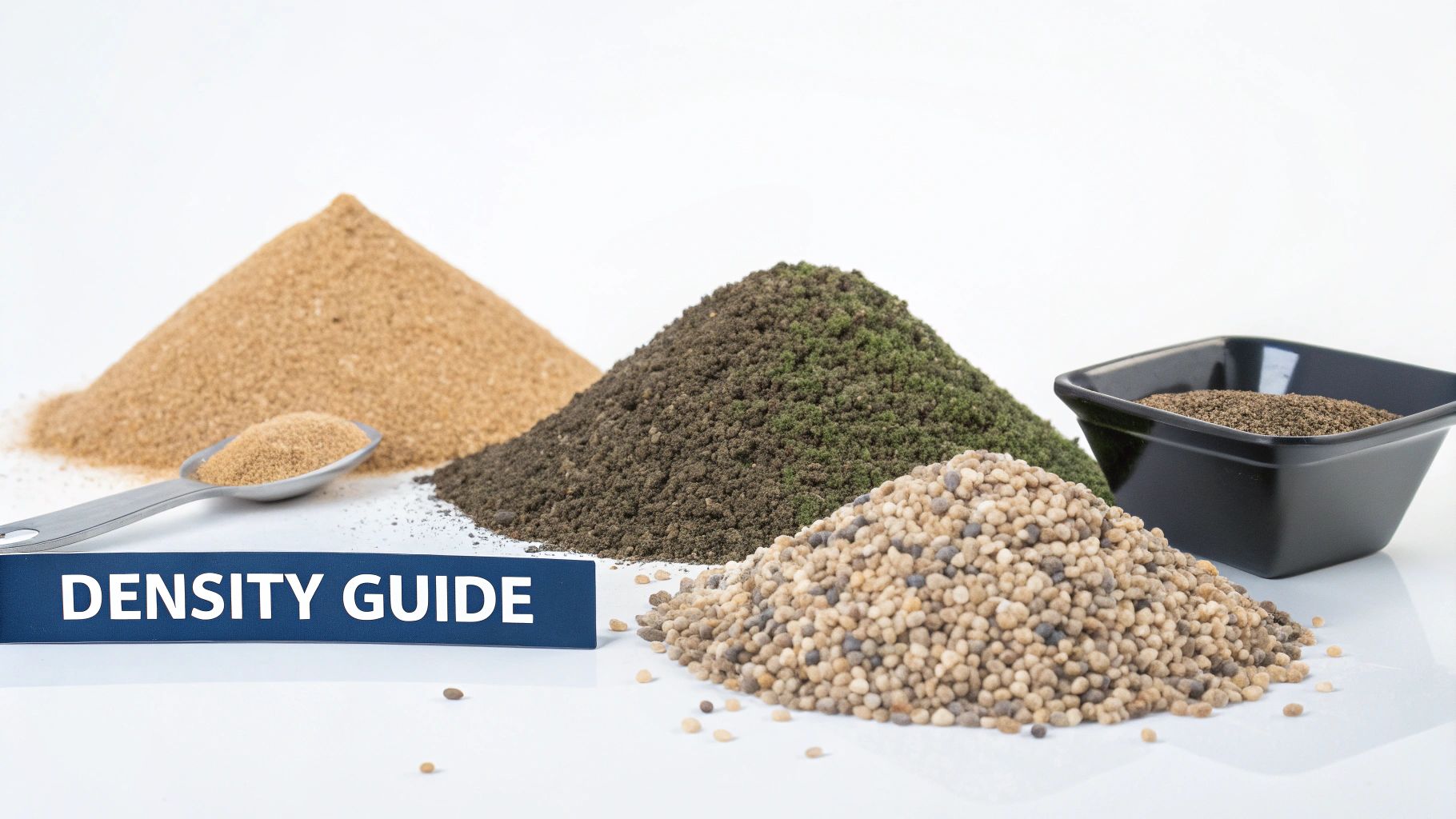
Why Bulk Density Isn’t a Fixed Number
Before we get to the numbers, it’s important to know that bulk density is a very good estimate, not a number set in stone. A few real-world factors can shift it slightly:
- Moisture Content: Wet sand is much heavier than dry sand. A sudden downpour can increase the weight of an aggregate pile without changing its volume, so suppliers usually account for typical moisture levels.
- Compaction: When you go over a sub-base with a wacker plate, you’re forcing out the air between the particles, which makes it denser. The figures we use are for the loose, uncompacted stuff you get delivered.
- Particle Size and Shape: Aggregates with sharp, interlocking pieces like crushed hardcore have a different density to materials with smooth, rounded stones like pea shingle.
Think of it like this: you can fill a jar with marbles, or you can fill it with sand. Both take up the same volume, but the sand fills every tiny gap, making it much denser and heavier. The same principle applies to different types of stone.
A Quick Reference Guide for UK Aggregates
To make things easier, here’s a handy table for the most common materials you'll be dealing with. Whether you're using an aggregate calculator uk or doing the sums yourself, pick the figure that best matches your material to get an accurate result.
Common UK Aggregate Bulk Densities
Here is a quick reference for some of the most popular aggregates and their typical bulk densities.
| Aggregate Material | Typical Bulk Density (Tonnes per m³) | Common Uses |
|---|---|---|
| MOT Type 1 / Hardcore | 1.9 – 2.2 | Sub-bases for driveways, patios, and building foundations. |
| General Ballast | 1.7 – 1.9 | Mixing with cement to create concrete for foundations. |
| Building Sand / Soft Sand | 1.4 – 1.6 | Mortar for bricklaying and rendering. |
| Sharp Sand / Grit Sand | 1.5 – 1.7 | Screeding floors, block paving, and concrete mixes. |
| Pea Shingle (10mm/20mm) | 1.5 – 1.7 | Decorative paths, drainage, pipe bedding. |
| Crushed Concrete | 1.7 – 2.0 | A recycled alternative for sub-bases and fill. |
| Slate Chippings | 1.2 – 1.4 | Decorative ground cover, mulch, and pathways. |
| Topsoil (As Dug) | 1.3 – 1.5 | General landscaping, creating garden beds, and levelling. |
Remember, choosing the right material is just as important as the calculation itself. For any load-bearing surface, a solid sub-base is essential, and MOT Type 1 is the go-to choice for its fantastic compaction properties. You can find out more in our detailed guide on what defines Type 1 aggregate. Getting this wrong—using building sand where sharp sand is needed, for example—could seriously compromise your project.
The Financial Impact of Getting It Right
Nailing this calculation has a direct impact on your wallet, especially as material costs keep climbing. The UK Aggregates Price Index (API) is forecast to rise at a compound annual growth rate of 8.1% through to 2025. In fact, between 2021-22, the API jumped 1.5% year-on-year, hitting its highest point since records began.
This steady price increase means every tonne you over-order is an increasingly expensive mistake.
Let's look at a quick example. Say you need 5 m³ of material.
- If you mistakenly use the density of building sand (1.5 tonnes/m³) for a MOT Type 1 (2.0 tonnes/m³) order, you'd calculate 7.5 tonnes. You’d be short by a massive 2.5 tonnes, forcing a second, costly delivery.
- On the flip side, if you used the heavy MOT density for a decorative slate order (1.3 tonnes/m³), you'd calculate 10 tonnes when you only needed 6.5 tonnes. You'd be left with 3.5 tonnes of unwanted slate and a serious dent in your budget.
This is exactly why a generic, one-size-fits-all density figure just won’t do. By matching your specific aggregate to its correct bulk density, you ensure your final tonnage is as precise as it can be, saving you from project delays and unnecessary expense.
Getting Your Numbers Right: Real-World Examples
The theory is one thing, but seeing how the maths works on a real-world job is where it all starts to make sense. Let's run through the calculations for three of the most common projects we see, from garden patios to driveway installations.
Each example will break down the measurements, the different types of aggregate you'll need, and how to apply the formulas. Crucially, we’ll also add that all-important 10% extra for wastage so you don’t get caught short on the day.
Example 1: The Garden Patio
A new patio is a classic UK garden project, but it needs two different aggregates to do it properly: a solid sub-base and then a bedding layer for the slabs to sit on.
Let's say our new patio area is 6 metres long by 4 metres wide.
First up is the MOT Type 1 sub-base. For a standard patio that will only see foot traffic, a depth of 100mm (0.1m) is more than enough to give you a stable, well-draining foundation.
- Area:
6m (Length) x 4m (Width) = 24 m² - Volume:
24 m² (Area) x 0.1m (Depth) = 2.4 m³ - Weight: MOT Type 1 has a bulk density of about 2.0 tonnes per m³. So,
2.4 m³ x 2.0 = 4.8 tonnes. - Add 10% Wastage:
4.8 tonnes x 1.10 = 5.28 tonnes.
You’d be wise to order 5.5 tonnes of MOT Type 1.
Next, you need a sharp sand bedding layer. This is a much thinner layer, usually around 40mm (0.04m) thick, for levelling the paving slabs.
- Area: This stays the same at
24 m². - Volume:
24 m² (Area) x 0.04m (Depth) = 0.96 m³ - Weight: Sharp sand is a bit lighter, around 1.6 tonnes per m³. So,
0.96 m³ x 1.6 = 1.54 tonnes. - Add 10% Wastage:
1.54 tonnes x 1.10 = 1.69 tonnes.
For the sand, you'll want to order 1.75 or 2 tonnes. Since most suppliers deliver in bulk "tonne bags," simply ordering two bags is the easiest and most practical option here.
Example 2: The Domestic Driveway
A driveway has to handle the weight of cars, so the sub-base needs to be much deeper and stronger. Let’s imagine we’re putting in a new drive that is 8 metres long and 3 metres wide.
For a typical family driveway, you'll need a sub-base depth of at least 150mm (0.15m) of MOT Type 1. Skimping on this is a false economy—it’s what stops the drive from sinking or developing ruts later on.
- Area:
8m (Length) x 3m (Width) = 24 m² - Volume:
24 m² (Area) x 0.15m (Depth) = 3.6 m³ - Weight: Again, using 2.0 tonnes per m³ for MOT Type 1, the calculation is
3.6 m³ x 2.0 = 7.2 tonnes. - Final Tonnage with Wastage:
7.2 tonnes x 1.10 = 7.92 tonnes.
For a job this size, ordering a full 8 tonnes of MOT Type 1 is the smart move. It gives you a little extra to play with, which is perfect for filling any uneven patches in the ground and ensures you won't have to pause the project for a top-up delivery.
Example 3: Concrete Footings for a Garden Wall
Finally, let's look at the concrete footings for a garden wall. This is a bit different because you're ordering the separate ingredients—sand and gravel—to mix with your cement on-site.
For structural projects like retaining walls, getting your quantities spot on is vital for strength and proper drainage. There's a great guide on this topic that explains How to Build Retaining Walls the Right Way.
Imagine your foundation trench is 15 metres long, 0.5 metres wide, and 0.4 metres deep.
First, we need the total volume to be filled.
15m (L) x 0.5m (W) x 0.4m (D) = 3 m³
A standard C20 concrete mix for footings uses a ratio of 1 part cement, 2 parts sand, and 4 parts gravel. This means sand is 2/7ths of the mix, and gravel is 4/7ths.
So, for our total volume of 3 m³, we need to work out the volume for each aggregate.
How Much Sand?
- First, find the volume of one "part":
3 m³ (Total) / 7 (Total Parts) = 0.43 m³ - You need 2 parts sand:
0.43 m³ x 2 = 0.86 m³ of sand.
How Much Gravel?
- You need 4 parts gravel:
0.43 m³ x 4 = 1.72 m³ of gravel.
Now we just convert those volumes into weights for ordering.
Calculating Sand Tonnage
- Weight: Using a density of 1.6 tonnes/m³ for building sand:
0.86 m³ x 1.6 = 1.38 tonnes. - Add Wastage:
1.38 tonnes x 1.10 = 1.52 tonnes. - Order: Rounding up makes sense, so get 1.75 or 2 tonnes of building sand.
Calculating Gravel Tonnage
- Weight: Using a density of 1.6 tonnes/m³ for 20mm shingle:
1.72 m³ x 1.6 = 2.75 tonnes. - Add Wastage:
2.75 tonnes x 1.10 = 3.03 tonnes. - Order: Go for 3.5 tonnes of 20mm gravel to be safe.
By working through these common scenarios, you can tackle your own project with a lot more confidence. You'll know exactly how to measure your site, account for the correct depth, and turn those numbers into an accurate order every single time.
Getting Your Aggregate Ordered and Delivered
Right, you’ve done the maths, double-checked the numbers, and you know exactly how many tonnes you need. What’s next? This is where the planning becomes reality and you get the materials on-site. Getting the ordering and delivery right is just as important as your calculations.
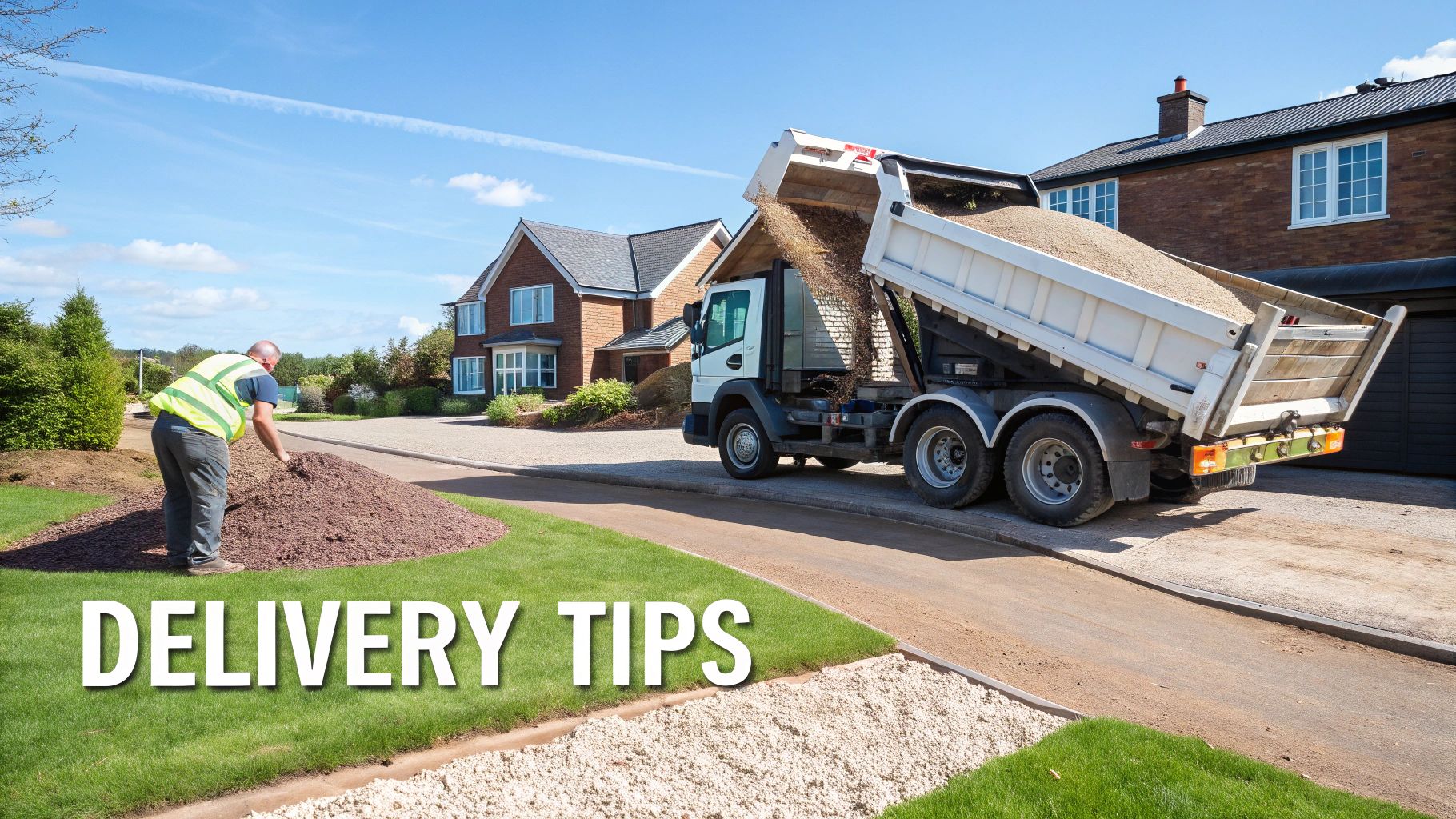
The market for aggregates is tied directly to the construction industry's health. For example, recent figures showed UK construction output grew by 0.3% in the three months to August 2025, but the concrete and aggregate sector actually saw a monthly dip. This kind of fluctuation is exactly why getting your order right the first time is so important.
Which Delivery Method is Best for You?
The scale of your project is the biggest factor in how you should get your aggregate delivered. UK suppliers have a few standard options, each designed for different jobs.
- 25kg Bags: These are perfect for really small tasks, like patching a tiny bit of path or topping up a garden planter. They're dead easy to handle but work out as the most expensive way to buy aggregate by the tonne.
- One-Tonne Bulk Bags: You’ll often hear these called "dumpy bags." They are the go-to choice for most domestic projects like patios, garden paths, or shed bases. They usually arrive on a pallet lorry and are a clean, convenient option.
- Loose Loads: If you’re tackling a bigger job like a full driveway or digging foundations, ordering a loose load tipped directly from a lorry is easily the most cost-effective way to go. Deliveries can range from a few tonnes right up to 20 tonnes from an articulated truck.
Don't Skip the Delivery Logistics Check
Before you hit that ‘confirm order’ button, do yourself a favour: walk outside and have a proper look at your property's access. There’s nothing worse than a lorry with ten tonnes of MOT Type 1 turning up, only to find it can't get down your drive. It’s a costly and stressful mistake to make.
A quick five-minute check for access issues can save you from a major delivery headache. Think like the driver: are there any tight corners, low-hanging branches, or parked cars that could cause a problem? It’s far better to spot an issue beforehand than when a lorry is blocking your street.
Here’s what to look out for:
- Overhead Obstructions: Look up! Are there any low-hanging telephone wires or power cables that a high-sided vehicle might snag?
- Access Width: Is your driveway, or the road leading to it, actually wide enough for a large lorry to get through without causing damage?
- Ground Conditions: The spot where you want the delivery needs to be firm and level ground. A heavy lorry will quickly sink on soft grass or a soggy verge, especially after it’s been raining.
- Tipping Space: A loose load needs a clear, safe area to be tipped onto. Make sure there's enough room for the pile without blocking the pavement or your neighbour's drive.
Have a Word with Your Supplier
Don't be shy about picking up the phone and having a chat with your supplier. A good company, like us here at The Waste Group, will be more than happy to answer your questions and help make sure the delivery goes smoothly.
For those tackling really big projects, a comprehensive guide to rural concrete has some great insights into the procurement and delivery process.
When you call, it helps to have this information ready:
- Your final, calculated tonnage.
- The exact type of aggregate you need.
- Your full address and a clear description of where you want the delivery.
- Any potential access problems you've spotted.
Thinking through these final details ensures the last leg of your project is as well-planned as your initial calculations.
Your Aggregate Questions Answered
Even with the best calculations, a few questions always seem to pop up right before you're ready to order. It’s completely normal. Getting these last few details ironed out gives you that final bit of confidence, ensuring your project runs without a hitch from the very first delivery.
Think of this as your quick-fire FAQ for those last-minute doubts. We'll tackle the most common queries we hear, helping you sidestep the usual pitfalls that can catch people out.
How Much Extra Aggregate Should I Order for Wastage?
A good rule of thumb in the UK is to add a 10% wastage allowance to your final number. This simple buffer is an absolute lifesaver.
This little bit extra covers you for things like slight variations in ground level, a bit of material lost during spreading, and the natural compaction that happens as the aggregate settles. It’s a small addition that prevents big headaches.
For larger projects or particularly uneven ground, bumping that up to 15% is a very safe bet.
It's always cheaper to have a little left over than to pay a separate, often expensive, delivery charge for a small top-up. That second delivery fee can easily wipe out any savings you thought you were making.
What Is the Difference Between Bulk Density and Specific Gravity?
They might sound similar, but they are critically different for your calculations. Mixing them up will lead to a completely wrong order.
- Specific Gravity: This is a technical term for the density of a single, solid particle of stone, with no air around it. It's a number used in geology, not for ordering building materials.
- Bulk Density: This is the one you absolutely need. It measures the weight of the aggregate as it's supplied—including all the natural air gaps and voids between the individual particles.
This is exactly why a cubic metre of loose gravel weighs much less than a solid cubic metre of rock. For any calculation, always use the bulk density figure provided by your supplier.
Are Online Aggregate Calculators Accurate?
Online aggregate calculators are an excellent tool for getting a quick estimate, and they're a fantastic starting point. It's always smart, however, to understand the maths behind the magic.
The catch is that many calculators use a generic, pre-set density that might not perfectly match the specific material you're buying. This guide gives you the power to use the exact bulk density figure from your supplier, so you can double-check any calculator's result for maximum accuracy.
How Do I Measure an Irregularly Shaped Area?
The easiest way to tackle a complex, curvy shape is to not measure it as one single area. The trick is to break it down.
Divide the whole space into a collection of simple shapes like rectangles and triangles. Calculate the area of each smaller shape individually, then just add them all together for your total square meterage.
For curved sections, you can get a surprisingly accurate measurement by breaking the curve into several small, straight-edged trapezoids and summing their areas. It’s a far better approach than just trying to guess the area of the whole shape at once.
Ready to put your calculations into action? At The Waste Group, we supply a full range of high-quality aggregates for any project, big or small. From MOT Type 1 to decorative gravel, we offer reliable delivery across Dorset. Order your aggregates online today or give our friendly team a call to discuss your needs.