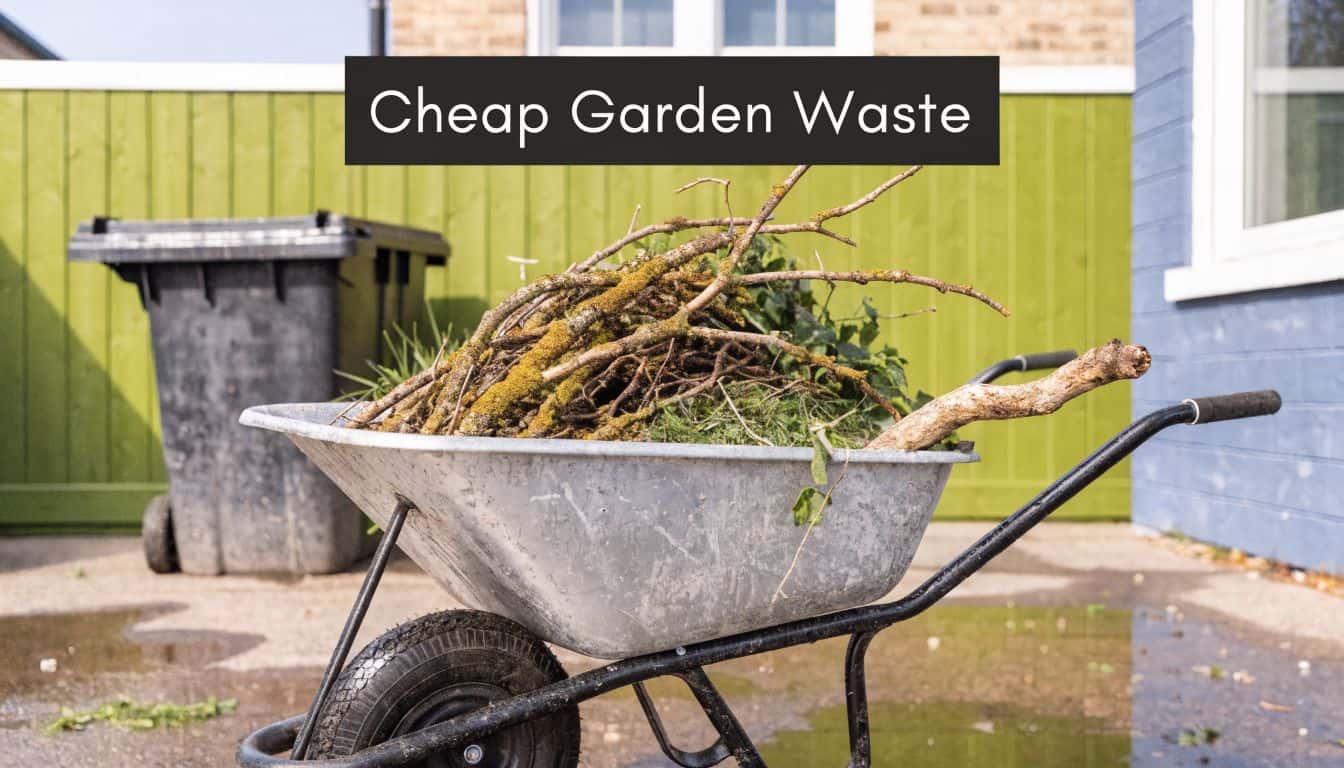
You finish a weekend in the garden feeling productive. The hedge is down, the borders are cleared, the old shrubs are out, and then you turn round and realise the hard part is still sitting there in a heap. Branches, clippings, root balls, soggy bags of leaves, maybe a surprising amount of soil.
That’s usually the moment people start searching for the cheapest way to remove garden waste. In Dorset, the right answer depends less on the word “garden” and more on three things: how much waste you’ve made, how heavy it is, and how many hours you’re willing to spend shifting it yourself.
If you’ve only got regular cuttings, one answer makes sense. If you’ve ripped out a whole border and ended up with roots and soil, that answer changes fast. If you’re a professional pricing labour for such projects, the cheapest option on paper can become the most expensive choice on site.
Your Guide to Garden Waste Removal
A lot of people start in the wrong place. They compare prices before they sort the waste into types and volumes. That’s how a cheap-looking plan turns into repeated trips, a filthy car, wasted time, and disposal problems when the tip won’t take what you’ve brought in the way you expected.

For light, ongoing maintenance, composting and council collections can be sensible. For a one-off clear-out, free tip access often wins if you’ve got the transport and don’t mind loading. For mixed, heavy, awkward garden waste, paying for a container or collection is often the smarter financial move, even if it doesn’t look like it at first glance.
Use this quick comparison first, then match it to your job.
| Method | Best for | Cost position | Labour on you | Main limitation |
|---|---|---|---|---|
| Home composting | Regular light green waste | Lowest if suitable | High | Slow, limited by space and waste type |
| Council green waste service | Routine garden maintenance | Low | Low | Best for lighter, accepted green waste only |
| HWRC trips | Small to medium DIY clear-outs | Very low if you can transport it | High | Repeated loading and travel |
| Skip hire | Mixed and heavy waste | Mid upfront, often cheapest overall for bulk | Medium | Needs space and proper loading |
| Grab lorry | Large piles with poor access | Higher upfront | Low | Best when volume and access justify it |
One practical tip before you move anything. If you’re hauling bags or tools across a long garden, better kit saves effort. Something as simple as choosing the right best garden wagon wheels can make repeated loading less punishing, especially on gravel, grass, or uneven paving.
Exploring Free and Ultra-Low-Cost Disposal Methods
You finish a Saturday hedge cut-back in Dorchester or Poole, look at the pile, and realise the cheapest option depends less on headline price and more on how many times you want to load the car.
Free and ultra-low-cost routes work best when the waste is light, clean, and spread out over time. They lose their value once volume climbs, the material gets woody or muddy, or your time starts disappearing into repeat trips. For homeowners doing regular upkeep, the low-cost choice is often different from the right answer for a gardening professional, tree surgeon, or builder clearing a site quickly.
Home composting suits steady household maintenance
Composting earns its keep with grass cuttings, leaves, dead annuals, and small amounts of soft prunings. It is a good fit for a homeowner maintaining one garden through the season. It is a poor fit for a one-off clearance after taking out shrubs, reducing a conifer, or lifting out root-heavy beds.
The trade-off involves speed and space. Composting costs very little in cash terms once the bin is in place, but it demands sorting, chopping down material, balancing green and brown waste, and waiting for it to break down. If the priority is getting the waste gone this week, composting stops being the cheapest answer because the pile stays on site.
That is the key divide. DIYers with ongoing light waste can save money here. Professionals and anyone doing a heavy clear-out usually cannot.
If you want a broad practical overview of compost systems and what people tend to try in different settings, this guide to composting in Chicago is a useful outside comparison, even though local collection rules in the UK differ.
Council collections are low-cost, but only inside their limits
For routine mowing, light pruning, and bagged green waste, council garden collections are usually the cheapest paid option for Dorset households. They work because the cost is spread across the year and the service removes the need for tip runs.
The limitation is volume and material type. These schemes are built for recurring domestic waste, not a weekend where you cut down half the garden. Once the job produces thick branches, oversized loads, or mixed waste, the price looks less attractive because overflow still has to go somewhere else.
I usually advise homeowners to use council collection only if the garden produces a manageable amount every few weeks. If the job has already overflowed the bin area, you are outside the sweet spot.
HWRC trips often win for small one-off DIY jobs
For a domestic clear-out with your own car, trailer, or van, the Household Waste Recycling Centre is often the cheapest route in Dorset. There is no collection charge for standard household garden waste, so the main cost is your fuel, your loading time, and wear on the vehicle.
This method makes sense for a DIYer clearing a few bags of clippings, hedge trimmings cut to size, or the remains of a border tidy-up. It makes less sense for a tradesperson billing by the hour, or for anyone facing repeated loads of wet, tangled material.
A simple way to decide is to count the trips before you start. One trip is usually worth it. Two can still be fine. By the third or fourth run, especially from rural parts of Dorset, the cheap option starts getting expensive in labour and hassle.
What makes “cheap” stop being cheap
The biggest hidden costs are practical ones:
- Dense or dirty waste. Soil, roots, and wet cuttings are slow to shovel and unpleasant to transport.
- Repeated loading. Every extra run means more lifting, more sweeping out the boot, and more time gone.
- Vehicle limits. Small cars fill fast, and trailers only pay off if you already own one.
- Site rules. HWRCs and council services may expect garden waste separated from rubble, timber, or general rubbish.
For anyone weighing container options before paying for collection, this guide on whether a HIPPO BAG or skip is the better value for bulky waste is useful once your project starts moving beyond what a car boot and a few tip runs can handle.
The short version is simple. Free methods are cheapest for light domestic waste and patient DIYers. Once the job is bulky, heavy, mixed, or time-sensitive, low upfront cost can turn into the expensive choice.
A Detailed Cost Comparison of Garden Waste Removal
A Dorset homeowner clearing a small hedge border and a garden professional stripping out an overgrown garden should not use the same disposal method. The cheapest option changes with volume, weight, access, and whose time is doing the loading.

The practical way to compare garden waste removal is to price the whole job, not just the collection line on the quote. That means looking at four things together. How much waste you have, how heavy it is, who is loading it, and how many times it gets handled before it leaves site.
Side-by-side comparison
| Method | Typical cost position | Ideal volume | Who loads it | Convenience | Best waste types |
|---|---|---|---|---|---|
| DIY via composting | Lowest if suitable | Small, ongoing | You | Low to medium | Soft green waste |
| DIY via council or HWRC | Low | Small to medium | You | Medium | Green waste, some separated garden waste |
| Man with a van | Mid to high, depending on labour and travel | Small to medium | Often the operator, sometimes shared | High | Loose cuttings, bagged waste, one-off clear-outs |
| Skip hire | Often better value once volume builds | Medium to large | You or your team | High | Mixed garden waste, heavier material if accepted |
| Grab lorry | Strong value on large outdoor clearances | Large | Operator loads with grab arm | Very high | Soil, rubble, bulky outdoor waste in open piles |
How to judge the real cost
For a DIYer, the cheapest route is often still DIY, but only while the job stays light and clean. A few sacks of hedge trimmings or lawn cuttings are one thing. Wet roots, old fencing, bramble crowns, and dug-out soil are another.
For a tradesperson, labour changes the maths fast. If a two-person team spends half a day loading a van, driving to tip, queuing, unloading, and returning, disposal has already cost more than the invoice from a container service in many cases.
That is why I tell customers to sort the job into one of three bands before they book anything:
- Small and light: composting, council collection, or a single HWRC run
- Medium and awkward: man with a van or skip bag, if access is tight
- Large, heavy, or mixed: skip hire, and sometimes a grab if the waste is already piled outside
Where man-with-a-van fits
Man-with-a-van services suit people who want the waste gone quickly and do not want a skip sitting on the drive. They work best for bagged green waste, loose cuttings, and smaller clear-outs where labour is part of the service.
The weakness is cost control. Quotes can shift based on how well the waste is stacked, whether the load includes soil or timber, how far the operator has to travel across Dorset, and how long the crew spends on site. For one modest load, that can be fair value. For repeated loads or dense material, it often becomes an expensive shortcut.
Skip versus skip bag
Skip bags make sense where space is tight or you want to fill the container gradually. They are less forgiving on weight and loading height, so they tend to suit lighter garden waste rather than heavy spoil. If you are weighing container options, this comparison of HIPPO bag vs skip for bulky waste removal gives a clearer view of where each one saves money.
The handling test most people miss
Cheap disposal usually means more handling.
- Cut and sort the waste
- Bag or stack it
- Load it into a car, trailer, or van
- Drive it off site
- Unload it
- Clean up and do it again if the first load did not finish the job
That process is acceptable for a small domestic tidy-up. It is poor value on a clearance, a renovation, or any job where paid labour is involved.
Practical rule: Count how many times the same pile gets touched. Once or twice is fine. By the third or fourth handling cycle, the low-price option usually stops being the cheap option.
When Skip Hire Becomes Your Most Cost-Effective Option
Saturday morning in Dorset, the first load looks manageable. A few conifer cuttings, old fence panels, some bags of weeds. By Sunday afternoon, the job has turned into wet soil, root balls, broken sleepers, and a driveway full of loose waste. That is usually the point where skip hire becomes the cheaper decision, not the expensive one.

For homeowners, the tipping point is rarely the first pile. It is the moment the waste gets heavier, messier, and harder to stack safely in a car or trailer. Soil, stumps, hardcore, timber edging, and soaked hedge cuttings change the maths fast. One container on site often costs less than several tip runs once you count fuel, time, loading, unloading, and the risk of overloading a vehicle.
In Dorset, a small skip often suits garden renovations, border removals, shed clear-outs, and turf stripping. It gives you one fixed disposal route while the work is still going on. That matters if you want the site kept usable, especially on tight driveways or jobs where the garden is being rebuilt in stages.
The practical tipping point
A skip usually starts to pay for itself when any of these apply:
- the waste will take more than a couple of vehicle runs
- the material includes soil, roots, timber, or broken slabs
- you are paying anyone by the hour to help
- the job will create waste over two or three days, not all at once
- you need one clear loading point instead of piles across the garden
For a DIY householder, that often means a weekend clearance that has grown larger than planned. For a garden professional or builder, it can be the moment labour starts waiting around for disposal.
Why the numbers often favour a skip
Skip hire works best where cost certainty matters. You book the container, load it as you go, and the collection cost is already built in. There is no guessing how many runs remain or whether the last load will fit.
That fixed-price structure is often what makes it cheaper than man-and-van collection on mixed garden jobs. Collection crews are useful for small loose loads and awkward one-off pickups. Once the volume builds and the waste gets dense, skips tend to hold their value better because you are paying for the container rather than repeated labour and transport time.
If you want a closer look at sizes, accepted materials, and typical domestic use cases, this guide on skips for garden waste covers the practical details.
What a skip does better on real jobs
The main saving is not just disposal price. It is reduced handling.
- You load once: Waste goes straight into the container instead of into bags, then a car, then out again at the tip.
- You keep working: No stop-start cycle for tip runs halfway through the job.
- You contain mixed waste properly: Green waste, timber, fencing, and renovation debris are easier to manage in one place.
- You avoid vehicle strain: Heavy soil and roots are where many DIY disposal plans become false economy.
I see this regularly on Dorset garden refits. A customer starts with the idea of using the car and local recycling site, then realises the job is producing waste faster than they can clear it. At that stage, a skip is usually the lower-cost option because it protects both labour time and momentum.
This short video gives a useful visual sense of how skip-based waste removal fits into real-world projects.
A simple rule works well here. If the waste is heavy, mixed, or still being generated as the job continues, a skip is often the cheapest way to finish the project cleanly.
Scaling Up for Professionals and Major Projects
A Dorset homeowner clearing one border can get away with slow, cheap disposal. A garden professional stripping out turf, shrubs, fencing, and spoil across three days cannot. Once paid labour is involved, the cheapest option is the one that keeps the crew on the tools instead of walking waste across site or queuing to unload it.
Start with two questions. How is the waste being produced, and how hard is it to reach from the road?
If the job creates waste steadily over several days, a larger skip or RoRo bin usually gives better control. The team can load as they work, keep the site tidy, and avoid leaving mixed piles of green waste, timber, and soil around the property. That matters on tight domestic sites in places like Poole, Wimborne, and Christchurch, where access is often decent at the front but awkward once you get into the back garden.
Grab hire suits a different type of job. If the waste is already heaped, close enough to the lorry, and awkward to shift by hand, the machine does the heavy part quickly. That often saves more money than chasing the lowest disposal price.
Match the method to the job size
For working gardeners, outdoor contractors, and groundwork teams, the decision usually looks like this:
- Ongoing garden redesign or landscaping job: Use a skip if waste is being generated bit by bit through the week.
- Large pile of soil, hardcore, or uprooted material near the roadside: Use a grab lorry if it can reach the load cleanly.
- Major dig-out or strip-out with sustained heavy waste output: Price a RoRo bin if site space allows and volume is high enough.
- Rear garden with poor access and long barrow runs: Favour the option that cuts handling time, even if the hire charge is higher.
The trade-off is simple. Skips give control. Grabs give speed. RoRo bins suit sustained bulk volumes on larger contractor jobs.
Where professionals usually lose money
It is rarely on the headline hire price. It is on labour drag.
Two operatives spending hours loading bags, dragging brash to the front, or making repeat disposal trips can wipe out any saving from choosing the cheapest-looking option on paper. I see this on Dorset clearances where the waste plan is treated as an afterthought. The job starts well, then half a day disappears into moving material from the back garden to wherever the vehicle can get to.
That is why access matters more on trade jobs than it does on small DIY clear-outs.
A practical decision framework
Use this on site before booking anything:
- Small crew, waste building up over time, space for a container. Book a skip.
- One large pile, roadside reach, speed matters. Book a grab.
- Heavy bulk waste on a bigger contract. Price larger containers early, not halfway through the job.
- Restricted access or expensive labour on site. Choose the method that cuts waste handling first.
For contractors comparing reach, loading control, and labour input, this guide on grab lorry vs skip for access-led waste removal is a useful next read.
Understanding Disposal Laws and Recycling Rules
A cheap clearance stops being cheap the moment a load is rejected, reclassified, or dumped illegally. I see this catch people on Dorset jobs when they book the lowest quote without checking what the collector will take, where it will go, or whether the paperwork matches the waste.
Householders and trades have different duties, but the practical rule is the same. If you hand waste to someone else, check they are allowed to carry it and ask what facility they are using. A cash job with no details is a risk. If that load ends up fly-tipped in a gateway or lay-by, you may still have questions to answer.
Before any collection, check four things:
- Who is collecting the waste
- Whether they are a registered waste carrier
- What site the waste is going to
- What written record you will keep, even if it is just a booking confirmation or invoice
The other point that affects cost is classification. Garden waste is not one material. Soft green waste such as grass, leaves, and hedge trimmings is usually the easiest and cheapest stream to process. Soil, stumps, root balls, treated timber, old fencing, and mixed shed-clearance waste can fall under different charging rules and are often refused by green waste schemes.
The Environment Agency’s guidance on your duty of care for waste makes the basic standard clear. Waste must be stored, transported, and transferred without causing pollution, and it must go only to an authorised person or site. For a Dorset homeowner, that means checking before the vehicle leaves. For a garden service provider or tree team, it also means keeping the right transfer paperwork in place for business waste.
Sorting pays for itself on bigger clear-outs.
A mixed heap is slower to load, harder to price, and more likely to trigger extra charges at disposal. Separate these where you can:
- Clean green cuttings and clippings
- Branches, logs, and untreated timber
- Soil, turf, and roots
- Painted, treated, or contaminated materials
That gives you more disposal routes and fewer surprises. If a load is clean, it is easier for the carrier to send it for composting, chipping, or recycling. If everything is mixed together, the cheaper outlets often disappear and the bill usually goes one way.
For DIY jobs, the money-saving move is simple. Keep pure green waste separate from heavy or mixed material. For trade jobs, do the same but add paperwork discipline, because one rejected load can wipe out the saving from choosing a cheaper collection in the first place.
Your Quick Garden Waste Decision Checklist
If you want the cheapest way to remove garden waste, answer these in order.
- Is it regular light garden maintenance waste? Use composting or your council green waste service if the material fits the scheme.
- Can you transport it safely yourself? If yes, a few HWRC runs are usually the lowest-cost route for a domestic clear-out.
- Is there a lot of soil, roots, or mixed heavy waste? Move away from green-bin thinking and price a skip.
- Do you want the waste gone while you work, not after? A skip usually makes the job smoother and more cost-effective overall.
- Are you a contractor pricing labour as well as disposal? Choose the option that cuts handling, even if the hire fee is higher.
- Is access poor, with waste behind walls or fences? Grab hire becomes the more efficient solution.
- Is legality unclear with the person collecting it? Don’t use them.
The cheapest option isn’t the one with the smallest invoice. It’s the one that fits the waste type, the project size, and the amount of labour you’re about to burn getting rid of it.
If you want a practical quote from a local team that handles domestic clearances, trade waste, skips, grab hire, and compliant disposal across Dorset, speak to The Waste Group. They cover everything from small garden projects to major site clearances, with straightforward advice on the most cost-effective option for the job.