
Boost Compliance with a commercial waste management company: A Quick Guide
Boost Compliance with a commercial waste management company: A Quick Guide
So, what exactly is a commercial waste management company? Think of them as a specialist partner dedicated to handling everything your business throws away—from collection and processing to recycling and final, legal disposal. They provide the expertise and the heavy-duty infrastructure needed to manage business waste properly and keep you on the right side of environmental regulations.
Why Your Business Needs a Commercial Waste Management Company
Let's be clear: a professional waste management company does a lot more than just empty your bins. They are a logistics partner for your refuse, orchestrating a complex system that keeps your business clean, compliant, and running smoothly.
You wouldn’t try to manage your company’s complex finances without an accountant, would you? It’s the same principle. You bring in an expert to handle the intricate and highly regulated world of commercial waste.
This partnership is so important because business waste is a different beast entirely from the rubbish you put out at home. It’s generated in much larger quantities, varies massively from one industry to the next, and comes with a stack of strict legal duties. A construction site in Poole, for instance, produces heavy, bulky debris like rubble and wood. Meanwhile, a busy restaurant in Bournemouth is dealing with daily food waste and endless packaging. Each needs a totally different collection method, processing route, and disposal plan. Trying to juggle all that in-house isn’t just a headache; it’s a huge legal and financial gamble.
The Real Cost of Getting It Wrong
Failing to manage your waste professionally can backfire, fast. We're talking hefty fines for non-compliance, business disruption from overflowing bins, and serious damage to your brand’s reputation.
The scale of this issue is immense. In 2020, the UK generated a staggering 40.4 million tonnes of commercial and industrial waste, with a massive 83% of that coming from England alone. This figure shows the sheer volume that companies like The Waste Group are set up to handle, making sure businesses like yours don't become another negative statistic. You can see the full picture in the government's report on UK waste statistics.
A professional waste partner turns a mandatory, often awkward task into a streamlined, responsible part of your business. They lift the burden of compliance off your shoulders, so you can focus on what you do best—running your company.
More Than Just Empty Bins
Ultimately, hiring a commercial waste management company is about more than just getting an empty bin delivered. It’s about gaining peace of mind, boosting your operational efficiency, and showing a real commitment to being environmentally responsible.
They help you navigate complicated rules, tweak collection schedules to save you money, and push your recycling rates higher. For a specific example, just look at the significant benefits of e-waste recycling, which include better data security and a stronger ESG profile. This kind of specialist knowledge is exactly why professional waste management is a smart business decision, not just another operational cost.
Decoding the Services a Waste Partner Provides
Think of a professional commercial waste management company as having a massive toolkit. Each tool is designed for a very specific job, and knowing which one to pick saves you time, money, and a whole lot of hassle. You wouldn't use a sledgehammer to hang a picture frame, right? The same logic applies here.
Let’s get past the industry jargon and look at what these services actually mean for your business. We'll explore real-world scenarios so you can see exactly which solution fits, whether you’re clearing out a small office or managing a huge construction site.
This flowchart gives a bird's-eye view of the fundamental choices a business has when it comes to dealing with its waste.
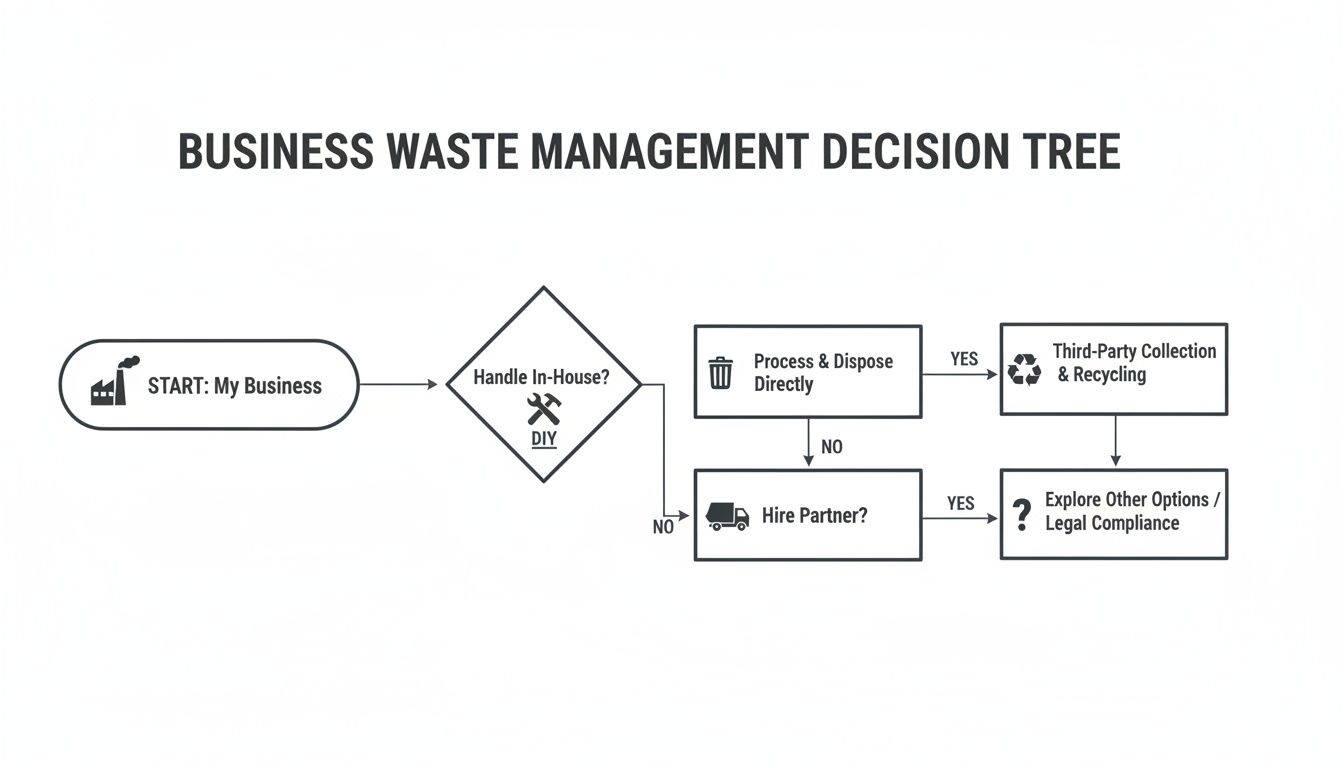
As you can see, while going it alone might seem simpler at first, bringing in a specialist offers a structured, compliant, and often much more cost-effective path for getting your waste sorted and recycled properly.
To make it even clearer, let's match some common business projects to the right waste service.
Matching Your Project to the Right Waste Service
| Project Type | Recommended Service | Best For… | Typical Sizes/Capacity |
|---|---|---|---|
| Shop Refits & Office Clear-outs | Skip Hire | One-off projects with mixed, bulky waste over a few days or weeks. | 4-12 cubic yards |
| Major Construction & Demolition | RORO Bin | High-volume, heavy waste like concrete, soil, and metal. | 20-40 cubic yards |
| Daily Business Operations | Wheelie Bin Collection | Regular, predictable waste streams like general, recycling, and food. | 240L – 1100L bins |
| Excavation & Site Clearance | Grab Lorry Hire | Large quantities of loose, heavy materials that are hard to load manually. | Approx. 15 tonnes |
| Handling Hazardous Materials | Asbestos Disposal | Strictly regulated materials requiring certified handling and paperwork. | Secure, sealed containers |
This table is just a starting point, of course. A good waste partner will always help you figure out the most efficient setup for your specific needs.
Skip Hire for Versatile Projects
When most people picture waste removal, the humble skip is probably the first thing that comes to mind. Skip hire is the classic, go-to solution for a massive range of commercial projects that create a fair bit of waste over a short time.
Picture a retail shop in Bournemouth getting a week-long refit. There's going to be old shelving, ripped-up flooring, packaging, and all sorts of general rubbish. A single skip placed on-site becomes the central hub for all of it, keeping the work area tidy and safe. When it's full, the waste company just comes and takes it away to be sorted. Simple.
Skips are brilliant for:
- Office Clear-outs: Getting rid of old desks, chairs, carpets, and years of accumulated clutter.
- Small Renovations: Managing debris from shop refits or minor building work.
- Landscaping Jobs: Clearing out soil, green waste, and old patio slabs.
RORO Bins for Large-Scale Waste
For the really big jobs, a standard skip just isn't going to cut it. That's where Roll-on/Roll-off (RORO) bins step in. These things are enormous containers, often up to 40 cubic yards, built to handle huge volumes of heavy, bulky waste.
Think of a major construction site in Poole putting up a new apartment block. They're churning out a constant stream of concrete, bricks, metal, and timber. A RORO bin can swallow all of that high-volume waste, meaning fewer collections are needed and the project stays on track. Its huge, open-top design also makes it a breeze to load with machinery.
A RORO bin is the heavy-lifter of the waste world. It's the solution you need when dealing with substantial quantities of construction, demolition, or industrial waste that would overwhelm smaller containers in a matter of hours.
Wheelie Bins for Daily Operations
Of course, not all business waste is from one-off projects. Most businesses generate a steady stream of rubbish every single day. For them, scheduled wheelie bin collections are the bread-and-butter service that keeps their premises clean, tidy, and hygienic.
A busy restaurant in Dorchester, for example, produces food scraps, glass bottles, and cardboard packaging daily. A dedicated set of wheelie bins—one for general waste, one for mixed recycling, and another just for glass—is the perfect system. With a reliable weekly or fortnightly collection, the restaurant managers never have to worry about overflowing bins or hygiene issues. To see what works for your daily needs, it's worth learning about the different commercial waste management services available.
Specialised Services for Difficult Waste
Finally, a truly professional waste partner has solutions for the tricky stuff—the hazardous or awkward materials that need specialist handling to be disposed of safely and legally. Getting this wrong can lead to big fines and even bigger headaches.
Two of the most common examples are:
-
Asbestos Disposal: Asbestos is a highly dangerous material and is governed by incredibly strict regulations. A licensed waste company provides secure, sealed containers and manages the entire chain of custody, from collection to its final destination at a certified facility, giving you all the official paperwork you need for your records.
-
Grab Lorry Hire: What if you have a massive pile of soil or rubble from an excavation that you can't easily load into a skip? A grab lorry is your answer. It uses a hydraulic crane to literally "grab" huge quantities of loose material and load it onto its truck bed, saving an incredible amount of time and manual labour.
Getting to Grips with Waste Compliance and Your Environmental Duty
Staying on the right side of waste legislation isn't just about ticking boxes—it's a legal must-have for any business. The rules around commercial waste can feel like a tangled mess that’s always changing, and that's where a professional commercial waste management company really proves its worth. Think of them as your expert guide through the legal maze.
At the very heart of UK waste law is something called the 'Duty of Care'. It's a simple but powerful principle: your business's waste is your responsibility, from the moment you create it until it's finally disposed of. You've got to make sure it doesn't cause any harm to people or the environment.
This isn't just a vague idea; it's backed up by a critical piece of paperwork called a Waste Transfer Note (WTN). The easiest way to think of a WTN is as a passport for your rubbish. It's a legal document that tracks its entire journey, showing who made it, what's in it, and who collected it.

If you don't have a correctly filled-out WTN for every single collection, you have zero proof you’ve done your legal duty. You can dive deeper into the specifics in our guide on what a Waste Transfer Note is and see why it’s so vital for your records.
Staying Ahead of the Rules
Waste law doesn’t stand still. A perfect example is the new Simpler Recycling legislation, which has really shaken things up for UK businesses. This new rule means any business with 10 or more employees now has to separate dry recyclables, food waste, and general waste right where it's created.
It’s a major government push to get our national recycling rates up, and for good reason. Commercial and industrial waste makes up a massive 23% of the UK's total, completely dwarfing the 15% that comes from households.
A good waste partner doesn't just react when these big changes happen; they see them coming. They make sure your bin systems, collection schedules, and even staff training are all up to scratch with the new rules, so you stay compliant without any headaches or disruption.
"True compliance isn't a one-time setup; it's an ongoing process. A professional partner proactively manages regulatory shifts, ensuring your business is always protected from fines and legal action."
This proactive approach is everything. It turns compliance from a potential nightmare into a smooth, background process you don’t even have to think about.
Going Greener: Beyond Just Following the Law
While staying legal is the baseline, modern waste management is just as much about being a good environmental steward. The goal has shifted from just getting rid of rubbish to treating it like a valuable resource. It’s the foundation of the circular economy, where we try to keep materials in use for as long as we possibly can.
Your waste partner is on the front line of making this happen. They do it in a few key ways:
- Pushing Recycling Rates Higher: By giving you clearly labelled bins and using high-tech sorting at their facilities, they ensure as much material as possible—from cardboard and plastic to glass—is diverted from landfill.
- Creating Energy from Waste: For anything that can't be recycled, they often use processes that turn that waste into energy, cutting down our reliance on landfills even further.
- Advising on Sustainable Habits: They can give you practical advice on how to reduce waste in the first place and make smarter buying decisions for your business.
A huge part of this is understanding the difference between terms like Compostable vs Biodegradable. Knowing what these labels really mean helps you make choices that are genuinely green. Ultimately, when you pick the right partner, staying compliant and being environmentally responsible become two sides of the same coin, boosting your reputation and making your business stronger.
Understanding the Real Cost of Waste Management

When that invoice from your commercial waste management company lands, what are you actually paying for? It’s easy to think of it as a simple fee for taking your rubbish away, but the final figure is a blend of several different factors.
Getting your head around these costs is a game-changer. It turns waste management from a confusing, unpredictable bill into something you can actually control and budget for. The pricing isn’t just plucked out of thin air; it’s a direct reflection of the logistics, labour, and legal hoops involved in dealing with commercial waste the right way.
Key Factors That Shape Your Bill
At its heart, the cost comes down to the work involved. A small office with one wheelie bin of paper recycling each week is going to have a much smaller bill than a busy construction site needing a 40-yard RORO bin collected every single day. The type of waste and how much of it there is are always the starting point.
But there’s a bit more to it than that. Several other key components will influence the final price on your invoice:
- Service Type and Frequency: A one-off skip hire for a weekend clear-out is priced differently to a regular, scheduled wheelie bin contract for a restaurant. More frequent collections mean more fuel, more vehicle wear, and more staff time.
- Transport and Logistics: This is a simple one – the further your site is from the recycling or disposal facility, the more it costs in fuel and driver hours. It all gets factored into the fee.
- Government Levies and Taxes: This is a big one and it often catches people by surprise. The UK government charges a Landfill Tax on any waste that can't be recycled. This is specifically designed to make sending waste to landfill as unattractive as possible. As of 2024, this tax is over £100 per tonne, a hefty cost that is passed directly on to you, the waste producer.
The most direct way to control your waste management costs is to reduce the amount of material you send to landfill. Every item you successfully recycle is an item that avoids the hefty Landfill Tax.
Decoding Gate Fees and Recycling Credits
Another term you’ll hear thrown around is the ‘gate fee’. You can think of it as an entry ticket for your rubbish. It’s the charge that a recycling centre or disposal facility applies to accept the waste from our lorries. A professional commercial waste firm pays this fee on your behalf.
The price of this "ticket" varies massively depending on what’s being dropped off.
A container full of clean, well-sorted cardboard will have a very low gate fee – it might even earn a small rebate. On the flip side, a skip of mixed, contaminated general waste heading for landfill will have a much higher fee. This is where your efforts in sorting waste on-site really pay off. By separating your recyclables properly, you help your waste partner deliver cleaner materials, which lowers their gate fees and, in turn, can bring down your overall bill. Our guide to commercial waste disposal costs breaks these factors down even further.
The whole UK waste management market is growing fast, partly because of these stricter rules and the big push towards a circular economy. The market is predicted to hit USD 66.24 billion by 2033, driven by commercial needs and new environmental laws. This just goes to show how financially important it is for businesses of all sizes to manage their waste properly.
That's why a transparent pricing model from your waste partner is so important. You need to see exactly where your money is going and understand how your own recycling efforts are making a real difference to your bottom line.
How to Choose the Right Waste Management Partner
Picking a commercial waste management company is about much more than just comparing quotes. It’s about finding a reliable partner who will keep your operations smooth, compliant, and efficient for the long haul. The cheapest option can quickly become the most expensive if they miss collections, offer poor support, or land you in hot water with regulations.
Making the right choice means looking beyond the price tag to find genuine value. You need a partner who understands your specific needs, holds all the right licences, and can prove they do what they say they will. It's the difference between a simple supplier who just drops off a bin and a true partner who actively helps your business succeed.

Key Questions for Vetting Your Waste Partner
Before you sign any contract, it’s vital to ask the right questions. Think of it as a job interview for a crucial role in your business. Any reputable company will welcome this level of detail and have clear, confident answers ready for you.
To help you dig deeper and find a provider you can trust, we've put together a list of essential questions. These will help you cut through the sales pitch and understand how they really operate.
| Category | Question to Ask | Why It Matters |
|---|---|---|
| Compliance & Insurance | "Can you provide a copy of your Waste Carrier Licence and proof of public liability insurance?" | This is non-negotiable. It protects your business from liability from day one and confirms they are legally allowed to handle your waste. |
| Local Operations | "Where are your local depots and recycling facilities located?" | A strong local presence, particularly in areas like Dorset, means faster response times, greater reliability, and a lower carbon footprint for collections. |
| Recycling Performance | "What are your current recycling rates, and can you provide reports showing where our waste goes?" | This question tests their commitment to sustainability. Vague answers are a red flag. You want proof of high diversion rates from landfill. |
| Customer Support | "If there's a problem, who do I call? Do I get a dedicated account manager or a local support team?" | When something goes wrong, you need to speak to a real person who can solve your issue quickly, not get lost in a national call centre queue. |
Asking these questions upfront ensures you're partnering with a transparent, capable, and professional company that takes its responsibilities—and yours—seriously.
Understanding the Service Level Agreement (SLA)
The Service Level Agreement (SLA) is arguably the most important document in your partnership. It's the contract that lays out exactly what you can expect—and what happens if things go wrong. Don’t just skim it; read it carefully.
A solid SLA should clearly define:
- Guaranteed Collection Times: It should specify the days and even the time windows for your collections. Vague promises like "weekly collections" just aren't good enough for a professional operation.
- Contingency Plans: What happens if a truck breaks down or a collection is missed? The SLA must outline the backup plan and how quickly they’ll fix the problem.
- Clear Pricing Structure: The agreement should detail all costs, including container rental, collection fees, and any potential surcharges for things like overweight bins. There should be no hidden fees.
- Reporting and Data: It should state what kind of data you'll receive, such as waste volume reports and recycling statistics, to help you track your environmental performance and meet your own targets.
A detailed SLA is the mark of a professional commercial waste management company. It shows they are confident in their ability to deliver and are prepared to stand by their promises.
From Supplier to Strategic Partner
Ultimately, you’re looking for more than just a company that empties your bins. You need a strategic partner who adds real value to your business. This means finding a provider who is flexible, offers expert advice, and has a proven reputation for reliability.
A great partner will proactively suggest better solutions. For example, they might notice your general waste bin is consistently overflowing and suggest a free waste audit. This could help identify new recycling opportunities that actually lower your bill by reducing your Landfill Tax liability.
A genuine partner invests in your success. They understand that by helping you manage your waste more efficiently and sustainably, they build a stronger, long-term relationship based on trust and mutual benefit. That’s the real difference between a transactional service and a true partnership.
Got Questions About Commercial Waste Management?
Getting your head around commercial waste can throw up a lot of questions. Whether you're sorting out waste services for the first time or just double-checking your current setup, getting clear answers is key to making smart, legal, and budget-friendly choices. We've pulled together some of the most common queries we hear from businesses just like yours.
Think of this as your quick-reference guide for those nagging waste-related questions.
What Paperwork Do I Actually Need to Keep?
This is a big one, and getting it wrong can land you in serious hot water. The single most important piece of paper you need to hold onto is your Waste Transfer Note (WTN).
A WTN is the legal receipt that proves you've passed your waste on to a licensed company. It details what the waste is, how much of it there is, and who's taking it away, fulfilling your 'Duty of Care'. You absolutely must keep copies of your WTNs for at least two years. If you're dealing with hazardous materials, that extends to a minimum of three years.
Your waste partner should be giving you one of these for every single collection, whether it's a paper copy or a digital file. Without it, you've got no proof you're disposing of your waste by the book.
How on Earth Do I Pick the Right Bin Size?
Choosing the right bin is a classic balancing act. You don't want it overflowing before collection day, but you don't want to pay for a half-empty container either. A good commercial waste management company will help you figure this out, usually by starting with a quick waste audit.
If you want to get a rough idea yourself, think about these things:
- How much do you throw out daily? Keep an eye on how many standard bin bags your business fills over a few days. This will give you a starting point. A small café might only need a 240L wheelie bin, but a bustling restaurant will likely need a much bigger 1100L bin.
- What kind of waste is it? Bulky but light stuff like cardboard boxes will fill a bin in no time. On the other hand, heavy, dense waste like food scraps or glass might not take up much room but will add a lot of weight.
- How often will it be collected? If you're tight on space, you might go for a smaller bin that gets emptied more often. If you've got plenty of room, a larger bin collected less frequently could work out cheaper.
Don't stress about getting it perfect on the first try. A flexible provider will let you easily swap your bin for a bigger or smaller one after a few weeks once you have a better feel for what you actually need.
That willingness to adapt is the sign of a partner that’s focused on you, not just locking you into a rigid contract that doesn't quite fit.
What if I Just Have a One-Off Project?
Plenty of businesses have a steady, predictable amount of daily waste but then occasionally face a huge clear-out. Think of an office refurbishment, a seasonal stock clearance, or a big landscaping job. This is exactly what services like skip hire are for.
There’s no need to mess with your regular wheelie bin contract for a temporary spike in rubbish. You can simply hire a skip for as long as the project lasts. It keeps all your project waste separate from the day-to-day stuff, which makes everything much tidier and easier to manage.
Just have a chat with your waste provider about the project. They’ll be able to recommend the right skip size—from a little 4-yarder for a small clear-out to a big 12-yard skip for a major renovation—and sort out delivery and collection to fit your timeline.
How Do I Know My Waste Is Actually Being Recycled?
It's a fair question, especially for any business that cares about its environmental impact. The best way to be sure your waste is handled properly is to pick a transparent and reputable partner.
A trustworthy commercial waste management company won't be shy about showing you the data. You should be able to ask for:
- Recycling Reports: These should clearly show you what percentage of your waste is being diverted from landfill.
- Where It's Going: They should be able to tell you which licensed recycling facilities your waste is taken to for sorting and processing.
- Proper Bin Labelling: A good company will give you clearly marked bins for different types of waste (e.g., general, mixed recycling, glass, food) to help you separate things correctly from the get-go.
Good companies are proud of their recycling rates and often have official environmental certifications. For them, sustainability isn't just a box to tick—it's a core part of their business. Ask for proof and look for that transparency, and you can be confident your efforts are making a real difference.
Ready to work with a commercial waste management company that gives you transparent, reliable, and compliant solutions for your Dorset business? The Waste Group offers a full range of services, from flexible skip hire to scheduled commercial collections, all backed by a real commitment to sustainability and great customer support. Get a straightforward quote and manage your waste with confidence by visiting The Waste Group.