
The Ultimate Guide to Confidential Documents Disposal in the UK
The Ultimate Guide to Confidential Documents Disposal in the UK
That pile of old paperwork tucked away in the corner? It’s not just clutter—it’s a ticking time bomb. Proper confidential documents disposal isn't just about tidying up; it's the process of securely destroying sensitive physical records to prevent data breaches, and it's a non-negotiable part of modern business security. Getting this wrong can expose your business, staff, and customers to serious financial and reputational damage.
Why Secure Document Disposal Is a Critical Business Function
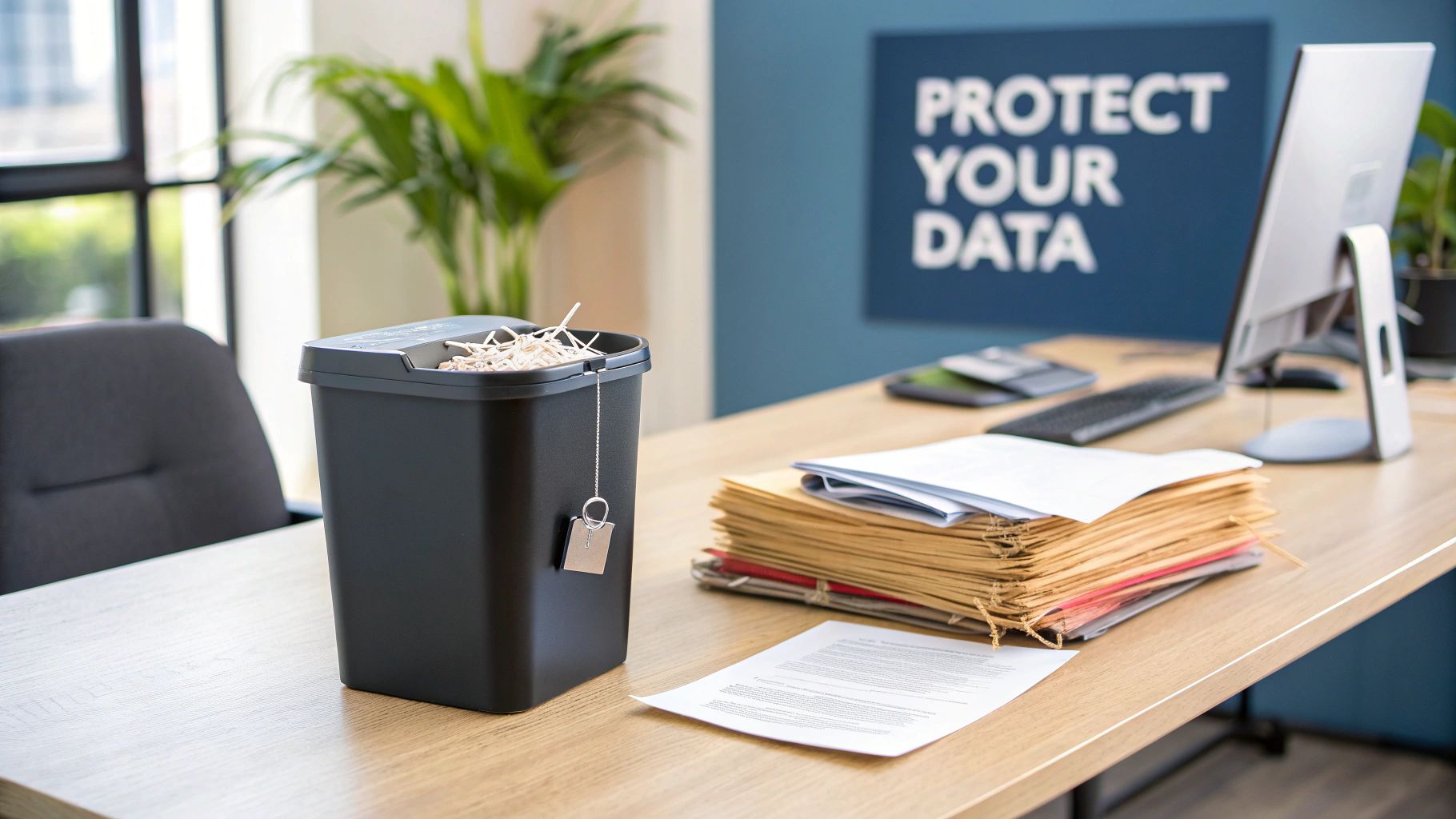
In a world obsessed with digital threats like phishing scams and hacking, it’s all too easy to forget about the risks posed by good old-fashioned paper. But a single piece of paper tossed into a general recycling bin can be just as devastating as a compromised server.
The hard truth is that information thieves, often called "dumpster divers," still see unsecured waste as a goldmine for sensitive data. This isn't some far-fetched scenario; it happens every day.
Imagine a small accountancy firm getting rid of old client invoices and tax drafts in its standard commercial wheelie bin. Those documents are packed with names, addresses, and financial details—everything a criminal needs for identity fraud. The second that bin hits the kerb, that data is basically public property.
The Overlooked Threat in a Digital-First World
The rise of remote working has only made this problem worse. Many employees are now handling confidential client contracts, HR files, and strategic plans from their home offices. Without the secure shredding consoles you’d find in a corporate environment, these critical documents often end up in household recycling, completely unprotected.
The statistics paint a pretty grim picture. In the UK, data breaches impact a staggering 90% of large businesses and 75% of small businesses each year. While we always hear about the digital attacks, a huge number of these incidents start with physical records. In fact, around 40% of data security incidents involve paper documents, often due to simple theft or accidental loss. This gap in security is exactly why a solid confidential documents disposal strategy is so essential.
A data breach doesn't always start with a click. Sometimes, it starts with a carelessly discarded piece of paper. Your physical waste stream is a direct extension of your data security perimeter and must be treated with the same level of importance.
The Real-World Consequences
The fallout from a paper-based data breach can be catastrophic. It goes far beyond just losing the information, creating a ripple effect that can destabilise a business of any size.
Here’s what’s really at stake:
- Financial Penalties: Under GDPR, the fines for a data breach are severe. We're talking up to £17.5 million or 4% of a company's global annual turnover. The average cost of a UK data breach is now around £4 million—a sum that could easily bankrupt a small or medium-sized business.
- Reputational Damage: Trust is your most valuable asset. A publicised data breach shatters customer confidence, leading to client loss and a tarnished brand that can take years, if not decades, to rebuild.
- Legal Action: People affected by a data breach have the right to seek compensation. This can open the door to expensive legal battles and even class-action lawsuits.
- Competitive Disadvantage: If sensitive business information like client lists or trade secrets falls into a competitor's hands, the strategic damage can be permanent.
At the end of the day, secure document disposal isn't just a compliance task to tick off a list. It's a fundamental part of risk management. Putting a professional disposal process in place is an investment in protecting your finances, your reputation, and the trust you've worked so hard to build. It’s a core part of any effective commercial waste management strategy that every business needs to prioritise.
Getting a Handle on Your Sensitive Documents
Before you can even think about shredding, you need to know exactly what you’re dealing with. A vague idea of "sensitive paperwork" just won't cut it. Real security, whether you're running a busy office or just managing your household finances, starts with a clear system for spotting what needs protecting and how to manage it until it's time for destruction.
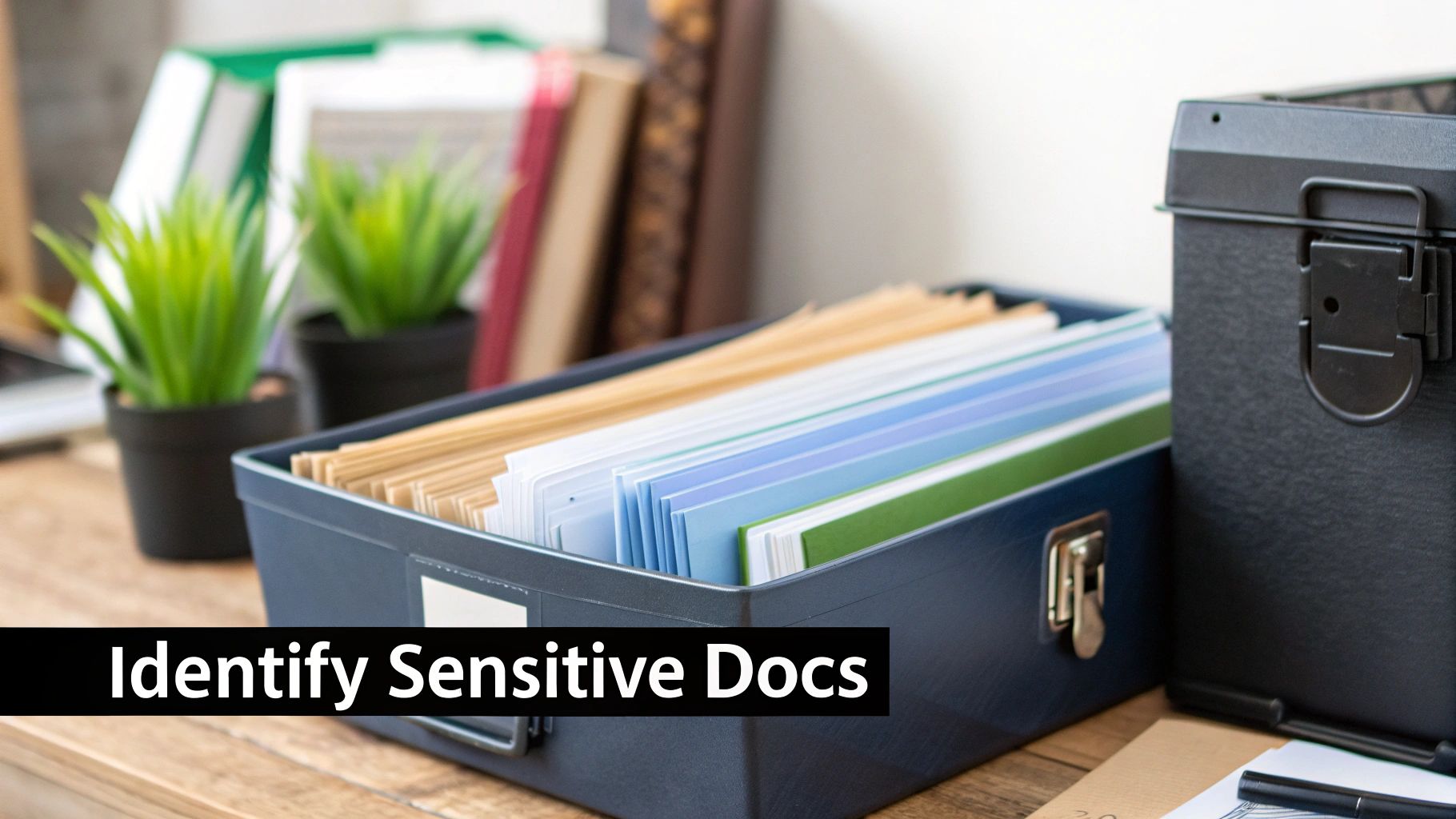
The trick is to shift your mindset. This isn't about a massive, one-off clear-out. It’s about building a simple, repeatable process that stops sensitive information from ever falling through the cracks. The goal is to make secure handling a daily habit, not an annual chore.
What Actually Counts as a Confidential Document?
So, what are we looking for? A confidential document is any piece of paper that holds sensitive, private, or personally identifiable information (PII). If that information got into the wrong hands, it could lead to financial loss, damage your reputation, or cause personal harm. It sounds broad, but most of these documents fall into a few key areas.
For a business, the list is long and comes with serious legal weight:
- Employee and HR Records: Think payroll details, performance reviews, disciplinary reports, and even the CVs from unsuccessful applicants.
- Financial Documents: Bank statements, tax filings, invoices, purchase orders, and profit and loss statements all contain critical data.
- Client and Customer Information: Under data protection laws like GDPR, things like contracts, project briefs, contact lists, and purchase histories are all confidential.
- Strategic Information: Business plans, marketing strategies, and product development notes are the kind of things your competitors would love to see.
For a household, the list is just as critical:
- Financial Paperwork: Old bank statements, credit card bills, mortgage agreements, and tax returns.
- Personal Identification: Expired passports, driving licences, and old utility bills that link your name to your address.
- Medical Records: Appointment letters, prescription info, and test results are all highly personal and sensitive.
Get into the habit of asking yourself one simple question whenever you handle a document: "Could this information be used to harm me, my family, my business, or my clients?" If there’s even a chance the answer is yes, it needs to be secured.
Establishing a Document Retention Schedule
You can't—and frankly, shouldn't—keep every document forever. A document retention schedule is your roadmap, a simple policy that outlines how long you need to keep specific types of documents before they can be securely destroyed. This isn't just about being tidy; for many business records in the UK, it’s a legal requirement.
For example, HMRC requires businesses to keep financial records for at least 6 years from the end of the last company financial year they relate to. Employee records tied to payroll often have a similar retention period.
A clear retention policy does two things. First, it keeps you compliant with the law. Second, it gives you a clear trigger for when a document can move from secure storage to secure disposal. This prevents the endless pile-up of paperwork and shrinks your data footprint.
Your schedule doesn't need to be some complex beast. A straightforward table can do the job perfectly.
Here's a quick guide to get you started on what to keep, and for how long.
Confidential Documents and Recommended UK Retention Periods
| Document Type | Examples | Typical UK Retention Period | Disposal Method |
|---|---|---|---|
| Business Financials | Invoices, Tax Returns, Bank Statements | 6 years after financial year-end | Secure Cross-Cut Shredding |
| Employee Data | Payroll, Contracts (post-employment) | 6 years after employment ends | Secure Cross-Cut Shredding |
| Client Contracts | Signed Agreements, Project Files | 6 years after contract ends | Secure Cross-Cut Shredding |
| Household Bills | Utility Bills, Credit Card Statements | 12 months (unless needed for tax) | Secure Cross-Cut Shredding |
Once you've mapped out your retention periods, you're one step closer to a streamlined and secure system.
Setting Up a Secure Collection System
Right, you know what to shred and when to shred it. The final piece of the puzzle is managing those documents in the meantime. Just leaving sensitive papers in an open recycling bin or a tray on someone's desk is a security nightmare waiting to happen.
The most effective solution is to set up secure collection points. For businesses, this usually means using our lockable shredding consoles or bins. Staff can pop confidential documents in throughout the day, and the contents stay locked away and out of sight until your scheduled collection.
At home, it could be as simple as a dedicated, clearly labelled box kept somewhere safe, well away from the general household waste. The key is creating a single, secure destination for all sensitive paper. This simple habit turns confidential documents disposal from a last-minute scramble into a smooth, organised process.
Navigating UK Laws for Document Disposal
Figuring out the rules for disposing of confidential documents isn’t just a headache for big corporations. It's a legal must-do for any business, sole trader, or even a household that handles someone else's personal information. Getting it right is all about protecting data, dodging massive fines, and keeping the trust you’ve worked so hard to build.

The legal landscape in the UK might seem like a maze, but it all comes down to one simple idea: if you hold someone's data, you are responsible for keeping it safe, right up until it's completely destroyed. That responsibility doesn't just vanish when you pop a document in the bin.
GDPR and Your Paperwork
The General Data Protection Regulation (GDPR) is the big one when it comes to UK data protection, and it applies to physical paper just as much as it does to digital files. It’s a common mistake to think data breaches are only about hackers and emails, but a lost client file or a carelessly binned invoice is just as serious.
Under GDPR, simply chucking a document with personal data into your general waste can be classed as a data breach. Why? Because you've failed to use the right "technical and organisational measures" to keep that information secure.
The financial fallout from a mistake like this can be eye-watering. The fines are deliberately severe to make businesses sit up and take notice. A single breach could land you with a penalty of up to £17.5 million or 4% of your company's global annual turnover – whichever is higher. For a small business, that kind of fine could be the end of the road.
The Ever-Changing Legal Scene
Rules around data and waste are constantly being tweaked to keep up with new challenges. For example, from 31 March 2025, the new Simpler Recycling legislation will demand stricter waste separation for businesses with over 10 employees, and that absolutely includes how you handle paper waste. Falling behind on these changes isn’t really an option.
These regulations make it clear that professional, secure shredding isn't just a 'nice-to-have'. It's a core part of running a compliant and responsible business, showing you’re serious about protecting the data people have trusted you with.
Peace of mind in data protection comes from having a documented, auditable process. Simply hoping for the best is not a viable strategy and exposes your business to unnecessary and significant risk.
The Power of Proof: A Certificate of Destruction
So, how do you prove you’ve done everything by the book? This is where a Certificate of Destruction is worth its weight in gold. Issued by a professional shredding company like The Waste Group, this document is your official, legal proof that your documents were securely destroyed in a fully compliant way.
Think of it as your get-out-of-jail-free card if an auditor or the Information Commissioner's Office comes knocking. It will always include the key details:
- The type and amount of material destroyed.
- The exact date and time it was destroyed.
- The location of the shredding.
- Confirmation from the certified provider who did the job.
- A unique serial number for easy tracking and verification.
This certificate officially passes the responsibility for the material from you to us. It completes the chain of custody and neatly ties up your data protection duties for that batch of documents.
Maintaining Your Chain of Custody
The "chain of custody" is simply the documented trail that follows your confidential material from the moment it leaves your hands to its final destruction. This includes crucial paperwork like Waste Transfer Notes, which are a legal requirement for any movement of commercial waste.
Keeping this trail intact is vital for proving you have a solid system. If you’re ever questioned, you can pull out a clear, unbroken record showing secure handling at every single step. You can learn more about the importance of this document in our guide on what a Waste Transfer Note is.
Ultimately, navigating these laws is about creating a defensible position, making sure every stage of your document disposal is secure, documented, and completely compliant.
Choosing the Right Secure Disposal Method for You
Once you've got a system for spotting and gathering your sensitive paperwork, the next big question is: how do you actually get rid of it? Making the right choice here is all about balancing security, convenience, and cost to find what works for you, whether you're a busy law firm or just keeping on top of your household admin.
The options can seem a bit much, but they really boil down to three main choices: using your own office shredder, hiring an on-site professional service, or using an off-site one. Each has its place, but they offer very different levels of security and peace of mind.
The Personal Office Shredder: When Is It Enough?
For a tiny handful of non-critical personal papers—think old utility bills or junk mail credit card offers—a personal shredder can feel like a cheap and easy fix. It’s right there when you need it.
But that convenience often comes with a false sense of security. Most of the shredders you’d buy for your home or office use a simple strip-cut method. This slices paper into long, spaghetti-like ribbons that, with a bit of patience, can be put back together. For any business document with client or staff details, a strip-cut shredder just isn't compliant with GDPR.
On top of that, they're slow, they jam constantly, and they make a surprising amount of mess. Every minute your team spends feeding documents through one sheet at a time is a minute they're not doing their actual jobs, which adds up to a hidden labour cost.
A personal shredder is definitely better than chucking whole documents in the bin, but it rarely gets close to the security standards businesses need to meet. It’s a tool for minor personal admin, not a serious solution for professional data disposal.
On-Site Shredding: Maximum Security and Peace of Mind
On-site shredding, sometimes called mobile shredding, is the top-tier service. A specialised truck with a powerful industrial shredder built into it comes right to your door. The biggest advantage? You can literally watch your documents being destroyed, which offers an unmatched level of security.
This is the perfect choice for organisations that handle really sensitive information and need a completely unbroken chain of custody they can witness themselves.
- Law Firms: Need to give clients total assurance that privileged information has been destroyed without question.
- Healthcare Providers: Must have verifiable proof that patient records are destroyed in line with strict confidentiality laws.
- Financial Institutions: Require absolute certainty that financial data has been made completely unrecoverable.
The process itself is simple. A vetted security professional collects your locked bins or bags, takes them straight to the mobile shredding truck outside, and tips the contents directly into the shredder – all while you watch. This completely removes any risk of data being compromised in transit.
Off-Site Shredding: The Efficient and Cost-Effective Solution
Off-site shredding gives you a more budget-friendly option without sacrificing security. With this service, a professional team collects your confidential documents in sealed, GPS-tracked vehicles. They're then taken to a secure, access-controlled shredding plant where they're destroyed under 24/7 CCTV surveillance using massive industrial shredders.
This is often the most practical choice for businesses that have a steady stream of confidential waste but don't need the visual confirmation of on-site destruction. It’s efficient, causes minimal disruption to your day, and you still get the same level of compliance and security certification. When you're weighing up the options, looking into all the available confidential data destruction methods helps you pick the right solution for your business.
A huge plus for both professional services is their role in sustainability. UK waste management companies report that about 50% of business waste is paper, so recycling it securely is a big deal for the environment. After industrial shredding, the paper is baled and sent straight to recycling mills. Most professional services guarantee that 100% of the shredded paper is recycled.
No matter which professional service you choose, you'll receive a Certificate of Destruction. This is a crucial legal document that acts as your proof of compliance, forming a vital part of your audit trail and showing your commitment to data protection.
Comparing On-Site vs Off-Site Shredding Services
Deciding between having your documents shredded at your location or at a secure facility can be tricky. Both are highly secure, but they cater to different priorities. Here’s a quick breakdown to help you see which one fits your needs best.
| Feature | On-Site Shredding | Off-Site Shredding |
|---|---|---|
| Security | Maximum. You witness the destruction process firsthand. | Very high. Documents are transported in sealed, tracked vehicles to a secure facility with CCTV. |
| Convenience | Highly convenient. The service comes directly to your premises. | Minimal disruption. Quick collection without needing you to oversee the shredding. |
| Cost | Typically more expensive due to specialised vehicles and time on-site. | More cost-effective, especially for regular, high-volume collections. |
| Peace of Mind | Unparalleled. Visual confirmation eliminates any doubt. | High. Relies on the provider's trusted, certified processes and chain of custody. |
| Speed | Destruction happens immediately on-site. | Destruction occurs shortly after arrival at the secure facility. |
| Ideal For | Businesses with highly sensitive data (legal, finance, healthcare) or strict internal policies. | Businesses needing a regular, efficient, and budget-friendly secure disposal solution. |
Ultimately, both professional shredding services provide a secure, compliant, and environmentally friendly way to handle your confidential waste. The choice simply comes down to whether you value the visual confirmation of on-site destruction or the cost-efficiency of off-site processing.
How to Select a Professional Shredding Service
Choosing who to trust with your confidential documents is a big deal. This decision directly impacts your security and your legal obligations. It’s not just about getting rid of paper; you're handing over sensitive information to a third party. A reliable provider should really act as an extension of your own security measures, giving you total peace of mind.
To make the right choice, you need to know what to look for. This isn't the time to simply grab the cheapest quote you can find. Your decision should be grounded in their certifications, transparency, and a solid track record of keeping information secure.
This decision tree can help you visualise that initial choice between trying to handle it all yourself and calling in the experts.
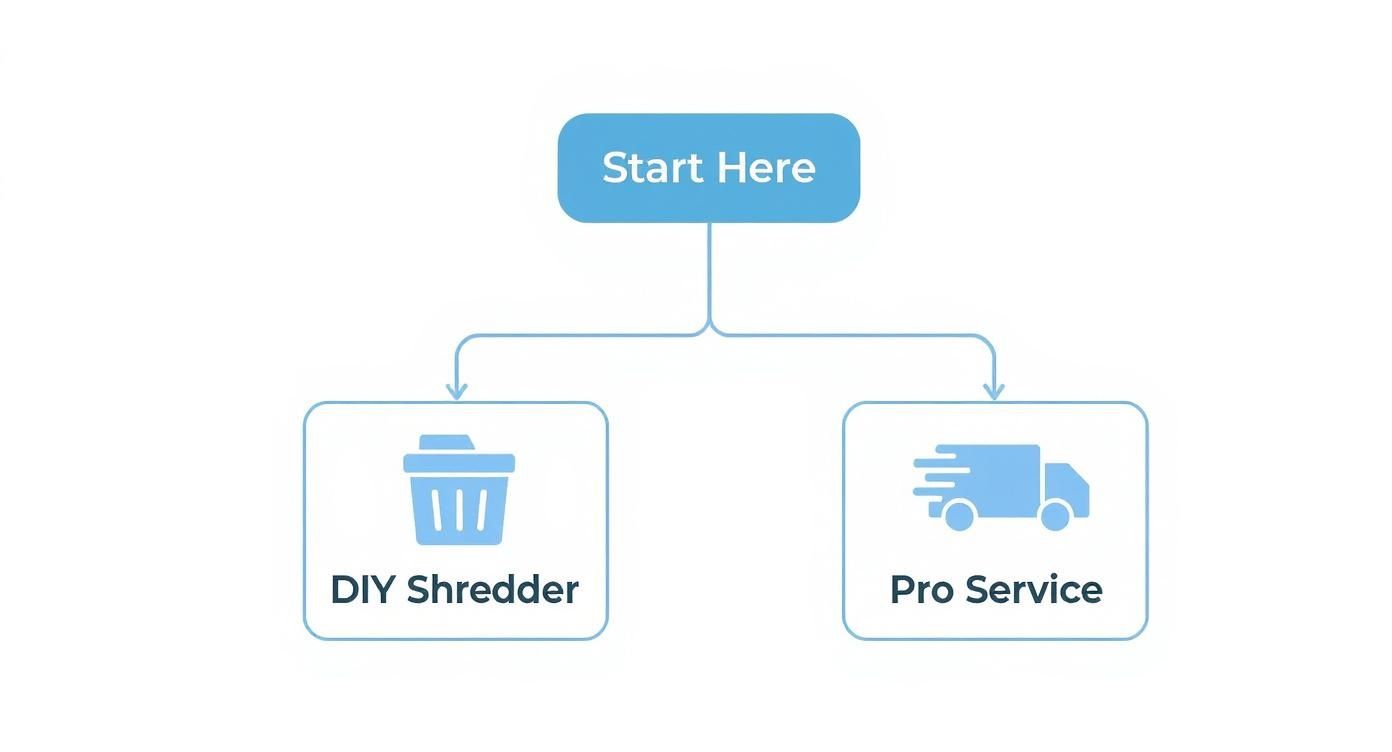
As the graphic shows, you've got two main paths. It’s about weighing the convenience of a small office shredder against the robust security you get with a professional service.
Key Accreditations to Look For
Professional certifications aren't just fancy badges for a website. They are independent proof that a company meets the highest industry standards for security and quality. In the UK, the most important one to look for when it comes to shredding is BS EN 15713.
This standard sets out a strict framework for the secure destruction of confidential material. If a provider has this certification, they've been audited on everything from staff security vetting to the physical security of their facilities and vehicles.
Choosing a BS EN 15713 accredited company is the single most effective way to know you're working with a legitimate, high-security operator. It shows a serious commitment to data protection that goes far beyond simple promises.
On top of this, it's worth checking for other quality marks like ISO 9001 for quality management and ISO 14001 for environmental management. This latter one shows they take the recycling process just as seriously.
Questions to Ask Before You Commit
When you start phoning around for quotes, remember that the price is only one part of the conversation. Use this as a chance to properly vet potential providers and get a feel for their professionalism.
Here are the essential questions you should be asking:
- Can you walk me through your chain of custody process? They should be able to clearly explain every single step, from secure collection and transport to final destruction, with no grey areas.
- Are your collection staff DBS-checked and uniformed? The people physically handling your sensitive documents must be trustworthy and easy to identify.
- What kind of insurance coverage do you have? You need to know they have adequate liability insurance to protect you in the unlikely event something goes wrong.
- Do you provide a Certificate of Destruction for every job? This is a complete non-negotiable. When you hire a professional service, always make sure they provide a Certificate of Destruction as official proof of secure disposal.
A confident, professional company will have clear, immediate answers to all of these.
Understanding Pricing and Spotting Red Flags
Shredding services usually base their prices on the volume or weight of the paper, and they'll often give you options for a one-off clear-out or regularly scheduled collections. A scheduled service, like the ones we offer alongside our other commercial waste collection services, is usually much more cost-effective for businesses that generate confidential waste on an ongoing basis.
Be very wary of quotes that seem too good to be true. If the price is rock-bottom, it often means corners are being cut somewhere else.
Keep an eye out for these red flags during your search:
- Vague answers about recycling: A reputable company will be proud to state their 100% recycling policy for all shredded paper.
- No physical address: Steer clear of any company that only operates with a mobile number and a generic website.
- Hesitation to provide references or proof of certification: Transparency is everything. A trustworthy provider will have nothing to hide.
By taking a methodical approach and asking these pointed questions, you can confidently choose a partner who will protect your information, ensure your compliance, and uphold your reputation.
Common Questions About Document Disposal
Even with a solid plan in place, a few specific questions always seem to pop up when it's time for the actual shredding. Getting these final details right is what separates a good disposal process from a great, fully compliant one.
Let's run through some of the most common queries we hear from clients. These are the real-world concerns that can make all the difference, helping you manage your documents with complete confidence.
What Is a Certificate of Destruction and Why Do I Need One?
Think of a Certificate of Destruction as the official receipt for your data protection efforts. It’s a formal document we issue that serves as your legal proof of secure disposal, confirming that your documents have been irreversibly destroyed in line with UK law.
For GDPR purposes, this certificate is your essential audit trail. It typically includes:
- A unique transaction number for easy tracking.
- The exact date and location of the destruction.
- The name of the company that handled the service.
- Confirmation that the process met all required security standards.
For any business, this document isn't just a nice-to-have. It's crucial compliance evidence that proves you took your responsibility to protect sensitive information seriously.
Can Shredded Paper Actually Be Recycled?
Absolutely, and it's one of the biggest benefits of using a professional shredding service. While the shredded mess from a small home machine can be tricky for local recycling to handle, professional providers have this down to a fine art.
Once your documents are cross-cut into tiny, confetti-like pieces, the material is baled and securely sent to a partner paper mill. There, it gets pulped and transformed into new paper products. This process guarantees your data is gone for good while also supporting a circular economy. Always ask a potential provider to confirm their 100% recycling policy for total peace of mind.
Choosing a certified shredding service means you don't have to pick between security and environmental responsibility. A professional partner delivers both, ensuring your confidential documents disposal process is as green as it is secure.
How Often Should I Schedule Shredding?
The right frequency really depends on how much confidential paper your organisation gets through. There’s no single answer, but we can help you figure out the most efficient and cost-effective schedule for your needs.
- High-Volume Businesses: A law firm, accountancy practice, or healthcare provider often benefits from a scheduled weekly or fortnightly service. We place secure, locked consoles in your office for daily use, and our team collects the contents automatically.
- Lower-Volume Businesses & Home Offices: If you produce less sensitive paper, a one-off collection whenever you've filled a few bags or boxes is usually the best way to go.
The most important thing is to stop a risky pile-up of documents. A regular schedule takes the guesswork out of the equation and makes secure disposal a seamless part of your routine.
Is My Small Home Office Shredder Secure Enough?
A personal shredder is definitely better than chucking documents straight into the bin, but it rarely meets the security standards required for business information under GDPR.
Most cheaper models use a basic "strip-cut" method, slicing paper into long ribbons that, with enough patience, could be put back together. For proper data protection, a "cross-cut" shredder is the minimum standard, turning paper into tiny confetti. Professional services like ours use industrial-grade machines that go way beyond this, making reconstruction physically impossible. Using a professional service ensures you aren't just ticking a box—you're fully protected.
Ready to implement a secure, compliant, and hassle-free disposal strategy? The Waste Group offers professional shredding services tailored to your exact needs. Get in touch today to ensure your confidential information is protected.