
Your Guide to Secure Confidential Waste Disposal in the UK
Your Guide to Secure Confidential Waste Disposal in the UK
Confidential waste disposal isn't some complex process reserved for spies and secret agents. It's simply the secure destruction of sensitive information to stop it from ending up in the wrong hands. This covers everything from paper documents to old hard drives, making sure any data about your customers, staff, or business operations is gone for good. Think of it as a critical final step in protecting privacy and staying on the right side of the law.
What Is Confidential Waste and Why Does It Matter?
When you hear "confidential waste," it's easy to picture dramatic scenes of corporate espionage. The truth is, it’s much more down-to-earth and affects every single one of us. Confidential waste is any material, physical or digital, holding information that isn't meant for public eyes.
Take a look around your own home or office. That old bank statement, a client invoice from a past job, or even a CV from someone who applied for a role years ago—all of it contains sensitive data. Just chucking these into the general waste bin is like leaving your front door unlocked. You're inviting trouble.
The Everyday Risks of Improper Disposal
Ignoring the need for secure confidential waste disposal is a bit like leaving the keys in your car's ignition. The fallout can range from a minor headache to a full-blown financial and personal disaster. The risks are very real and include:
- Identity Theft: Discarded utility bills, old credit card statements, and even delivery notes can give criminals all they need to steal your identity.
- Corporate Espionage: Competitors could get their hands on your sales reports, client lists, or strategic plans, gaining an unfair edge.
- Reputational Damage: A data breach from poorly managed waste can shatter the trust you've built with customers, leading to lost business.
- Legal Penalties: Strict rules like the GDPR come with hefty fines for failing to protect personal data, making compliance a financial must.
The scale of this problem is huge. In the UK, identity fraud happens around 500 times a day, and it often starts with documents that weren't disposed of properly. The average cost of a data breach is a shocking £4 million, with 21% of breaches caused by simple human error, like not shredding sensitive papers. You can discover more insights about confidential waste facts and how they impact UK businesses.
In essence, managing confidential waste isn't just about ticking a compliance box; it's a fundamental act of protecting people. It safeguards your family, your employees, your customers, and the integrity of your business from harm that is entirely preventable.
Ultimately, taking a professional approach to getting rid of confidential waste is one of the most sensible steps you can take. It closes a major security loophole that many people and businesses completely overlook, giving you peace of mind and showing a real commitment to protecting data.
Navigating Your Legal Obligations for Data Disposal

Getting rid of confidential waste the right way isn’t just good practice; it's a legal minefield if you get it wrong. In the UK, the rules around data protection are incredibly strict, and failing to comply can bring serious consequences for any business, whether you're a sole trader or a huge corporation. These laws aren’t there to trip you up – they exist to protect people's fundamental right to privacy.
Think of it as your 'duty of care'. Just like you’re responsible for keeping staff and customers safe on your premises, you’re also legally on the hook for protecting their personal information, even when you’re throwing it away. That responsibility doesn't magically disappear when a document leaves your office. It sticks with you right up until that information is securely and permanently destroyed.
The GDPR and Data Protection Act 2018
The two big players in UK legislation are the General Data Protection Regulation (GDPR) and the Data Protection Act 2018. Together, they form a solid framework that dictates exactly how businesses must handle personal data from start to finish.
These regulations make it crystal clear: personal information must be processed securely, and that absolutely includes how you dispose of it. Just tossing documents with personal details into the regular recycling is a direct breach of these rules. The Information Commissioner's Office (ICO), the UK's data protection watchdog, has the power to issue eye-watering fines for getting this wrong.
Fines for serious data breaches can soar to £17.5 million or 4% of a company's total annual worldwide turnover – whichever is higher. This really puts the financial risk of sloppy data disposal into perspective.
And these penalties aren't just empty threats. Plenty of UK companies have been hit with massive fines for failing to protect data. In one case, a London-based pharmacy was fined £275,000 for leaving around 50,000 documents containing sensitive patient data in unlocked containers behind its building. It’s a stark reminder that your legal duty of care covers the entire lifecycle of the data you handle.
Why Documentation Is Your Best Defence
Proving you’ve done the right thing is just as important as actually doing it. This is where professional paperwork becomes your shield. When you work with a certified disposal company, you create a clear, auditable paper trail that proves you’re serious about compliance.
There are a couple of key documents you absolutely need:
- Waste Transfer Note: This is a legal document that tracks the transfer of waste from your business to the disposal company. It's your proof that you handed over your confidential materials to a licensed carrier. To get into the nitty-gritty, check out our guide on what is a waste transfer note.
- Certificate of Destruction: Once your documents have been securely destroyed, you'll receive this certificate. It’s your official confirmation that the job is done, detailing the date, time, and method of destruction. It’s a crucial piece of evidence if you ever face a compliance audit.
To stay out of trouble, it's vital to have robust internal policies. A good starting point is to review your UK data retention policies to understand when you are legally required to dispose of certain data. By knowing these timelines and keeping meticulous disposal records, you build a strong, compliant foundation for your business. This documented approach doesn't just protect you from legal headaches; it also builds trust with your clients and partners.
Choosing Your Disposal Method: On-Site vs Off-Site
So, you’re committed to a secure disposal plan for your confidential waste. That's the first and most important step. Now for the next big decision: where does the destruction actually happen?
Should the shredding take place right there at your premises, where you can see it with your own eyes? Or is it better to have everything collected and securely destroyed at a specialist facility? This choice between on-site and off-site disposal is a crucial one, and each has its own clear advantages.
Think of it like choosing between a top chef cooking a meal in your kitchen versus dining at their five-star restaurant. One gives you ultimate oversight and control in your own space, while the other offers a seamless, expert service from start to finish. Neither is automatically better; it all comes down to what fits your business's needs, security policies, and budget.
What Is On-Site Confidential Waste Disposal?
On-site disposal, often called mobile shredding, brings the entire destruction process right to your doorstep. A purpose-built vehicle, which is basically a high-security shredding factory on wheels, will arrive at your location.
Our vetted, uniformed staff collect your confidential materials from the secure bins we provide and immediately feed them into the shredder on the vehicle. You're welcome to watch the whole thing happen. For many businesses, especially in sectors like law or healthcare, being able to witness the destruction firsthand provides an unbeatable level of assurance.
What Is Off-Site Confidential Waste Disposal?
With off-site disposal, our professional team collects your confidential waste in sealed, lockable containers. These are then loaded onto secure, GPS-tracked vehicles and transported to our access-controlled destruction facility.
The entire journey is governed by a strict, unbroken chain of custody, so you know your sensitive data is protected every step of the way. This approach is often more cost-effective and efficient, especially for businesses that need regular collections or have large volumes of waste. You don’t need to set aside staff time to oversee the process; just hand over the locked containers and wait for your official Certificate of Destruction to arrive.
Comparing Your Options Side-by-Side
To make the right call, you need a clear look at how each method stacks up. While both are fully compliant and incredibly secure when you use a reputable provider like The Waste Group, their day-to-day operation is quite different. For instance, on-site services use powerful, vehicle-mounted specialized shredders to destroy documents instantly.
Let's break it down in a simple table.
On-Site vs Off-Site Confidential Waste Disposal
| Feature | On-Site Disposal (Mobile Shredding) | Off-Site Disposal (Secure Collection) |
|---|---|---|
| Security | Highest level of immediate assurance, as you can witness the destruction. | Extremely high, with a documented chain of custody, GPS tracking, and secure facilities. |
| Convenience | Highly convenient as the service comes to you. May require staff to be present. | Very convenient. Quick collection with minimal disruption to your workday. |
| Cost | Typically more expensive due to the specialised vehicle and on-site staff time. | Generally more cost-effective, especially for regular collections and larger volumes. |
| Speed | The process is immediate for the documents being shredded at that moment. | Destruction occurs after transport, but collection is swift and efficient. |
| Best For | Businesses with high-security needs, one-off purges, or those requiring absolute visual confirmation of destruction. | Organisations looking for a cost-effective, regular service with minimal operational disruption. |
At the end of the day, both methods get the job done securely and professionally. The real question is about what works for you.
The critical takeaway is that a professional service, whether on-site or off-site, guarantees a secure and compliant process. The choice is less about which is 'safer' and more about which operational model aligns best with your business's workflow, budget, and internal security policies.
A law firm handling extremely sensitive client files might prefer the visible peace of mind that on-site shredding offers. On the other hand, a busy high-street shop needing a quick, regular collection of daily paperwork will likely find the efficiency and value of an off-site service is the perfect fit. By weighing these factors, you can confidently choose the path that best protects your information and keeps your business running smoothly.
Understanding the Secure Chain of Custody
When you hand over your sensitive documents, how can you be absolutely sure they’re properly destroyed? It’s a fair question, and the answer is the secure chain of custody. This is, without a doubt, the most important part of professional confidential waste disposal.
Think of it as a documented security detail for your information. It’s a step-by-step paper trail that follows your waste from the moment it leaves your office right up to its final destruction. This unbroken chain is your guarantee that nothing gets lost, stolen, or compromised along the way.
The Critical Links in the Chain
A solid chain of custody isn't just a vague promise; it’s a series of concrete, verifiable steps. Each link is designed to keep your materials secure throughout the entire journey. It's a non-negotiable part of any reputable service.
Here’s what that process looks like in practice:
- Vetted Personnel: Every single person who handles your waste, from the driver who collects it to the operator at the plant, must be security-screened and fully trained in data protection.
- Secure, Locked Containers: Your documents go into tamper-proof bins or consoles at your premises first, keeping them safe even before they're picked up.
- GPS-Tracked Vehicles: The collection vans are tracked in real-time. This gives us a complete record of their journey from your site to the secure destruction facility.
- Monitored Facilities: Our destruction centres are highly secure environments with strict access controls, CCTV, and tight operational procedures to prevent any unauthorised access.
This diagram breaks down the process for both on-site and off-site disposal, showing how the chain of custody is maintained in each scenario.
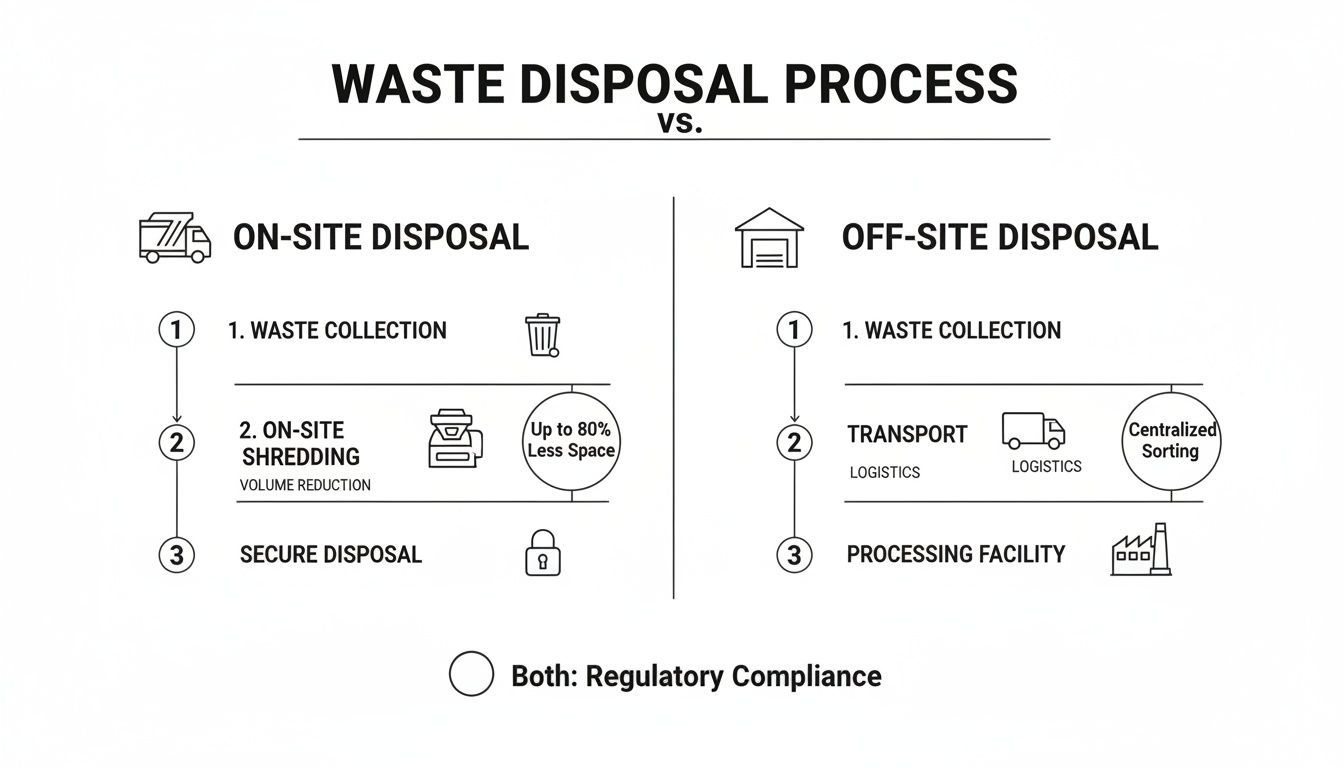
As you can see, whether the shredding happens in a mobile truck at your door or at one of our secure plants, the principles of a documented and secure journey never change.
Your Proof of Compliance The Certificate of Destruction
The final, crucial piece of the puzzle is the Certificate of Destruction. This isn't just a simple receipt. It's a vital legal document that officially confirms your confidential materials have been securely and permanently destroyed, all in line with UK data protection laws.
This certificate is your official proof that you've done your due diligence. If the Information Commissioner's Office (ICO) ever conducts an audit, this is the document that shows you’ve met your legal responsibilities for data disposal.
Without this certificate, you have no hard evidence that your waste was handled correctly, leaving you exposed to potentially huge legal and financial penalties. The certificate details exactly what was destroyed, when and where it happened, and the method used.
Ultimately, a verifiable chain of custody is the bedrock of trustworthy confidential waste disposal. It turns a simple collection into a fully accountable security operation, giving you total peace of mind that your most sensitive information is protected from start to finish.
How to Choose the Right Disposal Partner
Picking a partner for your confidential waste disposal is one of the most important decisions you’ll make to protect your business. This isn't just about finding the cheapest collection; it's about trusting another company with your most sensitive information. The right partner is the final, critical link in your data security chain, so you need to choose wisely.
Think of it like choosing a bank. You wouldn't just go with the one that has the flashiest advert; you'd look for a solid reputation, tough security measures, and clear, transparent processes. The same thinking applies here. You need a partner who can prove they are trustworthy, compliant, and professional from start to finish.
Verify Key Certifications and Standards
Before you even think about prices, the very first step is to check for accreditations. These aren’t just logos for a website; they are independent proof that a company meets strict national and international standards for security, quality, and environmental management. A lack of these is a major red flag.
As a bare minimum, you should be looking for these credentials:
- BS EN 15713: This is the gold standard for secure data destruction in the UK. It covers everything from staff security screening and secure vehicles to the final destruction method. Any provider without this simply isn't operating at the level required for confidential waste.
- ISO 9001: This one is all about quality management. It shows the company has solid, repeatable processes to make sure they deliver a high-quality, reliable service time after time.
- ISO 14001: This certification proves a commitment to environmental responsibility. It confirms the provider has systems to manage their environmental impact, prioritising recycling and sustainable practices.
A truly professional partner will be proud of their accreditations and have them on full display. If you have to dig around to find this information or they seem hesitant to show you proof, it’s best to walk away.
Ask the Right Questions
Once you have a shortlist of accredited providers, it's time to dig a little deeper. A good company will welcome your questions and have clear, confident answers. Your goal is to understand their processes inside and out to ensure they tick all your security and compliance boxes. It's also useful to know what else they can do; for instance, a company offering a full range of commercial waste management services is often better equipped to handle all of a business's needs.
Here are some essential questions to put to any potential partner:
- Can you talk me through your entire chain of custody process? They should be able to explain every single step, from the moment they collect from your site to the moment you get the Certificate of Destruction.
- Are all your staff DBS checked and security vetted? Anyone who comes into contact with your sensitive documents must have undergone thorough background checks. No exceptions.
- Are your collection vehicles GPS-tracked and properly secured? This is a key part of the BS EN 15713 standard and provides crucial accountability while your waste is on the road.
- What actually happens to the paper after it's shredded? A responsible provider should have a zero-landfill policy, guaranteeing that 100% of shredded paper is baled and sent for recycling.
- Can I watch the destruction process? For on-site shredding, this should be standard practice. For off-site, some facilities might offer viewing options for that extra peace of mind.
- What is included in your quote? Make sure you ask about container rental, collection fees, and any other potential charges. You need total transparency on price.
Choosing the right disposal partner isn't a task to be rushed. By focusing on verified credentials and asking detailed questions about how they operate, you can see past the price tag. You'll find a trustworthy provider who delivers a secure, transparent, and fully compliant service that genuinely protects your business.
Sustainable Disposal and Environmental Responsibility
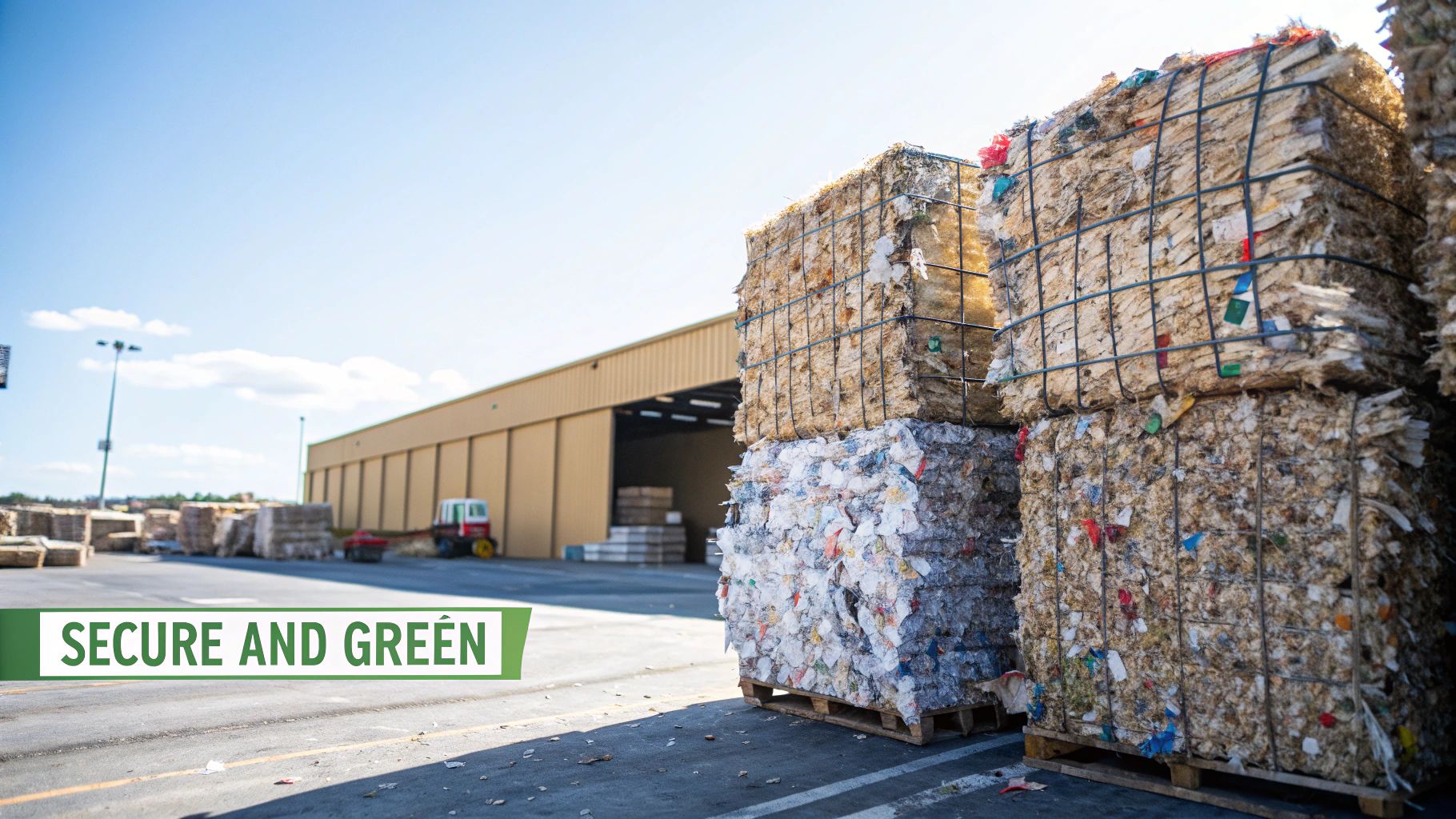
Choosing a professional service for your confidential waste isn't just about security and ticking compliance boxes. It's a powerful statement about your company's commitment to the planet. In a world where sustainability is more than just a buzzword, the way you handle old documents can either add to landfill problems or become a green success story.
Fortunately, you don't have to choose between protecting your data and protecting the environment. Modern confidential waste disposal is designed to do both, turning a legal necessity into a fantastic green initiative.
From Shredded Paper to New Products
Once your sensitive documents are shredded into tiny, unreadable fragments, their story is far from over. Instead of heading to a landfill site, the shredded material begins a new journey.
This is where the process really makes a difference for the planet:
- Baling: First, all the shredded pieces are tightly compressed into huge, dense bales. This simple step makes them much easier and more efficient to transport to a recycling mill.
- Pulping: At the mill, the bales are mixed with water and chemicals to break down the paper fibres into a thick slurry known as pulp.
- De-inking and Cleaning: The pulp then goes through a cleaning process to strip out any ink, staples, and other contaminants, leaving a pure, raw material ready for its next life.
- Remanufacturing: Finally, this clean pulp is pressed, dried, and turned into all sorts of new paper products – from office paper and cardboard to tissues and napkins.
By partnering with a disposal service that has a zero-to-landfill policy, you ensure that 100% of your shredded paper gets recycled. It’s a simple choice that has a massive positive impact, helping to conserve trees, save water, and cut down on the energy needed to create new paper from scratch.
Embracing the Circular Economy
This whole system is a perfect example of the circular economy in action. Instead of the old, wasteful model of "take, make, and throw away," we create a closed loop where materials are reused for as long as possible. Every single document you shred becomes a valuable part of this sustainable cycle.
You can learn more about how the circular economy transforms waste management and the benefits it brings to UK businesses.
Tying your data security needs to your corporate sustainability goals is a genuine win-win. It shows you're a forward-thinking business, which resonates with clients, employees, and stakeholders who care about environmental responsibility. It’s proof that protecting your information and protecting the planet can be done in one smart, simple step.
Frequently Asked Questions
When it comes to getting confidential waste disposal right, a few practical questions always seem to pop up. To help clear things up and build on what we’ve already covered, here are some straightforward answers to the queries we hear most often.
What Common Items Count as Confidential Waste?
It's a much broader category than you might think. Anything containing personal, sensitive, or commercially valuable data falls under this umbrella. We're not just talking about top-secret company documents; it's the everyday paperwork that could cause real problems if it ended up in the wrong hands.
Just think about items like:
- Financial Records: Invoices, bank statements, purchase orders, and payroll slips.
- Employee and HR Files: CVs, employment contracts, health information, and disciplinary notes.
- Client and Customer Data: Contact lists, project briefs, contracts, and anything with personal details.
- Household Documents: Old passports, utility bills, tax returns, and even junk mail that reveals your personal information.
A good rule of thumb is: if making it public could harm your business or an individual, it needs to be disposed of securely.
Is My Small Office Shredder Good Enough for Compliance?
While an office shredder is definitely better than nothing, it rarely meets the strict data protection standards set out by GDPR. Most standard office machines use a basic strip-cut method, and you'd be surprised how easily those long strips can be pieced back together.
On the other hand, professional services use industrial-grade cross-cut shredders. These machines don't just cut paper; they pulverise it into tiny, confetti-like pieces, making it virtually impossible to reconstruct. Crucially, a professional service also gives you a Certificate of Destruction – your official, legal proof that you’ve disposed of the data compliantly. That's something your office shredder can never provide.
How Often Should I Schedule a Collection?
There's no single right answer here – it all comes down to how much sensitive material your organisation generates. The service should fit your specific needs like a glove.
A small business or home office might only need a collection once a month or every quarter. But for larger organisations in data-heavy fields, like law firms, accountancy practices, or medical clinics, a weekly service is often necessary to stop sensitive documents from piling up unsafely. Many providers offer flexible options, from one-off clear-outs to regular scheduled collections using secure, lockable consoles placed right in your office.
For a flexible, secure, and fully compliant confidential waste disposal service that works for you, trust The Waste Group. Get your free, no-obligation quote today!