
UK Cost of Asbestos Disposal A Homeowner’s Guide
UK Cost of Asbestos Disposal A Homeowner’s Guide
When you're faced with an asbestos problem, one of the first things on your mind is, understandably, the cost. You might see figures like £0.55 to £0.80 per kilogram for asbestos disposal in the UK, but that number is just a small part of a much bigger picture.
Think of it less as a simple disposal fee and more as an all-in-one safety and compliance package.
Understanding the True Cost of Asbestos Disposal
Paying for asbestos disposal isn't like buying an item off the shelf. You're funding a highly specialised safety operation. The final price on your invoice covers a whole series of critical, legally-required steps designed to protect you, the public, and our environment from those hazardous fibres.
The total cost is built from several key components. That price per kilogram – which often gets bundled into a full removal quote – is a big one. For a typical homeowner in Dorset needing a garage roof removed, this could easily mean £200-£500 just in disposal fees for around 300-500kg of asbestos cement sheets.
But what else goes into that final figure?
Core Components of Your Quote
To give you a transparent and accurate quote, a professional service has to account for every step of the process, from the initial check to the final paperwork.
Here’s a look at the essential cost factors that go into a professional quote:
To help make sense of it all, here's a quick breakdown of the primary elements that contribute to the final cost of disposing of asbestos materials.
Quick Look at Asbestos Disposal Cost Factors
| Cost Component | Typical Price Range (UK) | Why It's Necessary |
|---|---|---|
| Lab Testing & Analysis | £40 – £100 per sample | Confirms the presence and type of asbestos to ensure the right safety protocols are followed. |
| Specialised Transport | Included in quote; varies by distance | Asbestos is hazardous waste and requires a licensed carrier with proper equipment and insurance. |
| Licensed Landfill Fees | £200 – £500+ (varies) | Asbestos must go to specific, licensed sites that can handle it safely. This is the "tipping fee." |
| Legal Paperwork | Included in service fee | A consignment note is a legal record proving your waste was handled and disposed of correctly. |
As you can see, each step is a crucial part of a safe and legally compliant process, not just an add-on.
It's a bit like getting a quote for other specialised home services. Looking at guides on something like dryer duct cleaning costs can be a good parallel; you see how labour, specialised equipment, and compliance all contribute to the final price. This mindset helps you ask the right questions and truly understand the value behind each line item on your asbestos disposal quote.
What Really Drives Asbestos Disposal Costs

Getting a ballpark figure for asbestos disposal is one thing, but understanding what shapes your specific quote is another. The final bill isn't just a number plucked from thin air; it's a careful calculation based on risk, the resources needed, and strict regulations. No two jobs are the same, which is why you’ll never see a one-size-fits-all price in this line of work.
Think of it this way: different types of asbestos are like different difficulty settings. Each level demands more skill, specialised gear, and time to handle safely, and all of that is reflected in the final cost.
The Type and Condition of Asbestos
The single biggest factor influencing the price is the type of asbestos you’re dealing with. Professionals break it down into two main camps, based on how easily it can release those dangerous fibres into the air.
-
Non-friable (Bonded) Asbestos: This is your entry-level material. We’re talking about things like asbestos cement sheets on a garage roof or old floor tiles. Here, the fibres are locked tightly inside a solid material, like cement or vinyl. As long as it’s in one piece, it’s relatively stable and lower risk. Removing it is less complicated, which helps keep the disposal costs down.
-
Friable Asbestos: This is the big one. It includes materials like sprayed insulation, pipe lagging, or asbestos insulating board (AIB). This stuff is soft, crumbly, and can be turned to dust with just hand pressure. It can release millions of fibres with the slightest disturbance, creating a serious health hazard.
Disposing of friable asbestos is a whole different ball game and is far more expensive. It requires highly licensed specialists, full enclosures with negative air pressure systems, and intensive decontamination procedures. Unsurprisingly, the cost can be several times higher than for bonded asbestos. The condition is also a huge deal; a broken, crumbling cement sheet will be handled with much greater caution—and at a higher price—than one that's still intact.
Quantity and Weight: The Heavier the Load, the Higher the Bill
The next major piece of the puzzle is simple: how much of it is there? Asbestos disposal costs are almost always worked out by weight. The more material you have, the more it will cost to transport it and tip it at a licensed landfill.
A handful of old asbestos floor tiles might only add a small amount to your bill. But taking down an entire corrugated asbestos roof from a large garage can generate hundreds of kilograms of waste. That sheer weight is a key reason why a project’s cost can quickly climb into the hundreds, or even thousands, of pounds.
The total weight doesn't just affect the tipping fees; it also determines the type of transport required. A small, sealed bag might go in a specialised van, but a full roof removal will need a dedicated, lockable asbestos skip, adding another cost layer to the job.
Tipping fees for asbestos waste in the UK can run anywhere from £50 to £200 per tonne at licensed sites, depending on the local council and what facilities are available. These fees, which cover the legally required double-bagging, GPS-tracked transport, and consignment notes, make up a big chunk of any project budget. Dorset tips tend to be mid-range, thanks to their proximity to the South Coast hubs. If you want to dig deeper, you can explore more about asbestos removal costs for 2025 on SR Solutions.
Site Accessibility and Location
Where the asbestos is on your property plays a massive part in the cost. An asbestos shed on the ground floor with easy access? That’s pretty straightforward. Asbestos insulating board in a cramped loft or a boiler room tucked away in a basement with no easy way out? Now you’ve got a logistical headache.
Difficult access means more hours on the clock for the removal team. It could involve:
- Mapping out complex routes to carry the waste safely out of the building.
- Bringing in extra equipment like scaffolding for work at height.
- More time spent on cleaning up along the entire removal path.
On top of that, your property's location within Dorset matters. The distance to the nearest licensed hazardous waste landfill will directly impact transport costs. A remote, rural home will naturally cost more for transport than a house in central Bournemouth that's just a short drive from a disposal site. Every extra mile adds to the final invoice.
Getting to Grips with the Legal Side of Asbestos Waste
Dealing with asbestos isn't just a safety exercise; it's a serious legal responsibility. The rules around its disposal are incredibly strict, and for a very good reason – they're there to protect absolutely everyone from the risk of stray fibres. It's best to see these regulations not as a hassle, but as your legal shield against eye-watering fines and future health liabilities.
The key piece of legislation here in the UK is the Control of Asbestos Regulations 2012. In plain English, this law puts a legal "duty of care" squarely on your shoulders as the person producing the waste. It doesn't matter if you're a homeowner having a clear-out or a contractor on a job site; you are legally accountable for that asbestos from the moment it leaves your property until it's safely disposed of.
Getting this wrong can have severe consequences. Fly-tipping asbestos, for example, can lead to unlimited fines or even prison time. It’s a stark reminder that cutting corners is simply never worth the gamble.
What "Duty of Care" Really Means
So, what does this "duty of care" actually look like in practice? It all comes down to a few critical, non-negotiable steps. These ensure there’s a clear, traceable paper trail for the hazardous material. You can't just pass it off to a "man with a van" and hope for the best.
To meet your legal duties, you must make sure your asbestos waste is:
- Handled by a Licensed Waste Carrier: Only a company that holds an official Waste Carrier Licence, issued by the Environment Agency, is legally allowed to transport asbestos.
- Taken to a Licensed Disposal Site: The waste has to go to a specific landfill or treatment facility that is licensed to handle and process asbestos. Your local tip or recycling centre is not an option.
- Documented with a Consignment Note: This is the single most important piece of paperwork in the whole process.
Making sure you understand these points is the foundation of safe and compliant asbestos disposal. For a deeper dive into the specifics, have a read of our guide to hazardous waste disposal regulations on our blog. It’ll give you the full picture of your responsibilities.
The All-Important Asbestos Consignment Note
The consignment note is the golden ticket of asbestos disposal. It is your official, legally-binding proof that you’ve done everything by the book and fulfilled your duty of care.
Think of a consignment note like a passport for hazardous waste. It tracks the waste's journey, collecting stamps (signatures) from you, the licensed carrier, and the final disposal site. Without this completed document, you have no proof the asbestos wasn't illegally dumped.
This document records all the crucial information: the collection address, the carrier's details, what type of asbestos it is, and the destination facility. Everyone involved signs it to confirm the handover at each stage. Once the asbestos is safely disposed of, you get a completed copy back. You must keep this document safe for at least three years as your proof of lawful disposal.
Bringing in a professional, certified company like The Waste Group takes this entire legal headache away. We handle all the licence checks and paperwork for you, ensuring you receive a completed consignment note for total peace of mind. It means every step is properly documented, fully compliant, and completely transparent, protecting you from any legal headaches down the line.
Real-World Asbestos Disposal Cost Scenarios
All the talk about cost factors is one thing, but seeing how it all adds up in the real world is where the penny really drops. To give you a clearer picture of the cost of asbestos disposal, let's walk through three common jobs we see all the time, from a small domestic task to a much larger commercial project.
These examples are designed to show you exactly how the type of asbestos, the amount, and how easy it is to get to the material all play a part in the final bill. Think of them as a handy guide to help you budget for your own project and know what to look for in a proper, transparent quote.
Scenario 1: The Homeowner's Asbestos Garage Roof
This is probably the most frequent asbestos job we come across for homeowners in the UK. We're talking about an old garage, typically with a corrugated roof made from asbestos cement, that needs to be taken down and carted away safely.
The good news here is that the asbestos is bonded (non-friable) and in pretty decent shape, which keeps the risk – and the costs – down. The garage is also right on the driveway, so access is a piece of cake.
This table gives you an idea of the costs involved in these common disposal scenarios, helping you see where your money goes.
Sample Asbestos Disposal Project Costs
| Project Scenario | Asbestos Type | Estimated Total Cost | Key Cost Components |
|---|---|---|---|
| Homeowner's Garage Roof | Bonded Asbestos Cement | £950 – £1,525 | Labour, specialised asbestos skip hire, and landfill tipping fees. |
| Contractor's Floor Tiles | Non-Friable Vinyl Tiles | £700 – £1,050 | Specialist van collection, careful labour to lift tiles, and paperwork. |
| Business's AIB Panels | Licensed Friable (AIB) | £4,000+ (Total Project) | Licensed labour, air monitoring, secure transport, and higher tipping fees. |
As you can see, the risk level and the complexity of the job are what really drive the price up.
For the garage roof, the straightforward nature of the job makes it quite manageable. The main costs are the physical labour to dismantle it carefully and the combined price of the special locked skip and the landfill's disposal fees.
Scenario 2: The Builder and the Hidden Floor Tiles
Next up, let's imagine a builder renovating a kitchen in a house built in the 1970s. They've just pulled up the old lino and, surprise, they've found 9-inch asbestos floor tiles underneath. It's an incredibly common discovery.
These tiles are also non-friable, but a few have cracked and broken during the initial work. Plus, the sticky black bitumen adhesive used to glue them down might also contain asbestos, which adds another layer of complexity.
This is a classic example of why getting a proper survey before you start swinging hammers is so important. Finding asbestos unexpectedly can bring a project to a screeching halt and blow the budget, turning a simple re-fit into a controlled hazardous waste job.
Here’s how the costs might break down for a typical 15-square-metre kitchen floor:
- Dedicated Van Collection: For a smaller amount like this, sending a van is much cheaper than hiring a full skip. You're looking at around £300 – £450.
- Labour & Containment: The painstaking work of lifting each tile without creating dust and scraping the old adhesive takes time and care. Expect to pay £400 – £600.
- Disposal Fees: These are usually rolled into the collection service fee for smaller jobs.
- Paperwork: The consignment note is non-negotiable and is part of the service cost.
The total for just the disposal part of this job would probably land between £700 and £1,050, sitting on top of the original kitchen renovation budget.
This infographic neatly summarises the legal duties that every single compliant asbestos disposal project has to follow.
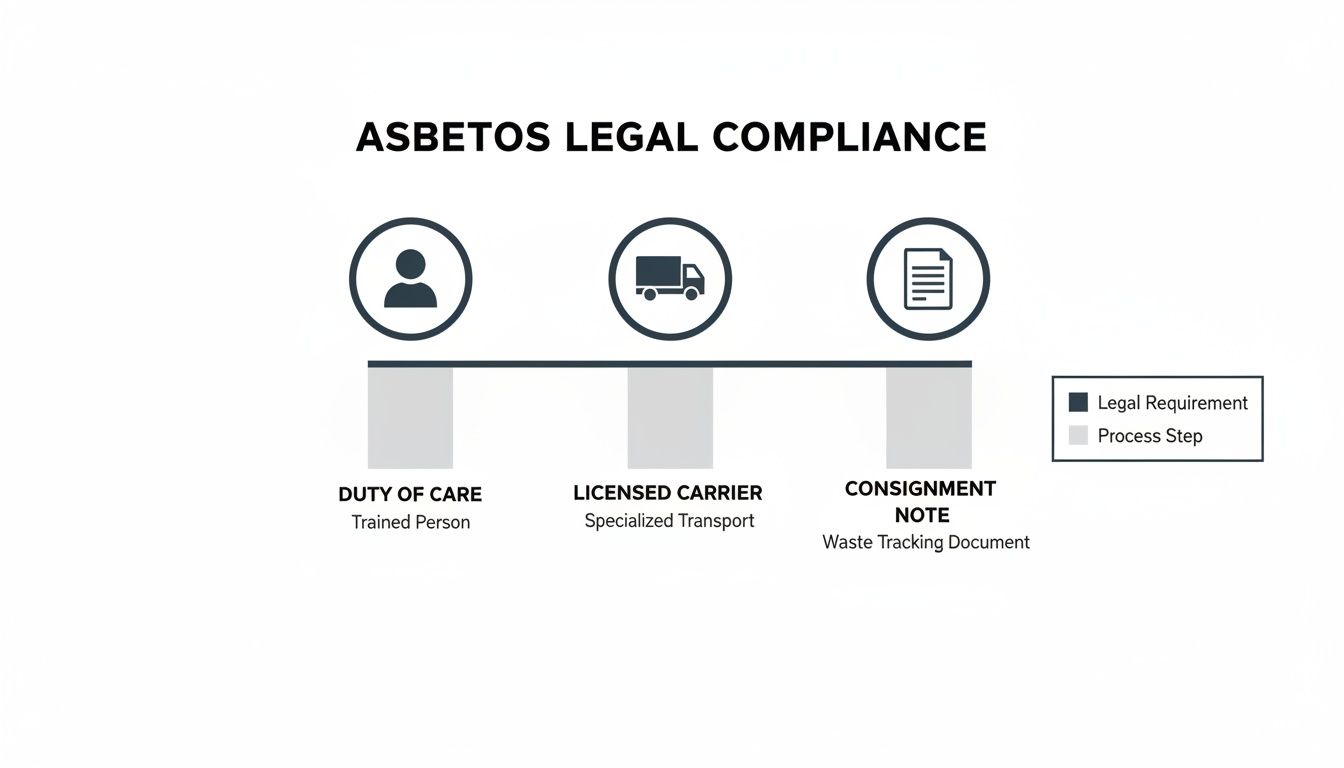
It’s a simple visual reminder: your duty of care means using a licensed carrier and getting the proper legal paperwork to prove it.
Scenario 3: The Business with Old Insulation Boards
Our final example is a business clearing out an old stockroom and finding asbestos insulating board (AIB) panels that were used for fireproofing. AIB is a licensed, friable material, meaning its fibres can easily become airborne. This immediately sends the risk level—and the cost—through the roof.
A job like this is notifiable to the Health and Safety Executive (HSE). It demands a specialist licensed contractor, a full sealed enclosure around the work area, negative air pressure units to contain fibres, and on-site decontamination facilities. It’s a serious operation.
For a small room of about 20 square metres, the disposal itself is just one slice of a much bigger, more expensive pie. The disposal-related part of the invoice might look something like this:
- Licensed Labour: This requires highly trained specialists working under strict, controlled conditions.
- Air Monitoring: This is mandatory before, during, and after the job to prove the area is safe.
- Secure Transport: The waste must be moved by a licensed carrier with specific training for high-risk materials.
- Tipping Fees: Charged by weight, just like other types, but handled at specialised landfill sites.
On a project of this scale, the transport and disposal alone could account for £800 – £1,200 of a total bill that could easily climb past £4,000. It's a stark illustration of how the high-risk nature of friable asbestos ramps up every single cost involved.
Your Step-by-Step Guide to Safe Asbestos Disposal
Dealing with asbestos disposal can feel like a minefield, but it doesn't have to be. By breaking it down into a few clear, manageable steps, you can get from A to B safely and legally. This is your roadmap from that first moment of suspicion to the final, signed-off disposal.
It all starts when you spot something you think might be asbestos. The most important thing to do first is also the simplest: do not touch it. Fighting the urge to poke, break, or move the material is critical, as that's exactly how the dangerous fibres get into the air.
The priority is to keep the area undisturbed and call in the professionals.
Step 1: Identify and Test Suspected Materials
Your first move is to get in touch with a UKAS-accredited asbestos surveying company. They'll send a trained surveyor who knows how to take a small sample safely, under controlled conditions. This tiny piece is then sealed up and sent off to a lab for proper analysis.
You simply can't skip this step. It’s what confirms whether you have asbestos and, crucially, tells you which type it is. This information dictates the risk level and the exact disposal method needed. The lab results will usually set you back between £40 and £100 per sample, but they give you the facts you need to move forward correctly.
Step 2: Find a Licensed Disposal Specialist
Once the lab confirms you have asbestos, it’s time to find a licensed hazardous waste carrier. Transporting asbestos without an Environment Agency Waste Carrier Licence is illegal, so this isn't a job for a standard 'man with a van'.
When you're looking for the right company, here's what to check for:
- Proof of Licence: Don't just take their word for it. Ask for their Waste Carrier Licence number and check it yourself on the Environment Agency's public register.
- Clear Quoting: A professional company will give you a detailed quote that breaks down the costs for transport, labour, and tipping fees. No hidden surprises.
- Local Know-How: A firm that knows the Dorset area will be familiar with the local licensed disposal sites and rules, which often makes for a smoother process.
Getting a few different quotes is always a good idea to compare the cost of asbestos disposal, but make sure you’re comparing apples with apples. If a quote seems too good to be true and doesn't mention the proper paperwork, it’s a massive red flag. For a deeper dive into safe practices, our guide on how to remove asbestos safely is essential reading.
Step 3: Arrange Collection and Get the Paperwork
With a specialist chosen, you can book the collection. They will give you clear instructions on how they need the waste prepared—it might need to be double-bagged or placed inside a special lockable asbestos skip.
The single most important part of this stage is the consignment note. This is a legal document that proves you've handed over the asbestos to a licensed carrier, officially transferring the responsibility from you to them.
When they arrive, both you (or your contractor) and the driver will sign this note. After your waste is safely tipped at the licensed facility, you'll get a final, completed copy. Keep this document somewhere safe for at least three years. It’s your legal proof that you did everything by the book.
How to Manage Asbestos Disposal Costs Intelligently
While safety and the law have to come first, managing the cost of asbestos disposal doesn't mean you’re stuck with the first price you're quoted. A bit of smart thinking can help you keep control of your budget without ever cutting dangerous or illegal corners. It’s all about being proactive and doing your homework.
A brilliant first step is to get quotes from a few different licensed waste carriers. Don’t just glance at the final figure, though. Ask each company for a proper, itemised breakdown. This lets you see exactly what you're paying for—labour, transport, skip hire, and landfill fees—so you can compare them fairly and spot a transparent, honest price.
Consider Alternatives to Full Removal
In some very specific cases, ripping everything out and disposing of it isn't the only safe path forward. If the asbestos-containing material (ACM) is in good nick, completely undisturbed, and isn't likely to get damaged, encapsulation could be a real option.
This is a specialist job where the asbestos is sealed with a protective coating, stopping any fibres from getting into the air. While it's not a DIY task, it can be a lot more cost-effective than a full removal project. The bigger picture shows asbestos costs the UK over £1.5 billion a year, with removal alone hitting £50-£150 per square metre, plus disposal fees. Encapsulation, on the other hand, can be as low as £33 per square metre, offering a huge saving on materials that are still intact.
Important Takeaway: Encapsulation is only for stable, undamaged asbestos. You absolutely need a professional survey to know if it's a safe and suitable strategy for your property.
Avoid Dangerous and Costly Mistakes
It might be tempting to find a shortcut, but the financial and legal fallout from getting asbestos disposal wrong is massive. One of the most dangerous myths floating around is that you can just chuck asbestos waste into a standard skip or mix it in with your general rubbish. This is illegal and incredibly dangerous.
Companies can face unlimited fines for fly-tipping asbestos, and homeowners aren't off the hook either. The price of a professional collection is a tiny fraction of the fines and clean-up bills you’d be staring at if you were caught. To get the full picture on the risks and rules, it’s well worth reading our guide on why you should never put asbestos in a general skip.
For landlords looking to keep property expenses down across the board, a smart landlord cost-saving guide can offer some great strategies that go beyond just asbestos. At the end of the day, paying for compliant disposal isn't just an expense—it's your insurance policy against much bigger financial and legal headaches later on.
Common Questions About Asbestos Disposal
When it comes to asbestos, it’s only natural to have a lot of questions, especially about the cost and the rules. To make things a bit clearer, we’ve tackled some of the most frequent queries we get from homeowners and tradespeople across Dorset.
Can I Take Asbestos to My Local Tip Myself?
The short answer here is almost certainly no. You can't just pop asbestos in the boot of your car and run it down to the local recycling centre.
While a handful of council tips might, in theory, accept a very small, securely wrapped amount of bonded asbestos from a homeowner, this is rare and always requires strict pre-arrangement. It’s absolutely illegal and extremely dangerous to chuck it in your household bin or a regular skip.
The only way to guarantee you're acting safely and within the law is by using a licensed hazardous waste carrier. They have the proper training, gear, and vehicles to move it to a certified disposal site, ensuring there's zero risk to you, the public, or the local environment.
What Is a Consignment Note and Why Is It Important?
Think of a consignment note as the official paper trail for your asbestos. It’s the legal document that tracks the waste from the moment it leaves your property to its final, safe destination. It’s your proof that you’ve done everything by the book.
This vital document gets signed by three parties: you (or your builder), the waste carrier who collects it, and the manager at the disposal facility. You must get a completed copy for your records. It’s your protection against any future legal headaches and proves the waste was managed responsibly. The official advice is to keep this note for at least three years.
This single piece of paper is your legal shield. It proves you followed the law and that your hazardous waste didn't end up fly-tipped in a country lane, which could lead back to you with severe penalties.
How Do I Know if a Company Is Licensed for Asbestos Waste?
Any legitimate company transporting asbestos waste must hold a valid Waste Carrier Licence, which is issued by the Environment Agency. Don’t just take their word for it—ask for their licence number. You can then check it for yourself on the EA's public register online.
It’s also worth remembering that asbestos removal (the act of stripping the material from a building) requires a different, even stricter licence from the Health and Safety Executive (HSE). A professional, reputable company will have no problem showing you their credentials, so never be afraid to ask.
Is It Cheaper to Get a Collection or Hire an Asbestos Skip?
This really boils down to the size of your job. If you’ve just got a few bags of asbestos cement sheets from a leaky shed roof or a small garage repair, a 'man-with-a-van' style collection is usually the most straightforward and cost-effective option.
But for bigger projects, like taking down an entire asbestos garage or pulling up a large area of old floor tiles, hiring a dedicated, lockable asbestos skip is often the smarter choice. It keeps all the hazardous debris safely contained in one spot, ready for a single, scheduled collection, which makes managing the project that much easier.
For a clear, competitive quote on compliant asbestos disposal in Dorset, trust the experts. The Waste Group provides fully licensed collection and skip hire services, ensuring your project is handled safely and legally from start to finish. Get your free quote online today at https://www.thewastegroup.co.uk.