
Dimensions of a 4 yard skip: Quick Sizing Guide for UK Projects
Dimensions of a 4 yard skip: Quick Sizing Guide for UK Projects
If you’re measuring space for a skip and want to know exactly what you’re getting, here’s a quick snapshot. A standard 4-yard skip typically comes in at 6 ft long × 4 ft wide × 3 ft high (roughly 1.83 m × 1.22 m × 0.91 m) and will safely hold about 3.06 m³ of waste.
Key Dimensions And Capacity At A Glance
The infographic below visualises length, width and height for quick reference.
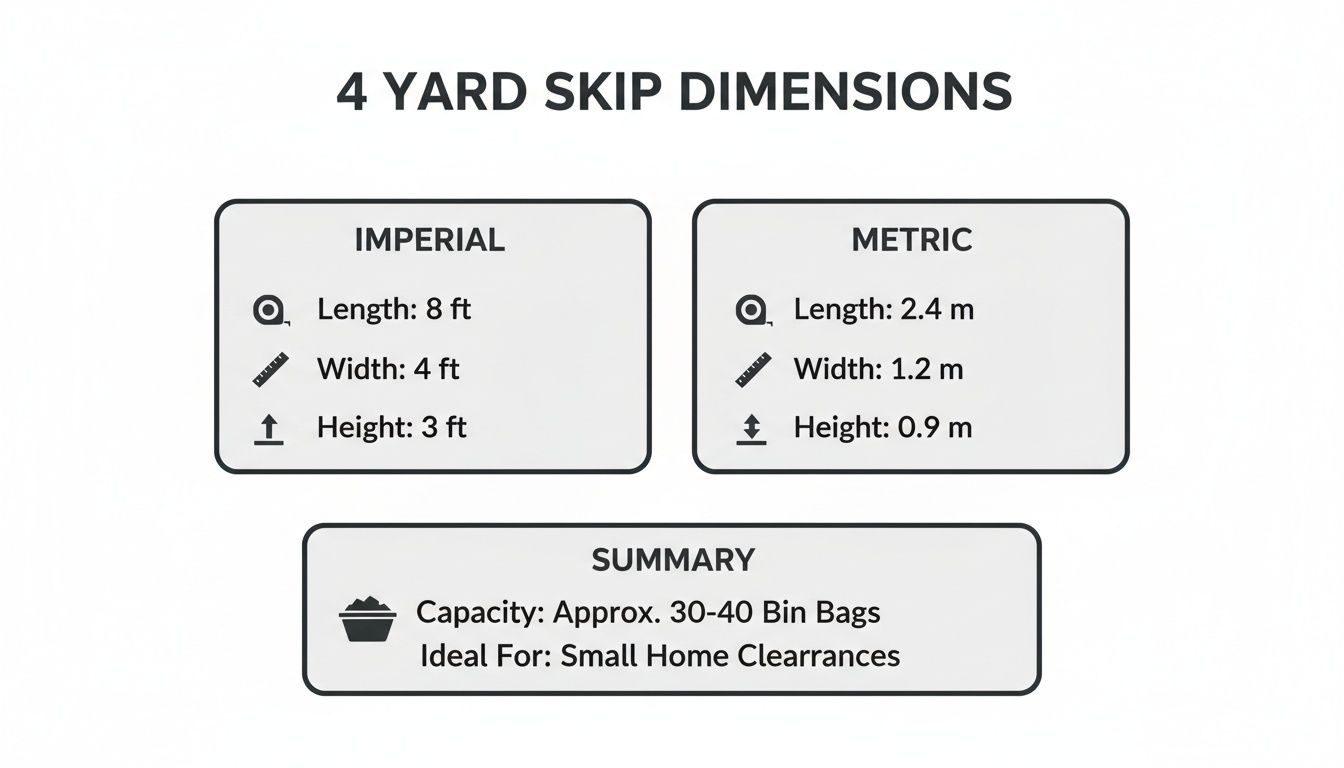
This visual highlights the external and internal measures you need for driveway and permit planning.
Below is a quick reference table summarising the main length, width, height and capacity of a 4-yard skip in both imperial and metric units.
Summary Of 4 Yard Skip Key Measurements
| Dimension | Imperial | Metric |
|---|---|---|
| Length | 6 ft | 1.83 m |
| Width | 4 ft | 1.22 m |
| Height | 3 ft | 0.91 m |
| Capacity | 4 yd³ | 3.06 m³ |
Keep these numbers close to hand when you’re checking gate clearances or marking out space for permits.
- Typical safe fill volume up to 3.06 m³
- Standard weight limit around 2 tonnes for mixed waste
- Fits approximately 30–40 black bin bags
Use these figures to confirm a skip will clear gates, driveways or council permit zones before you order. This snapshot gives you the essentials for garden clear-outs, renovation debris or general household waste.
Common Uses
- Garden clearance: up to 30 bin bags of greenery
- Small renovation debris: kitchen units and tile offcuts
- Household clear-outs: old cushions, cardboard boxes
Armed with these figures, you can plan waste removal precisely and avoid hidden charges with The Waste Group. Confirm vehicle access and street-permit height restrictions before booking to ensure a smooth drop-off and collection. Check local council rules on skip permits and placement fees if you plan to leave the skip on public roads. The Waste Group’s online permit service streamlines this process. Book today online easily.
Understanding Skip Dimensions In Imperial And Metric
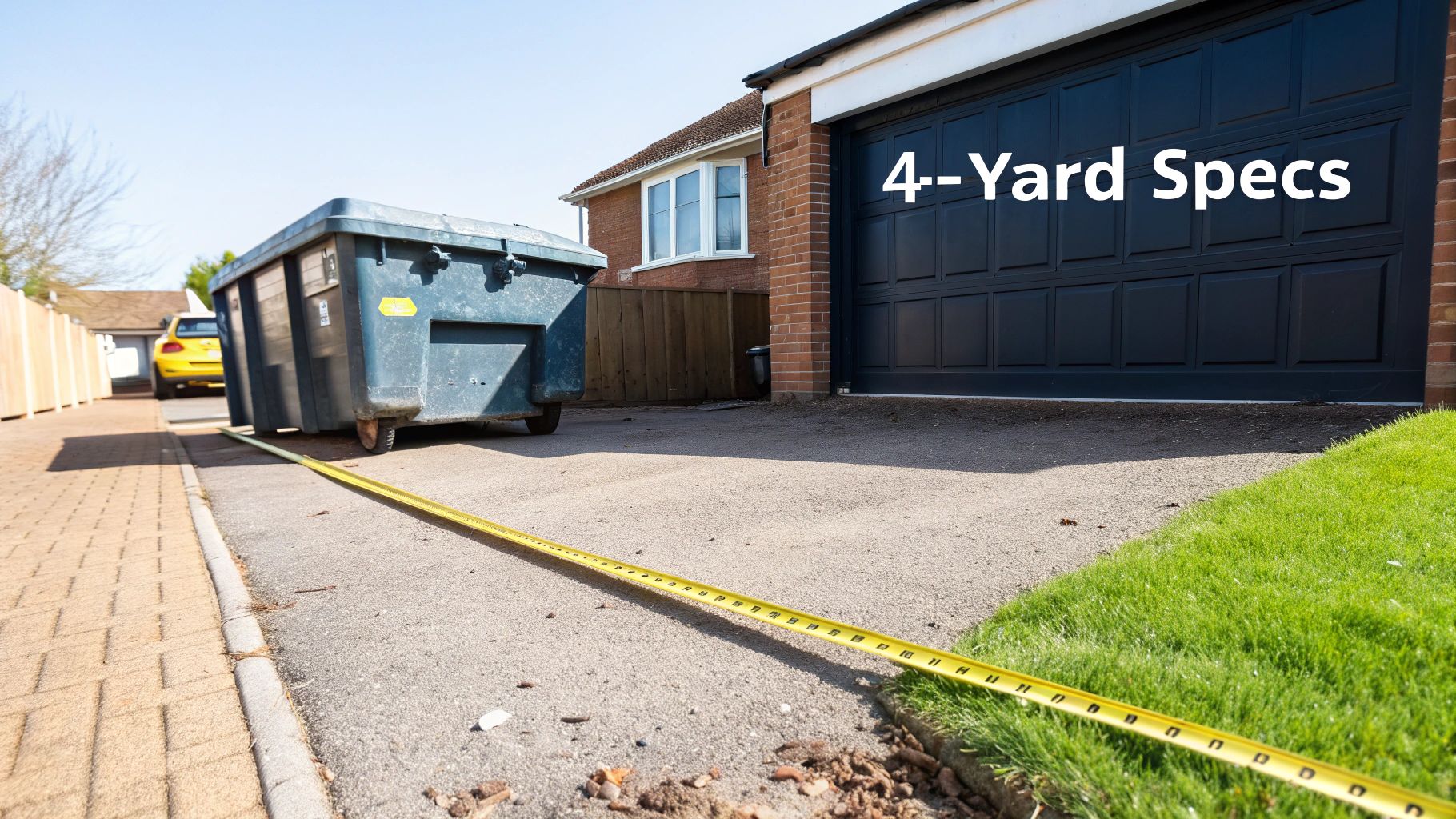
Fitting a 4-yard skip into a tight spot often feels like a game of Tetris. Visualising its true size prevents cramped driveways or unexpected overhangs on the road.
Imagine lining up two garden wheelbarrows end to end—that’s roughly the 6 ft (1.83 m) length you’ll need to clear.
In most UK skip fleets, a 4-yard skip measures about 6 ft × 4 ft × 3 ft externally. In metric terms, that’s 1.83 m long, 1.22 m wide and 0.91 m high, with internal dimensions slightly smaller once you subtract the wall thickness (around 50 mm each side).
For a broader overview of skip sizes, take a look at EJ Shanley’s guide to different UK skip sizes.
“Checking clearance before hire saves time, money and awkward repositioning,” industry experts advise.
Key External Dimensions:
- External Length: 6 ft (1.83 m)
- External Width: 4 ft (1.22 m)
- External Height: 3 ft (0.91 m)
- Internal measurements are reduced by roughly 50 mm per side
Most providers tweak these figures by a few inches to ensure safe lifting and balanced weight distribution.
Checking Driveway And Street Fit
Narrow passages often require at least 2.5 m of clearance. Before you book, measure your gate or alley width and add a 20 cm buffer for the delivery truck’s overhang.
Remember, the skip’s 1.83 m length plus the lorry’s tail swing can demand up to 3 m of space.
Table Comparing Provider Variations
| Provider | Length | Width | Height |
|---|---|---|---|
| The Waste Group | 1.83 m | 1.29 m | 0.97 m |
| Samson | 2.51 m* | 1.62 m* | 1.00 m* |
| EJ Shanley | 1.80 m | 1.22 m | 0.91 m |
Ensure your chosen spot can accommodate both the skip and the delivery vehicle—double-checking now saves awkward repositioning later.
Converting Dimensions To Cubic Metres And Explaining Capacity
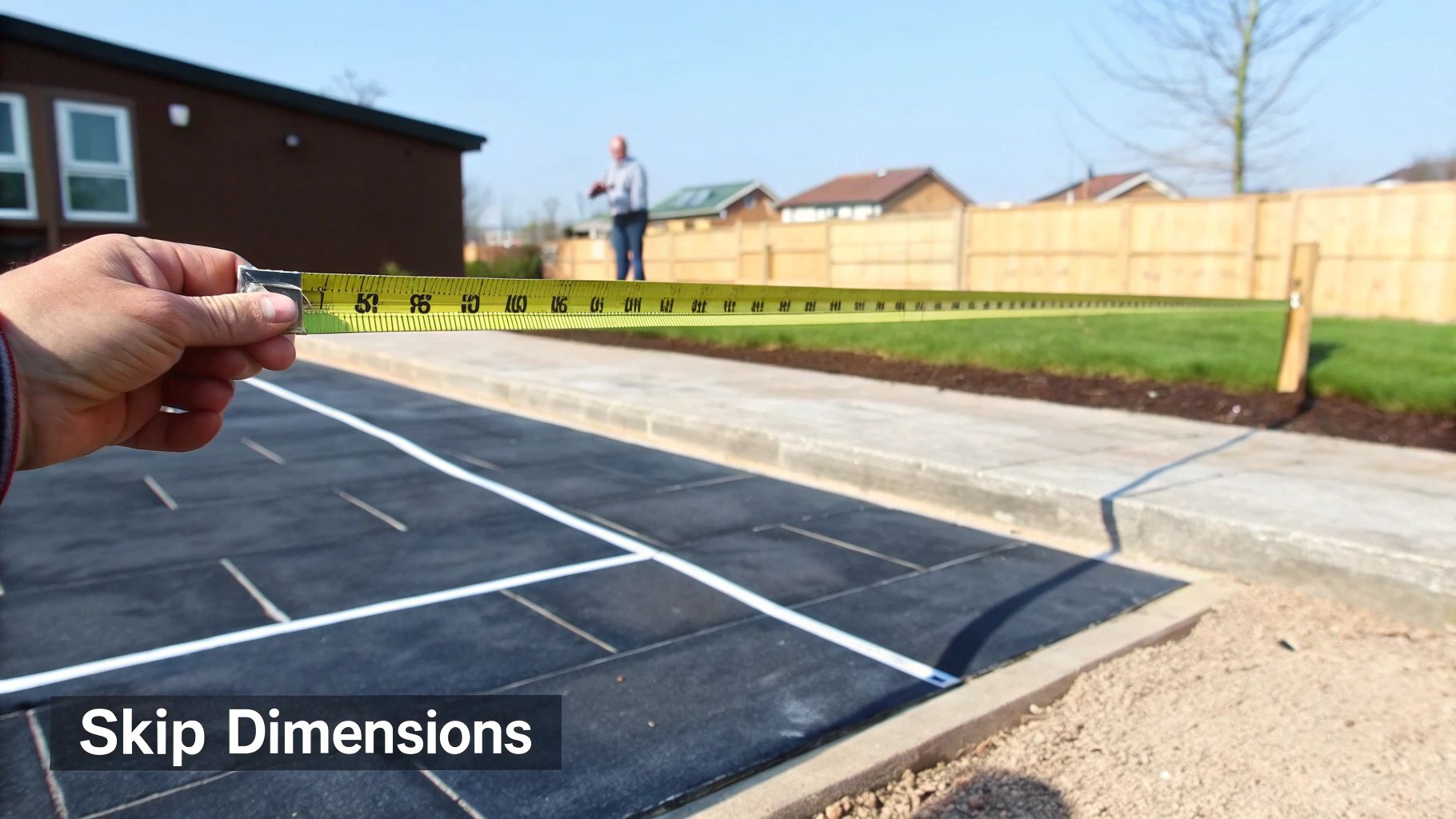
Measuring a skip’s inside dimensions—length, width and height—is the only way to pinpoint its real-world volume. In my experience on garden clearances and building refurbishments, these figures often tell a different story than the nominal size.
Typically, a 4-yard skip clocks in at around 1.7 m by 1.1 m by 0.8 m, which mathematically equals 1.5 m³ before you factor in safe-fill limits.
Step By Step Volume Calculation
First, measure the internal length, width and height in metres. Then multiply those three figures to find the raw volume.
• 1.7 m × 1.1 m × 0.8 m = 1.5 m³ raw capacity
• Apply a 75% fill coefficient to stay below the transport line
• 1.5 m³ × 0.75 = 1.12 m³ of usable space
Think of it like packing a small hatchback. It takes roughly three full loads of garden waste to match what a 4-yard skip will hold—and that’s before getting close to the rim.
Never load above the rim for safety and regulatory compliance
Of course, odd shapes and large items eat into that usable space. And when you’re dealing with heavier rubble, you’ll hit the weight limit long before you hit the volume cap.
Examples Of Material Effects
- Garden waste: light and fluffy, so it fills every corner
- Concrete rubble: dense, so the skip may reach 2 tonnes weight threshold quickly
- Mixed waste: balanced bulk, usually maxes out around 35 black bin bags
Factors That Affect Capacity
Skips aren’t perfect boxes. Sloping walls and the fill line chip away at the theoretical volume. In practice, a 4-yard unit holds closer to 3 m³ at its top fill line.
Most operators cap mixed waste at 2 tonnes, so planning heavy loads is crucial—check our guide on calculating concrete volume before you order.
| Measurement | Raw Volume | Safe Volume |
|---|---|---|
| 1.7 m × 1.1 m × 0.8 m | 1.5 m³ | 1.12 m³ |
When placing your skip, allow at least 3 m of clearance for the truck’s tail swing. Uneven loading can shift weight and lead to penalties, so distribute the load evenly and review hire terms to avoid surprises. Stay safe, comply with regulations, and you’ll get the most out of every skip delivery.
Typical Load Capacity And Weight Limits
Industry Weight Ceilings
The Health and Safety Executive sets strict weight ceilings on skip loads to curb tipping risks and keep our roads safe. Exceeding these limits not only carries hefty fines but also jeopardises safe transport.
For mixed general waste, you’re usually capped at 2 tonnes. Hardcore and building rubble often max out at 200–300 kg long before the skip looks full. Soil and topsoil, however, can pack in as much as up to 4 tonnes while occupying a very similar volume.
- Mixed household waste balances weight and volume fairly evenly.
- Hardcore and rubble add weight quickly but leave pockets of empty space.
- Soil compacts tightly, hitting weight limits long before the skip seems full.
- Recyclables generally stay light—unless you bind them into dense bundles.
Material Weight Examples
Knowing how different materials settle can save you time and money. A 4-yard skip brimming with rubble might weigh around 250 kg, yet swap in wet soil and you’re looking at 4 tonnes. Heavy items chew through your safe capacity in a heartbeat.
The standard UK 4-yard skip holds about 3–3.06 cubic metres, roughly 30–40 black bin bags worth of waste. For a closer look at measurements, check out our sizing guide.
Even filling keeps you clear of fines and prevents lorry instability.
Tactics To Avoid Overload Fees
An overloaded skip can land you with up to a £500 fine, plus surcharges for each extra tonne. Always double-check the weight limits in your hire agreement.
Try these loading techniques to keep extra costs at bay:
- Spread heavy items evenly from front to back.
- Lay bulky pieces down first, topping up with lighter materials.
- Never pile above the marked safe-fill line.
You might also find our detailed insights into skip weight limits useful in our guide on skip limits. Following these steps will help keep your project compliant and your budget on track.
What A 4 Yard Skip Will Hold
Think of a 4-yard skip as a three-dimensional puzzle where every item—garden waste, rubble or a bit of old furniture—dictates how you pack. It’s not just about filling space; it’s about stacking smart.
For instance, you can squeeze in around 25–30 standard bin bags of general household waste. That’s about three full car boots of clutter.
Alternatively, if you’re moving hardcore or soil, you’re looking at roughly 18 wheelbarrow trips. Bear in mind though: as soon as that rubble gets heavy, you’ll hit the weight limit long before you reach volume capacity.
And don’t forget the fluff. Sofa cushions are like marshmallows on top of a chocolate bar—you might fit a couple of cushions to fill those final gaps.
- Bin bags: 25–30 bags (approx. 3 m³ at the safe fill line)
- Wheelbarrow loads: 18 trips of soil or turf
- Bulky items: Sofas, chairs and small cabinets require a bit of Tetris-style placement
Case Study Examples
In one garden clearance, Joan laid down leafy branches first—almost like building a roaring log fire. She then tucked in hedge trimmings in bin bags to fill the lower layers.
Next came an evenly distributed barrow of soil, which prevented the lorry from tipping forward on collection day. Finally, more bin bags squeezed into every crevice.
| Scenario | Items | Quantity |
|---|---|---|
| Garden Clearance | Branches, hedge cuttings, bin bags | 20 bin bags + 18 barrow loads |
| Kitchen Refit Debris | Cupboards, tiles, sink | 15 bin bags + solid debris |
“Spread the load evenly to avoid excess weight charges,” recommends a Waste Group driver.
In a kitchen refit, heavy tiles went in first. On top, she stacked broken cabinetry in cardboard boxes. The result? A perfectly balanced skip, no awkward lumps or last-minute reshuffles.
By layering the heaviest materials at the bottom and finishing with lighter items near the rim, you’ll pack safely and efficiently—just like laying a solid foundation for a house.
Happy loading!
Placement And Permit Considerations

Choosing exactly where your 4-yard skip sits can feel a bit like a game of Tetris. Pick the wrong spot and you risk bumps, blocked access or unexpected charges.
If you’re placing it on private property, double-check your gate’s width and height against the dimensions of a 4-yard skip, leaving a 20 cm buffer on each side for truck clearance.
Planning to put your skip on the road? You’ll need a council permit first.
Learn more about skip permits in our guide from The Waste Group.
- Typical permit cost: £50–£100 depending on your local council and placement
- Lead time: usually 3–7 days, although it can vary
- Extra fees: sometimes a road-space licence is needed for overnight stays or evening collections
“Skipping permit checks can save you costly delays,” advises a Waste Group driver.
Regional Variations And Permit Rules
Even among the four corners of the UK, a 4-yard skip’s size can dance around a little. From Scotland’s Highlands down to South East England, you’ll see slight shifts.
| Dimension | Lower End | Upper End |
|---|---|---|
| Length | 1.8 m | 2.51 m |
| Width | 1.29 m | 1.62 m |
| Height | 0.97 m | 1.0 m |
For a deeper dive into these numbers, take a look at Read the full insights about skip size variations.
Negotiating Dimension Adjustments
Tighter spaces don’t always spell disaster. Reach out early to discuss slight tweaks—many skip providers can shave off a few centimetres if needed. This little flexibility might be the difference between a smooth delivery and a stuck skip.
Safety And Prohibited Items
Before you start tossing rubbish in, gear up: gloves, safety boots and eye protection are musts. Lay down ground-protection boards to shield your driveway.
• Do Not Put In Skips:
- Asbestos
- Batteries
- Electrical goods
Ordering And Delivery Tips
Preparation pays off. Book your 4-yard skip at least 2 days in advance to lock in your slot.
• Confirm placement dimensions with The Waste Group’s booking team
• Check the weather and ground conditions before collection
• Keep driveways and access points clear to avoid rescheduling fees
By planning ahead and knowing the rules, you’ll dodge fines and delays. Contact The Waste Group early to chat about your site layout and any permit costs. Happy loading—safely!
FAQ

You might wonder how much a 4-yard skip actually holds. Once you factor in the steel walls and stick to the safe fill line, the true capacity settles at around 3.06 m³. In practical terms, that’s roughly 30–40 standard bin bags before you start testing its limits.
Costs And Avoiding Fees
Skip hire charges hinge on your location, the total weight of your load and the type of waste you’re disposing of. To keep your bill in check, always:
- Check for mixed-waste surcharges
- Find out if your council requires a permit
- Clarify any extra disposal fees up front
Loading Above The Rim
Overfilling your skip is more than just messy—it breaches safety rules and could land you with a fine. Always fill below the top edge and give the driver a clear view when they collect.
Prohibited Items
Remember, these items must never go into your skip:
- Asbestos
- Batteries
- Electrical goods
For a full list of restrictions and safe disposal alternatives, see our waste policies.
Ready to book your skip? Contact The Waste Group today.
Next Steps
- Browse our waste policies for a detailed breakdown of prohibited items and potential fees
- Book early to lock in your preferred delivery date