Secure Disposal of Confidential Documents A UK Compliance Guide
Secure Disposal of Confidential Documents A UK Compliance Guide
Properly getting rid of confidential documents is about more than just chucking paperwork in the bin. It's a secure, provable process—think professional shredding or incineration—that ensures sensitive data is gone for good. If you skip this step, you’re not just risking identity theft or corporate espionage; you're also falling foul of UK data protection laws, which can lead to some eye-watering fines.
Why Secure Document Disposal Is Non-Negotiable
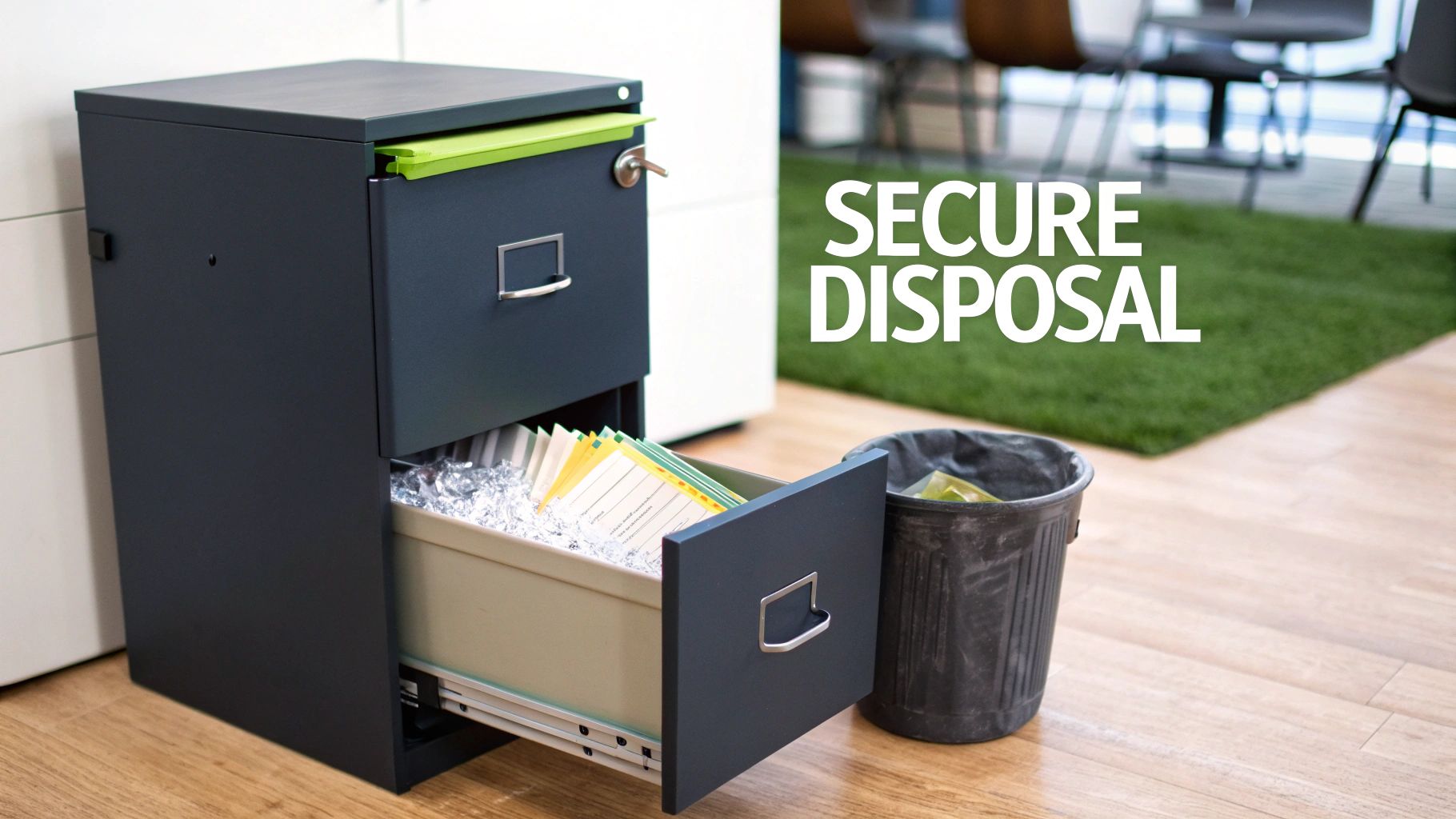
Failing to manage your confidential waste properly is the real-world equivalent of leaving your company's front door wide open. Imagine leaving an unlocked filing cabinet on the pavement overnight. That's exactly what an ordinary bin full of unshredded records is—a golden opportunity for data thieves.
This isn't just a headache for big corporations. Every single one of us, from individuals to small businesses, handles paperwork packed with sensitive information. Secure disposal is the final, critical step in keeping that data safe.
Identifying At-Risk Documents
It's surprising how many everyday documents need to be securely destroyed. Without a clear plan, they can easily end up in the general waste, creating a huge risk. We're talking about things like:
- Financial Records: Bank statements, invoices, payroll slips, and old tax documents.
- Employee and HR Files: Contracts, CVs, performance reviews, and anything with personal contact details.
- Client Information: Customer lists, contracts, project briefs, and account details.
- Personal Documents: Utility bills, medical records, and any piece of paper with names, addresses, or account numbers on it.
Basically, any document that contains Personally Identifiable Information (PII) must be treated as confidential. Destroying it securely isn't just good practice; it's a legal requirement to protect against fraud.
The Real-World Consequences of Negligence
The fallout from improper disposal is real, severe, and goes way beyond a simple privacy slip-up. Here in the UK, these risks are anything but theoretical. While everyone's focused on cyber threats, physical paperwork is still a massive weak point. In fact, some analyses suggest that around 40% of data security incidents still involve paper records. You can learn more from The Waste Group’s UK-focused guidance on confidential document disposal.
This kind of oversight can land you in hot water with the UK GDPR.
The Information Commissioner’s Office (ICO) has handed out penalties totalling over £39 million to UK organisations for mishandling personal data, and that absolutely includes failures in secure disposal.
For homeowners and small businesses across Dorset, a single bank statement or client file tossed in the wheelie bin can be all it takes to trigger identity theft or cause serious, lasting damage to your reputation. The main risks are clear:
- Identity Theft: Criminals are experts at piecing together scraps of information from discarded documents to open fraudulent accounts in your name.
- Corporate Espionage: Competitors can get their hands on your trade secrets, client lists, or sensitive financial data.
- Legal Penalties: Breaching UK GDPR can result in fines of up to £17.5 million or 4% of annual global turnover, whichever is higher.
- Reputational Damage: A data breach shatters trust with your customers, and rebuilding that trust is a long, expensive process.
When it comes down to it, secure disposal isn't just an admin task—it's a fundamental pillar of modern data protection that safeguards your finances, your reputation, and your legal standing.
Navigating Your Legal Obligations in the UK
Getting your head around the legal duties for document disposal can feel a bit like wading through treacle. But honestly, the core ideas are pretty straightforward and are there to protect everyone—your business, your customers, and your staff.
In the UK, it all boils down to two key bits of legislation: the UK GDPR (General Data Protection Regulation) and the Data Protection Act 2018. These aren't just for massive corporations; they apply to everyone, from a solo tradesperson to a national company handling personal data. They provide a clear framework for how you should collect, store, and, most importantly, destroy sensitive information. Getting this right isn’t just about dodging fines; it’s about building trust and being a responsible business.
The Core Principles You Must Follow
At the heart of UK data protection law are several principles that directly shape how you should handle your paperwork. For document disposal, two stand out: 'storage limitation' and 'integrity and confidentiality'.
-
Storage Limitation: You simply can't keep personal data forever "just in case." This principle means you must only hold onto information for as long as is strictly necessary for the reason you collected it in the first place. Once that time is up, you’re legally required to get rid of it securely.
-
Integrity and Confidentiality: This is all about keeping data safe. You have to handle it in a way that protects it from anyone who shouldn't see it, as well as from accidental loss or destruction. Just chucking a customer file into a general waste bin would be a clear breach of this duty.
The Information Commissioner's Office (ICO) is the UK's data watchdog, and they make it clear that these principles are the foundation of good data protection.
To help you get to grips with these rules, we've broken down the key principles that affect your document disposal process.
Key UK Data Protection Principles at a Glance
This table offers a quick rundown of the main UK GDPR principles and what they practically mean when it's time to clear out those old files.
| UK GDPR Principle | What It Means for Document Disposal |
|---|---|
| Lawfulness, fairness and transparency | Be open about why you're collecting data and have a lawful reason for it. Your disposal process should align with this. |
| Purpose limitation | Only use the data for the specific reason you told people you would. Don't keep it for other, unrelated future uses. |
| Data minimisation | Only collect what you absolutely need. The less data you have, the less you have to worry about disposing of later. |
| Accuracy | Keep data up-to-date. If it's no longer accurate and you can't correct it, it should be securely destroyed. |
| Storage limitation | Don't be a data hoarder. Set clear time limits for how long you keep records and stick to them. |
| Integrity and confidentiality (security) | This is a big one. You must use secure methods (like shredding) to destroy documents to prevent unauthorised access. |
| Accountability | You must be able to prove you're complying. This means keeping records of your disposal activities (e.g., certificates of destruction). |
Following these principles isn't just a box-ticking exercise; it's about building a robust system that protects sensitive information from the moment you get it to the moment it's destroyed.
Creating a Document Retention Policy
So, how do you put all this into practice? The answer is a document retention policy.
Think of it as your company's rulebook for information. It should clearly define how long you keep different types of documents and, crucially, outline the secure method for destroying them once they're no longer needed.
For instance, HM Revenue and Customs (HMRC) requires you to keep most business records for at least five or six years. A good retention policy would state that financial documents are securely shredded seven years after the end of the relevant tax year. This creates a clear, consistent, and defensible process. Understanding the wider benefits of meeting security compliance helps show why these procedures are so vital.
A documented retention and disposal policy is your first line of defence. It shows regulators like the ICO that you’re proactive and organised in your approach, moving your business beyond guesswork and into a proper system of data management.
When you use a professional service, you create a paper trail that proves you've done everything by the book. The documentation you receive, like a Waste Transfer Note, is a key part of this. To get a better handle on this, our guide explains what a Waste Transfer Note is and why it’s so important for your records. This structured approach turns a legal headache into a simple, manageable part of your business operations.
Choosing the Right Document Destruction Method
Once you’ve got a handle on the legal side of things, the next logical step is figuring out how to actually destroy your documents. This isn’t a one-size-fits-all decision. The best method really boils down to how much paper you have, your security needs, and your budget.
Let's walk through the most common options, starting with the least secure and working our way up to the professional gold standards.
The Pitfalls of DIY Office Shredders
For many small offices or home setups, a standard office shredder feels like the obvious, easy solution. And while it’s definitely better than just chucking whole documents in the bin, these machines have some serious drawbacks for business use or for anyone handling genuinely sensitive information.
Most consumer-grade shredders use a simple strip-cut, slicing paper into long ribbons. With a bit of patience, a determined person could piece those back together. Even basic cross-cut shredders might not chop the paper up small enough to satisfy UK GDPR requirements for secure destruction, leaving you wide open to risk.
On top of that, these little machines aren't built for heavy lifting. They overheat, jam constantly, and chew up a surprising amount of staff time. For anything more than the odd, low-risk document, they quickly become a massive headache.
Professional On-Site Shredding
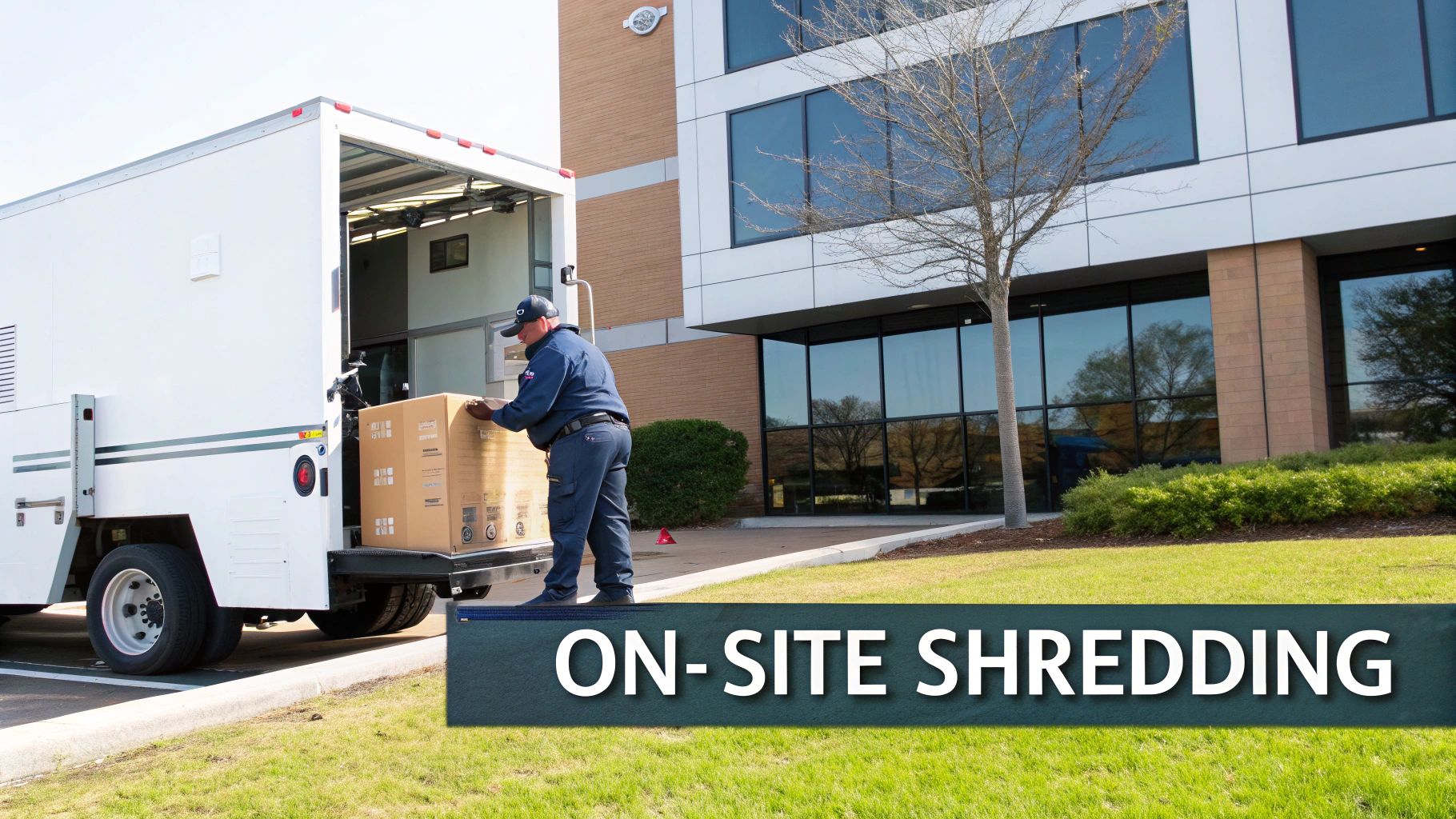
This is where things get serious. On-site shredding, often called mobile shredding, is a huge step up in both security and convenience. A specialised shredding truck pulls up right at your premises, whether you're in Bournemouth, Poole, or anywhere in between.
You can physically watch your documents being tipped into the industrial-grade shredder right there on the vehicle. It's a completely unbroken chain of custody that gives you total peace of mind. This method is perfect for businesses that need to witness the destruction for their own compliance records or internal policies.
- Key Benefit: You see it all happen with your own eyes, in real time.
- Best For: Organisations with high-security needs or those who want absolute certainty.
Professional Off-Site Shredding
Off-site shredding delivers the same level of industrial-strength destruction, just with a slightly different workflow. A security-vetted professional collects your documents in locked, tamper-proof containers and transports them in a secure vehicle to a dedicated destruction facility.
At the plant, everything is monitored by CCTV as the documents are shredded, baled, and sent off for recycling. While you don't witness the shredding firsthand, the process is governed by incredibly strict protocols. This is often the more cost-effective choice for businesses that have large or regular amounts of paper to get rid of.
Opting for a professional service, whether on-site or off-site, is a game-changer for compliance. It transforms document disposal from a risky chore into a managed, auditable business process, complete with a Certificate of Destruction to prove you’ve done everything by the book.
Considering Incineration
Incineration is another method that guarantees complete destruction. It involves burning paper at incredibly high temperatures, making it utterly impossible for any information to be recovered.
While it's highly effective, it's less common for standard paper documents these days compared to shredding, partly due to environmental factors. However, it's still a solid option for certain types of highly sensitive materials where total obliteration is the number one priority and recycling takes a back seat.
At the end of the day, professional shredding has become the industry standard. The UK Document Management Services sector, which includes document destruction, was on track to generate £1.4 billion in 2025. Demand for these services has shot up since UK GDPR came into force, as businesses now build secure disposal into their everyday waste management, from skip hire to regular wheelie bin collections. You can read more about these trends in the latest UK government cyber security survey.
Your Step-by-Step Compliant Disposal Process
Knowing the right methods is one thing, but actually putting them into practice is where security really happens. A solid confidential document disposal plan isn't a one-off task; it's a continuous cycle that protects your information from the day it's created to the moment it's safely destroyed.
This five-step process is a clear roadmap. Think of it as a defensible and compliant system that any organisation can use to manage sensitive paperwork securely—and prove they’ve done it right.
Step 1: Identify and Segregate Documents
The journey starts with knowing what you actually need to protect. Let's be honest, not every piece of paper in your office is a state secret, so the first step is to separate the sensitive from the mundane. This process, called segregation, is the bedrock of an efficient system.
Get your team into the habit of spotting documents with Personally Identifiable Information (PII), commercial secrets, or financial data. Setting up designated, clearly labelled bins for confidential waste is a simple but powerful way to stop it from getting mixed in with the general rubbish. This small change builds a culture of security from the ground up.
Step 2: Use Secure Collection Containers
Once you've identified a confidential document, it should never just be tossed into an open box or a standard recycling bin. It needs to go straight into a secure, tamper-evident container. Any professional shredding service worth its salt will provide these as part of their service.
These usually come in two main forms:
- Locked Consoles: These are designed to blend into an office environment, looking a bit like a sleek piece of furniture. They have a narrow slot for posting documents, keeping the contents secure.
- Secure Wheelie Bins: Perfect for larger volumes, like during a big office clear-out. These locked bins offer much more capacity while keeping everything just as secure.
Using proper containers means that from the second a document is discarded, it’s shielded from prying eyes right up until collection.
Step 3: Establish a Secure Chain of Custody
The chain of custody is probably the single most important concept in secure document disposal. It's the unbroken, documented trail that follows your sensitive information from the moment it leaves your hands to the second it's destroyed.
This involves security-vetted staff, GPS-tracked vehicles, and sealed, tamper-proof containers. Every handover is logged, creating a fully auditable trail that proves the integrity of the process. This isn't just about ticking boxes; it's your legal proof that you've met your duty of care under UK GDPR.
A strong chain of custody is your best defence in an audit or a data breach investigation. It shows you took every reasonable step to protect sensitive data, even after it left your building.
This meticulous tracking ensures there are no weak links in the chain where documents could be lost, stolen, or compromised.
Step 4: Oversee the Destruction Process
Now for the main event—the actual destruction. If you've opted for on-site shredding, you can watch it happen yourself as the mobile shredding truck turns your documents into confetti right outside your door. With off-site services, the destruction takes place at a secure, CCTV-monitored facility.
Both methods use powerful industrial shredders that obliterate paper far more effectively than any standard office machine could, making the information completely irrecoverable. While we're focused on paper here, the same principles apply to digital data. Understanding how to handle digital records is just as crucial; a practical guide to removing personal information from the internet offers some great insights into digital destruction techniques.
Step 5: Receive Your Certificate of Destruction
This is the final step that closes the loop. Once your documents have been completely destroyed, your shredding provider will issue a Certificate of Destruction. This is a formal legal document that acts as your official record of compliant disposal.
It will always include key details like:
- The date and time of the destruction.
- The location where the destruction occurred.
- A unique reference number for the job.
- A confirmation statement that the materials were destroyed according to the relevant standards.
Filing this certificate away safely is non-negotiable. It completes your chain of custody and gives you the definitive proof you need to show regulators like the ICO that you’ve done everything by the book.
How To Select A Professional Destruction Service
Choosing a partner for your confidential document disposal is a decision built on trust. You're not just getting rid of old paperwork; you're handing over sensitive data that could cause chaos in the wrong hands. It’s vital to look past the flashy website and ask the tough questions that separate the true professionals from the rest.
Think of it like hiring a security guard for your data. You wouldn’t just hire the first person you see without checking their credentials and background, and the exact same principle applies here. A credible provider won’t just promise security—they’ll prove it with transparent processes and recognised accreditations.
Look For Key Industry Accreditations
The very first thing you should check for is their list of certifications. These aren't just fancy badges for their website; they are independent proof that a company meets tough standards for security, quality, and environmental management.
In the UK, one of the most important standards to look for is BS EN 15713. This is the European gold standard for securely destroying confidential material. It sets out strict rules for every single step, including:
- Security Vetting: All staff handling your documents must pass thorough background checks, like DBS (Disclosure and Barring Service) checks.
- Secure Vehicles: Collection vans and lorries must be tracked, properly secured, and built to stop anyone from getting unauthorised access.
- Facility Security: The site where the destruction happens needs solid security like CCTV, controlled access points, and alarms.
Without this certification, you have no real guarantee that a provider is following best practices. It’s a non-negotiable.
The whole secure disposal journey can be broken down into four key stages, from collection right through to getting your certificate.
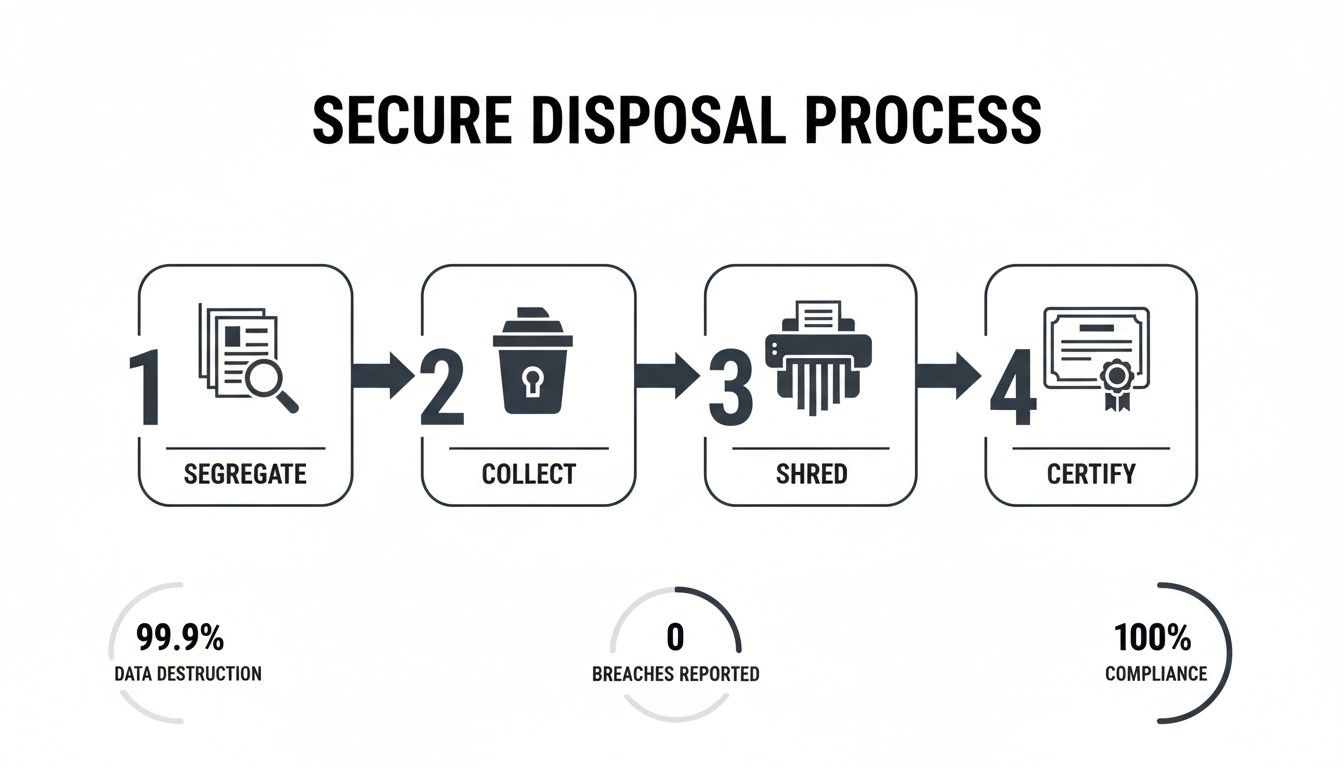
This visual guide shows the essential path your documents take, highlighting the steps that are absolutely critical for a compliant and secure process.
Verify The Chain Of Custody Process
A clear, unbroken chain of custody is the backbone of secure disposal. Before you even think about signing a contract, ask a potential provider to walk you through their exact process, step-by-step. How do they keep your documents secure from the second they leave your office until they’re turned into confetti?
This process should include providing you with locked, tamper-evident collection bins and documenting every single handover. A professional service will show you a clear, auditable trail that leaves zero room for error or security gaps.
A provider’s willingness to explain their chain of custody in detail is a strong indicator of their professionalism and commitment to security. If their answers are vague, it's a major red flag.
Non-Negotiable Proof Of Destruction
Your legal responsibility for the data doesn't end when the collection truck drives off. It only ends when you have solid proof that the documents have been completely and irreversibly destroyed. This proof is called a Certificate of Destruction.
This isn't an optional extra; it's a critical legal document. It confirms that your provider has done their job and acts as your evidence of compliance with UK GDPR. Never, ever partner with a service that doesn't provide one as standard for every single collection. It’s a crucial part of your own compliance records, just as important as the services offered within broader commercial waste collection services.
Ask About Their Environmental Policy
Finally, responsible disposal should also be environmentally responsible. A top-tier provider won’t just shred your paper; they’ll also make sure it gets put back into the production cycle. Ask them straight: is 100% of the shredded paper recycled? Choosing a partner who shares this commitment helps you meet your own sustainability targets, turning a simple compliance task into a positive environmental action.
Integrating Secure Disposal Into Your Waste Management
When you bring all the pieces together, the path to secure document disposal becomes crystal clear. Let’s be honest, the risks of getting it wrong—from eye-watering ICO fines to the kind of reputational damage you can’t come back from—are far greater than the effort it takes to build a solid, compliant system. Choosing the right disposal method and keeping a clear chain of custody aren't just 'best practices'; they're fundamental to how a responsible business operates today.
The final, crucial step is to weave this process into the very fabric of your daily operations. Secure document disposal shouldn't be an afterthought or a complicated chore that gets put off. It needs to fit seamlessly into your overall waste management strategy, turning what could be a major vulnerability into just another smooth, efficient part of the workday.
A Unified Approach to Waste
Most businesses are juggling multiple types of waste. You've got your general waste, your recycling, and maybe even bulky items that need a skip. Trying to manage separate providers for your wheelie bins, another for skips, and a third just for confidential paper can quickly become a headache of invoices, contacts, and crossed wires. It's inefficient, costly, and leaves room for error.
A single, trusted partner who can handle all your waste streams simplifies everything. It means one point of contact, one set of invoices, and a coordinated strategy that ensures no sensitive materials ever slip through the cracks.
This integrated approach isn't just about making your life easier. It’s about creating a much stronger compliance framework from the ground up. When the same experts who manage your other site waste are also handling your confidential shredding, the entire process becomes more secure and accountable.
Creating an Effortless System
The ultimate goal is to make secure disposal second nature for your team. A comprehensive service provider helps you get there by supplying the right tools for the job, like locked office consoles for day-to-day documents and secure wheelie bins for those bigger clear-outs. When collection happens on a regular, predictable schedule, security simply becomes routine.
This system design removes the guesswork and human error that so often leads to data breaches. No more stray piles of sensitive documents waiting for someone to find a spare half-hour to shred them. Instead, you have a consistent, professional system humming away in the background, letting you and your team get on with what you do best. This is a core part of effective commercial waste management services, where every bit of waste is treated with the proper level of care.
By partnering with a specialist who provides a complete solution, you're not just ticking a box for the disposal of confidential documents. You’re investing in a smarter, safer, and more efficient way to manage all your waste, protecting your business and building that all-important trust with your clients.
Frequently Asked Questions About Document Disposal
Even with the best plan in place, questions always seem to crop up when you’re getting ready to dispose of confidential documents. We get it. To help you tackle your sensitive paperwork with complete confidence, here are some straightforward answers to the questions we hear most often.
How Long Should I Keep Documents Before Disposal?
This is probably the most critical question, and there’s no single answer. UK law sets out different retention periods for different types of documents. For instance, HMRC generally expects businesses to hold onto financial records for at least five to six years. Employee records often need to be kept for the duration of employment plus another six years.
Your best bet is to create a formal document retention policy. This isn't just paperwork for the sake of it; it's a practical guide that should clearly state:
- The kinds of documents your organisation creates and receives.
- Why you need to keep them (legal or operational reasons).
- Exactly how long each document type must be stored.
- The secure destruction method you'll use once that time is up.
Having this policy written down is your proof that you’ve got a structured, compliant system.
Can I Just Burn My Confidential Documents?
While throwing documents on a fire certainly destroys them, it’s not a method we’d ever recommend for a business. Proper, professional incineration services are one thing, but a DIY bonfire or using an incinerator bin is a whole different ball game. It’s incredibly difficult to guarantee that every last scrap of paper has been completely destroyed, not to mention the obvious environmental and safety risks.
There’s a reason professional shredding is the industry standard. It’s far more secure, controlled, and better for the environment. Certified services ensure that 100% of the shredded paper is recycled.
What Is A Certificate Of Destruction?
Think of a Certificate of Destruction as your official receipt for responsible data disposal. It's a formal, legal document that a professional shredding company gives you once your documents have been completely destroyed. This certificate is your concrete proof that you've complied with UK data protection laws like the UK GDPR.
This piece of paper is a vital part of your audit trail. It logs the date, time, and method of destruction, officially closing the chain of custody and ending your legal responsibility for that information. Always make sure you get one and file it away – it's non-negotiable proof that you’ve handled the disposal of confidential documents correctly.
Is A Home Office Shredder Good Enough?
For a handful of personal, non-critical bits of paper, a small shredder from your local office supply shop is better than nothing. But for any business, or for documents that hold sensitive personal data, they just don't cut it. Most of these basic shredders use a simple strip-cut method, leaving behind long strips that can be pieced back together with surprising ease.
Even the slightly better cross-cut models often fail to meet the security standards required by regulations. Professional services use industrial-grade machines that pulverise paper into tiny, confetti-like fragments that are impossible to reconstruct. For genuine compliance and total peace of mind, professional shredding is really the only way to go.
Ready to put a secure, hassle-free document disposal system in place? The Waste Group provides professional, compliant confidential waste services across Dorset, which can be seamlessly integrated with our full range of waste management solutions. Make sure your sensitive data is handled the right way, from start to finish. Learn more and get a quote today.