A Practical Guide to Disposal of Old Paint Cans in the UK
A Practical Guide to Disposal of Old Paint Cans in the UK
Before you can even think about getting rid of those old paint cans cluttering up your garage or shed, there's one crucial question you need to answer: is the paint water-based or oil-based?
Getting this right from the start is everything. Why? Because the disposal methods are completely different. Water-based paint (emulsion) can often be dried out and disposed of with your household rubbish, but oil-based paint is a different beast altogether. It's officially classed as hazardous waste and needs to be handled by your local council's specialist services.
Mixing them up won’t just cause a headache; it can harm the environment and potentially land you in hot water with local regulations.
First Things First: Is Your Paint Water-Based or Oil-Based?
Playing detective with old paint tins might not sound exciting, but it’s the most important part of the job. Luckily, you don’t need to be Sherlock Holmes – the clues are usually right there in front of you.
Check the Label for Clues
Your first port of call should always be the can itself. Manufacturers are required to put all the key information on the label, you just need to know what you’re looking for.
- Water-Based Paints: Keep an eye out for words like "emulsion," "latex," or "acrylic." The biggest giveaway, though, is often in the cleanup instructions. If it says to use simple soap and water, you’ve got a water-based paint.
- Oil-Based Paints: These will often be labelled with terms like "alkyd," "solvent-based," "enamel," or "gel paint." The cleanup instructions will tell you to use mineral spirits or white spirit – a sure sign it’s oil-based.
This simple diagram breaks down the process visually.
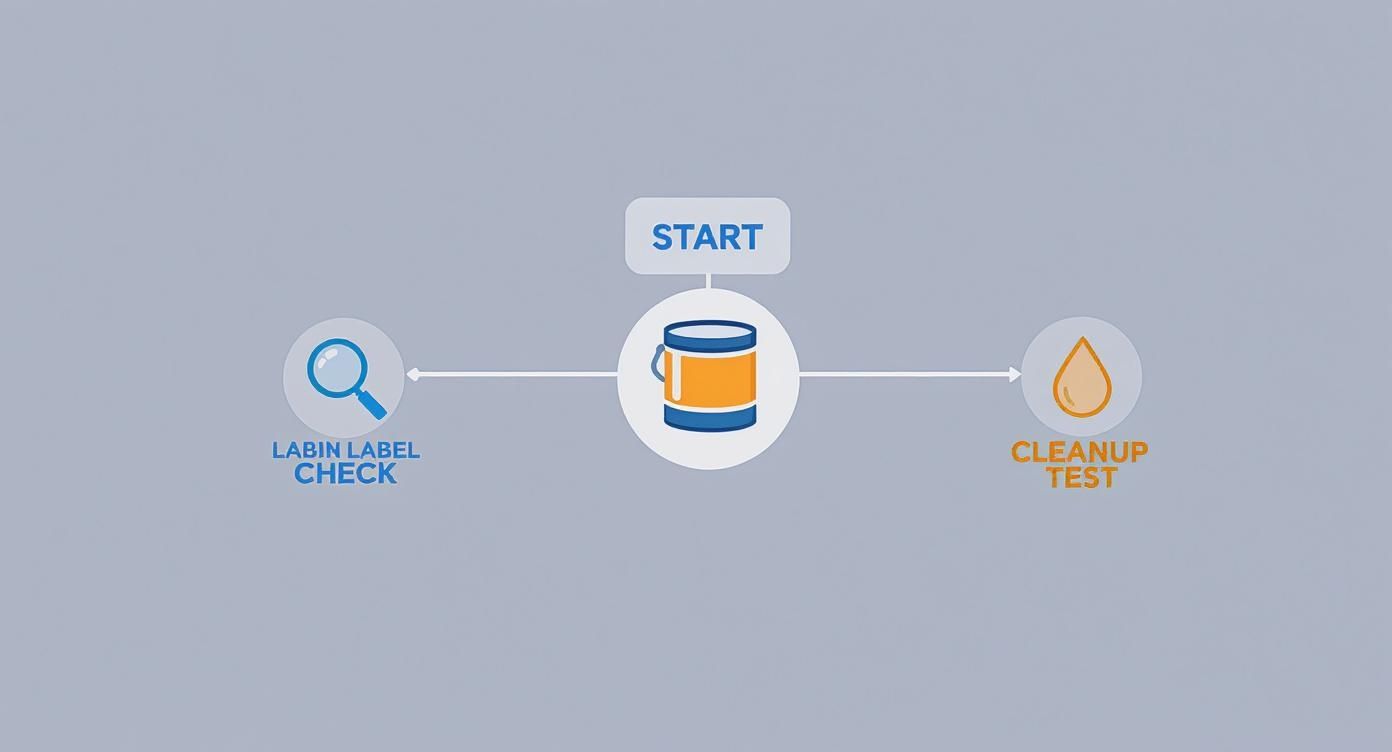
As you can see, a quick look at the label or a simple test is all it takes to figure out what you're dealing with.
What to Do If the Label Is Unreadable
We’ve all been there. Years of storage in a damp shed or garage can leave a paint can rusty and the label completely illegible. Don't worry, there's a simple test you can do.
Just dab a small amount of the paint onto a spare bit of cardboard. Then, take a rag soaked in water and try to wipe it off. If the paint starts to dissolve and cleans up easily, it's water-based. If it just smudges around and refuses to budge without something stronger like white spirit, then you're dealing with an oil-based paint.
To make things even clearer, here's a quick comparison to help you tell them apart at a glance.
Quick Paint Identification Guide
| Characteristic | Water-Based Paint (Emulsion) | Oil-Based Paint (Solvent-Based) |
|---|---|---|
| Common Names | Emulsion, Latex, Acrylic | Alkyd, Enamel, Urethane, Varnish |
| Cleanup | Soap and water | White spirit, mineral spirits, turpentine |
| Smell | Low odour, sometimes a faint chemical smell | Strong, distinct solvent or chemical smell |
| Drying Time | Dries relatively quickly to the touch | Takes much longer to dry, remains tacky |
| Consistency | Thinner, runs more smoothly | Thicker, stickier, and more viscous |
This table should cover most situations, but if you're ever in doubt, it's always safest to treat the paint as hazardous and take it to a proper disposal facility.
Key Takeaway: Identifying your paint type is the most critical first step. Water-based (emulsion) disposal is simple, while oil-based paint is classified as hazardous waste in the UK and must be taken to a designated facility.
Preparing Water-Based Paint for Easy Disposal
So, you've checked the tin and confirmed it's water-based paint. Good news – you can breathe a sigh of relief. Getting rid of old cans of emulsion is a whole lot simpler than dealing with their oil-based cousins. Your main goal here is straightforward: solidify any remaining liquid paint before it goes in the bin.
Liquid paint is a massive headache for waste collection services. It has a nasty habit of leaking from refuse lorries, which can contaminate other recyclable materials and create a real mess on our streets. That’s why almost every local council in the UK has a ban on liquid paint in household rubbish.
By drying it out, you turn it into a harmless solid block that can be binned without any fuss. How you go about this really just depends on how much paint is left in the tin.
Dealing with Nearly Empty Cans
Got a can with just a small amount of paint sloshing around at the bottom – less than an inch or so? This is the easiest scenario by far. All you really need is a bit of patience.
Just pop the lid off and leave the can somewhere safe where it won't be knocked over by kids or pets, and where it won't get rained on. A well-ventilated garage, a shed with the door propped open, or even a secure spot in the garden on a dry day will do the trick. The air does all the hard work, and within a few days, the paint will be rock solid.
Even with low-odour water-based paints, good ventilation is key. It helps the paint dry much faster and disperses any faint fumes, making the whole process quicker and more pleasant.
Solidifying Larger Amounts of Leftover Paint
What happens if you've got a can that's a quarter or even half-full? Leaving that much paint to air-dry would take forever and might not even work properly. When you're dealing with a larger volume, you need to give it a helping hand. The solution is to add something to absorb the moisture and speed up the solidifying process.
You don't need to buy anything special for this; a few common household items work perfectly. The trick is to add your chosen material and give it a really good stir until the paint is no longer a liquid. You're aiming for a thick, clumpy texture that won’t spill out if the can gets tipped over.
Here are a few things that work a treat:
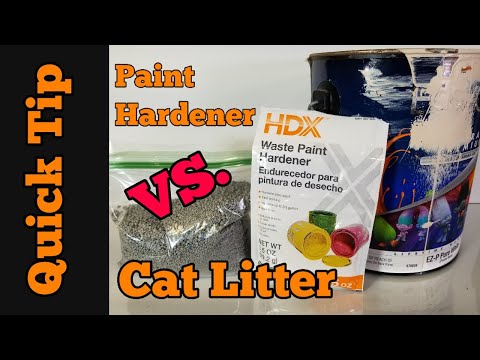
- Cat Litter: A brilliant and cheap option. Its absorbent clay is literally designed to clump up and soak liquid.
- Sawdust: If you do any DIY or woodworking, you’ve probably got bags of this stuff. It mixes in easily and does a great job of absorbing moisture.
- Soil or Sand: A scoop from the garden works just as well, turning the liquid paint into a thick, unspillable sludge.
- Shredded Paper or Cardboard: Got some old newspapers or junk mail? Tear it into small strips and mix it right in.
Once you’ve mixed it and the paint looks solid, it's a good idea to leave the lid off for another day or so, just to be certain it's completely firm. After that, the can and its solid contents are ready to go straight into your regular household waste bin.
Navigating the Rules for Oil-Based Paint Disposal
Unlike its water-based cousin, oil-based paint is a completely different kettle of fish when it's time for disposal. Because of the solvents and volatile organic compounds (VOCs) it contains, it is legally classified as hazardous waste in the UK. This means you absolutely cannot just let it dry out and pop it in your household bin.
Getting rid of oil-based paint the wrong way poses a serious environmental risk. If it finds its way into a landfill, those nasty chemicals can seep into the soil and contaminate groundwater, causing lasting damage to local ecosystems.
And the scale of the problem is bigger than you might think. The UK has a mountain of leftover decorative paint to deal with each year—an estimated 34 million litres of it. What’s truly alarming is that around 98% of this is thought to be disposed of incorrectly, whether through landfill, incineration, or just being poured down the drain.
Finding Your Local Hazardous Waste Service
Given its hazardous status, the only correct and legal route for households to get rid of old oil-based paint is through a dedicated council service. Every local authority has a system for this, which usually comes in one of two forms:
- Household Waste Recycling Centres (HWRCs): You probably know it as the "tip" or the "dump." Many larger recycling centres have a specific, designated area for hazardous household waste, including old paint.
- Special Collections: Some councils will offer to collect hazardous items directly from your home. This might come with a small fee or have limits on how much they'll take at one time.
The simplest way to find out what’s on offer is to visit your local council’s website. A quick search for "[Your Council Name] hazardous waste disposal" should take you straight to the right page with all the details on opening times, booking slots, and any costs.
Top Tip: Before you load up the car, always double-check your council's website. Some HWRCs require you to book a slot in advance, especially for hazardous materials, to make sure a specialist is on-site to handle them safely.
Preparing and Transporting Cans Safely
Once you know where you’re headed, getting the paint cans ready for the journey is vital for avoiding messy or dangerous spills. Safety first, always.
Start by making sure the lids are on as tightly as possible. If a lid is a bit loose or damaged, try placing a layer of cling film over the top before hammering the lid back on to create a much better seal. When it comes to transport, it’s always a good idea to place the cans upright in a sturdy cardboard box or a plastic crate. This should stop them from toppling over while you're driving.
It's also worth remembering that the rules for hazardous materials don't just stop at the paint itself. For example, products like the best paint remover for wood often contain chemicals that need just as much care when being disposed of. If you’re having a big clear-out of the garage, treat these items with the same respect. You can find out more about the strict regulations around this in our detailed guide on hazardous waste disposal.
Give Your Leftover Paint a Second Life
Before you even think about drying out old paint or looking up your local hazardous waste site, it's worth asking one simple question: could someone else use this?
Giving paint a second life isn't just the most eco-friendly option; it's a brilliant way to help out in your local community. So many half-used tins of paint sit gathering dust in sheds and garages, not because the paint has gone off, but just because the job is done. Rehoming it is a fantastic way to cut down on waste.
The Community RePaint Network
One of the best routes for this is the Community RePaint network. It's a fantastic nationwide scheme that collects leftover, usable paint and gets it into the hands of individuals, families, charities, and community groups who need it. Your unwanted paint could help them brighten up their spaces at a fraction of the cost.
Donating is getting easier all the time, with drop-off points popping up at many household recycling centres and participating DIY stores across the UK.
So, what can you donate? The network is usually happy to take most types of paint, as long as it's still in a usable condition.
- Water-based emulsion: This is the most common and always in demand for interior walls and ceilings.
- Gloss and satin paints: Perfect for woodwork and always needed.
- Undercoats and primers: The essential first step for so many decorating projects.
- Exterior and masonry paints: These are great for community gardens or sprucing up outdoor buildings.
The main rules are that the paint must be in its original tin, be at least a third full, and still be liquid. They can't take things like paint thinners, industrial paints, or any tins that are rusty, unlabelled, or have hardened.
Since 2023, schemes like Community RePaint have really ramped up their efforts, expanding collection points and making it much simpler for homeowners to get involved. This kind of grassroots approach is key to tackling the mountain of paint waste we generate.
Think about it: that half-tin of magnolia gathering cobwebs in your garage could help a local charity give its community hall a much-needed facelift, or help a family on a low income decorate their first home.
Other Creative Donation Avenues
If there isn't a Community RePaint scheme on your doorstep, don't despair. There are plenty of other places that would be grateful for your leftover paint.
It's always worth checking with these options:
- Local Theatre Groups: Amateur dramatics societies are almost always working on a shoestring budget and constantly need paint for building sets and props.
- Schools and Nurseries: They often require small amounts of different colours for art projects, craft clubs, and brightening up classrooms.
- Community Forums and Social Media: A quick post on a local Facebook group, Nextdoor, or a site like Freecycle can quickly connect you with a neighbour who needs that exact colour for a touch-up job.
Taking a few minutes to explore these avenues can stop perfectly good paint from going to waste. For more brilliant ideas on cutting down on what you throw away, check out our other useful tips for recycling.
Dealing With Empty Paint Cans and Aerosols
Once you’ve finished your decorating and sorted out any leftover paint, you’re left with the containers. Getting rid of these properly is the final piece of the puzzle. What you do next all comes down to whether the can is metal, plastic, or an aerosol spray.
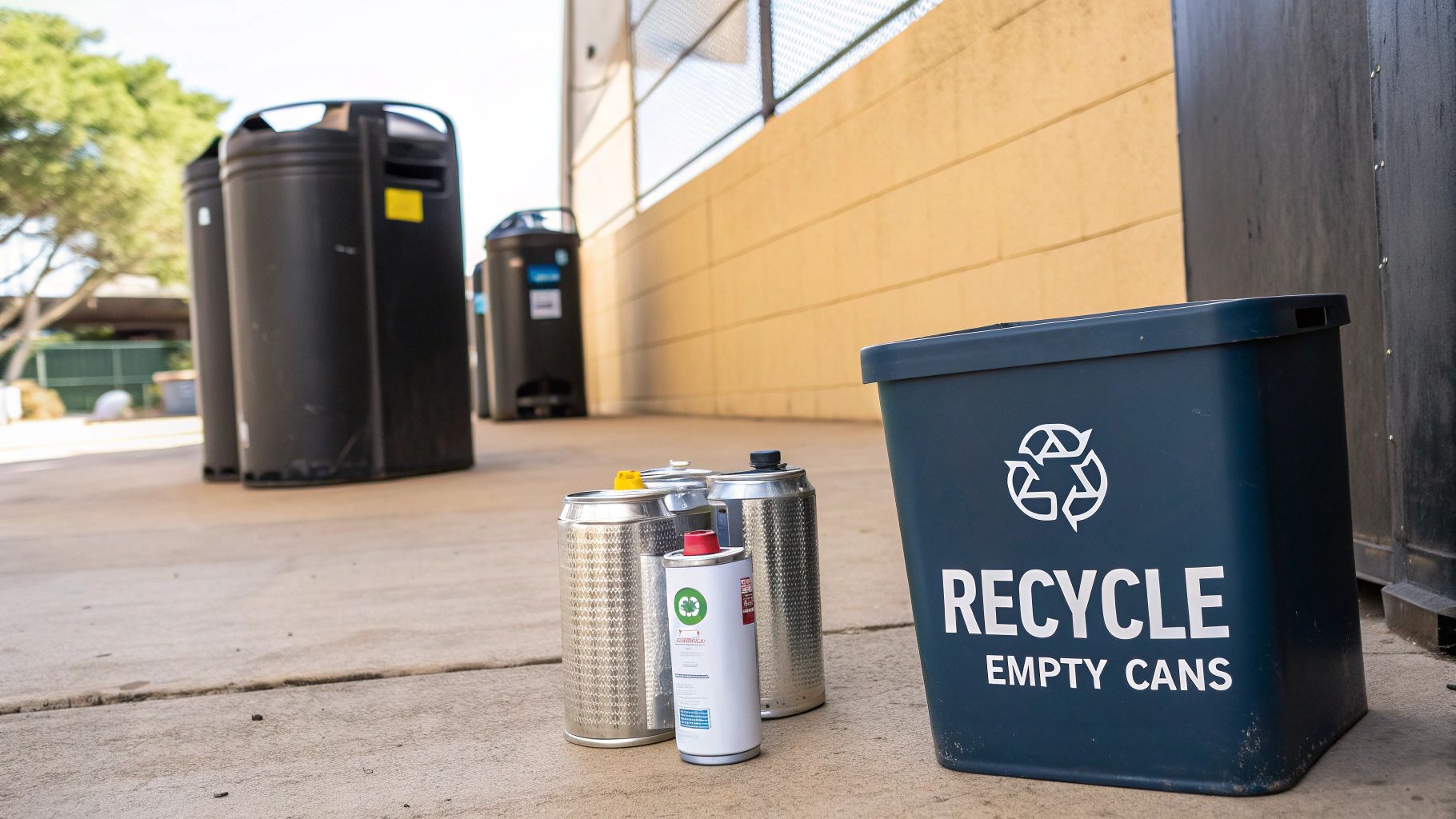
The good news is that for empty metal paint cans, most local councils across the UK are happy to take them in your household recycling bin. The golden rule is to make sure they are completely empty and dry. We’re not talking spotless, just a thin, solid film on the inside is fine.
Prepping Metal and Plastic Cans for Recycling
Before you pop a metal can into the recycling, give it a quick once-over. A simple test is to tip it upside down – if any paint drips out, it’s not ready. Any residue has to be fully hardened before it can go.
For plastic paint pots, the process is a little different. First, you'll need to hunt for a recycling symbol, which is usually a triangle with a number inside it. Councils have different rules on which plastics they'll accept, so it's always best to check what your local authority allows. A quick look on their website usually clears this up.
Here's a pro tip: leaving the lid off a nearly empty metal or plastic can in a well-ventilated spot for a day or two is often all it takes to dry out the last few drops. This simple step makes it far more likely to be recycled successfully.
The Special Case of Aerosol Cans
Aerosol paint cans need a bit more care because they’re pressurised. They’re a classic "what do I do with this?" item, and unfortunately, they often end up where they shouldn't. This is precisely why it’s so important to understand what you can't put in a skip.
An aerosol can has to be completely empty – that means no paint and no propellant left inside. You’ll know it’s empty when you press the nozzle and absolutely nothing comes out, not even a faint hiss of air.
A couple of crucial safety points:
- Never pierce or crush an aerosol can. Even one that seems empty can hold some residual pressure, creating a real safety hazard if it gets punctured.
- Remove any loose plastic parts. Pop off the lid and nozzle before you put the can in your recycling bin.
The UK's waste industry is always evolving to manage items like these more effectively. In fact, the non-hazardous waste treatment sector, which handles containers that don't hold highly toxic stuff, is projected to be worth a massive £4.8 billion by 2025. This growth is largely driven by public demand for better recycling solutions for tricky items like old paint cans. By following these simple steps, you're doing your part to ensure your empty containers are handled safely and sustainably.
Common Questions on Paint Disposal Answered
Even with the best instructions in hand, there are always a few niggling questions that pop up when you're staring at a pile of old paint tins. Let's clear up some of the most common queries so you can get the job done confidently and correctly.
Can I Pour Water-Based Paint Down the Sink?
This is a big one we hear all the time, and the answer is a firm no. It might feel like a harmless shortcut since it's "water-based," but sending emulsion down the drain is a really bad idea. That paint can easily solidify inside your pipes, creating stubborn blockages that are a total nightmare to sort out.
It's not just your own plumbing at risk, either. Pouring paint down the sink puts a huge strain on local wastewater treatment plants. These systems just aren't built to filter out the complex polymers and pigments found in modern paint, which can lead to problems for the wider environment. Always make sure water-based paint is completely solid before you bin it.
How Much Does Hazardous Paint Disposal Cost?
For most households, the cost of getting rid of old oil-based paint is usually nothing at all. The vast majority of local councils provide this service for free at their Household Waste Recycling Centres (HWRCs). They see it as part of their duty to manage hazardous household waste safely.
In some areas, the council might offer a special collection service right from your doorstep, which could involve a small fee to cover their transport costs. Your best bet is always to have a quick look at your local council's website for the specifics, but you can generally expect it to be a free or very low-cost process.
The legal and environmental responsibility for managing hazardous waste is significant. By taking your old oil-based paint to a designated facility, you're playing a vital part in a nationwide system designed to protect our soil and water from contamination.
Is Very Old Paint Still Usable?
You might be surprised! If a can of paint has been stored properly—with the lid hammered on tight and kept somewhere without extreme temperature swings—it can stay perfectly good for years.
Here's what to look for:
- Water-based paint: Give it a good stir. If it mixes back into a smooth, even consistency and doesn't smell sour or mouldy, it’s probably fine. If you find stubborn lumps that just won't mix in, it's past its best.
- Oil-based paint: This type often gets a thick skin on top. If you can peel that skin off and stir the rest of the paint until it's smooth, you should be good to go.
The best way to know for sure is to do a quick test patch on some scrap cardboard or wood. If it goes on smoothly and dries as it should, you've just saved yourself a disposal job.
Clearing out the garage or shed often involves more than just paint. For a complete and responsible clear-out, you might also need guidance on how to dispose of unwanted furniture responsibly. This ensures every part of your project is handled in the right way.
For any project, big or small, managing waste correctly is key. Whether you're dealing with old paint, garden waste, or construction debris, The Waste Group offers reliable and responsible skip hire and waste management solutions across Dorset. Find the perfect skip for your needs at https://www.thewastegroup.co.uk.