
Disposing of Confidential Waste: Essential Guide to Secure Shredding
Disposing of Confidential Waste: Essential Guide to Secure Shredding
Getting rid of confidential waste properly is about much more than just feeding a few sheets of paper into the office shredder. It’s a complete, secure, and documented process for destroying anything—physical or digital—that holds sensitive information. We're talking about everything from old client invoices and branded staff uniforms to retired hard drives and expired ID cards. The goal is to make sure that data is gone for good, keeping your organisation fully compliant with UK law.
Understanding What Counts as Confidential Waste
First things first, you need a clear picture of what actually qualifies as confidential waste. It’s a common mistake to think this only covers things like financial reports or top-secret business plans. The reality is much broader and touches almost every part of your business, from HR right through to marketing.
The Information Commissioner's Office (ICO) is the go-to authority here, offering heaps of guidance on UK GDPR. Their resources clearly define what personal data is and your responsibilities for protecting it. Any item containing this kind of information automatically becomes confidential waste the moment you're done with it, and that means it needs to be disposed of securely.
It’s Not Just About Paper Anymore
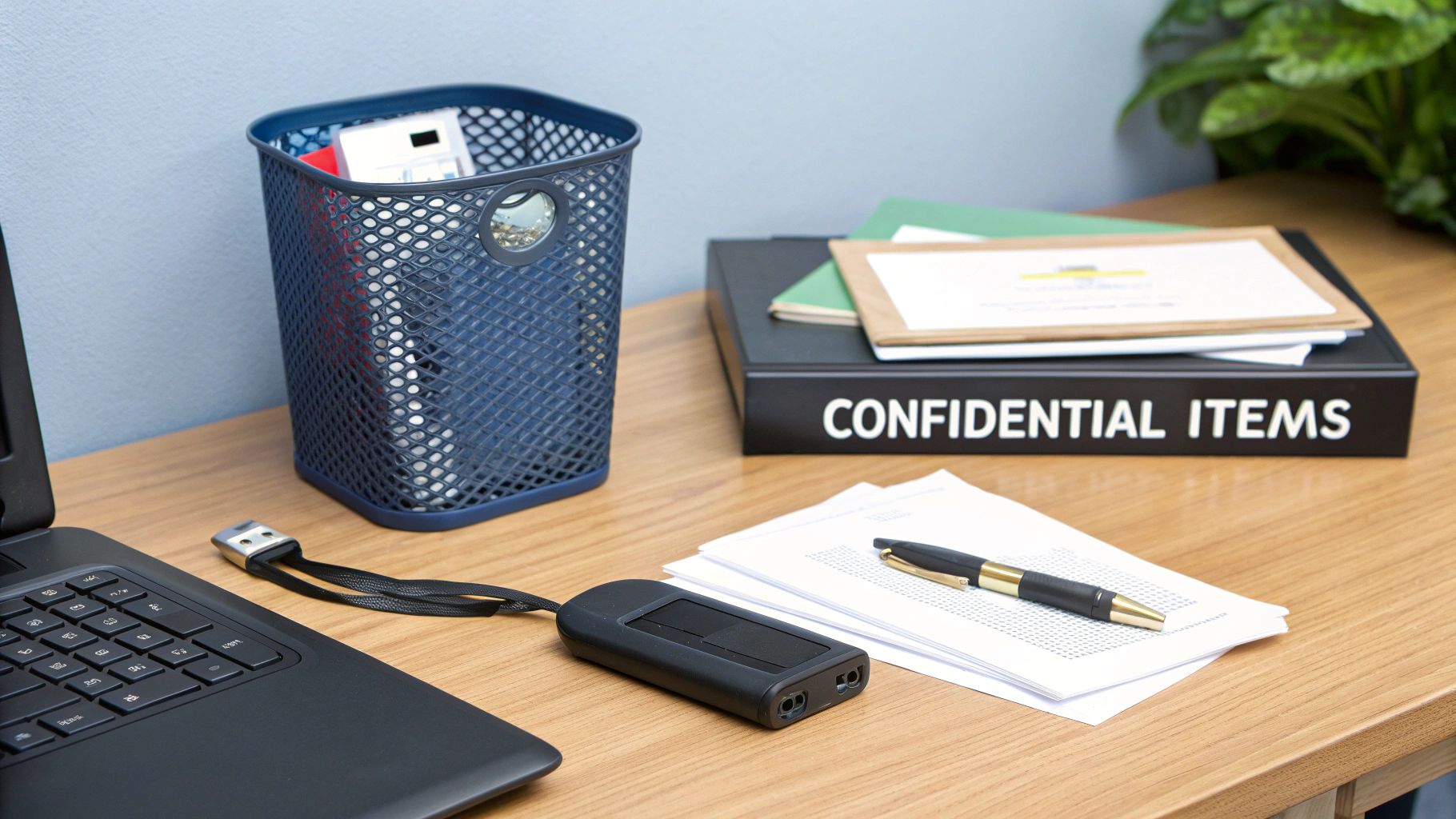
While paper documents are a massive source of confidential information, you can't overlook the risk from digital media and other physical items. A single hard drive tossed in a skip can do more damage than a whole filing cabinet of paperwork. Your internal policy needs to cover the full spectrum of materials.
Just think about the everyday items that could cause a serious breach:
- Employee Information: CVs from unsuccessful applicants, old payroll slips, disciplinary notes, and health records.
- Customer and Client Data: Invoices, contact lists, delivery addresses, and any other personally identifiable details.
- Financial Records: Bank statements, old purchase orders, and out-of-date tax documents are a goldmine for fraudsters.
- Digital Media: Old work laptops, USB sticks, backup tapes, and even CDs can hold recoverable data, long after you’ve hit ‘delete’.
- Branded Materials: Think expired staff ID cards, old company uniforms, or even headed notepaper. In the wrong hands, these could be used to impersonate your staff or business.
How a Simple Mistake Can Unravel Everything
Let’s make this real. Imagine a small marketing agency is clearing out old project files and chucks some draft client strategy notes into a public recycling bin. A rival firm happens to find them, instantly gaining insight into a huge upcoming campaign. This isn't some far-fetched spy movie plot; it’s a genuine risk that stems from sloppy waste management.
The fallout from a mistake like that goes way beyond losing a competitive advantage. It can set off a chain reaction of serious problems:
- Crippling Fines: Breaching the Data Protection Act 2018 can result in fines of up to £17.5 million or 4% of your global turnover, whichever is higher.
- Reputational Ruin: News of a data breach travels fast. The damage to customer trust can take years to repair and will absolutely hit your bottom line.
- Identity Theft and Fraud: For criminals, a bin full of discarded personal data is like striking gold.
The threat is real and happens more often than you’d think. In the UK, identity fraud occurs around 500 times a day, often fuelled by information scavenged from carelessly thrown-out documents and hard drives.
It's shocking but true: statistics show that around 40% of all data security incidents still involve physical paper documents. It’s a stark reminder that despite our digital world, the humble piece of paper remains a massive weak spot.
With the average data breach costing a business a staggering £4 million, it’s plain to see that a solid plan for disposing of confidential waste isn't a 'nice-to-have'—it's essential. You can read more about these confidential waste statistics to get the full picture. This isn't just an issue for big corporations; it's a fundamental part of daily operations for any business that wants to protect its clients, its staff, and its own future.
Getting to Grips with Your Legal Duties
Understanding your legal responsibilities isn't just a box-ticking exercise; it’s the bedrock of any sensible confidential waste plan. This isn't just about 'doing the right thing'. It's about meeting specific, legally-binding standards that protect your customers, your reputation, and your business from some pretty serious consequences.
For any UK business, there are two key bits of legislation you absolutely must have on your radar.
First up is the Data Protection Act 2018, which is essentially the UK’s version of GDPR. This law dictates how you must handle personal data, and its rules don't just stop once you've finished using the information. They extend right up to the moment of destruction. You have a legal duty to make sure personal data is destroyed securely and completely once you no longer need it. If you don't, it’s a data breach. Simple as that.
The second is your 'Duty of Care', which comes from the Environmental Protection Act 1990. While this applies to all your business waste, it has extra teeth when it comes to confidential materials. The law requires you to store your waste securely, stop it from getting into the wrong hands, and only pass it on to a licensed waste carrier.
Why You Can't Afford to Get This Wrong
It’s tempting to see these rules as just more red tape, but the fallout from ignoring them is very real. A data breach isn't always some sophisticated hack. It can be as simple as an old invoice being found in a general waste bin or an auditor discovering you have no proper records of how you dispose of sensitive documents.
Think about it. A medium-sized recruitment agency has a routine audit. They can't show any Waste Transfer Notes for their confidential shredding for the past year. Even if no data has actually been leaked, the Information Commissioner's Office (ICO) could land them with a hefty fine just for failing to prove they have a compliant process in place.
The penalties are no joke. A single breach of GDPR can lead to fines of up to £17.5 million or 4% of your company's annual global turnover – whichever is higher.
And that's just the financial hit. The damage to your reputation from being named and shamed as a company that plays fast and loose with personal data can be devastating. It can take years to win back customer trust.
To give you a clearer picture, here’s a quick rundown of what UK law demands from businesses when it comes to confidential waste.
UK Legal Requirements for Confidential Waste at a Glance
| Legal Requirement | Governing Act/Regulation | What It Means in Practice |
|---|---|---|
| Secure Destruction | Data Protection Act 2018 (UK GDPR) | You must permanently destroy personal data you no longer need. This means shredding, pulping, or incinerating it, not just binning it. |
| Duty of Care | Environmental Protection Act 1990 | You are legally responsible for your waste from creation to disposal. You must ensure it is handled safely and only by authorised people. |
| Use of Licensed Carriers | The Waste (England and Wales) Regulations 2011 | You can only transfer your waste to a person or company that holds a valid Waste Carrier Licence from the Environment Agency. |
| Waste Transfer Notes (WTNs) | The Waste (England and Wales) Regulations 2011 | You must complete and keep a WTN for every single load of waste that leaves your premises. These records must be kept for at least two years. |
This table isn't exhaustive, but it covers the core duties that form the backbone of a compliant disposal process. Getting these right is non-negotiable.
Turning Law into Action
So, how do you translate all this legal jargon into practical, everyday actions? Your compliance really boils down to a few key steps that create an unbroken chain of security for your sensitive information.
Here’s what that looks like on the ground:
- Secure Storage: You must keep all confidential materials locked away in secure bins or containers while waiting for collection. Leaving sacks of documents by the loading bay is a clear breach of your Duty of Care.
- Licensed Carrier: Only use a waste carrier who is officially registered with the Environment Agency. Don't be shy about asking to see their licence and checking its validity online.
- Complete the Paperwork: For every single collection, you must get a Waste Transfer Note. This document is your legal proof of who took your waste, what it was, and where it went. You have to keep these records for a minimum of two years.
- Get Proof of Destruction: Once the job is done, you should receive a Certificate of Destruction. This is the final piece of the puzzle, confirming your obligations under the Data Protection Act have been fulfilled.
The legal landscape is always shifting. The £39 million in penalties already issued under the Data Protection Act 2018 shows the ICO means business. It’s also important to remember that 'confidential' isn't just about customer data. For businesses dealing with international clients, for example, understanding HIPAA compliance can help broaden your definition of what counts as sensitive information.
Setting Up Your Internal Handling Process
Knowing your legal duties is one thing, but your day-to-day actions are what really keep your organisation safe. A solid internal handling process is the bridge between legal theory and practical, real-world security. It’s all about making sure every sensitive document is managed securely, from the moment it’s finished with until it’s collected for destruction.
This isn't about inventing complicated new workflows. It’s about embedding simple, secure habits into your team's daily routine. The goal? To make secure disposal the easiest, most obvious choice for every single employee. A messy approach, with papers piling up on desks or chucked into open trays, is just a data breach waiting to happen.
Choosing the Right Secure Containers
The first physical step is getting the right tools for the job. Your standard office bins and open-topped recycling boxes simply aren’t cut out for confidential materials. You need dedicated, secure containers that stop wandering eyes and unauthorised access dead in their tracks.
Think about what your specific work environment needs:
- Lockable Consoles: These are perfect for busy office spaces. They often look like a smart piece of office furniture but have a narrow slot for posting documents. The only way to get inside is with a key, allowing staff to dispose of items easily without compromising security.
- Secure Wheelie Bins: Got an area that produces a lot of confidential paper, like a mailroom or print station? A lockable wheelie bin is a practical choice. They hold much more and can be easily moved to a central collection point.
- Secure Shredding Bags: With hybrid and remote working now the norm, managing waste from home offices is a real challenge. Giving employees heavy-duty, sealable sacks lets them store confidential documents safely at home before bringing them into the office or arranging a collection.
Pro Tip: Put your secure containers in convenient, high-traffic spots. A lockable console right next to the printer or photocopier makes it second nature for staff to immediately get rid of misprints. This one simple step can drastically reduce the chance of sensitive documents being left lying around.
Creating a Clear Internal Policy
Your shiny new containers are only useful if everyone knows what they’re for and how to use them. A straightforward, well-communicated internal policy is absolutely essential. This doesn't need to be a 50-page novel; it should be a practical guide that everyone can understand and actually follow.
Your policy should clearly spell out:
- What to Secure: A simple list of documents and media that must go into the secure containers. Think anything with customer details, financial data, or employee information.
- Container Locations: A quick map or list showing where every secure bin or console is located. No excuses!
- Key Control: Decide who is responsible for the keys. This should be a very small number of trusted people to maintain a clear chain of custody.
- Remote Worker Guidelines: Specific instructions for team members working from home, explaining how to use their secure bags and what the process is for returning them.
Once you’ve written the policy, don’t just stick it on the intranet and hope for the best. Staff training is critical. A quick run-through during a team meeting can make all the difference. It’s a chance to reinforce that secure disposal is a shared responsibility that protects the company, their colleagues, and your customers. A well-informed team is your best line of defence against a data breach.
Your Internal Handling Checklist
Building a robust system doesn't have to be a headache. Just break it down into a few manageable steps. Use this checklist to guide you and make sure you haven’t missed anything important.
- Assess Your Needs: Work out where and what type of confidential waste is being created across your business, including home offices.
- Source Secure Containers: Buy or hire the right mix of lockable consoles, bins, and bags for your setup.
- Strategic Placement: Position containers in logical, high-traffic areas to encourage everyone to use them consistently.
- Draft a Clear Policy: Write a simple, easy-to-understand document outlining the entire process.
- Assign Key Responsibility: Nominate a 'data security champion' or a small group to manage the keys and oversee the system.
- Train Your Team: Run a short training session so everyone understands their role and why the policy is so important.
- Schedule Regular Collections: Set up a consistent collection schedule with your chosen waste management provider to stop containers from overflowing.
- Review and Adapt: Check in on the process every so often to spot any problems and make adjustments as your business changes.
Choosing Your Secure Disposal Provider
Once your internal processes are buttoned up, it's time for the next big decision: picking the right professional partner to handle the final destruction. This isn't just about getting rid of paper; you're entrusting another company with your most sensitive information. This choice is fundamental to making sure all your efforts lead to legally compliant and totally secure disposal, so it requires some serious thought and vetting.
The two main ways this works are on-site and off-site shredding. Each has its own pros and cons, and the best fit really depends on your business's specific needs, security demands, and budget.
On-Site Versus Off-Site Shredding
On-site shredding, sometimes called mobile shredding, is exactly what it sounds like. A specialised truck with a powerful industrial shredder built into it comes directly to your premises. Your locked bins are emptied into the truck, and you can literally watch your documents get destroyed on a mounted camera. It offers the ultimate peace of mind and an unbreakable chain of custody right before your eyes.
Think of a law firm dealing with highly sensitive case files. They would almost certainly insist on on-site shredding to personally witness and verify that every single document has been destroyed. It completely removes any doubt.
Off-site shredding, on the other hand, involves a secure vehicle collecting your confidential waste and taking it to a purpose-built destruction facility. There, your materials are shredded in a tightly controlled and monitored environment, usually alongside waste from other clients. This option is often more cost-effective and efficient, especially for businesses with huge volumes of waste – for example, a national retailer clearing out old records from multiple stores.
Let's be clear: both on-site and off-site services from a reputable provider are incredibly secure. The choice really boils down to your organisation's priorities. Do you value the absolute transparency of witnessed destruction, or the logistical ease and cost savings of bulk off-site processing?
To help you weigh it up, let's put the two main approaches side-by-side.
Comparing On-Site vs Off-Site Shredding Services
Deciding between having your confidential waste shredded at your location or taken away can feel like a big call. Both methods are secure when done by a professional company, but they cater to different needs and priorities. The table below breaks down the key differences to help you figure out which service is the right fit for your organisation.
| Feature | On-Site Shredding | Off-Site Shredding |
|---|---|---|
| Security | Highest level of transparency; you can physically witness the destruction. | Highly secure, but relies on trusting the provider's facility protocols. |
| Convenience | Instant destruction happens right on your premises, with no transport involved. | The provider handles everything, from collection to destruction at their site. |
| Cost | Generally more expensive due to the dedicated vehicle and time spent on-site. | Often more budget-friendly, particularly for larger, regular volumes. |
| Best For | Businesses needing maximum assurance, like legal, financial, or healthcare sectors. | Organisations focused on cost-efficiency with high volumes of waste. |
Ultimately, the best choice depends on what you value most. If seeing is believing and you need that undeniable proof of destruction, on-site is the way to go. If you trust your vetted partner and are looking for an efficient, cost-effective solution for large amounts of material, off-site is a brilliant option.
Your Vetting Checklist for Potential Providers
Whichever model you lean towards, doing your homework is non-negotiable. A truly professional provider will be completely transparent and more than happy to show you their credentials.
This flowchart can help you think through your own internal waste handling protocols before you even start talking to external companies.
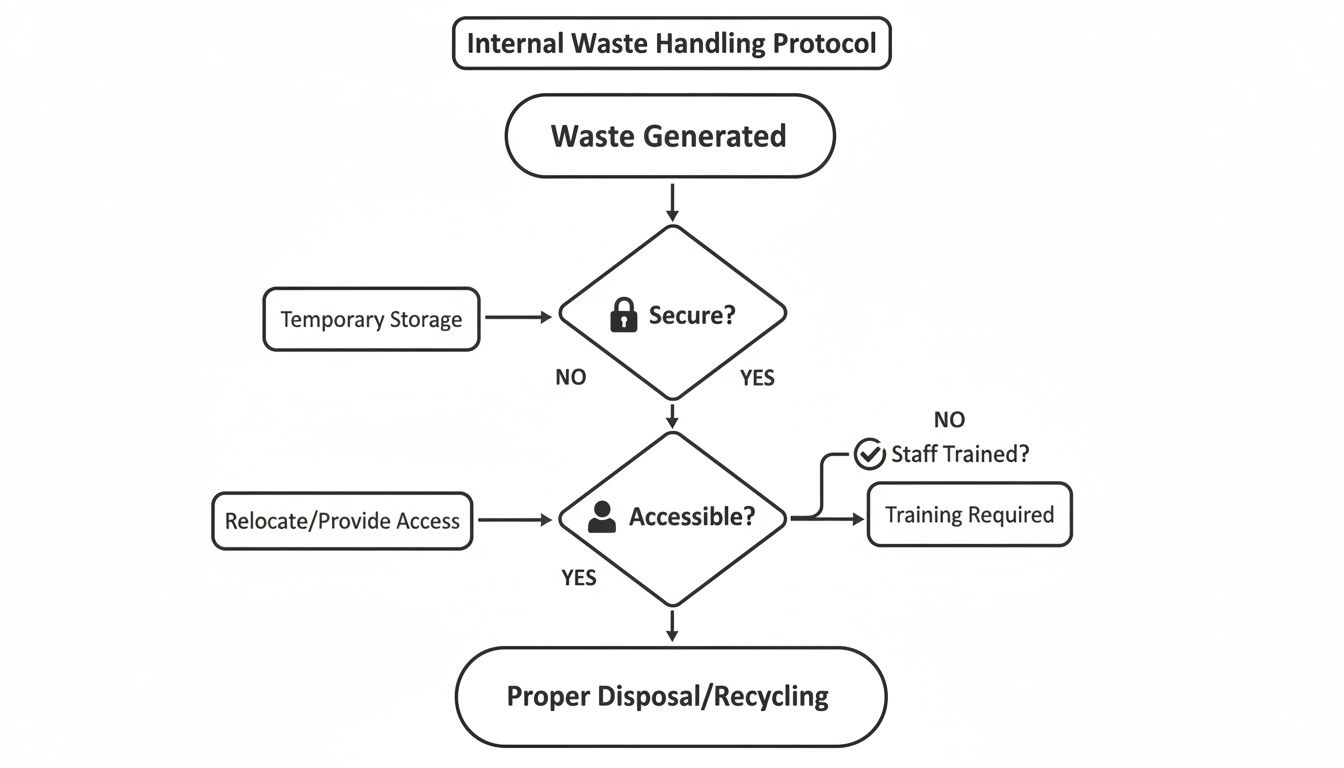
Running through this kind of decision tree helps you see if your internal systems for security, access, and staff training are ready for a smooth handover to a professional service.
When you're ready to vet a potential provider, use this checklist:
- Accreditation is Key: They must be accredited to BS EN 15713. This is the gold standard in Europe for secure data destruction, covering everything from staff security checks to the final particle size of the shredded paper. It’s your guarantee of a professional, audited process.
- Staff Security Screening: Ask if all their employees who handle sensitive materials have undergone DBS (Disclosure and Barring Service) checks. You have to know that every single person in that chain of custody is trustworthy.
- Secure Vehicles: Confirm their collection vehicles are fitted with GPS tracking and are securely locked at all times. This ensures your materials are monitored and protected from the moment they leave your sight.
- Guaranteed Certificate of Destruction: Any reputable provider will issue a Certificate of Destruction as standard after every collection. This is your critical legal proof that you've fulfilled your data protection duties.
- Waste Carrier Licence: They absolutely must hold a valid Waste Carrier Licence from the Environment Agency. You can, and should, check this on the Environment Agency's public register.
Keep an eye out for a few red flags. Rock-bottom pricing that seems too good to be true usually is—it can be a sign they're cutting corners on security or compliance. A vague or confusing explanation of their process is another major warning sign. A real professional partner should be able to walk you through their entire procedure with confidence and clarity.
Remember, the right provider doesn’t just handle confidential shredding; they often offer a wide range of commercial waste collection services that can help streamline your broader business needs.
Closing the Loop with a Clear Chain of Custody

Your legal responsibility for that confidential waste doesn't just vanish the moment the collection truck pulls away. It’s a common misconception.
True compliance means having an unbroken, fully documented trail. This paper trail needs to prove your sensitive materials were handled securely from your office right through to their final, irreversible destruction. This documented journey is what we call the chain of custody.
Think of it as the evidence that backs up your entire process. If the Information Commissioner's Office (ICO) ever comes knocking, or if you're wrongly accused of a data breach, this paperwork is your first and strongest line of defence. It turns your word into verifiable proof.
Without this documentation, you're leaving your business dangerously exposed. It’s like sending a valuable parcel without any tracking—you can only hope it gets there, but you have no real way to prove it.
The Two Documents That Matter Most
Your chain of custody really boils down to two crucial pieces of paper. For any business that takes data protection seriously, these are completely non-negotiable.
First up is the Waste Transfer Note (WTN). This is a legal document required for every single collection of waste that leaves your premises, confidential or not. It formally passes the responsibility for the waste from you (the producer) to your licensed waste carrier. You can get the full rundown on what is a Waste Transfer Note and why it’s so vital for staying compliant.
The second, and just as important, is the Certificate of Destruction. Your shredding provider issues this after your documents have been destroyed. It’s your official confirmation that the job is done and you’ve met your obligations under the Data Protection Act.
Imagine this scenario: a former client claims you mishandled their personal data after finding some old invoices in a public bin. With a complete chain of custody, you can immediately produce a Waste Transfer Note showing the exact date of collection and a Certificate of Destruction proving it was all securely shredded. The accusation falls flat because you have the evidence.
What to Look For in Your Paperwork
These documents aren't just generic receipts; they have to contain specific details to be legally valid. Skimping on the details can make them useless in an audit.
Your Waste Transfer Note must include:
- A clear description of the waste (e.g., "confidential paper documents for shredding").
- The quantity of the waste.
- The date and time of the collection.
- Your details as the waste producer.
- The details of your licensed waste carrier, including their registration number.
Your Certificate of Destruction should clearly state:
- The date the destruction took place.
- The method used (e.g., cross-cut shredding to BS EN 15713 standard).
- A unique serial number for tracking.
- A signature from an authorised person at the facility.
These documents are far more than just formalities; they are the final, essential step in a secure disposal process. They close the loop, providing the auditable proof that you’ve taken your Duty of Care seriously from start to finish. Always make sure you receive and file them meticulously—you’re legally required to keep them for a minimum of two years.
Balancing Data Security and Sustainability
A common worry I hear is that the strict processes for confidential waste disposal must be bad for the environment. People often assume secure destruction means everything gets incinerated or chucked into a landfill, but thankfully, the reality is the complete opposite. Professional shredding services are actually a brilliant part of the circular economy, proving you don't have to choose between security and sustainability.
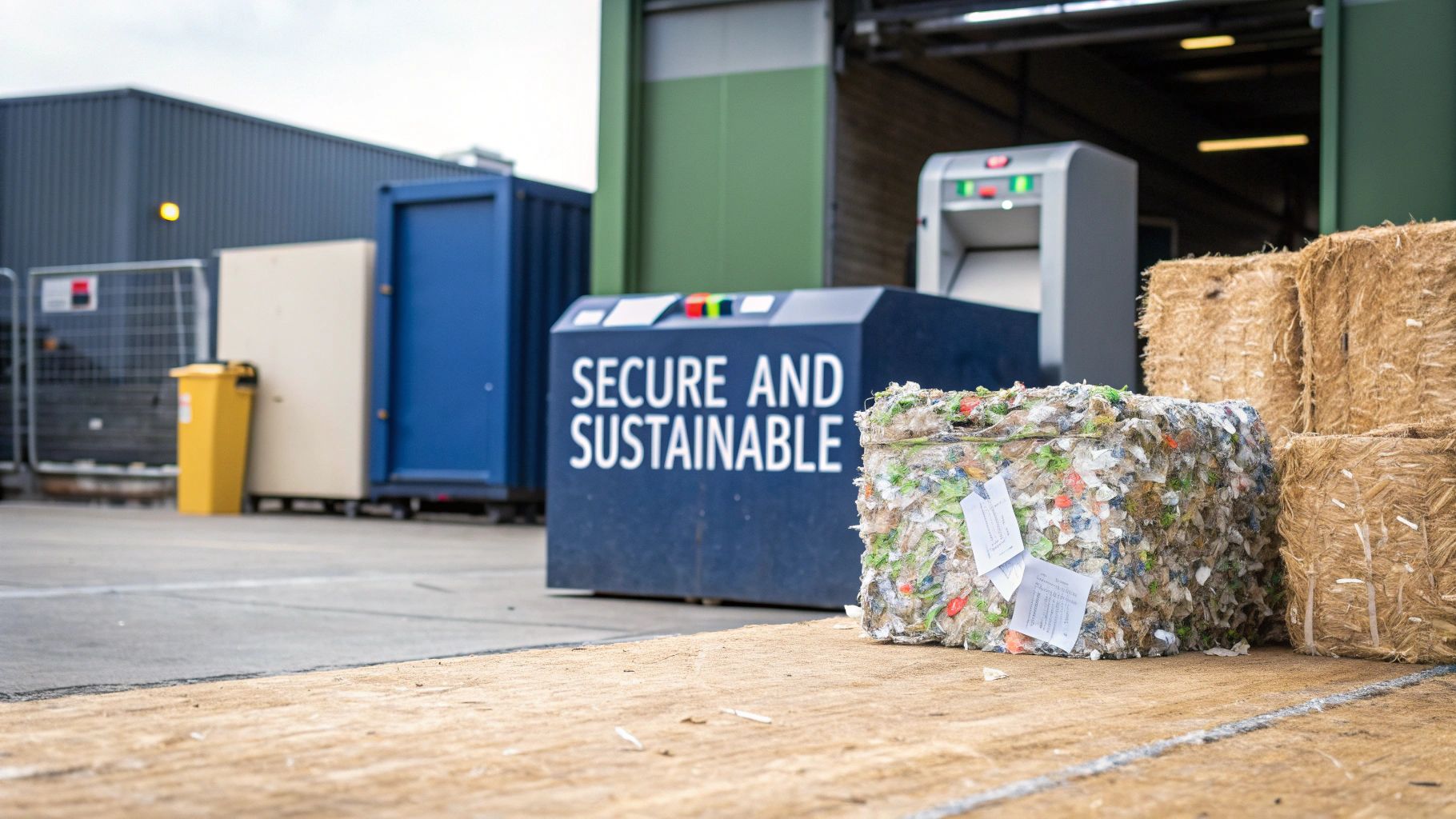
When you team up with a properly accredited secure disposal provider, 100% of the shredded paper is baled up and sent straight to recycling mills. There, it gets pulped and turned back into useful products we all use, like tissue paper, cardboard, and office supplies.
This isn't just about stopping sensitive information from getting into the wrong hands. It also drastically reduces the need for virgin wood pulp, saves water, and cuts down on energy use.
Aligning Security with Your Green Credentials
Choosing a certified provider does more than just tick the data protection box. It actively helps your company hit its Corporate Social Responsibility (CSR) and Environmental, Social, and Governance (ESG) targets. By making secure shredding a part of your waste strategy, you create a real, positive environmental impact you can actually report on and be proud of.
And this isn't a small-scale thing. In the UK alone, confidential waste services are responsible for shredding and recycling the paper equivalent of 700,000 trees every single year. It’s a massive contribution to the nation's recycling goals, which have seen paper recycling rates climb above 70%.
This commitment can be a powerful message for your clients, staff, and stakeholders. It shows your organisation takes its duty of care seriously – both to data and to the planet. For a deeper look at your company's environmental impact, have a look at our guide on how to calculate your carbon footprint.
At the end of the day, secure disposal is a vital piece of the puzzle on how to prevent data breaches. Instead of seeing it as just another compliance chore, think of it as an opportunity. It’s a chance to strengthen your data security while making a measurable contribution to a greener future. With the right partner, protecting sensitive information and protecting the planet really do go hand in hand.
Common Questions About Confidential Waste
Even with a solid plan in place, a few practical questions always pop up when it comes to handling sensitive materials. Let’s tackle some of the most common queries we get from businesses and homeowners about getting rid of confidential waste the right way.
Can I Just Use an Office Shredder?
While your standard office shredder is handy for ripping up a few documents here and there, it’s really no match for a professional service. Most of these machines only strip-cut paper, leaving long strands that, with enough patience, could potentially be pieced back together.
Professional services are a different beast altogether. We use industrial cross-cut shredders that turn documents into tiny, confetti-like pieces, meeting the rigorous BS EN 15713 security standard. More importantly, you get a Certificate of Destruction. This isn't just a piece of paper; it’s your legal proof that you’ve disposed of your data responsibly – something your office machine can never provide.
How Much Does Professional Disposal Cost?
The cost really depends on what you need. Key factors include how much waste you have, how often you need it collected, and whether you prefer the shredding to happen on-site at your premises or off-site at a secure facility.
A one-off clear-out, for example, might be charged by the sack or bin. On the other hand, a regular scheduled service with a secure console in your office will typically have a fixed monthly or quarterly fee.
It's helpful to reframe this from a cost into an investment. When you think about it, the price of secure disposal is tiny compared to a potential £17.5 million GDPR fine for a data breach. It’s a crucial part of managing your business's risk.
What Happens to Old Hard Drives?
Getting rid of digital data securely is more than just hitting 'delete'. The process involves total physical destruction. First, old hard drives, USB sticks, and other media are fed into specialised shredders that grind them into tiny fragments. This makes it physically impossible for anyone to recover the data.
Once destroyed, it’s all about responsible recycling. The shredded fragments – a mix of aluminium, steel, and plastics – are carefully separated. These raw materials are then sent on to specialist recycling facilities to be repurposed. It’s always a good idea to ask your chosen provider how they handle their e-waste to make sure your data security and environmental policies go hand-in-hand.
Ready to put a secure, compliant, and sustainable waste plan in place for your business? The Waste Group offers expert solutions for all your confidential waste needs. Get a quote and protect your business today.