Hard Plastics Recycling: Your Guide to hard plastics recycling
Hard Plastics Recycling: Your Guide to hard plastics recycling
From old garden chairs to broken children's toys, bulky plastic items can be a real recycling puzzle. The simple truth is that while many of these hard plastics are highly recyclable, they often end up in landfill simply because of confusion and logistical headaches. This guide is here to cut through the noise, giving you clear answers and practical solutions for managing this tricky waste stream with confidence.
The Hard Truth About Hard Plastics Recycling
Let's face it: figuring out what to do with bulky plastic is confusing. Things like garden furniture, children’s car seats, and old storage containers are incredibly durable, but their size and composition mean they can't just be tossed into your standard kerbside recycling bin. This mismatch between the material's value and how we collect it is the core of "the hard truth" about hard plastics recycling.
Households and businesses across the UK often struggle to find clear guidance on how to dispose of these items correctly. As a result, a massive amount of valuable material is lost to landfill, putting a strain on the environment and wasting resources that could easily be fed back into a circular economy. The problem isn't that the plastic can't be recycled; it's that the system isn't always set up to handle it efficiently.
The Scale of the Plastic Problem
The statistics around plastic waste in the UK paint a pretty stark picture. For plastic waste, including hard plastics like bottles and containers made from HDPE and PP, the recycling rate is a concerning 9%. This figure is miles behind materials like paper (over 80%) or glass (nearly 70%), even though we produce around 2.5 million tonnes of plastic waste every single year. You can learn more about the plastic recycling challenges and opportunities we face right here in the UK.
This gap highlights a huge opportunity. By getting a better handle on hard plastics, we can improve these figures substantially and turn a waste problem into a resource solution.
The core challenge is bridging the gap between what is technically recyclable and what is practically collected and processed. Improving hard plastics recycling needs a synchronised effort from all of us—consumers, businesses, and waste management providers.
Navigating the Complexities
Adding another layer to the puzzle are the regulations governing the chemical makeup of plastics. For instance, European rules like the REACH Directive SVHC List identify substances that could pose risks, which affects whether certain older or more specialised plastics can be safely reprocessed. These regulations are vital for safety, but they can create hurdles for recycling.
Fortunately, practical solutions are out there. For projects that generate a lot of hard plastic—like a garden clearance, an office clear-out, or a renovation—services like skip hire offer a straightforward and responsible way forward. It ensures the materials are sent straight to facilities equipped to sort and process them correctly, setting the stage for successful recycling.
Decoding the Plastic Recycling Numbers
Ever flipped over a plastic container, spotted that little triangle with a number inside, and felt a bit lost? You’re definitely not alone. These symbols, officially called Resin Identification Codes (RICs), are less of a guarantee and more of a clue about the type of plastic you’re holding.
Think of them not as a green light for your recycling bin, but as the first step in a sorting process that's vital for successful hard plastics recycling.
Learning these codes is like learning a basic language. It helps you make smarter decisions about waste, whether you’re clearing out your garage, managing a building site, or just sorting the weekly rubbish. A recycling symbol doesn’t automatically mean your local council will take it, but knowing the plastic type is the first hurdle cleared.
The scale of the problem is huge. The UK gets through roughly 5 million tonnes of plastic every year, and hard plastics make up a massive chunk of that. This includes everything from milk bottles and buckets to bulky garden furniture, all of which present a real challenge to recycle effectively. You can dig deeper into the data on UK plastic consumption over at National Recycling.
A Quick Guide to the Plastic Codes
To help you get a handle on what you're dealing with, here's a quick rundown of the common hard plastics you'll find in homes and on construction sites. This table breaks down the codes you're most likely to see.
Common Hard Plastics and Their Recycling Codes
| Code | Abbreviation | Plastic Name | Common Examples | Recyclability Notes |
|---|---|---|---|---|
| 2 | HDPE | High-Density Polyethylene | Milk bottles, shampoo bottles, cleaning containers, site buckets | Widely recycled in the UK, especially bottle-shaped items. |
| 3 | PVC | Polyvinyl Chloride | Pipes, window frames, some flooring, guttering | Rarely accepted in household recycling due to its chemical makeup. |
| 5 | PP | Polypropylene | Garden furniture, car parts, kids' toys, margarine tubs, buckets | Its recyclability is on the rise, but it's not universally collected kerbside. |
While there are seven codes in total, these three—HDPE, PVC, and PP—are the main players when it comes to the kind of rigid, bulky plastics that don't fit in your wheelie bin.
The Big Three Hard Plastics
Let's quickly break down the most common types of hard plastic you'll encounter:
-
Code 2 HDPE (High-Density Polyethylene): This is your workhorse plastic – tough and versatile. It's used for milk jugs, shampoo bottles, bleach containers, and those sturdy buckets you see all over building sites. Good news: HDPE is one of the most widely recycled plastics in the UK.
-
Code 3 PVC (Polyvinyl Chloride): Known for its incredible durability and weather resistance, PVC is the go-to material for pipes, window frames, and certain types of flooring. The downside? It’s almost never accepted in kerbside collections because its chemical composition can contaminate other plastics during recycling.
-
Code 5 PP (Polypropylene): Another common and robust plastic, PP can handle the heat. You’ll find it in car parts, plastic garden furniture, children's toys, and food tubs. While its recycling is becoming more common, it’s still not accepted everywhere, especially in bulky forms.
This mind map offers a great visual summary of the hard plastic challenge, breaking down the core problems, the materials themselves, and the practical solutions.
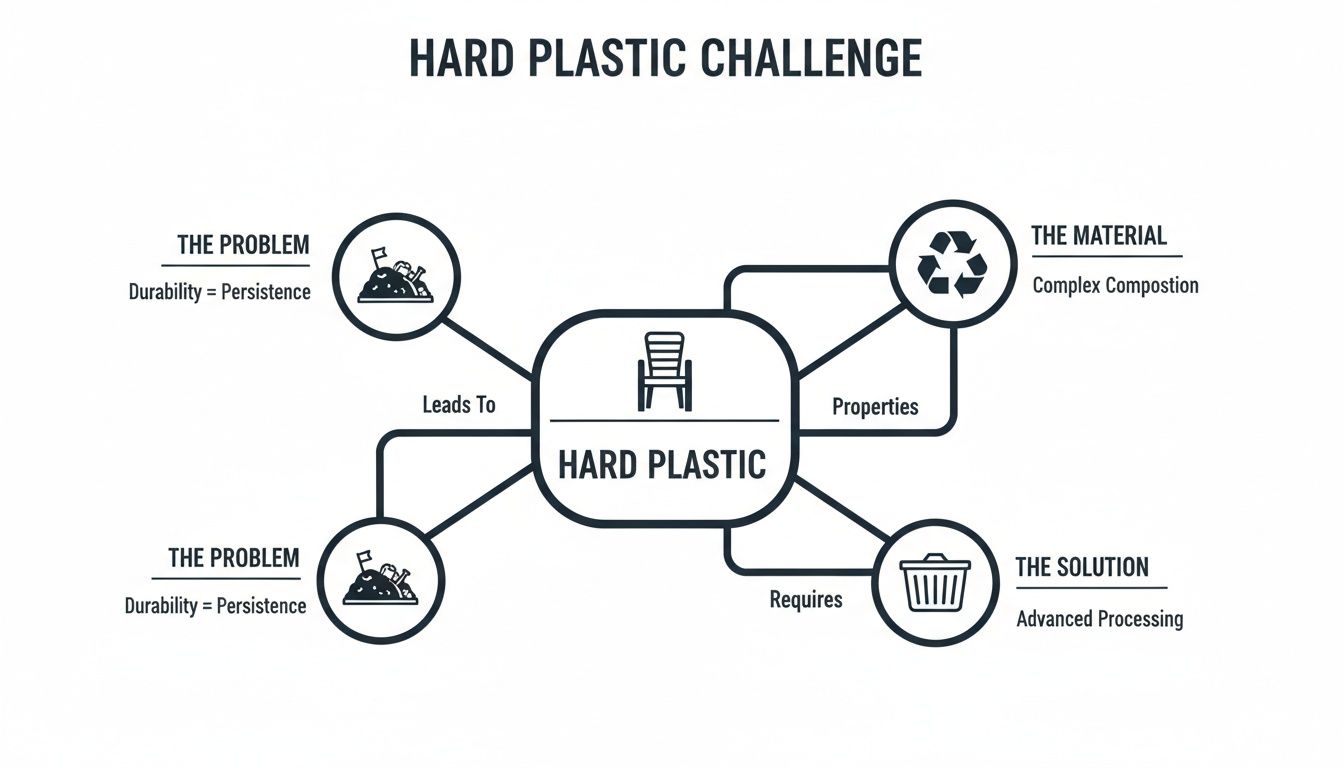
As the illustration shows, effective services like skip hire are crucial. They create a direct channel for these materials to get to the right processing facilities, completely bypassing the limitations of your standard household collection.
Why a Code Isn't a Guarantee
Here’s the thing: the presence of a recycling code can be seriously misleading. All it does is identify the type of plastic resin used to make the item. It says absolutely nothing about whether your local council has the right equipment or systems to actually recycle it.
A Resin Identification Code tells you what a plastic is, not where it can go. Local recycling capabilities are the real deciding factor.
For example, a plastic bucket might be made from highly recyclable Code 5 PP, but your local council may have no way of collecting or processing it. This is especially true for large, bulky items from a house clearance or a renovation project.
This gap is precisely where commercial waste management solutions come in. They ensure these valuable materials don't end up in landfill but instead reach a proper facility that knows exactly how to handle them.
How to Prepare Plastics for Successful Recycling
Getting your prep right is the single biggest factor in whether your plastic waste actually gets recycled or ends up rejected and sent to landfill. Think of it as a quick quality control check before it leaves your hands; a few simple steps can make sure your good intentions aren't wasted.
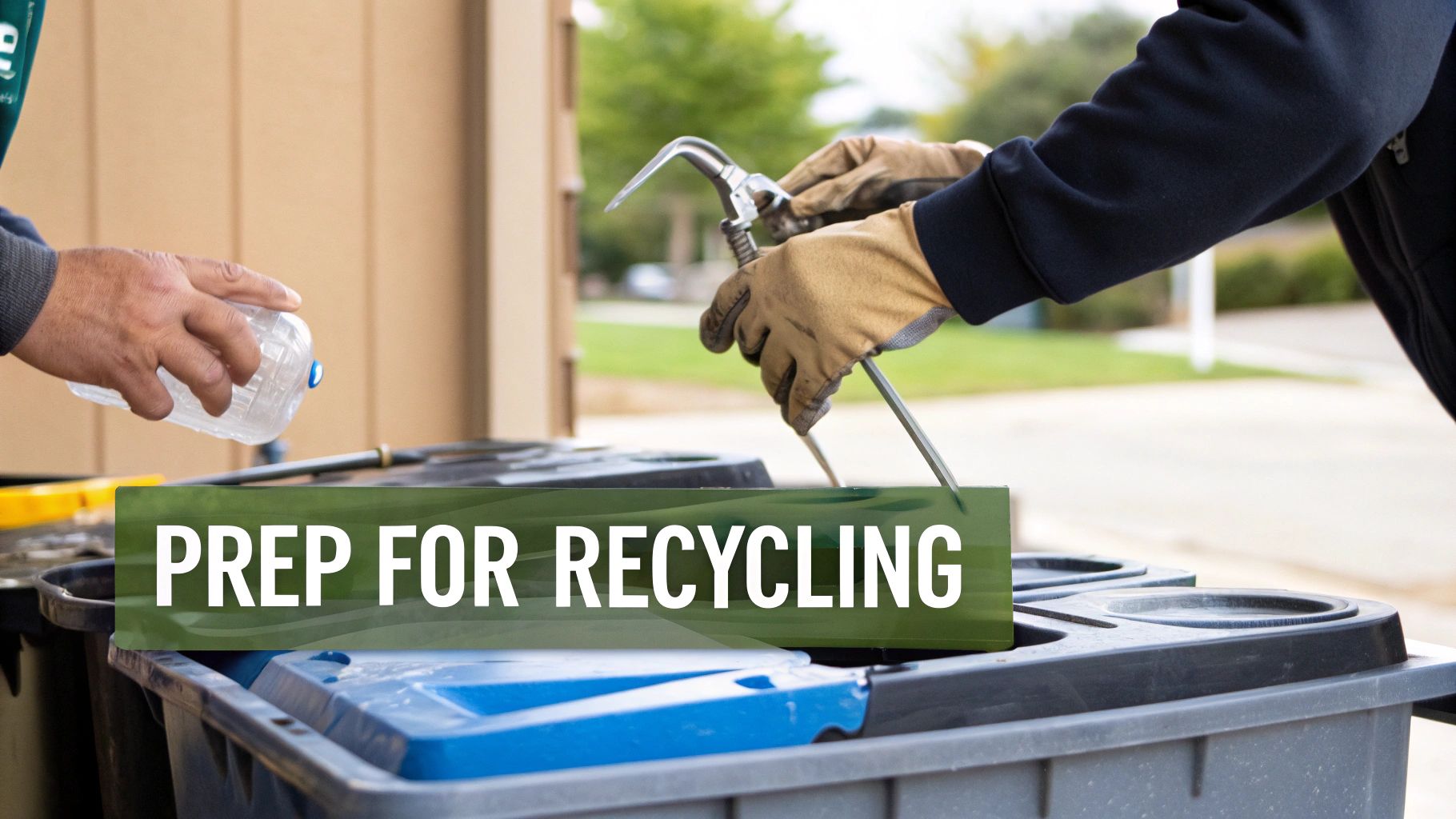
Contamination is the ultimate villain in the recycling story. Even tiny amounts of leftover food, oil, or non-plastic bits can spoil an entire bale of otherwise perfect recyclables. It’s like trying to bake a fresh loaf of bread using flour that’s got dirt mixed in—the end result is useless. The exact same principle applies to hard plastics recycling.
Your Pre-Recycling Checklist
To give your hard plastics the best possible chance of being recycled, just follow these simple but vital steps. It’s all about sending clean, uniform material down the line to the recycling facility.
-
Empty and Rinse: First things first, make sure containers are completely empty. A quick swill with water to get rid of food, drink, or product residue is crucial. They don't need to be sparkling clean, but they shouldn't have any major gunk left in them.
-
Remove Non-Plastic Parts: This one gets overlooked all the time but it's incredibly important. Pop any metal handles off buckets, pull rubber grips off tools, and separate any other materials you can. These foreign objects can jam up or damage expensive sorting machinery and contaminate the final plastic melt.
-
Check Local Guidance: Honestly, this might be the most critical step of all. Every council has slightly different rules, and this inconsistency is a major cause of confusion and inefficiency. For contractors or landscapers, not knowing the local rules for a job site means missed opportunities to recycle properly.
Following these guidelines is one of the most powerful things you can do to help the system work. For more helpful pointers, check out our guide covering essential tips for recycling.
Problematic Plastics to Watch Out For
While good preparation is key, some hard plastics are just inherently difficult for recycling plants to handle. Knowing what they are can save you time and prevent "wish-cycling"—the well-meaning but unhelpful act of tossing something in the recycling bin and just hoping for the best.
Contamination isn't just about leftover curry or sticky jam. It's also about mixing different types of plastics or including materials that machines simply can't identify or process, which can force a whole batch to be rejected.
Here are a few common culprits that regularly cause headaches:
-
Black Plastics: Many recycling centres use optical scanners to sort plastics by type. The carbon black pigment used to colour these items absorbs the light from the scanners, making them effectively "invisible" to the machinery. Because they can't be identified, they often get filtered out and sent straight to landfill.
-
Composite Plastics: Think of items made from several types of plastic all fused together, like some kids' toys or the casings on electronics. They can't be easily separated back into their original materials, which makes them a recycling nightmare.
-
Very Small Items: Tiny plastic bits like bottle caps (unless you screw them back on the bottle), plastic cutlery, or small toy parts often fall through the gaps in the sorting equipment. They either end up contaminating other recycling streams or get discarded as general waste.
Understanding these exceptions is just as important as knowing what to do right. By focusing your efforts on clean, properly sorted, and accepted types of hard plastic, you directly boost the efficiency of the entire hard plastics recycling system.
The Journey of Your Recycled Plastic
So, what really happens to that old plastic bucket or garden chair after it leaves your property in one of our skips? It’s not just dumped in a hole in the ground. Instead, it starts an impressive journey from being awkward waste into a valuable raw material.
This process is a world away from your typical kerbside collection, which is often limited to specific bottle shapes and drink containers. Commercial waste streams, like the ones we manage, are built to handle the very bulk and variety that household recycling simply can't.
The journey kicks off the moment we collect your skip. It’s transported not to a landfill, but to a specialist plant called a Materials Recovery Facility, or MRF for short. Think of it as a highly advanced sorting office for rubbish, where sharp-eyed experts and clever technology work side-by-side to separate everything out.

Arrival and Initial Sorting
When the skip arrives at the MRF, its contents are tipped out onto a huge floor. The first stage of sorting is surprisingly manual. A team of workers, known as 'pickers', pull out any large items that could jam or damage the machinery downstream – things like stray metal bars, chunks of wood, or old textiles. They also grab any oversized plastic items that need to follow a different route through the plant.
This first separation is absolutely crucial. It protects the expensive automated systems and keeps them running efficiently without costly breakdowns. It’s also the first quality check, which is why your efforts back at home or on-site to keep the plastic clean really do make a difference.
The Automated Sorting Process
Once the big contaminants are out of the way, the rest of the material is loaded onto a network of conveyor belts, starting its trip into the high-tech heart of the facility. This is where the real magic of hard plastics recycling happens.
The process unfolds in several key stages:
- Screening: First, the material moves over massive rotating screens. These act like a giant sieve, separating items by size and shape. Smaller bits fall through, while larger, flatter things like cardboard are carried over the top.
- Optical Sorting: This is the most critical step for plastics. As items zoom along the conveyor belt, near-infrared (NIR) scanners blast them with light. By analysing the light that reflects back, these scanners can identify the exact type of plastic polymer, telling the difference between HDPE and PP in a fraction of a second.
- Air Jets: The moment a scanner identifies a piece of plastic, a perfectly timed jet of compressed air shoots it off the conveyor belt and into the correct collection bin. This happens incredibly quickly, sorting thousands of items every hour with amazing accuracy.
At a modern MRF, plastics aren't just sorted by a number in a triangle; they're sorted by their fundamental chemical makeup. This level of precision is what allows recycled plastic to be turned back into high-quality new products, which is the whole point of a circular economy.
Cleaning and Final Processing
After being meticulously sorted into different polymer types, the plastic still isn't quite ready for manufacturers. It's often grubby and needs a thorough clean. The sorted plastic is moved to a washing line where it’s first ground down into small flakes.
These flakes are then washed in huge vats to get rid of any lingering dirt, labels, and glue. Once clean, the flakes are dried, melted down, and pushed through a machine called an extruder to form small, uniform pellets. These pellets, often called nurdles, are the final product. They get bagged up and sold to manufacturers who will use them to create everything from new garden furniture and pipes to car parts and even fibres for clothing.
However, this vital UK industry is facing some serious pressure. Recent challenges have seen 300,000 tonnes per year of mechanical recycling capacity close across Europe, with half of that impact being felt right here in the UK and the Netherlands. This slump puts future growth at risk just as the demand for recycled materials is on the rise. You can get a deeper look into these industry insights and future trends on Recycling Today.
Understanding this full journey—from your skip to a brand-new product—shows the direct link between your responsible disposal choices and the health of the entire recycling ecosystem.
Why Recycling Hard Plastics Matters
It’s easy to think of recycling as just "doing the right thing," but when it comes to hard plastics, the decision to recycle kicks off a powerful chain reaction of benefits, both for the planet and the economy. It’s a choice that turns bulky, awkward waste back into a valuable resource, proving that responsible waste management is also smart business.
Every piece of plastic garden furniture, every old PVC pipe, every bit of rigid packaging that gets recycled is one less item taking up precious space in our already strained landfills. These sites aren't infinite, and by diverting heavy, durable plastics, we dramatically extend their lifespan. It's a simple act that preserves land and shrinks the environmental footprint of waste disposal.
This process also hits the reset button on resource consumption. Let's not forget, virgin plastic is made from fossil fuels—a finite resource. By recycling, we cut down on the need to extract and process more oil and natural gas, conserving these vital resources for the future.
Reducing Our Carbon Footprint
The energy savings from recycling are massive. It takes far less energy to manufacture new products from recycled plastic pellets than it does to create them from scratch using raw materials. This energy efficiency translates directly into a smaller carbon footprint for countless products we use every day.
By choosing to recycle instead of sending plastics to landfill or incineration, we also prevent the release of harmful greenhouse gases. Landfills are a major source of methane, a particularly potent greenhouse gas. Recycling, on the other hand, helps to create a closed-loop system where materials get a second, third, or even fourth life.
The real power of hard plastics recycling lies in its ability to turn a linear "take-make-dispose" model into a circular one. This shift is fundamental to building a more sustainable economy and a healthier planet.
The Economic Case for Recycling
The benefits aren't just environmental; they make solid financial sense too. Recycled plastic isn't waste—it's a commodity. Once processed into pellets, it becomes a sought-after raw material for manufacturers right here in the UK, creating jobs and stimulating local economic activity.
For businesses, effective recycling has become a crucial part of financial and regulatory compliance. The introduction of measures like the Plastic Packaging Tax in April 2022 is a perfect example. This tax penalises packaging that contains less than 30% recycled content, which in turn drives up demand for high-quality recycled materials.
This kind of legislation makes a clear economic statement: businesses that invest in proper recycling streams aren't just meeting their environmental duties; they're also setting themselves up for a financial advantage. It perfectly aligns sustainability with profitability, turning compliant waste management into a competitive edge. To see how this fits into the bigger picture, you can learn more about the role of the circular economy in waste management and what it means for UK businesses on the ground.
Finding the Right Solution for Your Plastic Waste
So, you've got the theory down – you know your plastics, and you know how they need to be prepped. But the real challenge is often the logistics. What do you do with hard plastic waste that’s just too big for your kerbside bin? This is where the rubber meets the road, matching your project's specific needs with a disposal method that's both effective and compliant.
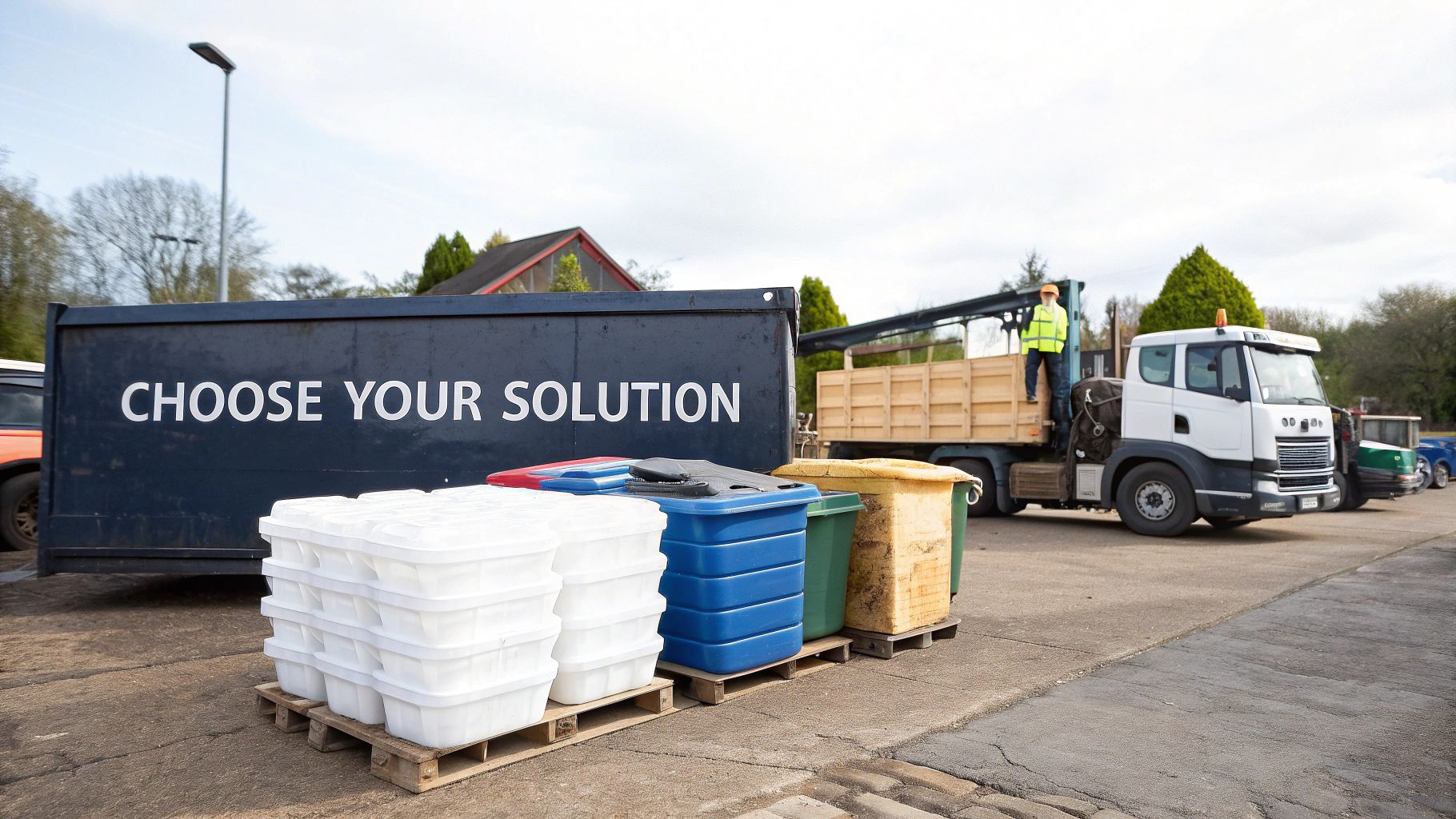
Whether you're dealing with leftover materials from a construction job or a garden full of old plastic furniture, different situations call for different solutions. The key is to pick the most efficient, cost-effective, and responsible option for the volume and type of waste you're generating. Nailing this choice is what makes your hard plastic recycling efforts a real success.
Matching the Solution to Your Project
Not all waste management solutions are built the same. A small garden clear-out has completely different requirements to a large-scale commercial renovation. Let's break down the best options for common scenarios.
-
For Home Renovations and Garden Clearances: A skip is often your best bet. When you're tackling a mix of waste, including bulky bits like old guttering, window frames, or broken garden chairs, a skip gives you a handy, contained space to chuck it all in. It just simplifies the whole process, letting you get on with the job.
-
For Large Volumes and Commercial Sites: When the amount of waste starts getting serious, a grab lorry is the ideal solution. These vehicles can collect huge piles of waste in one go, quickly and efficiently, without you needing to have a skip taking up space on site. They're perfect for major construction projects or massive clear-outs where time and space are tight.
The most effective waste management strategy is one that is scaled to your specific needs. Choosing the right service not only saves you time and money but also provides a direct route for your hard plastics to enter the correct recycling stream.
Creating Compliant Recycling Streams
For businesses, managing waste isn't just about keeping things tidy; it's a matter of legal compliance and corporate responsibility. Setting up a dedicated stream for hard plastics recycling is a critical step towards hitting sustainability targets and avoiding hefty fines.
This means partnering with a waste management provider who gets the nuances of commercial waste. A reliable partner can help you segregate different plastic types, provide the right containers, and make sure every collection is documented with the correct waste transfer notes. For readers outside the UK looking for similar guidance, exploring resources on local recycling services in Marietta can offer a useful comparison of how municipalities handle various materials.
Your Next Steps to Responsible Disposal
Choosing the right disposal method is what empowers you to handle your plastic waste responsibly. The goal is to make sure the materials you get rid of are seen not as rubbish, but as a valuable resource for the future.
With solutions like those offered by The Waste Group, you can easily arrange for the right service for your needs. It could be a small skip for a weekend DIY project or a grab lorry for a major site clearance. This direct approach guarantees your hard plastics are taken to facilities properly equipped to process them, closing the loop and contributing to a more circular economy.
Got a Question About Hard Plastics? We've Got Answers
Digging into the details of waste and recycling can throw up a few tricky questions, especially when you're faced with an unusual or bulky item. Think of this section as your quick-reference guide, where we tackle the most common queries about hard plastics recycling to clear up any lingering doubts.
Can Old Plastic Toys Be Recycled?
This is a classic question, and the honest answer is: it’s complicated. Many toys are made from excellent, recyclable plastics like Polypropylene (PP) or High-Density Polyethylene (HDPE), which is a great start. The problem is, they’re often a real mix of materials—think metal axles in a toy car, electronic bits in a talking doll, or different plastics fused together. That mix makes them a nightmare for recycling facilities to process automatically.
Your chances are much better if the toy is made from a single type of plastic and has a recycling code stamped on it (look for a 2 or 5). If you can, always pull out any non-plastic parts like batteries, screws, or fabric first. For those mixed-material or electronic toys, it's far better to find a specialised e-waste scheme or a local toy charity than to pop them in your recycling bin.
Do I Really Need to Scrape Off Every Last Bit of the Label?
Good news – you don’t need to spend your evening wrestling with stubborn paper labels. The recycling process has this covered. After collection, plastics are ground down into small flakes and then put through a hot wash cycle. This clever process is designed to separate all the unwanted stuff, like paper and glue, from the valuable plastic.
The plastic flakes sink, while all the paper pulp and gunk floats to the top and is skimmed off. So, while it’s helpful to remove any big, easy-to-peel plastic sleeves, don’t stress about the paper ones. The most important thing you can do is make sure the container is empty and give it a quick rinse.
When you're prepping your plastics, the real goal is to get rid of the contaminants that can wreck machinery or spoil a whole batch of recycling. A bit of paper label is a minor issue, but leftover food, liquids, and non-plastic attachments are the real deal-breakers.
Is Black Plastic Really That Bad for Recycling?
Unfortunately, yes. Black plastic remains a major headache for the recycling industry. The sorting facilities that separate our waste rely on near-infrared (NIR) scanners to identify different types of plastic on a fast-moving conveyor belt. The problem is that the carbon black pigment used to create black plastic acts like camouflage, absorbing the scanner's light.
This makes the item effectively invisible to the sorting machine. Because it can’t tell what kind of plastic it is, the machine automatically rejects it and sends it to landfill. It’s a real shame, because the black tray might be made from perfectly good PET or PP. While some new, detectable black pigments are being developed, for now, the best advice is to avoid buying black plastic when you can.
What’s the Deal With Big Things Like Garden Furniture?
Large plastic items like garden chairs, kids' slides, or those big storage boxes are perfect examples of hard plastics, but they absolutely don't belong in your kerbside bin. They are usually made from high-quality, recyclable PP (Code 5) or HDPE (Code 2), but their sheer size means they need a different collection route.
Here are your best options for getting rid of them properly:
- Your Local Tip: Most Household Waste Recycling Centres (HWRCs) have a special, large container specifically for rigid plastics.
- Bulky Waste Collection: Check with your local council. Many offer a service to collect large items from your home for a small fee.
- Skip Hire: If you're having a major clear-out with several bulky items, hiring a skip is easily the most efficient way to go. It ensures everything gets taken directly to a facility that knows how to handle and process these materials.
Choosing one of these routes ensures these valuable plastics are actually recycled and get a second life.
Ready to tackle your plastic waste the right way? The Waste Group offers a full range of skip hire, grab lorry services, and compliant waste management solutions to handle all your hard plastic disposal needs. Get your instant quote online today and let us make your recycling simple and effective.