How to Get Rid of Fluorescent Tubes: Safe, Easy Disposal Guide
How to Get Rid of Fluorescent Tubes: Safe, Easy Disposal Guide
Getting rid of old fluorescent tubes isn't as simple as just chucking them in the bin with the rest of your rubbish. These tubes are actually classified as hazardous waste, which means they need to be handled and disposed of correctly. The right way to do it is to take them, fully intact, to a proper hazardous waste collection point. This could be your local Household Waste Recycling Centre (HWRC) or a licensed commercial waste facility.
Why You Can’t Just Throw Fluorescent Tubes Away
That long, thin glass tube you've just replaced isn't just glass and metal—it contains a small but potent amount of mercury. While it's perfectly safe when sealed inside the tube, that mercury becomes a serious environmental threat if the tube gets smashed in a landfill. It’s a powerful neurotoxin that can contaminate soil, seep into our waterways, and pose a real risk to wildlife and, ultimately, human health.
This isn't just about being eco-friendly; it's a legal requirement. In the UK, a staggering 80 million fluorescent tubes are thrown away each year, which shows just how big this problem is. Under the UK's Waste Electrical and Electronic Equipment (WEEE) Regulations, these tubes are officially categorised as hazardous waste. Disposing of them improperly, like putting them in your general waste bin, can land you with a hefty fine of up to £5,000.
The Real-World Risks of Improper Disposal
When a fluorescent tube shatters in a landfill, it releases mercury vapour straight into the air and allows tiny mercury particles to leach into the ground. From there, this contamination can easily enter the food chain, building up in fish and other wildlife. It’s a silent, invisible threat that accumulates over time, adding to much bigger pollution problems.
Beyond the immediate danger of mercury, it's worth understanding the broader environmental impact of electronic waste to see why proper disposal is so critical. Tossing these items away irresponsibly not only harms our ecosystems but also completely undermines recycling efforts. It's crucial to remember what can't you put in a skip, and fluorescent tubes are definitely high on that list.
The core idea behind the WEEE Regulations is something called "producer responsibility." This basically means that the companies who make these products are financially on the hook for managing their environmental impact when they reach the end of their life. That's exactly why we have recycling schemes for these items in the first place.
Before we move on, let's quickly recap the main reasons why you can't just bin these tubes. It's a mix of environmental, health, and legal factors that all point to one conclusion: they need special treatment.
Why Proper Fluorescent Tube Disposal Matters
| Reason | Impact | Legal Standing (UK) |
|---|---|---|
| Mercury Content | A potent neurotoxin that contaminates soil and water, harming wildlife and entering the human food chain. | Classified as hazardous waste under the WEEE Regulations. |
| Environmental Harm | Broken tubes contribute to long-term pollution, adding to the cumulative damage caused by electronic waste in landfills. | Improper disposal breaches environmental protection laws. |
| Legal Compliance | It's against the law to dispose of fluorescent tubes in general waste or landfill due to their hazardous classification. | Fines can reach up to £5,000 for individuals and businesses who don't comply with the WEEE Regulations. |
| Resource Recovery | Proper recycling allows for the safe recovery of valuable materials like glass, metal, and even the mercury for reuse in new products. | The regulations are designed to promote a circular economy by encouraging the recycling of electronic components. |
As you can see, the rules aren't just there to make life difficult; they're essential for protecting public health and the environment.
Staying Compliant and Safe
For businesses, the legal side of things is even more stringent because of the "duty of care" principle. This means you are legally responsible for ensuring your waste is managed correctly from the moment you create it right through to its final disposal. Simply tossing old tubes into a commercial skip is a clear breach of that duty.
At the end of the day, these rules are in place to protect all of us. By taking a few extra minutes to dispose of your fluorescent tubes the right way, you're not just avoiding a fine—you're playing a crucial part in keeping our environment safe for everyone.
Preparing Tubes for Disposal Without a Single Crack
When you're dealing with fluorescent tubes, the golden rule is simple: don't break them. Before you even start thinking about the logistics of getting rid of them, your first job is to get them out of the fitting and stored away safely. It’s a job that needs a bit of care, but it’s straightforward enough.
First things first, and this is non-negotiable: kill the power. Head to your fuse box and switch off the circuit for that light fixture. Once you're absolutely sure there's no electricity, you can gently remove the tube. Most fittings just need a simple quarter-turn to pop the tube out of its sockets. Hold it steady with both hands, give it a gentle twist, and you’ll feel it come loose.
Safely Storing Old Tubes
With the tube safely out of the fixture, you need to find a secure spot for it until disposal day. Just leaning it against a wall in the garage is asking for trouble. The aim here is to wrap it up and protect that fragile glass from any accidental knocks.
A few good options come to mind:
- Original Packaging: If you happen to have the cardboard sleeve from the new tube, you’re in luck. It’s literally made for the job and offers the best protection.
- Dedicated Containers: For businesses or anyone tackling a big lighting refit, you can get specialised containers often called 'lamp coffins' or 'tube drums'. These are heavy-duty, purpose-built boxes designed to hold multiple tubes without them rattling around.
- DIY Protection: No original box? No problem. Just wrap each tube individually in a good layer of bubble wrap or even an old blanket. Once it’s cushioned, slide it into a sturdy cardboard box that’s long enough to hold the entire tube.
This diagram shows exactly why we take all this care. A single crack is all it takes to release the mercury inside, turning a simple disposal job into a contamination risk.

It’s not the broken glass that’s the main problem; it’s the hazardous mercury vapour that escapes. That’s why handling them carefully is so critical.
What to Do If a Tube Breaks
Let’s be realistic, accidents happen. If a tube does get broken, your immediate priority is to deal with the mercury exposure safely. The tiny amount of mercury inside—usually around 3 to 5 milligrams—gets released as both a vapour and tiny liquid droplets.
Whatever you do, never use a vacuum cleaner on a broken fluorescent tube. The heat from the motor will turn more of the mercury into vapour, and the exhaust will blow it all around the room, making a bad situation much worse.
Instead, here’s the process to follow:
- Ventilate Immediately: Get all windows and doors open to the outside, then clear the room of people and pets. Let it air out for a good 15-20 minutes to help disperse the worst of the vapour. Make sure you turn off your central heating or air conditioning system, too.
- Gather Your Supplies: You’ll need some stiff card (like an old business card), sticky tape (duct tape is perfect), some damp paper towels, and either a glass jar with a lid or a sealable plastic bag.
- Clean Up the Debris: Put on a pair of disposable gloves. Use the stiff card to carefully scoop up the bigger pieces of glass and any visible powder. For the tiny remaining shards and dust, press the sticky tape over the area to lift them up.
- Wipe the Area: Once the solid bits are gone, wipe down the area with the damp paper towels.
- Seal Everything Up: Put all your cleanup materials—the glass, the card, the used tape, and the paper towels—into your sealable jar or bag. Label it clearly as "Broken Fluorescent Tube Debris" and take it to your local hazardous waste facility along with any other intact tubes you have.
Your Legal Fluorescent Tube Disposal Options in the UK
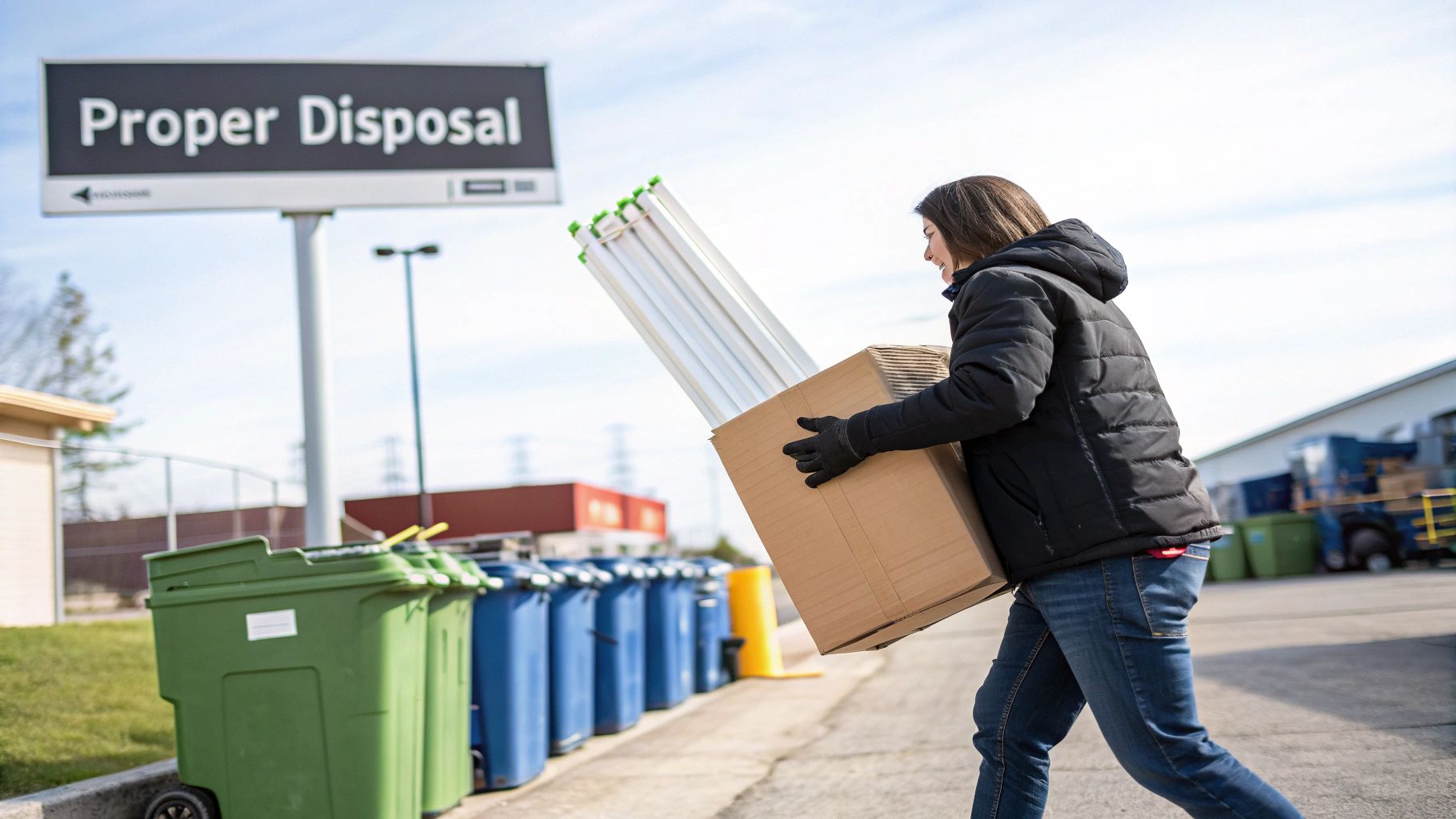
So, you’ve got your old fluorescent tubes safely packed and ready to go. The next job is finding the correct, legal place to take them. Here in the UK, you can't just toss them out for the bin lorry. The right disposal route depends entirely on whether you're a homeowner with one or two tubes, or a business managing commercial waste.
For homeowners, the process is usually quite straightforward and completely free of charge. Your local council is set up to handle this kind of hazardous material from households.
This is all governed by a strict legal framework. Fluorescent tube disposal falls under the UK’s WEEE (Waste Electrical and Electronic Equipment) regulations, which demand that these mercury-filled lamps are collected and treated separately to keep that mercury out of our environment. The scale of the problem is huge; in recent years, nearby Hampshire collected a massive 27,702 tonnes of e-waste, and Dorset's neighbour Devon wasn't far behind with 18,887 tonnes.
Using Your Local Household Waste Recycling Centre
For domestic waste, your local tip – or Household Waste Recycling Centre (HWRC) as it's officially known – is your go-to destination. Pretty much every HWRC has a special container or a dedicated area for fluorescent tubes and similar items like energy-saving CFL bulbs.
Before you set off, it's always a good idea to check your local council's website. You might need to book a time slot or just double-check the opening hours, especially if you're planning a weekend trip. When you get there, just find a staff member, let them know what you’ve brought, and they’ll show you exactly where to put them. The system is designed to make it as simple as possible for everyone.
A quick tip: Make sure you transport your tubes securely. Even on a short drive to the recycling centre, a loose tube can easily roll around in the boot and smash, creating a hazard you really don't need. Keep them in their box and lay it down flat.
Now, for anyone managing waste from a trade or business, the rules are completely different. The moment waste comes from a commercial setting, it’s covered by a strict set of legal duties.
The Business Duty of Care
If you're a business, you have a legal 'duty of care' over all your waste. This means you are responsible for it from the second it's created until it has been properly disposed of or recycled by a licensed facility. You absolutely cannot take commercial waste to a domestic HWRC. Doing so is illegal and could land you with some hefty fines.
To get rid of your business's fluorescent tubes correctly, you have to:
- Use a Licensed Waste Carrier: You must hire a company that holds an official waste carrier licence from the Environment Agency. This is your proof that they're authorised to transport hazardous materials.
- Obtain a Waste Transfer Note: Every time waste is collected, you must get the correct paperwork. For hazardous items like fluorescent tubes, this is called a Hazardous Waste Consignment Note, which tracks the waste from your premises to its final destination.
- Ensure Proper Segregation: You are required to keep fluorescent tubes and other hazardous items separate from your general commercial waste stream.
This paperwork is your legal evidence that you've disposed of your waste responsibly. It’s absolutely vital for compliance and will protect your business if you ever face an environmental audit. For a more detailed look at the rules, you might find our guide on hazardous waste disposal regulations useful.
For bigger jobs, like a full office refit in Poole or a site clearance in Bournemouth, using a professional waste management service isn't just an option—it's essential. A specialist provider can supply dedicated, compliant containers (often called 'lamp coffins') and arrange scheduled collections that suit your project timeline, making sure every single legal box is ticked.
When to Call in a Professional Waste Service
Getting rid of a couple of old fluorescent tubes from the garage? That's usually just a quick trip to the local recycling centre. But what happens when you’re staring down a pile of dozens, or even hundreds?
This is where the DIY approach starts to feel less practical and a whole lot more complicated. For bigger jobs, calling in a professional waste service isn't just about convenience—it's about staying safe and on the right side of the law.
The Tipping Point from DIY to Pro
Imagine you're managing a full office renovation or clearing out an old industrial unit. The scale is completely different. Handling a large volume of these fragile, hazardous tubes is a serious logistical challenge, and it's one you don't want to get wrong.
You’ll almost certainly need a specialist if you're dealing with:
- Commercial Refits: Upgrading the lighting across an entire office, shop, or warehouse will leave you with a mountain of old tubes.
- Site Clearances: Demolition and construction projects have a strict duty of care to dispose of all materials correctly, especially hazardous waste like fluorescent lighting.
- Regular Business Operations: Places that get through a lot of tubes, like schools, hospitals, or large factories, need a reliable, ongoing disposal partner.
- Property Clearances: If you're a landlord or managing an estate, clearing out a property can uncover years of accumulated waste, including boxes of old tubes.
In these situations, trying to ferry a van-load of fragile glass tubes filled with mercury is not just impractical; for a business, it's a risky and non-compliant move.
The biggest benefit, honestly, is peace of mind. A professional service takes the entire burden of compliance off your shoulders. They provide the right containers, handle the transport, and make sure every legal box is ticked. It frees you up to focus on the actual project.
The Real Benefits of a Specialist Service
Hiring a licensed waste carrier is about much more than just getting the tubes collected. You're paying for a complete, documented service that protects both your business and the environment.
You get access to purpose-built containers—often called 'lamp coffins'—which are designed to transport the tubes without them breaking. This is crucial for keeping that mercury safely contained.
Most importantly, you get a full paper trail. For every collection of hazardous waste, a licensed carrier must provide you with a Waste Transfer Note. This is a legal document, and it's your official proof that you've done your bit by passing the waste on to an authorised company. If you want to get into the detail, you can learn more about what a waste transfer note is and see why it’s so critical for any business.
Deciding between a trip to the tip and calling in the experts can be tricky. This table breaks down common scenarios to help you figure out the best approach.
DIY Disposal vs Professional Service: Which Is Right for You?
| Scenario | Best Disposal Method | Key Considerations |
|---|---|---|
| A few tubes from your home (e.g., shed or kitchen) | DIY Disposal | Your local household waste recycling centre is perfect for this. It's free and straightforward for domestic waste. |
| A small business replacing a dozen or so tubes | DIY Disposal (with caution) | Check if your local recycling centre accepts trade waste. Many don't, or they charge. Ensure your vehicle is suitable. |
| An office, shop, or school refitting its lighting | Professional Service | The volume is too high and risky for DIY. A licensed carrier ensures safety, compliance, and provides legal paperwork. |
| A construction site clearance | Professional Service | Essential for compliance. Waste must be segregated and documented as part of the site's waste management plan. |
| Regular, ongoing disposal needs | Professional Service | Set up a scheduled collection service. It's more efficient and ensures you're always compliant. |
Ultimately, for anything more than a handful of tubes from your own home, a professional service is the only truly responsible choice. It guarantees everyone's safety, keeps you compliant with the law, and gives you a documented, sustainable solution for getting rid of your fluorescent tubes for good.
Making the Smart Switch to LED Lighting
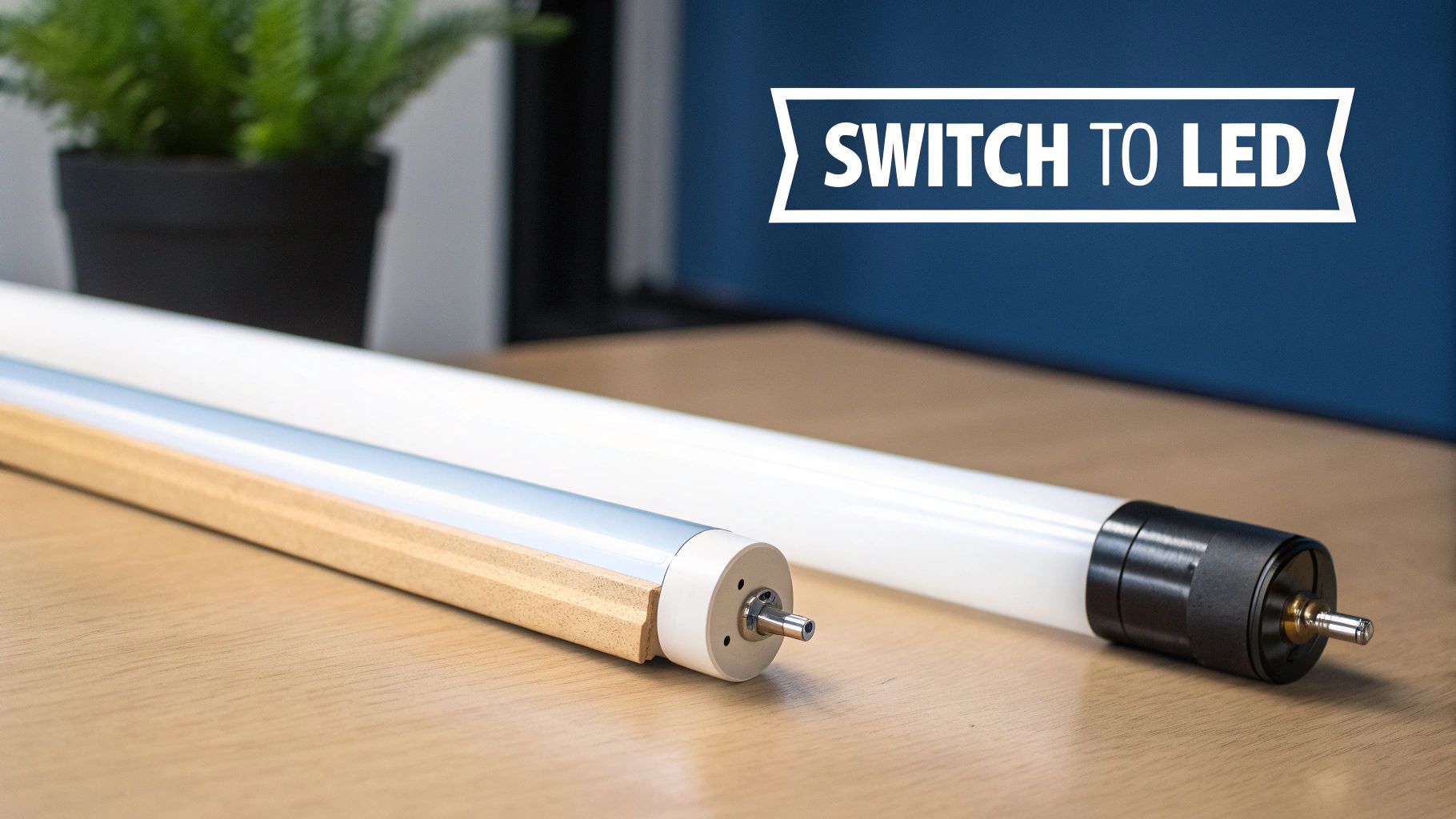
While it’s crucial to know how to get rid of fluorescent tubes safely, the best approach is to sidestep the problem completely. Upgrading to LED lighting isn't just about swapping a bulb; it's a smart decision that pays dividends for your wallet, your property, and the planet.
The biggest immediate win? You eliminate hazardous materials from your home or workplace. LEDs are completely free from the mercury that makes fluorescent tube disposal such a headache. This single change removes the health risks of accidental breakages and simplifies future disposal down the line, as old LEDs are just treated as standard electronic waste (WEEE).
The Financial and Environmental Payoff
The real case for switching to LED lighting goes well beyond easier disposal. When you look at the long-term savings and environmental benefits, it's an incredibly compelling upgrade.
- Significant Energy Savings: A modern LED tube uses 50-60% less energy than the fluorescent one it replaces. In a home, that's a noticeable drop in your electricity bill. For a business, that can quickly add up to thousands of pounds in saved overheads each year.
- A Radically Longer Lifespan: An average LED tube is rated for 50,000 hours or more. Compare that to a fluorescent, which typically gives you between 12,000 and 20,000 hours. This means far fewer replacements, saving you money on new bulbs and the time spent fitting them.
- Superior Light Quality: LEDs provide a steady, flicker-free light that’s much easier on the eyes. They also render colours more accurately than the sometimes harsh glare of older tubes. Plus, you get instant brightness without that annoying warm-up delay.
When you combine lower running costs with a much longer lifespan, the initial cost of buying the LED bulbs pays for itself far quicker than you might think.
Making the switch is a proactive environmental choice. Because LEDs last so much longer, they dramatically reduce the volume of waste heading for recycling facilities. Choosing mercury-free technology is a practical step towards creating a safer, more sustainable home or workplace.
For anyone ready to move on from fluorescent tubes for good, exploring modern energy efficient lighting options is a great starting point. The transition is about more than just replacing a bulb; it’s about upgrading to a lighting system that is cleaner, cheaper, and fundamentally better. By choosing LEDs, you solve the disposal problem for good.
Common Questions About Fluorescent Tube Disposal
Even when you understand the risks of mercury and the legal requirements, sorting out fluorescent tube disposal can still bring up a few practical questions. It's completely normal to have queries pop up when you're actually faced with the task.
Think of this section as a final checklist. We’ll run through the most common questions we hear, giving you direct answers to help you handle the job with confidence, whether you're dealing with one old tube from the shed or hundreds from a commercial site.
Can I Put Fluorescent Tubes in a Skip?
The short answer is absolutely not. You must never mix fluorescent tubes in a general waste skip.
Because they’re classified as hazardous waste, tossing them in with general rubbish is illegal under UK WEEE regulations. It’s all about preventing breakage and the release of mercury.
However, a professional waste service can provide a dedicated, enclosed container specifically for hazardous items like tubes. The key is to always inform your waste provider that you have fluorescent tubes. That way, they can arrange a fully compliant collection for you.
How Much Does It Cost to Dispose of Fluorescent Tubes?
For households, it’s usually free. Taking a small number of tubes from your home to your local Household Waste Recycling Centre (HWRC) won't cost you a penny. This service is funded through your council tax to help residents get rid of hazardous items safely.
For businesses, it's a different story. Costs will depend on a few things:
- The quantity of tubes you need to get rid of.
- Your location and how far the collection vehicle has to travel.
- The type of service you need – a one-off collection or a regular arrangement.
Commercial disposal fees cover collection by a licensed carrier, the right containment, and the specialist recycling process. Any reputable waste management company will give you a clear, itemised quote upfront, so there are no hidden surprises.
How Do I Find My Nearest Disposal Point?
If you're getting rid of tubes from home, your local council's website is the best place to start. It will have all the details on your nearest HWRC, including locations and opening times. The Recycle Now website also has a handy postcode locator tool that covers the whole of the UK.
For business quantities, your only legal route is to contact a licensed waste management company in your area. They’re set up to handle commercial hazardous waste and will arrange a compliant collection right from your site, complete with all the necessary legal paperwork.
Are New Energy Saving Bulbs Also Hazardous?
Yes, many of them are. Those spiral-shaped Compact Fluorescent Lamps (CFLs) also contain a small amount of mercury, just like their larger tube cousins. They need to be treated as hazardous waste and taken to the same collection points.
Modern LED bulbs, on the other hand, are a much safer alternative as they are completely mercury-free. While they don’t contain hazardous materials, they are still classed as electronic waste (WEEE), so they should be recycled properly rather than just being thrown in the bin.
At The Waste Group, we provide fully compliant and hassle-free disposal solutions for fluorescent tubes and other hazardous waste. Whether you're a business needing a reliable collection service or a homeowner with a large clearance project, we ensure your waste is handled safely and legally. Contact us today for a straightforward quote at https://www.thewastegroup.co.uk.