A Simple Guide to Sizes of Skips for Hire
A Simple Guide to Sizes of Skips for Hire
Trying to choose from the different sizes of skips for hire can feel a bit like guesswork, but it doesn't have to be. Getting it right is all about matching the skip to the scale of your job. It's simple, really—you wouldn't try to clear a building site with a wheelie bin, would you?
Quickly Match Your Project to the Right Skip Size
When you’re staring at a mountain of waste, the last thing you need is a complicated decision. The trick is to stop thinking in abstract terms like 'cubic yards' and start picturing how your rubbish will actually fit. A small garden tidy-up has completely different needs to a full-blown house renovation, and there's a skip size designed for just about every job.
The most common mistake we see is ordering a skip that's either too big or too small. Go too large, and you're paying for empty space. Go too small, and you'll end up needing a second skip, which means double the hassle and transport costs. Let's get it right the first time.
Finding the Perfect Fit
So, how do you avoid that classic pitfall? Start by visualising your waste in terms you already know. A standard builder's wheelbarrow holds about 100 litres, which means around ten full wheelbarrows of soil or rubble will fit into a one-cubic-yard space. This little trick makes it much easier to estimate what you need.
Key Takeaway: Think in bin bags or wheelbarrows. A small 4-yard skip, for instance, typically holds around 40 bin bags. That makes it perfect for a weekend garden blitz or a small bathroom refit. An 8-yard builder's skip? You're looking at about 80 bin bags, ideal for bigger clear-outs and renovation projects.
To help you get a better sense of what's out there, it's always a good idea to see what providers of commercial and residential dumpster rental services offer, as they often have detailed guides on what fits where.
This handy infographic breaks down the main categories: mini skips for those smaller home tasks, builders skips for renovations, and large skips for when you mean serious business.

As you can see, the type of project you're tackling is the best clue to the skip size you'll need.
To make it even simpler, here's a quick reference guide to help you match your job to the perfect skip.
Skip Size and Project Match-Up
| Skip Size (Yards) | Typical Capacity (Bin Bags) | Ideal For |
|---|---|---|
| 4 | Approx. 40 | Small kitchen/bathroom refits, garden clear-outs, minor DIY projects. |
| 6 | Approx. 60 | Bulky waste, small house renovations, moderate amounts of construction debris. |
| 8 | Approx. 80 | The classic "builder's skip." Great for large renovations and house clearances. |
| 12 | Approx. 120 | Full office clear-outs, large furniture items, significant construction jobs. |
This table gives you a great starting point for estimating your needs. Remember, it's always better to have a little extra room than to run out of space halfway through the job.
Choosing Mini and Midi Skips for Home Projects

When you’re tackling a project at home, it’s easy to think that bigger is always better. But when it comes to waste, that’s not always the case. For most DIY jobs and garden clear-outs, the smart money is on the more compact end of the sizes of skips for hire spectrum.
The mini and midi skips, particularly the 4-yard and 6-yard models, are the real champions for homeowners. Their popularity comes down to one thing: pure convenience. It can be tough to picture what 'cubic yards' means in real terms, so think of it like this: a 4-yard skip can hold roughly 40 standard bin bags. Suddenly, it’s much easier to see why they’re such a good fit for household jobs.
The Ideal Projects for Smaller Skips
So, what kind of jobs are we talking about? Essentially, anything that creates more rubbish than your weekly council collection can cope with, but not so much that you need a huge industrial container taking up the street.
- Garden Clear-Outs: The perfect solution for getting rid of soil, old turf, branches, and broken patio slabs after a weekend garden blitz.
- Small Renovations: Ideal for the debris from a bathroom or small kitchen refit, like old tiles, plasterboard, and kitchen units.
- Shed and Garage Clearances: The best way to finally get rid of all that accumulated junk, old furniture, and general clutter in one go.
One of the biggest perks of these smaller skips is their footprint. Most mini and midi skips are designed to fit neatly on a standard private driveway. This is a huge plus, as it often means you can skip the cost and paperwork of getting a skip permit from your local council, which is always needed if you place it on a public road or pavement.
Making the Right Choice
Even at the smaller end of the scale, you've got options. If space is really tight or you only have a small amount of light waste, you can find mini skips as small as 2 or 3 yards. These little powerhouses can hold between 20-30 bin bags and will slot onto almost any driveway.
Getting the size right can lead to some serious 34% efficiency gains, helping you avoid the classic mistake of paying for a bigger skip than you actually need.
Pro Tip: While a 4-yard skip is incredibly versatile, it's always worth double-checking the exact measurements to make sure it will fit where you want it. Take a look at our guide on the dimensions of a 4-yard skip for all the details.
And with services like our next-day delivery, sorting out your domestic waste has never been easier. You can have a skip arrive just as your project kicks off, fill it up in your own time, and then just call us to take it away when you're done. It makes the whole clear-out process completely hassle-free.
Why The 6-Yard Builders Skip Is The Industry Workhorse

If you ask anyone in the trade, they’ll tell you the 6-yard skip is the one they turn to time and time again. It’s earned its nickname, the ‘builders skip’, for a very good reason. It’s the perfect middle-ground, hitting that sweet spot between the smaller skips for a weekend garden tidy-up and the massive ones you see on huge construction sites.
Think of it like the trusty estate car of the skip world. It’s got enough boot space to handle the waste from a pretty serious project—like ripping out an entire kitchen or landscaping the garden—but it’s still nimble enough to fit onto most driveways without causing a headache. This blend of size and convenience makes it a real favourite for builders and homeowners alike.
The Perfect Balance Of Size And Weight
So, what can you actually fit in a 6-yarder? Its volume is big enough for about 60 standard bin bags, which is ideal when you’re dealing with all sorts of mixed, bulky waste from a clear-out or renovation. That’s why it’s one of the most popular sizes we deliver.
But where it really comes into its own is with heavy waste. This is a crucial point for anyone dealing with soil, rubble, or bricks.
Here’s a top tip from the pros: the 6-yard skip is almost always the biggest skip you can fill completely with heavy materials like soil, concrete, or bricks. Anything larger, and the skip would be too heavy for the lorry to legally and safely lift once it's full.
Because of this weight limit, the 6-yarder is the go-to choice for jobs like digging out foundations, taking down a garden wall, or getting rid of an old patio. You get the most space possible for your heaviest waste without breaking any rules. If you want to get into the nitty-gritty, our guide on how big a 6-yard skip is has all the dimensions and details.
A Popular Choice That Saves You Money
It’s not just about size; the 6-yard skip offers fantastic value for money. It helps you avoid a really common mistake: ordering a skip that’s way too big for the job. You might be surprised to learn that a whopping 73% of people hire a skip that's too large, potentially paying as much as 34% more than they needed to.
By choosing a 6-yard skip for those medium-sized projects, you’re getting the right amount of space without paying to transport fresh air. It’s the smart, cost-effective solution for countless projects up and down the country. You can even discover more insights on skip hire costs at checkatrade.com to see how prices stack up.
Scaling Up to Large Skips for Bulky Commercial Waste

When your project starts churning out more waste than a standard builder's skip can cope with, it’s time to think bigger. Large skips, specifically the 8, 10, and 12-yard options, are built for jobs that produce a mountain of lighter, bulkier materials. They’re the workhorses for big house clearances and a whole range of commercial projects.
But stepping up to these larger sizes brings a critical rule you absolutely have to know: the difference between volume and weight. While these skips give you an enormous amount of space, they are definitely not designed for heavy, dense waste like soil, rubble, or concrete.
Understanding the Volume vs Weight Rule
Let’s put it this way: picture two identical, massive boxes. You fill one to the brim with feathers and the other with rocks. They take up the exact same amount of space, but you know instantly which one is heavier. It's the same principle for these larger skips.
Our lorries have strict legal weight limits they must stick to for safety on the road. Filling a 12-yard skip with soil would make it dangerously overweight and physically impossible for the lorry's lifting gear to handle safely. This is precisely why the 8-yard skip is usually the largest size you can hire for heavy waste streams.
Crucial Point: For any skip larger than 8 yards, you must only fill it with lighter, bulky items. Think wood, metal, plastics, packaging, and large furniture. Getting this wrong can mean a refused collection and extra charges to sort it out.
Getting this right is fundamental for contractors and project managers. The 8 to 12-yard range is incredibly popular, and making the right choice saves time and money. In fact, analysis shows that professionals can save up to 34% by matching the skip to the waste type accurately, which also helps improve recycling rates. You can learn more about professional skip hire trends at designingbuildings.co.uk to see how the industry is evolving.
Ideal Projects for Large Skips
So, when is a large skip the right tool for the job? These containers are perfect for projects that create a lot of bulky but relatively lightweight debris.
- Full House or Estate Clearances: Getting rid of old furniture, carpets, and a lifetime's worth of clutter from an entire property.
- Large-Scale Renovations: Managing waste from big kitchen and bathroom refits that produce lots of mixed, lighter materials.
- Shop and Office Fit-Outs: Clearing out old fixtures, fittings, furniture, and packaging from commercial spaces.
- Construction Sites (Light Waste): Handling wood offcuts, insulation, plastic piping, and other light building materials that take up a lot of space.
An 8-yard skip can hold roughly 80 bin bags of waste, while a 12-yarder can take up to 120 bags, giving you plenty of capacity for these bigger jobs. Here at The Waste Group, we provide these larger sizes with next-day delivery, making sure your project keeps moving without a hitch.
Beyond Standard Skips with Roll-On-Roll-Off Containers
Sometimes a job is so big that even the largest standard skip just won't cut it. For those major construction projects, huge industrial site clearances, or demolition jobs, you need to call in the heavyweights of waste management: Roll-On-Roll-Off (RoRo) containers.
These are in a completely different league. Think of it this way: if a 12-yard skip is like a big transit van, a RoRo container is an articulated lorry. With massive capacities starting at 20 yards and going all the way up to 40 cubic yards, they're built for the high-volume, non-stop waste that comes from large commercial and industrial sites.
When to Choose a RoRo Container
Unlike a standard skip that gets lifted on and off a lorry, a RoRo is rolled on and off the back of a specialised truck. It's this design that allows them to handle the incredible weights and volumes that make them the only real choice for certain jobs.
- Large-Scale Construction and Demolition: They’re perfect for getting rid of huge amounts of concrete, metal, timber, and other building waste from major site developments.
- Industrial Waste Streams: Ideal for factories and manufacturing plants that produce a constant stream of bulky waste day in, day out.
- Major Commercial Clearances: The most efficient way to manage all the waste from clearing out large warehouses, retail parks, or entire office blocks.
You can get a better feel for their sheer size by checking out our detailed guide on roll-on-roll-off skip sizes.
Specialised Waste Management and Compliance
Big projects often bring tricky logistical challenges and strict safety rules. This is where having a proper waste partner, not just a skip provider, becomes essential. For instance, a site with tight or awkward access might need a grab lorry to load waste from hard-to-reach spots.
Safety and Compliance First: The moment hazardous materials like asbestos are involved, you can't just throw it in a standard skip. This requires an expert touch, with strict, legally-compliant disposal methods managed by certified professionals to keep everyone safe and protect the environment.
At The Waste Group, we look after every part of your large-scale waste needs. From delivering the right RoRo container and using our grab lorry fleet for tricky logistics, to making sure all waste—including hazardous materials—is handled responsibly and by the book.
Frequently Asked Questions About Skip Hire

Once you’ve picked your skip, a few final questions often pop up. We get it – you want the process to be as smooth as possible, from the moment you book to the day we collect.
To help you get everything sorted, we've put together answers to some of the most common queries we hear. Getting these details right from the start is the best way to avoid any unexpected hiccups or extra costs down the line.
What Happens If I Overfill My Skip?
It’s really important to keep your waste level with, or just below, the top of the skip's walls. Overfilling a skip isn't just a bit cheeky – it's illegal and incredibly dangerous. Waste can easily fall out during transport, creating a serious hazard for other road users.
Our drivers are legally required to refuse an unsecured load. If your skip is overfilled, you'll have to remove the extra waste before we can take it away. This can also lead to a wasted journey charge, so it's always best to load it responsibly. If in doubt, get a slightly bigger skip to give yourself some breathing room.
How Do I Know If I Need a Skip Permit?
This one's simple: a skip permit is only needed if any part of the skip has to sit on public land. That means a public road, a pavement, or even a council-owned grass verge. If you have a private driveway or garden where the skip can sit entirely on your own property, then no permit is required.
For many people, this is a big deciding factor when choosing between different skip sizes. Smaller skips are often chosen specifically because they're more likely to fit on a private drive, saving the hassle and cost of a permit. If you do need one, don't worry – a professional skip hire company can handle the application with your local council for you.
Are There Items I Cannot Put in a Skip?
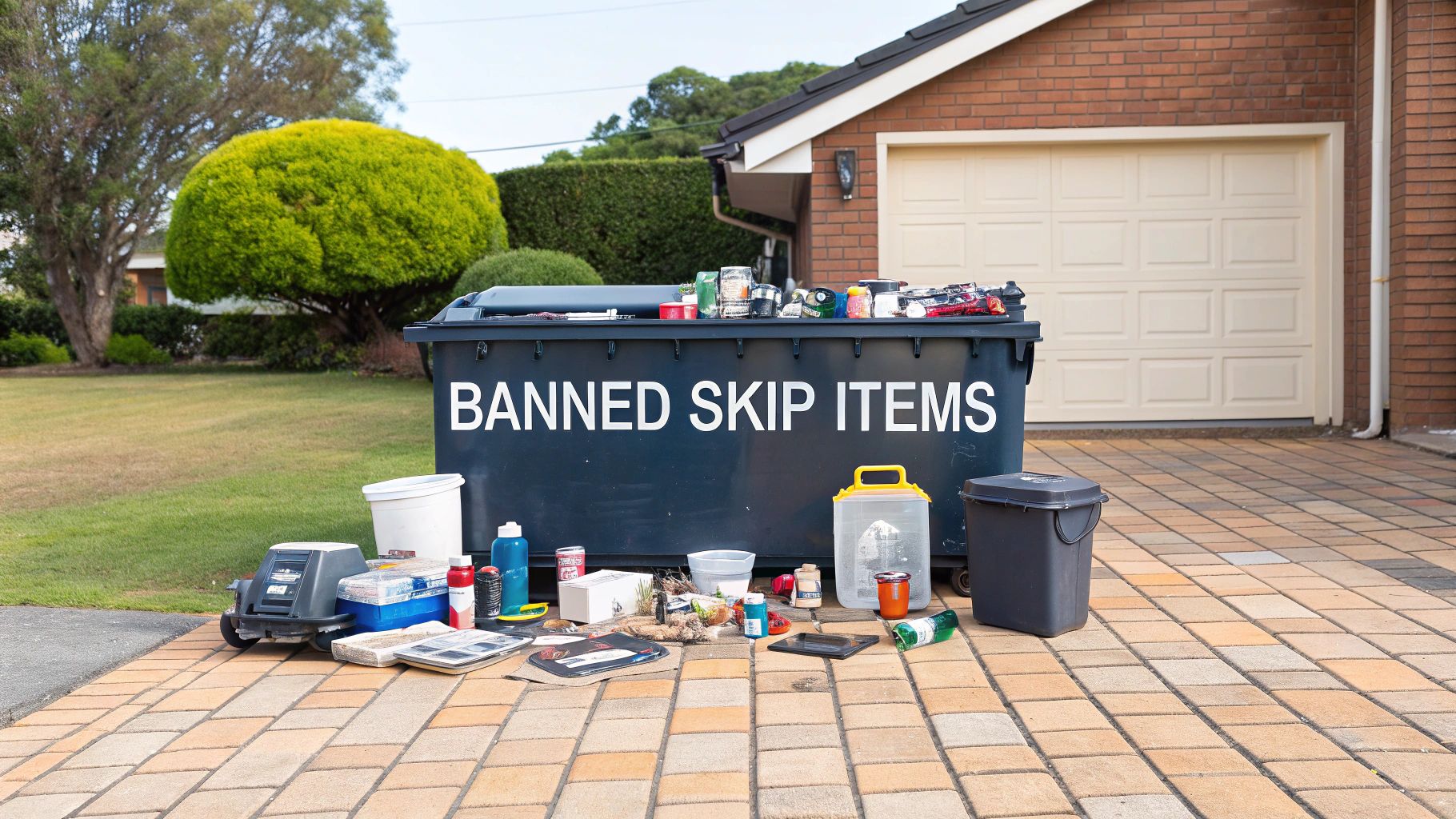
Yes, and this is a big one. Certain items are strictly banned from general waste skips because they are hazardous. Putting them in your skip will lead to a refused collection and could mean extra fees to get them disposed of correctly.
Here's a list of the usual suspects you can't put in a general skip:
- Asbestos
- Plasterboard (this needs its own dedicated bag or skip)
- Tyres and car batteries
- All electrical items (known as WEEE waste)
- Paints, solvents, and any liquids
- Gas cylinders
For something like asbestos, you absolutely must use a specialist disposal service. It's a matter of safety and legal compliance.
For a hassle-free solution to all your waste needs, from garden clear-outs to major construction jobs, trust the experts at The Waste Group. Explore our full range of services and get your free quote today.