Your Definitive Guide to UK Skip Hire Cost
Your Definitive Guide to UK Skip Hire Cost
Let's get straight to it: how much does it actually cost to hire a skip in the UK? For a small clear-out, you’re typically looking at around £100-£180 for a 4-yard skip. If you've got a bigger project on the go, a standard 8-yard builder's skip usually lands somewhere between £200 and £350.
Of course, these are just ballpark figures. The final price can shift depending on where you are in the country and exactly what you're throwing away.
Your Instant Guide to Skip Hire Prices

Getting a handle on the basic cost of a skip is the first step in planning any project, whether you're just sprucing up the garden or undertaking a full-blown renovation. Think of skip sizes a bit like shoe sizes—what’s perfect for one job won’t cut it for another, and the price tag changes to match. A mini skip is your best friend for a weekend clear-out, while a hefty builder's skip is the real workhorse for construction sites and major household projects.
To give you a clearer idea of what to expect, we've put together a simple price guide. It breaks down the typical costs for the most popular skip sizes you'll find across the UK, helping you line up your needs with your budget. If you're trying to see how skip hire fits into the bigger picture, it can be useful to look at the average UK house renovation costs to understand all the associated expenses.
Average UK Skip Hire Prices by Size
Here’s a quick-glance table showing what you can expect to pay for a week's hire on the most common skip sizes, from the smallest skips for minor jobs to the larger ones needed for building work.
| Skip Size (Cubic Yards) | Common Use Case | Typical UK Price Range (per week) |
|---|---|---|
| 4 Yard 'Mini' Skip | Small kitchen/bathroom refits, garden clearance | £100 – £180 |
| 6 Yard 'Small' Builder's Skip | Moderate domestic waste, soil, rubble | £180 – £280 |
| 8 Yard 'Large' Builder's Skip | Full house clearances, construction projects | £200 – £350 |
| 12 Yard 'Maxi' Skip | Large, bulky items, extensive renovations | £280 – £450 |
Important Note: Remember, these figures are just estimates for mixed general waste. Your final price can easily change based on your postcode, the specific type of waste, and whether you need a council permit for the skip.
These prices give you a solid starting point for your budget. But as you'll see, there are a few other key things that can make your final quote go up or down, which we'll dive into next.
Decoding Your Skip Hire Quote
Ever looked at a skip hire quote and wondered what’s really behind that final number? It's a bit like ordering a pizza – the size of the base sets the initial price, but it's the toppings and delivery details that shape the final bill. The skip hire cost isn't just one flat fee; it’s a combination of several key factors.
Getting your head around this from the start is the best way to avoid surprise charges and make sure you’re paying a fair price for exactly what you need. Let's break down the five core parts of your quote, from the skip's size to the type of waste you're chucking out.
Skip Size: The Foundation of Your Price
The single biggest thing that dictates your skip hire cost is the size of the skip itself. You wouldn’t hire a removals lorry to post a small parcel, and the same logic applies here. You need the right tool for the job. Companies price their skips based on their volume, which is measured in cubic yards.
A small 4-yard skip for a garden clear-out will, naturally, cost a lot less than a hefty 12-yard skip needed for a major house renovation. Nailing the size is crucial. If you go too small, you might end up needing a second one, which can literally double your cost. On the other hand, if you hire one that’s way too big, you’ve just paid for a load of empty space.
Waste Type: The Toppings on the Bill
Next up is what you’re actually planning to put in the skip. This has a massive impact on the price because different materials cost different amounts to dispose of, mostly down to their weight and how they need to be recycled.
Here’s a simple way to think about it:
- General Mixed Waste: This is your typical household junk, old furniture, and bits of light construction debris. It's the most common category and is usually covered by the standard price.
- Inert Waste: We're talking about heavy stuff like soil, rubble, bricks, and concrete. Skips for inert waste are often priced differently – sometimes they're even cheaper if you keep the materials separate, simply because they're easier to recycle.
- Hazardous Materials: Things like plasterboard, asbestos, old batteries, and electricals are a big no-no for mixed waste skips. They need specialised (and more expensive) disposal methods.
A quick tip: separating your waste can sometimes bring down the cost, as clean, sorted materials are more valuable to recyclers.
When you're trying to figure out different service charges, using something like a moving cost calculator can give you a good feel for how prices are put together for all sorts of logistical jobs.
Hire Duration and Council Permits
The standard hire period is usually between one and two weeks. While a lot of companies are pretty flexible, keeping your skip for longer can mean you’ll have to pay extra weekly charges.
Where you put the skip is another major cost factor. If it’s sitting on your own private property, like a driveway, there's nothing extra to pay. But if you need to place it on a public road or pavement, you’ll need a council permit. Depending on your local authority, these permits can add anywhere from £30 to over £100 to your bill.
The Overlooked Factor: Weight Limits
Finally, every skip has a maximum weight limit. Overfilling isn't just about piling things high; it’s about staying within a weight that can be safely transported. If you go over this limit, the driver might refuse to collect it, or you could be hit with significant extra charges, as disposal facilities often charge by the tonne. Always stick to the "level load" line you see on the side of the skip to avoid this expensive mistake.
Why Your Postcode Dictates the Price
Have you ever noticed how the price of the exact same thing can shoot up or down depending on where you are in the country? Skip hire is no different. Your postcode plays a surprisingly big role in the final quote, meaning the same 8-yard builder's skip in Liverpool could cost a whole lot more in London.
This isn't some random "postcode lottery," though. It's all driven by the real, day-to-day costs of running a business. Skip hire firms in major cities and down in the South East simply have higher overheads—everything from wages and business rates to insurance costs more. Naturally, those costs have to be factored into the price you pay.
The North-South Price Divide
One of the clearest examples of this is the price gap between northern and southern England. It’s a well-known trend that touches countless industries, and waste management is certainly no exception. A few key economic factors are behind this.
For starters, big urban hubs like London don't just have higher running costs. They also have to deal with stricter council regulations, pricier permits, and the constant battle with traffic, which burns more fuel and adds time to every single job. On the flip side, the level of competition in a local area can also nudge prices one way or the other; more companies vying for your business can sometimes lead to better rates.
This diagram shows the main things that come together to form your initial quote.

As you can see, while the skip size, the type of waste, and any permits are the core components everywhere, your specific location is what really sets the final price for each of them.
How Dorset Prices Compare
So, what does all this mean for anyone hiring a skip in Dorset? Well, being in the South of England means that prices in places like Bournemouth, Poole, and Weymouth are going to be more in line with the higher southern rates than the cheaper ones you might find up north.
The difference can be huge. You can sometimes see premiums of up to 70% in southern England and London compared to northern rates for the exact same skip. A tiny 2-yard skip might be £65 up north but rocket past £175 in the capital. For our customers here in Dorset, it means a standard 6-8 yard builder's skip will typically fall somewhere between £190 and £450.
To show you just how much location matters, here’s a quick look at the average prices for a standard 8-yard skip across the UK.
Regional Price Comparison for an 8-Yard Builder's Skip
| UK Region | Average Price Range (excl. permit) |
|---|---|
| North West | £220 – £260 |
| Midlands | £240 – £280 |
| South West (inc. Dorset) | £260 – £310 |
| South East | £280 – £350 |
| London | £340 – £450+ |
The table really highlights that North-South divide. It’s clear that where you live has a direct and significant impact on your skip hire bill.
Knowing how these local market forces work helps you set a realistic budget from the get-go. While you won't find northern prices in Dorset, working with a local specialist like The Waste Group ensures you get a fair, competitive rate backed by our price-match guarantee.
For a deeper dive into how prices vary from town to town, check out our guide on local skip hire prices in the UK.
The Hidden Landfill Tax Driving Up Your Bill

When you get a quote for a skip, it’s easy to assume the price is just for the hire company’s service – the skip itself, the drop-off, and the collection. But a huge slice of your bill is actually a mandatory government charge that has nothing to do with the skip at all. This is the UK Landfill Tax, an often-overlooked environmental levy that directly inflates your skip hire cost.
The tax was brought in to make sending waste to landfill more expensive, pushing everyone towards recycling instead. It’s a classic "polluter pays" principle. The more non-recyclable rubbish we all create, the more we have to pay. For skip hire companies, this tax is a direct, unavoidable cost they must pay for every single tonne of waste they take to a landfill.
Naturally, this fee is passed directly on to you, the customer. It's not an optional extra or a hidden profit margin for the company; it's a non-negotiable part of the waste disposal process that every legitimate operator has to factor into their pricing.
How the Tax Impacts Your Quote
The impact this tax has on your quote is significant, and it’s only getting bigger. In the UK, skip hire prices have been heavily pushed up by the escalating landfill tax, which is set to jump to £126.15 per tonne in April 2025. That marks a massive 38% increase from 2019 levels, and it continues to climb. For waste management companies like us here at The Waste Group in Dorset, this is a major cost driver we have to pass on just to cover the regulated disposal fees. Find out more about how disposal costs make up over half of the total skip hire price.
This means a substantial chunk of what you pay is simply settling a tax bill with HMRC. It’s a key reason why the cost of hiring a skip has risen so steadily over the years, completely separate from a company’s own running costs like fuel or wages.
Think of it like buying a festival ticket. A big part of the price isn't for the band; it's for venue hire, security, and taxes. In the same way, a huge part of your skip hire fee isn't for the skip; it's the mandatory tax for dealing with what's inside it.
Understanding this is vital. It really shows the real-world value of choosing a waste partner that genuinely focuses on recycling. Every item that can be sorted and kept out of a landfill isn't just good for the planet—it actively helps control these ever-increasing costs for everyone involved.
Navigating Commercial Skip Hire Prices
When you step up from a weekend garden clear-out to a full-blown commercial project, waste management becomes a completely different beast. For contractors, site managers, and business owners, the way skip hire works—from logistics to pricing—is on another level. It's not just about ordering a bigger skip; it’s about a structured service built for the complex, high-volume waste streams that commercial sites generate.
Commercial skip hire is all about efficiency and staying on the right side of regulations. This often means bringing in the big guns like roll-on/roll-off (RoRo) bins, which are designed to swallow massive amounts of construction or demolition debris. The pricing reflects this, calculated based on haulage fees, the weight (tonnage) of the waste, and exactly what kind of material you're getting rid of. It’s a far more tailored approach than your standard domestic hire.
Specialised Services for Business Needs
Beyond just sheer size, commercial clients often need extra services to meet tricky site requirements or just to make the whole operation run smoother. These services have their own pricing, so it's vital to factor them into your project budget from the get-go.
A few common add-ons you'll come across are:
- Wait and Load: This is an absolute lifesaver on sites where there's no room to leave a skip or where getting a permit is a headache. The driver turns up, waits while you fill the skip, and then drives it away immediately. It saves you the cost and hassle of a permit and keeps your site clear.
- Lockable Skips: If your site isn't secure or you need to control what goes into your skip (and keep it dry), a lockable lid is a must. It stops fly-tippers from filling your skip with their own rubbish overnight.
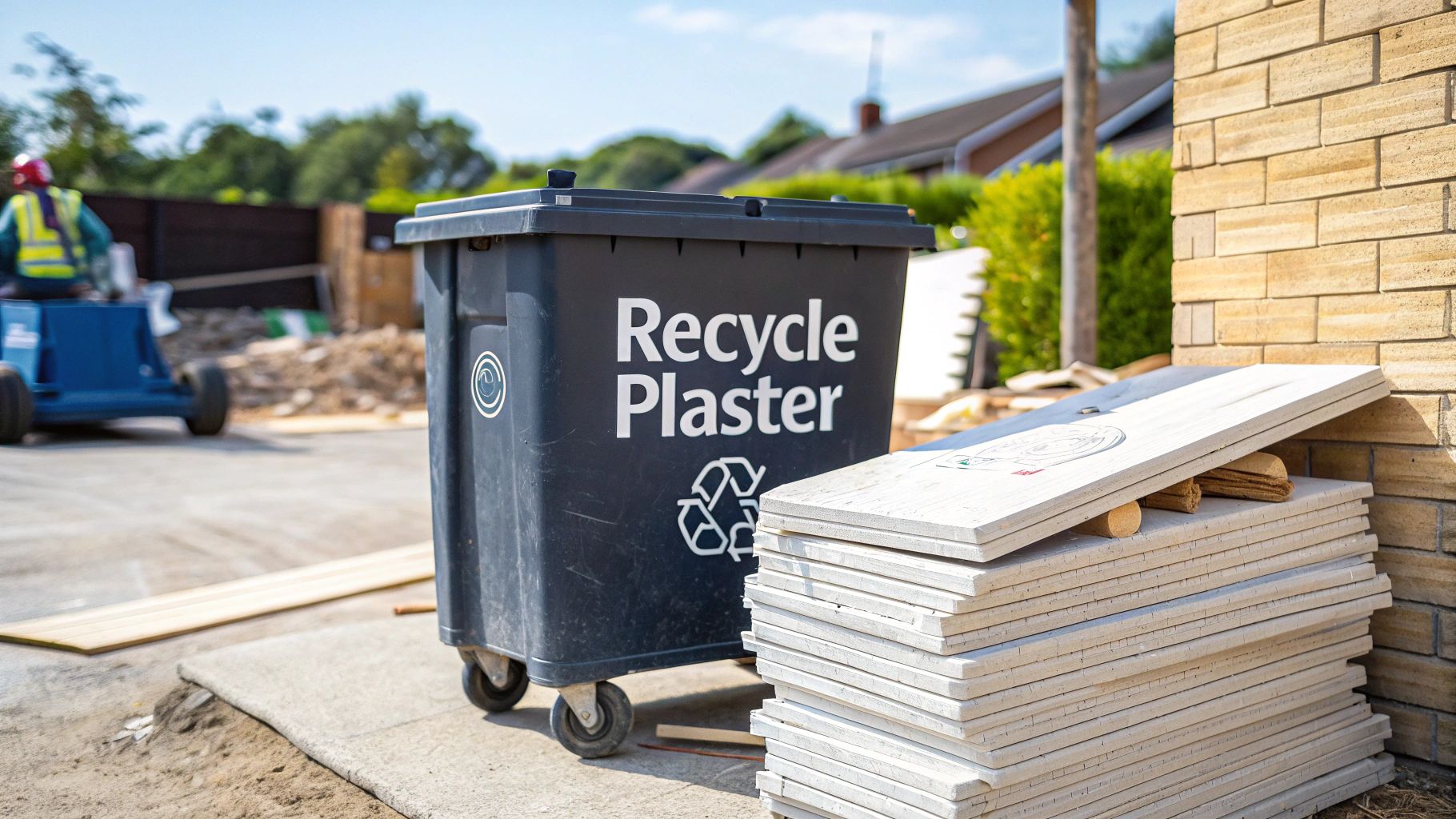
- Plasterboard Disposal: You can’t just chuck plasterboard in with general waste. Because of its chemical makeup, it has to be disposed of separately to comply with regulations. This usually means using special bags or a dedicated plasterboard-only skip, which comes with its own specific cost.
Understanding Commercial Pricing Structures
For builders and facilities managers across the UK, commercial skip hire pricing is designed to reflect both the volume and the type of material being handled. For example, a standard 8-yard skip—perfect for something like a shop refit—will typically set you back between £210 and £250 (plus VAT).
As the project scales up, so do the skips and the costs. A 12-yard skip, great for bulky packaging, might range from £260 to £320. For major clearances needing a 14-yard skip, you could be looking at £290 to £350. These figures, based on recent industry analysis, give you a solid baseline for forecasting your expenses.
To get a complete picture of what to expect when hiring for your business, our in-depth commercial skip hire guide for businesses is a fantastic resource. It breaks down everything you need to know to manage your waste streams efficiently and cost-effectively, no matter the size of your project.
Practical Ways to Lower Your Skip Hire Cost

Knowing what drives your skip hire cost is half the battle. Now for the good bit: putting that knowledge into action to actually save some money. With just a few smart moves, you can knock a decent chunk off the final bill without compromising on your project.
The aim is simple: get the most value out of every single cubic yard you’re paying for. Let's run through some tried-and-tested tips that will help keep your waste disposal budget firmly in check.
Choose the Right Size First Time
This is, without a doubt, the most critical decision you'll make. Get it wrong, and it gets expensive. Ordering a skip that’s too small often means you’ll have to hire a second one, instantly doubling your costs. On the flip side, a skip that’s way too big means you're literally paying for fresh air.
Take a few minutes to properly estimate how much waste you'll have. If you’re on the fence, it’s nearly always cheaper to go one size up than to risk needing another skip later on.
A classic mistake is forgetting about the bulky items. A three-seater sofa or an old mattress can fill a mini skip on its own. Always picture where those big, awkward things will go first when choosing your size.
Avoid Permit Fees by Using Private Land
Got a driveway? A front garden? Any private land at all? Use it. If you can place the skip on your own property, you immediately save yourself a headache and some cash.
Placing a skip on a public road or pavement requires a council permit, and that can add anywhere from £30 to over £100 to your bill, depending on where you live. This is a dead-simple way to cut your costs before you've even thrown the first bit of rubbish in.
Sort Your Waste Before You Fill
Some skip companies, including us, can offer better prices for specific, pre-sorted waste. For example, a skip filled with nothing but clean inert waste like soil and rubble is often cheaper to process than one full of mixed general rubbish.
By separating materials like wood, metal, and soil as you go, you might qualify for these lower rates. It also makes recycling far more efficient, which is a great bonus for the environment.
A few more quick wins:
- Break It Down: Maximise every last inch of space. Flat-pack that old wardrobe, smash up large pieces of wood, and stomp on any cardboard boxes. You’ll be amazed how much more you can fit in.
- Book in Advance: Don’t leave it to the last minute. Booking your skip a week or two ahead often means better pricing and guarantees you’ll get the size you need, when you need it.
- Share the Load: If your neighbour is also having a clear-out, why not team up? Splitting the cost of one 8-yard skip is always going to be cheaper than hiring two 4-yard skips separately.
For projects with lots of heavy waste like soil and hardcore, a skip might not even be your most cost-effective option. To see what else is out there, check out our guide on the average cost of hiring a grab lorry, which can be perfect for those bigger jobs.
Got Questions About Skip Hire Costs?
Even once you've got your head around the basics, a few specific questions tend to pop up right when you're about to book a skip. Getting clear, straightforward answers is key to moving forward with confidence and making sure there are no last-minute hitches with your skip hire cost.
We’ve pulled together some of the most common queries we get from our customers, covering everything from when to pay to what happens if your plans change. This quick FAQ section is designed to give you all the essential info in one easy-to-read spot.
When Do I Pay for My Skip?
Like most reputable skip hire companies, we ask for payment upfront when you place your order. This secures your booking and covers the initial delivery and reservation of the skip for your chosen dates.
Paying in advance just makes the whole process smoother for everyone. It means that on collection day, you don't have to worry about sorting out a bill; our driver can simply swing by and pick up the skip without any fuss. It keeps things efficient from start to finish.
What Happens if My Skip Is Overfilled?
This is a really important one. Every skip has a "level load" line clearly marked on the side, and it’s there for a very good reason: safety. An overfilled skip can be dangerous to transport, and our drivers are legally not allowed to collect them.
If your skip is overloaded, the driver will have to refuse the collection. You'll then be asked to remove the excess waste before we can send them back, which might mean an extra charge for a wasted journey. It’s always best to play it safe and stay below the line.
Can I Put Plasterboard in a Skip?
The short answer is no, not in a general mixed waste skip. Because of environmental regulations, plasterboard has to be disposed of separately from other materials. This is to stop it from releasing harmful gases when it breaks down in a landfill.
But that doesn't mean we can't take it off your hands. We offer specific plasterboard disposal services, which might involve dedicated bags or even a plasterboard-only skip. Just be sure to tell us you have plasterboard when you book, and we’ll sort out the correct, compliant solution for you. It guarantees your waste is handled legally and responsibly.
At The Waste Group, we believe in making waste management as simple and transparent as possible. If you have any more questions or want a competitive quote for your project in Dorset, just visit our website to book online or have a chat with our friendly team today.