
Skip Sizes UK: The Complete Guide to skip sizes uk for Any Project
Skip Sizes UK: The Complete Guide to skip sizes uk for Any Project
Struggling to figure out which skip size you actually need? It's a classic problem, but picking the right one is simpler than you might think. Getting it right boils down to having a good guess at how much waste your project will generate before you book. This little bit of prep work can save you from the headache of ordering a skip that’s too small, or wasting money on one that’s far too big.
Think about it in real terms. A 2-yard 'mini skip' is your best friend for a weekend garden clear-out or decluttering a single small room. As the jobs get bigger, so does the skip. A 4-yard 'midi skip' can easily swallow the waste from a small bathroom refit. For the really hefty jobs, like major home renovations and construction projects, the ever-popular 6-yard and 8-yard 'builders skips' are the industry standard for a reason.
Visualising Your Waste
To make the decision even easier, this chart breaks down your choice by project type.

This visual guide is a great starting point, showing how smaller, domestic jobs are perfect for mini skips, while significant renovations really need a builders skip. But what if your waste falls somewhere in between, or you're dealing with items that can't go in a skip? Sometimes, another solution is a better fit. For a different approach, you might look into hiring a junk removal company.
A good rule of thumb is to slightly overestimate. It's often cheaper to hire a skip that's one size too big than to pay for a second one later.
Ultimately, taking a moment to match your project to the right skip is the key to a smooth, cost-effective clear-up. It saves you time, money, and a lot of hassle down the line.
Understanding Skip Dimensions From Mini To Maxi
Choosing the right skip isn't just about guessing how much rubbish you have. You need to put on your engineer's hat for a moment and think about two things: volume and footprint. It’s one thing to have enough space inside the skip for your waste, but it's another to have enough physical space on your property to actually place it. This is where getting to grips with the common skip sizes UK hire companies offer is an absolute must.
Every skip size is built for a different kind of job, from a weekend garden tidy-up to a major building project. They're named after their volume in cubic yards – a traditional measurement that instantly gives you a feel for how much they can hold. Let's walk through the most common options, starting with the smallest.
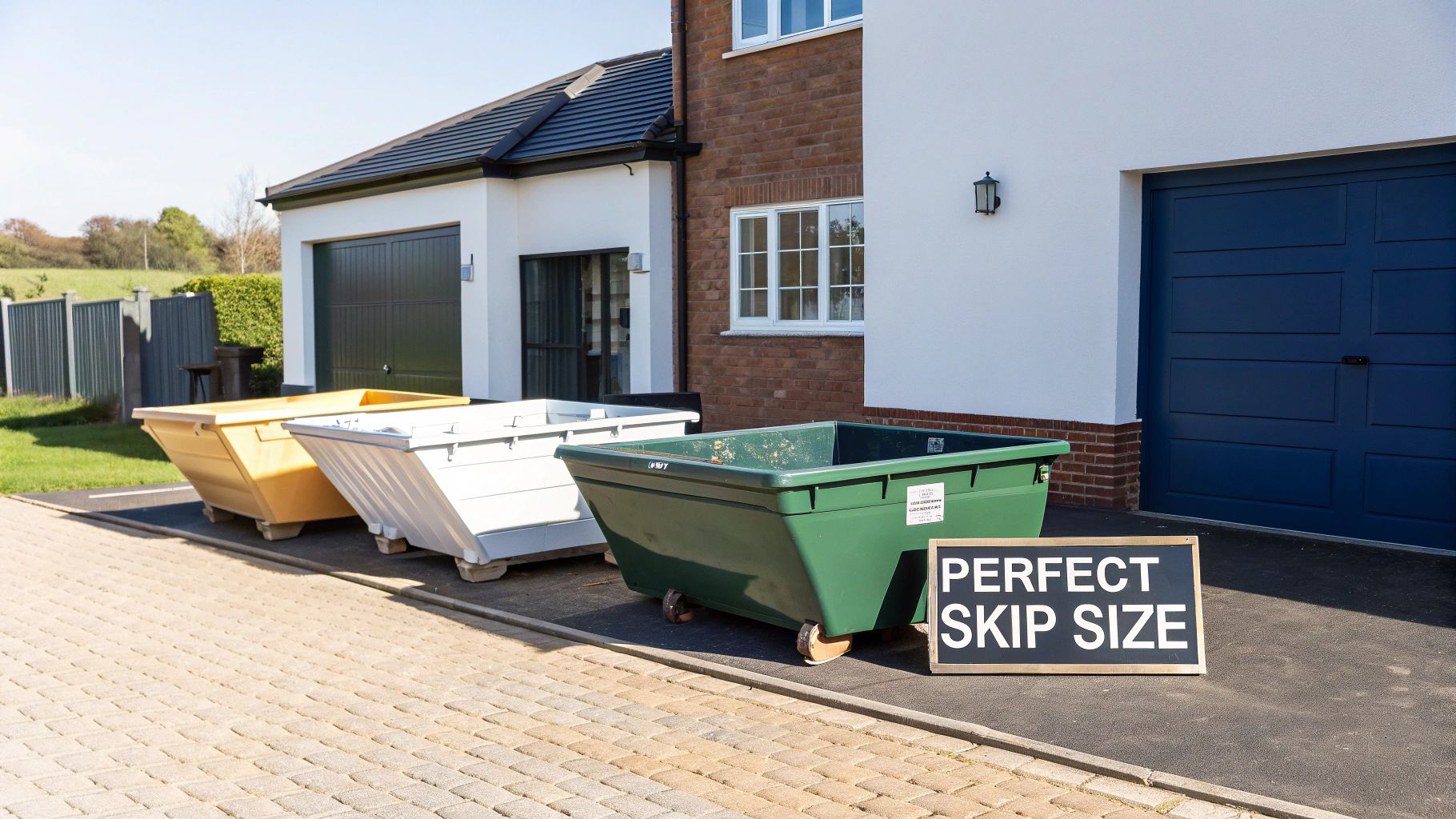
The Compact Options: Mini and Midi Skips
First up is the 2-Yard 'Mini' Skip, the most nimble option out there. Think of this as the perfect sidekick for those small but necessary clear-outs. It’s compact enough to tuck into tight spots like a small driveway or garden path, making it incredibly convenient.
- Capacity: Holds roughly 20-25 standard black bin bags.
- Ideal For: Small garden jobs, clearing out a single room, or getting rid of leftover DIY materials.
Moving up a notch, we have the 4-Yard 'Midi' Skip. This is easily one of the most popular choices for home-based projects. It gives you a decent jump in capacity from the mini, but it's still a manageable size for most residential properties.
In the UK, we measure skips in cubic yards, a tradition that's stuck around. A 4-yard skip, for example, holds about 3 cubic metres of waste. To put that in perspective, you're looking at 25-30 bin bags or around 18 wheelbarrow loads. If you want the exact measurements, its typical dimensions are around 6ft long, 4ft wide, and 3ft high. You can dive deeper in our guide to 4-yard skip dimensions.
The Workhorses: Builders Skips
When you're getting into more serious renovation territory, you'll need a builders skip. The 6-Yard 'Small Builders' Skip is the go-to for many medium-sized jobs like a full kitchen or bathroom refurbishment, or a major garden overhaul.
It hits that sweet spot of holding a good amount of bulky waste—think old kitchen units, soil, and rubble—while still fitting comfortably on most driveways.
The biggest of the standard domestic skips is the 8-Yard 'Large Builders' Skip. This is your default choice for major renovation projects, home extensions, and any significant construction work.
Important Note: While it can hold a lot, an 8-yard skip is generally the largest size you can fill with heavy waste like soil, concrete, and rubble. Any bigger, and the skip lorry simply wouldn't be able to lift it safely.
For Commercial and Industrial Projects
For those huge jobs that generate mountains of light waste—like shop fit-outs, office clearances, or large construction sites—you'll need to step up to Roll-On/Roll-Off (RoRo) containers. These are in a different league to standard skips.
- 20-Yard RoRo: A great fit for large volumes of light construction debris or commercial waste.
- 40-Yard RoRo: The big one. This is for massive commercial clear-outs and industrial sites that produce a high volume of waste.
Understanding this progression from the little mini skip to the giant RoRo helps you properly size up your own project. Now you can picture not just how much rubbish each skip can take, but also the actual space it'll need on the ground, helping you make a much smarter decision.
Matching Your Project to the Right Skip
Choosing the right skip isn't guesswork; it's about smart planning. The goal is simple: match the amount of waste you're expecting to create with the capacity of the skip. Get this right, and you'll avoid paying for a half-empty skip or, worse, having a dangerously overfilled one that needs a second, costly collection.
Let's walk through some real-world projects and connect them to the standard skip sizes UK providers offer. By seeing how they match up, you'll get a much clearer picture of what your own job requires and can book your skip with confidence.
Small Jobs and Garden Clearances
For those smaller domestic tasks, a 2-yard 'mini' skip is usually the perfect fit. It’s the ideal choice when you've got more waste than your council bin can handle but not quite enough to justify a bigger, pricier container.
Think about these kinds of jobs:
- A weekend garden tidy-up: Clearing out old bushes, turf, lawn clippings, and soil.
- Decluttering a single room: Finally emptying out that spare room, small shed, or attic.
- Minor DIY waste: Getting rid of offcuts from a small flooring or tiling project.
The mini skip's compact size also means it can fit easily on almost any driveway, saving you the hassle and cost of a council permit.
Medium Projects Like Kitchen and Bathroom Refits
When you move up to a bathroom or kitchen renovation, the amount and type of waste change completely. This is where a 4-yard 'midi' skip or a 6-yard 'small builders' skip really comes into its own. These sizes are built to handle a mix of bulky items and heavier materials.
A 4-yard skip is a great shout for a small bathroom strip-out, easily taking an old toilet, sink, tiles, and flooring. For a full kitchen remodel with old cabinets, worktops, and maybe even an appliance or two, the 6-yard skip is the safer bet. It’s an incredibly popular size for a reason—it hits the sweet spot for a huge number of homeowners tackling renovations. In fact, of the roughly 17 million skips hired in the UK each year, the 6-yarder is a firm favourite for exactly these kinds of jobs.
Pro Tip: When you're dismantling kitchens or bathrooms, try to break items down as much as you can. Flat-packing old cabinets or smashing up plasterboard can save a surprising amount of space in your skip.
Large Renovations and Construction Work
For major home extensions, big clear-outs, or proper construction work, the 8-yard 'large builders' skip is the industry go-to. It’s designed to handle a serious amount of heavy construction waste like soil, concrete, bricks, and rubble.
This is the largest skip you can reliably fill to the top with heavy, dense materials before it risks exceeding the lorry's legal lifting limit. When you're sizing up a project this big, it’s worth looking at what different providers offer. Some companies might have specialised containers or services that are a better match for your specific waste, like those found with Exayard's skip hire services.
You’ve picked out the perfect skip, but the job’s only half done. Now you need to figure out where to put it. Getting this right is absolutely crucial, because putting a skip in the wrong place can lead to hefty fines and a whole lot of hassle.
It all boils down to one simple question: is the skip going on your own private property, or on public land?
If you've got a driveway, a front garden, or another bit of private land with good access, you're golden. This is by far the easiest and cheapest option. Plonking a skip on your own property means you don't need any permission from the council. No permit, no extra fees, no waiting around. Simple.
When a Council Permit Is Required
But of course, not everyone has a convenient driveway just waiting for a skip. If the only spot is on a public road, the pavement, or even a council-owned grass verge, then you absolutely must get a skip permit.
This isn't just bureaucratic red tape; it's a serious matter of public safety. A permit ensures your skip is positioned correctly so it doesn’t block traffic, cause a hazard for pedestrians, or become invisible at night. In almost every case, your skip hire company will handle the permit application for you – after all, it’s their responsibility to make sure everything is above board.
A skip permit is a legal requirement under the Highways Act 1980. If you place a skip on a public road without one, you risk a significant fine and an order for its immediate removal. That’s a headache you definitely don’t need in the middle of a project.
Getting a permit isn't instantaneous. Most councils need a few days to process the application, so you need to factor that time into your plans. The cost can also vary wildly depending on where you are in the UK, typically ranging from £15 to over £60. If you want to get the full picture, it’s worth reading a proper guide on the subject. You can learn more about skip permits and when they are required to make sure you're fully prepared.
Safety Measures for On-Road Skips
Once the permit is sorted and your skip arrives on the road, there are a few non-negotiable safety rules that have to be followed to protect the public.
- Traffic Cones: There should be at least four cones marking out the skip’s position to help guide traffic around it.
- Reflective Markings: The skip itself must have reflective stickers on each corner, making it easy for drivers to spot.
- Night-Time Lighting: When it gets dark, safety lamps must be attached to the skip and lit to keep it visible.
Your skip provider is responsible for kitting the skip out with all this safety gear. By getting your head around these placement rules, you can make sure your project runs smoothly, safely, and legally from the moment the skip is delivered to the day it’s collected.
What Can and Cannot Go in Your Skip

Once you’ve picked out the right skip, the next big question is: what can you actually throw in it? It’s a crucial step. Getting it right isn’t just about cramming as much in as possible; it’s about avoiding surprise charges and making sure your waste gets handled the right way.
Think of it this way: a skip is the perfect tool for most jobs, but it’s not a magic bin for everything.
For the most part, skips are designed for the kind of stuff you’d expect from a clear-out, renovation, or garden tidy-up. This general household and construction waste is exactly what they’re made for.
Generally Accepted Items
You can confidently load up your skip with a whole host of common materials from around the house, garden, or building site. Things like:
- General Household Waste: Old furniture, carpets, plastics, and fittings that aren't electrical.
- Garden Waste: Soil, turf, leaves, branches, and other bits from the garden.
- Building Debris: The classic stuff – bricks, rubble, concrete, wood, and scrap metal.
- Packaging: Cardboard boxes and other simple packaging materials.
The wide variety of standard skip sizes UK providers offer is built to handle this exact mix of rubbish. It’s part of a huge system that helps manage everything from small domestic clear-outs to the 32.6 million tonnes of commercial waste England generated in 2023. You can find more fascinating UK waste stats in this report from WeArePinpoint.co.uk.
Strictly Prohibited Items
Knowing what you can't put in a skip is just as important. Trying to sneak in forbidden items can lead to the collection being refused or, even worse, some hefty fines for improper disposal. These rules are there for very good reasons, mostly to do with safety and protecting the environment.
Never mix hazardous materials with general waste. Things like plasterboard and asbestos need specialised disposal to prevent harm to people and the environment. It’s not just bad practice to mix them in—it’s illegal.
The blacklist includes anything that’s considered hazardous or needs special handling. Make sure you keep these items well away from your skip:
- Asbestos: This is extremely dangerous and must be dealt with by specialist removal services. No exceptions.
- Plasterboard: It has to be disposed of separately from all other waste.
- Electricals (WEEE): This means fridges, TVs, monitors, microwaves, and any other electronics.
- Tyres and Batteries: They contain nasty chemicals that can leak and cause contamination.
- Hazardous Liquids: Paint, solvents, oils, and chemicals are all strictly forbidden.
If you’re ever scratching your head about a particular item, it’s always best to ask first. We’ve put together a handy guide that goes into more detail on what can and cannot be put in a skip to make sure your project goes off without a hitch.
Common Skip Hire Questions Answered
Even after you’ve picked the perfect skip size and you’re clear on what can go inside, a few last-minute questions nearly always pop up. Getting these final details sorted is the key to a completely smooth hire, making sure there are no surprises when your skip arrives or when it’s time for collection.
This last section is all about clearing up those common queries with simple, practical answers. We’ll cover how long you can keep the skip, what’s actually included in the price, and why keeping your load level is so important. Think of it as the final piece of the puzzle, giving you the confidence to manage your project from start to finish.
How Long Can I Keep the Skip?
One of the first things people ask is about the hire period. How long do you actually get to have the skip on your property?
The standard hire period for most UK skip companies is one to two weeks. This window is usually more than enough time for homeowners to tackle their project, whether it’s clearing out the garden or a small renovation, without feeling the pressure. It’s a good balance, giving you ample time to fill it up while letting the hire company keep their skips in rotation.
Of course, we all know projects don’t always run like clockwork. If you find you need the skip for a bit longer, most companies are pretty flexible. You can usually arrange an extension for an extra fee, but it’s always best to have this chat upfront to avoid any confusion later on.
Key Takeaway: If your skip is on a public road and you need more time, don't forget your council permit will also need extending. Forgetting to do this can lead to a fine, so always keep your hire company in the loop to make sure everything stays above board.
What Does the Skip Hire Price Include?
Knowing exactly what you're paying for is crucial. When you get a quote for skip hire, you’re not just paying for a big metal box. The price is an all-in-one fee that bundles together several key services, which is what makes it so convenient.
A typical skip hire quote will almost always include:
- Delivery: The cost of getting the skip to your location.
- Collection: The price of picking the full skip up when you're done.
- Waste Disposal: The fees for sorting, recycling, and lawfully disposing of everything inside.
It’s a single, comprehensive charge for the entire service, from drop-off right through to disposal. The only common extra you might see is the fee for a council permit if the skip has to live on a public road. This permit cost, which can be anything from £15 to over £60, is normally organised by the skip company but passed on to you.
What Happens If I Overfill My Skip?
This is a big one. It’s so tempting to try and squeeze in that last bit of rubbish, but overfilling a skip is a serious problem that hire companies can’t just ignore. For both safety and legal reasons, skips must not be filled past the top of their sides. This is what we call a 'level load'.
An overflowing skip is a major hazard during transport. Bits of waste can easily fall off the lorry, creating a real danger for other drivers and pedestrians. Because of this, our drivers are legally required to refuse collection of any skip that’s been overloaded.
If your skip is deemed unsafe to move, you’ll be facing a few headaches:
- The driver will have to ask you to remove the excess waste until it’s level.
- This can cause delays to your day and you might be hit with a wasted journey charge.
- You’ll then be left with a pile of waste you still need to get rid of.
To avoid all this hassle, always pick a skip size that gives you a little bit of breathing room. It’s much better to have a bit of space left over than to deal with the stress and extra cost of an overfilled skip.
Ready to book the perfect skip for your project without any hassle? At The Waste Group, we offer a wide range of skip sizes with next-day delivery across Dorset. Our straightforward pricing, price-match guarantee, and expert team make waste management simple. Get your instant online quote today and let us handle the rest.