A Practical Guide to UK Trade Waste Disposal
A Practical Guide to UK Trade Waste Disposal
Let’s start with a simple truth: if your business creates any waste at all, you have a legal ‘Duty of Care’ to manage it properly. This isn't just about being a good corporate citizen or looking after the planet; it’s a non-negotiable legal requirement for every UK business, from the smallest high street café to the largest construction firm.
Getting trade waste disposal right is the very bedrock of running a responsible, compliant business.
So, What Exactly Is Trade Waste and Why Is It Such a Big Deal?
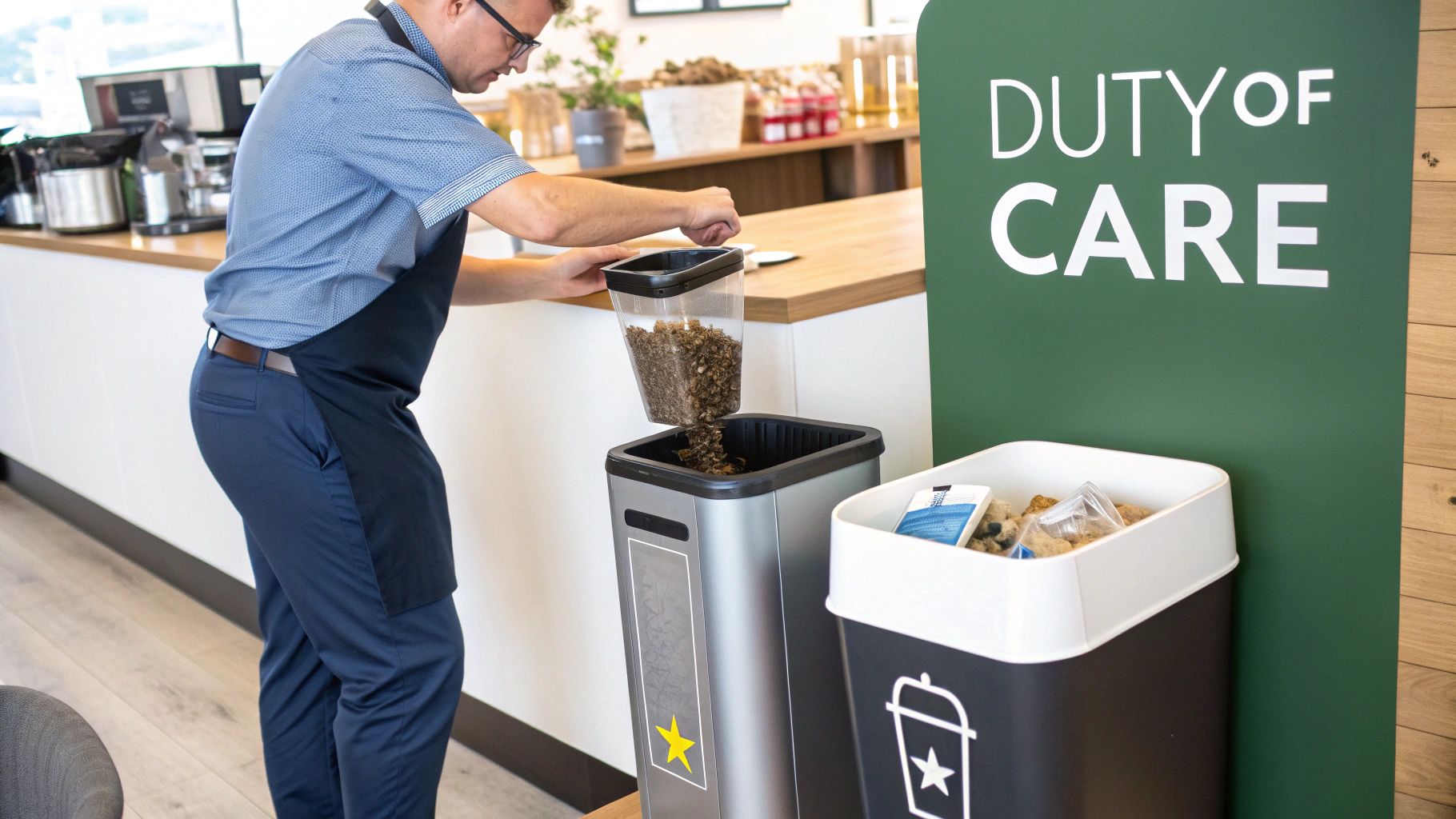
Put simply, trade waste is any and all waste that comes from your commercial activities. It covers a massive spectrum of materials. Think about the used coffee grounds from a café, offcuts from a factory floor, printer paper from an office, or rubble from a builder’s site. If your business produced it, it's trade waste.
Here’s the crucial difference: at home, your council takes care of your bins as part of your council tax. For a business, that responsibility—and the cost—lands squarely on your shoulders. You can't just pop your commercial refuse in a public bin or use your domestic collection. That's illegal.
This obligation is officially known as your 'Duty of Care', a key principle baked into the Environmental Protection Act 1990. In practice, it means you are legally accountable for your waste from the moment it's created until it has been properly and finally disposed of.
The Waste Hierarchy: Your Legal Roadmap to Compliance
To fulfil your Duty of Care, you must follow the principles of the waste hierarchy. This isn't a friendly suggestion; it's the legal framework that dictates how you should prioritise your waste management efforts, putting the most environmentally friendly options first.
The hierarchy ranks your options from best to worst:
- Prevention: Can you stop creating the waste in the first place?
- Reuse: Can an item be used again for its original purpose or a new one?
- Recycling: Can the materials be broken down and reprocessed into something new?
- Recovery: Can you get value from the waste in other ways, like generating energy?
- Disposal: As a last resort, is sending it to landfill the only option left?
This framework is so important because it legally compels you to try the options higher up the list before jumping straight to disposal. All good trade waste strategies are built around pushing as much material as possible up this ladder.
The Sheer Scale of UK Business Waste
The amount of waste UK businesses generate is staggering, and it really puts into perspective why these rules are so critical. Official government statistics estimated that commercial and industrial (C&I) waste generation was around 40.4 million tonnes in 2020. More recent figures for England alone suggest C&I waste stood at about 32.6 million tonnes in 2023, showing just how much businesses consistently produce. You can explore more about UK waste trends to get the full national picture.
Your legal 'Duty of Care' requires you to ensure that anyone handling your business waste—from collection to disposal—is a registered waste carrier. This means you must check their credentials and keep records to prove you did.
The Paper Trail: Why Waste Transfer Notes Are Essential
A huge part of proving you’re compliant is the Waste Transfer Note (WTN). Think of it as the official receipt for your waste. This is a legally required document that must be completed for every single transfer of non-hazardous waste. It spells out exactly what the waste is, how much of it there is, and who is taking it away.
Without a completed WTN for every collection, you have absolutely no proof that you’ve met your Duty of Care. If your waste is later found fly-tipped or mishandled by the company you hired, this paperwork is your only real defence. We'll dive deeper into managing this crucial documentation later in the guide.
Below is a quick summary of your core legal duties. Understanding these is the first step towards building a compliant waste management process.
Your Core Legal Responsibilities at a Glance
This table breaks down the fundamental legal duties every UK business must follow for its trade waste. Getting these right protects you from fines and ensures you're operating responsibly.
| Responsibility | What It Means in Practice | Consequences of Non-Compliance |
|---|---|---|
| Contain Waste Securely | You must store your waste in suitable containers (like bins or skips) to prevent it from escaping, causing pollution, or harming people. | Fines for littering or pollution incidents. Potential prosecution if escaped waste causes significant environmental harm. |
| Use a Licensed Carrier | You must only give your waste to a company that holds a valid Waste Carrier Licence from the Environment Agency. It's your job to check. | Unlimited fines if your waste is fly-tipped by an unlicensed carrier. You remain responsible for the waste until final disposal. |
| Complete Waste Transfers | You must ensure a Waste Transfer Note (WTN) is completed for every single load of non-hazardous waste that leaves your site. Both parties must sign it. | Fixed penalty notices or prosecution. Without a WTN, you have no proof of compliant disposal. |
| Follow the Waste Hierarchy | You must take all reasonable steps to apply the waste hierarchy (Prevent, Reuse, Recycle, Recover, Dispose) to your waste streams. | While harder to enforce directly, failure to demonstrate this can be a factor in other environmental prosecutions. |
Remember, ignorance of the law is no excuse. These responsibilities are absolute, and regulators are cracking down on businesses that fail to take them seriously.
The Smart Way to Manage Waste On-Site
Throwing all your business waste into a single bin isn't just inefficient; it's a costly mistake that directly hits your bottom line and can land you in legal trouble. Proper on-site waste management is about much more than just keeping your premises tidy. Think of it like organising your stockroom: the better you sort everything, the smoother, safer, and more cost-effective your whole operation becomes.
That’s the core principle of smart trade waste disposal. By setting up a clear system to separate different materials right where they’re created, you unlock some serious benefits. This process is called waste segregation, and it’s the most powerful tool you have for controlling costs and meeting your environmental duties.
The Financial Case for Waste Segregation
When all your waste gets mixed together, it’s classed as 'general waste'—the most expensive type to get rid of. This is largely down to the UK Landfill Tax, which is designed to make sending rubbish to landfill as painful for your wallet as possible.
But when you start separating materials like cardboard, glass, and food, they stop being 'rubbish' and become resources. These clean, segregated streams can be collected for a much lower cost. In some cases, you might even get a rebate for high-quality stuff like baled cardboard or certain metals.
- Slash Your Landfill Tax: By diverting recyclable materials away from your general waste bin, you dramatically cut down on the weight-based charges that make up a huge chunk of your disposal bill.
- Lower Collection Fees: It’s cheaper for waste carriers to process clean, separated recyclables, and those savings are often passed on to you through lower collection fees for specific recycling bins.
- Potential Revenue Streams: Got high volumes of clean metal or plastic? You can sometimes sell these to recycling processors, turning a cost centre into a modest source of income.
This approach turns your waste from a liability into a potential asset. For businesses involved in building or renovation, knowing how to handle disposal through efficient construction cleanup is a vital part of smart on-site management.
Setting Up Your On-Site System
Creating a decent segregation system doesn't have to be complicated. The secret is to keep it clear and consistent. Your goal is to make it dead simple for staff to put the right waste in the right place, which minimises the contamination that can ruin a whole bin of good recyclables.
Start by figuring out your main waste streams. For most businesses, this will mean:
- Dry Mixed Recycling (DMR): This usually covers paper, cardboard, plastic bottles, and metal cans.
- Glass: Always best kept separate to stop breakages contaminating everything else.
- Food Waste: An absolute must for hospitality, food retail, and canteens.
- General Waste: This is for anything left over that isn't recyclable or hazardous.
Get some clearly labelled, colour-coded bins and place them in sensible, accessible spots. You’d be amazed how much difference a simple sign with pictures of what goes in each bin can make in cutting down mistakes.
Simpler Recycling Makes Segregation a Legal Duty
What was once just good practice is now becoming a legal requirement for many businesses. The government has been shaking things up, and new rules are changing the game for how UK businesses must separate their waste.
A huge change on the horizon is the ‘Simpler Recycling for Businesses’ initiative. From March 2025, this UK-wide rollout will legally require organisations with ten or more employees to have separate collections for dry recyclables and food waste, on top of their general waste. This new rule is set to affect hundreds of thousands of businesses, all with the aim of boosting the amount and quality of materials we recycle.
Handling Hazardous and Specialist Waste
Getting your cardboard and food waste separated is a great start, but some materials need a whole lot more respect. We're now moving into the territory of hazardous and specialist waste—the kind of stuff that, because of its chemical or physical makeup, poses a real threat to people and the environment.
When it comes to these materials, getting your trade waste disposal right isn't just a box-ticking exercise. It's a legal minefield, and one wrong step can land your business in serious trouble.
Think of your normal Duty of Care as the baseline for all your waste. For anything hazardous, that duty gets dialled up to eleven. These items can never be tossed in with your general waste or chucked into a standard recycling bin. It’s illegal, for one, but it’s also incredibly dangerous. It can lead to fires in bin lorries, pollute soil and rivers, or cause genuine harm to the people handling it down the line.
The list of what's classed as hazardous is longer than you might think and includes many items businesses use every day.
Common Examples of Hazardous Waste
- Chemicals: This covers everything from solvents, paints, and pesticides to industrial cleaning agents and lab chemicals.
- Asbestos: Any item containing asbestos is in a class of its own. This could be old insulation board, garage roofing, or textured coatings. It requires specialist handling, period.
- Batteries: Think car batteries (lead-acid) and rechargeable ones (lithium-ion). They're packed with heavy metals and corrosive chemicals.
- WEEE (Waste Electrical and Electronic Equipment): Things like old computers, fridges, and even fluorescent light tubes contain hazardous bits and pieces, like mercury and flame retardants.
- Oils and Solvents: This includes used engine oil, industrial lubricants, and degreasing fluids.
This visual guide shows the basic flow for segregating common, non-hazardous waste streams.
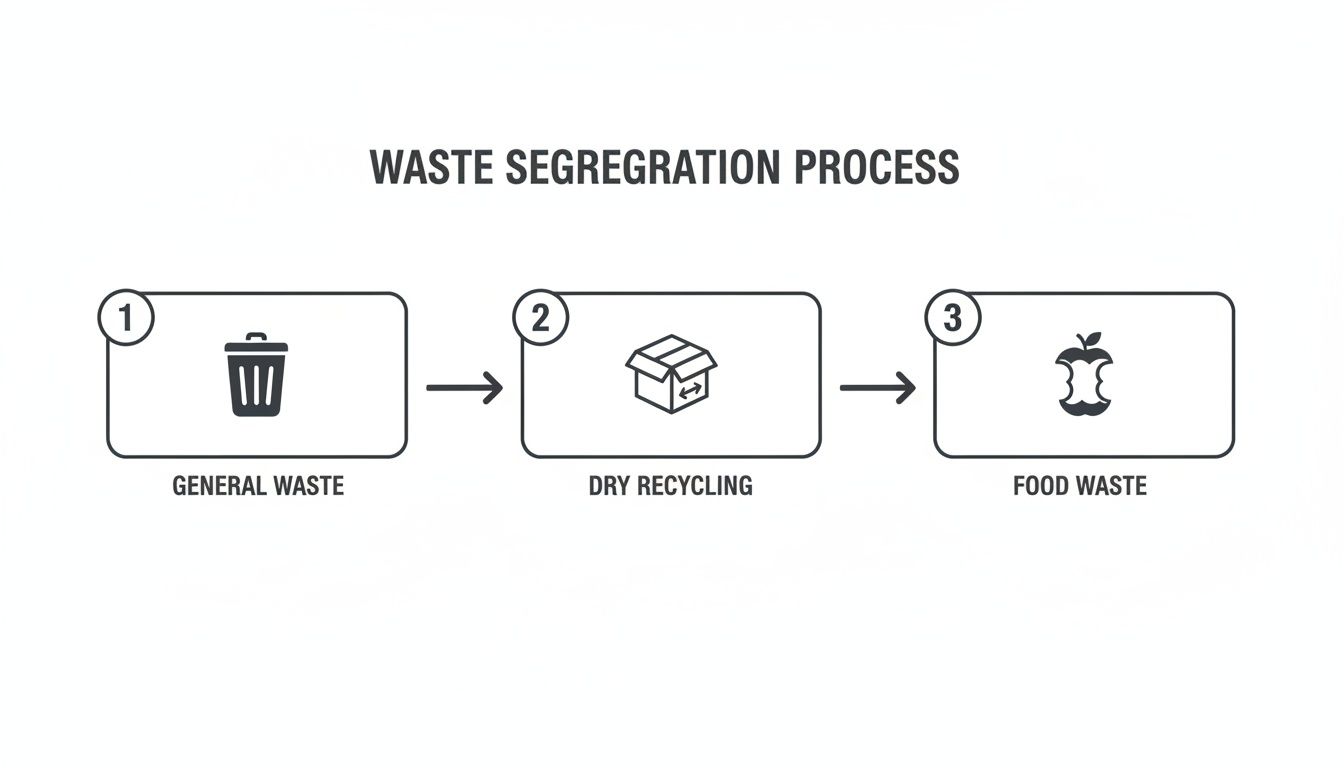
The infographic highlights why separating everything at the source is so important. It’s the foundation for proper recycling and helps you spot the items that need to be pulled out for a specialist disposal route.
The Chain of Custody for Hazardous Materials
Getting rid of hazardous waste demands a much more detailed paper trail than a standard Waste Transfer Note. The whole process is governed by a document called a Hazardous Waste Consignment Note (HWCN).
Think of this note as a legal passport for your waste. It tracks the material from the moment it leaves your site to its final, safe destruction or treatment at a licensed facility. Every single person who touches that waste—that’s you (the producer), the carrier, and the final disposal site—has to sign it.
You are legally required to hang onto your copy of the HWCN for a minimum of three years. For a proper deep dive, it's worth reading up on the finer points of hazardous waste disposal regulations to see exactly how they affect your business.
Crucially, you can only give hazardous waste to a carrier who holds a specific licence to transport it. Your general waste collector is almost certainly not authorised, so you absolutely must use a specialist provider for these materials.
Managing Other Specialist Waste Streams
Beyond the legally defined hazardous materials, other types of waste need special treatment because of what they are. These streams also need their own dedicated collection services to make sure they are handled safely, securely, and confidentially.
- Confidential Waste: This is any document or digital media holding sensitive data. We’re talking customer details, financial records, or HR files. To comply with GDPR and shield your business from data breaches, this waste must be securely destroyed, usually by shredding or incineration. You should always be given a certificate of destruction as proof.
- Clinical Waste: This is waste produced by healthcare settings like doctors' surgeries, dental practices, or even tattoo parlours. It covers things like sharps (needles), used dressings, and old medicines. Because it carries an infection risk, it must be segregated into specially marked containers and collected by a licensed clinical waste contractor.
How to Choose the Right Waste Service

Picking the right partner for your trade waste disposal is a massive decision for your business, affecting everything from your budget to your legal standing. It’s about much more than just grabbing the cheapest quote. You need a reliable, legally sound, and efficient service that actually fits what you do. Get it wrong, and you could be facing overflowing bins, missed collections, or even hefty fines.
Think of it like hiring a key member of staff. You need to do your homework to make sure they're qualified and trustworthy. After all, your legal Duty of Care doesn't just stop the second the rubbish leaves your site.
First, Look Inward: What Does Your Business Actually Need?
Before you even think about calling a waste company, you need a very clear picture of your own rubbish output. How can anyone give you an accurate quote or the right containers if you're guessing? It’s time for a quick internal audit.
Start by asking a few simple but crucial questions:
- What types of waste are you making? Get specific. Is it mainly dry mixed recycling, food scraps, glass bottles, and general waste? Or do you have trickier streams like hazardous materials or confidential documents?
- What’s your typical volume? How many bags of rubbish do you fill up each day or week? This is the key to figuring out the bin size and number you’ll need.
- How often do you need a collection? A bustling restaurant will likely need food waste collected daily, but a small office might only need a weekly recycling pick-up. Be honest here to avoid paying for half-empty bins or dealing with an overflowing mess.
Having the answers to these questions gives you a solid brief to take to potential suppliers, making sure they quote for what you actually need.
Getting to Grips With Your Container Options
Once you know your waste profile, you can start looking at the tools for the job: the containers. Waste management firms offer a whole range of options, each designed for different types and scales of business. Nailing this choice is vital for keeping your costs down and your site tidy.
To help you find the perfect fit, let's break down the most common choices available for trade waste disposal.
Comparing Common Trade Waste Containers
A comparative look at different waste collection containers to help you find the perfect fit.
| Container Type | Ideal For | Typical Capacity | Common Business Use Case |
|---|---|---|---|
| Wheelie Bins | Low to medium waste volumes; segregation at source. | 240 – 1100 Litres | Offices, small shops, cafes, and restaurants. |
| Skips | Bulky waste, short-term projects, and construction debris. | 4 – 12 Cubic Yards | Shop refits, office clear-outs, and small building projects. |
| Roll-on/Roll-off | Very large volumes of light or heavy waste. | 20 – 40 Cubic Yards | Major construction sites, demolition, and large manufacturers. |
| Grab Lorry Hire | Inert waste like soil and rubble in hard-to-reach areas. | ~16 Tonnes (8-wheeler) | Groundworks, landscaping projects, and site clearances. |
Choosing the right container from the start prevents a lot of headaches later on, ensuring you have enough space without paying for air.
How to Properly Vet a Waste Provider
With a clear idea of your requirements, you can start shortlisting companies. This is where you do your due diligence and separate the true professionals from the cowboys. Any respectable company will be more than happy to answer your questions and provide the paperwork to prove they're legitimate.
Your first and most important question should always be: "Are you a registered waste carrier and can you provide your licence number?" This is an absolute deal-breaker. You can—and should—check their status on the Environment Agency’s public register.
Beyond that critical first step, here are the essential follow-up questions you need to ask:
- Can you show me your environmental permits? This proves they are legally allowed to run their waste transfer station or recycling facility.
- What are your recycling rates? A good provider will be open about their environmental performance and committed to sustainable practices.
- Do you provide a compliant Waste Transfer Note for every single collection? This paperwork is your legal evidence that you've disposed of your waste correctly.
- What happens if I have an issue or need an emergency collection? Give their customer service a test run. You need a responsive partner, not a company that's impossible to get hold of.
- Can I get a detailed, itemised quote with no hidden fees? Keep an eye out for sneaky extra charges like bin rental, delivery fees, or excess weight penalties.
Choosing a provider who can answer these questions with confidence is your best protection. For a deeper dive, it's worth learning about the different aspects of commercial waste management services to see what a comprehensive package involves. Putting in this groundwork now will save you time, money, and stress in the long run.
Controlling Costs and Reducing Your Bill
Getting a handle on your trade waste is about more than just ticking compliance boxes; it's one of the most effective ways to tighten up your operational spending and boost your bottom line. Your waste bill isn't a fixed overhead you just have to swallow. It's a variable cost that you can directly influence by being smarter about what you throw away.
The price you're quoted is usually a combination of things. You'll have fixed charges, like your bin rental, and a standard cost for each collection. But the real game-changer, the part of the bill that can creep up, is almost always linked to the weight of your general waste. The heavier that bin is, the more you pay. Simple as that.
This weight-based charging is where costs can get out of hand for many businesses, but it's also your single biggest opportunity to save money.
How Waste Segregation Slashes Your Bill
As we've mentioned, lumping all your rubbish together means it's all classified as 'general waste'—and that’s the most expensive ticket in town. The main reason for this hefty price tag is the UK Landfill Tax. This is a government levy deliberately designed to make landfill the least attractive option financially. For every tonne of general waste you produce, this significant tax is added to your bill.
This is where getting serious about segregation turns from an environmental chore into a powerful financial strategy.
By simply separating clean, recyclable materials like cardboard, paper, plastic bottles, and glass, you're pulling that weight out of your general waste bin. This immediately cuts your exposure to the Landfill Tax, taking a huge chunk out of the most expensive part of your bill.
Think about it like this: every kilogram of cardboard you put in a recycling bin instead of the general waste skip is a kilogram you're not paying that premium landfill rate for. Those savings build up faster than you'd think.
Practical Steps to Reduce Your Costs
Beyond sorting your waste, there are several other straightforward things you can do to make your waste disposal more cost-effective. It all starts with really looking at what you’re throwing out.
- Do a Quick Waste Audit: Just for a week, pay close attention to what's actually ending up in your bins. Is food waste contaminating your dry recycling? Is your general waste bin full of flattened cardboard boxes that could have been recycled? A simple check-up like this will instantly show you where the easy wins are.
- Get Your Collection Schedule Right: Are you paying for a weekly collection when your bins are only ever half-full? Or worse, are overflowing bins forcing you to pay for expensive, last-minute emergency collections? Speak to your provider about adjusting your schedule to match your real-world needs.
- Talk to Your Waste Provider: Once you have a clearer picture of your waste streams, have a chat with your provider. You might be able to negotiate better rates for well-segregated materials or find a more efficient mix of bin sizes and collection days. A good waste partner wants to help you find savings.
Ultimately, the key is to stop seeing waste as an unavoidable cost and start treating it as a resource you can manage. When you actively control what you throw away, you're not just fulfilling your legal duties—you're making a real, positive impact on your company's finances.
Why Your Paperwork Is Your Proof of Compliance
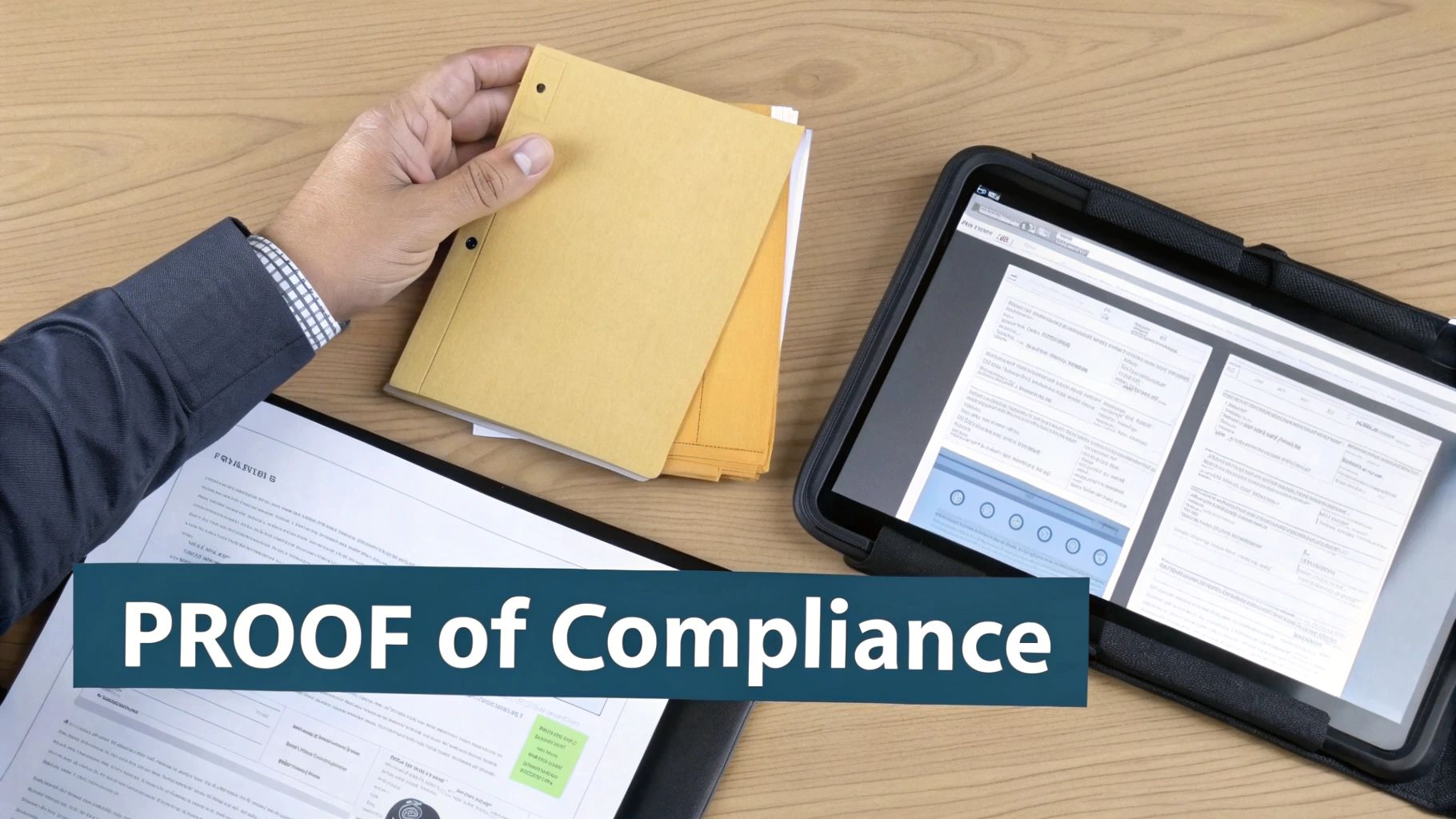
Here’s something many businesses don't realise: your responsibility for trade waste doesn't just disappear when the collection lorry rounds the corner. In the eyes of the law, you're on the hook until it's been properly and legally disposed of. Your only real defence? A solid paper trail.
Think of your waste documentation as your business's insurance policy against some hefty fines.
Without the right paperwork, you have zero proof that you’ve met your Duty of Care. If your waste somehow ends up fly-tipped and traced back to you, the first thing an inspector from the Environment Agency will demand to see is your documentation. This is the paperwork that proves you did the right thing and handed your waste over to a licensed carrier.
The Two Pillars of Waste Documentation
For every single load of waste that leaves your premises, a specific legal document has to be filled out. These notes are non-negotiable, forming the backbone of your compliance records. Getting to grips with their different roles is absolutely vital.
There are two main types you need to know:
- Waste Transfer Note (WTN): This is your standard, go-to document for all non-hazardous trade waste. It’s a formal receipt detailing what the waste is, how much there is, and the details of both your business (the producer) and the licensed company collecting it.
- Hazardous Waste Consignment Note (HWCN): For anything riskier, like asbestos or chemicals, this much more detailed note is required. It creates a complete chain of custody, tracking the hazardous material from you to the carrier and all the way to its final, specialist disposal facility.
Each note has to be accurately filled in and signed by both you and the driver at the point of collection. That simple act is what legally transfers responsibility for that specific load. If you want to dive deeper, you can learn all about what a Waste Transfer Note is and why every box matters.
Your Record-Keeping Obligations
Just filling out the notes isn't the end of the story. You are legally required to hang onto them for a set period, ready for inspection at a moment's notice. This is your long-term proof that you’ve been following the rules all along.
You must keep your completed Waste Transfer Notes for a minimum of two years. For Hazardous Waste Consignment Notes, the rule is even stricter—you must keep them for at least three years.
A simple, organised filing system is all you need, whether it’s a physical folder or a digital one. Storing them by date makes it easy to pull out exactly what an inspector asks for. While waste paperwork is a critical piece of the puzzle, it's also wise for businesses to understand the broader UK property compliance landscape to ensure every angle is covered.
Frequently Asked Questions
Even with the best plan in place, the world of trade waste can throw up some tricky questions. Here are a few straightforward answers to the queries we hear most often from businesses across Dorset.
Do I Need a Trade Waste Contract for a Tiny Amount of Waste?
Yes, you absolutely do. This is a big one that catches a lot of small businesses and sole traders out.
The moment waste is created as part of a commercial activity—even if it's just one small bag from an office bin—it's legally classed as trade waste. It doesn't matter how little there is. You can't pop it in a public bin or mix it with your household rubbish. You must have a proper agreement with a licensed waste carrier and keep your Waste Transfer Notes as proof of legal disposal.
What Is the Difference Between a Waste Transfer Note and a Consignment Note?
Think of it as two different levels of paperwork for two different levels of risk.
- A Waste Transfer Note (WTN) is your day-to-day document. It’s required for all non-hazardous trade waste and basically records what the waste is, how much there is, and who is taking it away.
- A Hazardous Waste Consignment Note (HWCN) is the more detailed, stringent document needed specifically for hazardous materials like chemicals or asbestos. It tracks the waste's journey from your site to its final disposal point, ensuring a full, unbroken audit trail.
The key takeaway is simple: WTNs are for your general and recyclable waste, while HWCNs are mandatory for anything classified as hazardous. This ensures a strict chain of custody is maintained for materials that could cause harm.
Can I Take My Business Waste to the Local Tip?
It’s almost certain the answer is no. The local recycling centre you use for your own home's rubbish is a Household Waste Recycling Centre (HWRC), and as the name suggests, it's licensed only for waste from domestic properties.
Trying to dump your trade waste there is illegal and you could face a hefty fine if caught. Some councils do have separate commercial waste disposal sites, but you'll have to pay, and you'll still need to follow all the rules—that includes having the right paperwork and a waste carrier's licence if you're transporting the waste yourself.
For a fully compliant, hassle-free solution for your business in Dorset, trust the local experts. The Waste Group offers a complete range of trade waste disposal services, from skip hire to specialist collections, ensuring you meet all your legal obligations affordably and efficiently. Find out how we can help by visiting https://www.thewastegroup.co.uk.