Where Can I Dispose of a Car Battery a Practical UK Guide
Where Can I Dispose of a Car Battery a Practical UK Guide
Got a dead car battery sitting in your garage? You’re not alone. When it's time to find out where can I dispose of a car battery, the good news is you have several straightforward—and often free—options right here in the UK. The most common spots are your local council recycling centre, big automotive retailers like Halfords, and the garage fitting your new battery.
Whatever you do, don't just chuck it in your household bin. It’s actually illegal, as they’re officially classed as hazardous waste.
Your Guide to UK Car Battery Disposal Options
A dead car battery is more than just a lump of useless metal; it's a piece of hazardous waste that demands proper handling. Tossing it into a skip or your wheelie bin isn't just a bad idea for the environment—it's against the law. These things are full of corrosive acid and heavy metals like lead, which can cause serious contamination if they seep out in a landfill.
Fortunately, getting rid of an old car battery the right way is surprisingly simple. The UK has a solid system in place for recycling them, making sure all those nasty materials are dealt with safely. For most car owners, it boils down to three main choices:
- Council Recycling Centres: You probably know it as 'the tip'. Your local Household Waste Recycling Centre (HWRC) will have a specific area just for car batteries. For residents, this is almost always a free service.
- Automotive Retailers: High-street names like Halfords or Euro Car Parts typically have a free take-back scheme. You can usually just walk in and drop off your old battery, even if you’re not buying a new one from them there and then.
- Garages and Mechanics: This is by far the easiest route. If you're getting a professional to swap out your battery, they'll almost certainly take the old one off your hands as part of the job.
Getting this right is a vital part of responsible car ownership and plays a big role in protecting our local environment. For more general advice, we’ve put together some great tips for better recycling habits that cover all sorts of household items.
Because car batteries are so hazardous, their disposal is highly regulated in the UK. The upside of this strict system is that up to 95% of a battery's components can be recovered and reused. This turns a potential environmental problem into a source of valuable raw materials. You can find more battery waste stats over at Collect & Recycle.
To help you decide which option is best for you, here’s a quick comparison.
UK Car Battery Disposal Options at a Glance
This table gives you a simple breakdown of the most common places to dispose of a car battery, looking at how convenient they are, what they might cost, and who they’re best suited for.
| Disposal Location | Typical Cost | Convenience Level | Best For |
|---|---|---|---|
| Council Recycling Centre | Free | Medium | DIY car owners who live near a centre and can transport the battery safely. |
| Automotive Retailers | Free | High | People buying a new battery at the same time or who want a quick drop-off point. |
| Garages/Mechanics | Usually Free (with service) | Very High | Anyone having their battery professionally replaced—it's a hassle-free solution. |
| Scrap Metal Yards | Potential small payment | Low | Those willing to travel and potentially earn a few pounds for the battery's lead content. |
As you can see, there's no shortage of responsible ways to get rid of that old battery. It really just comes down to what's most convenient for you.
How to Handle and Transport an Old Car Battery Safely
Before you even start thinking about where to take your old car battery, the absolute first priority is safety. A dead car battery isn't just a heavy lump of plastic and metal. It’s packed with corrosive sulfuric acid and still holds enough of a charge to be a serious fire risk if you get it wrong.
A few simple precautions are all it takes to prevent a really nasty accident.
First things first, get the right gear on. Thick gloves and safety goggles are non-negotiable. Battery acid can cause horrible chemical burns on your skin and could be catastrophic for your eyes. It might feel a bit over the top for a quick trip from the garage to the boot, but trust me, it’s a crucial first step.
Preparing the Battery for Transport
Once you're kitted out, give the battery a quick once-over. Have a good look for any cracks in the plastic casing or any signs of leakage, paying close attention to the base. If you do spot a leak, you’ll need to be extra careful.
To stop any acid from spilling inside your car, you need to contain it properly. The best way to do this is by placing the battery inside a tough, leak-proof plastic box or even a sturdy bucket. If you’re caught short, a couple of heavy-duty bin bags can do the job in a pinch. The goal is simply to create a solid barrier between the battery and your car's interior.
This flowchart gives you a good idea of the journey a battery takes once it leaves your hands.
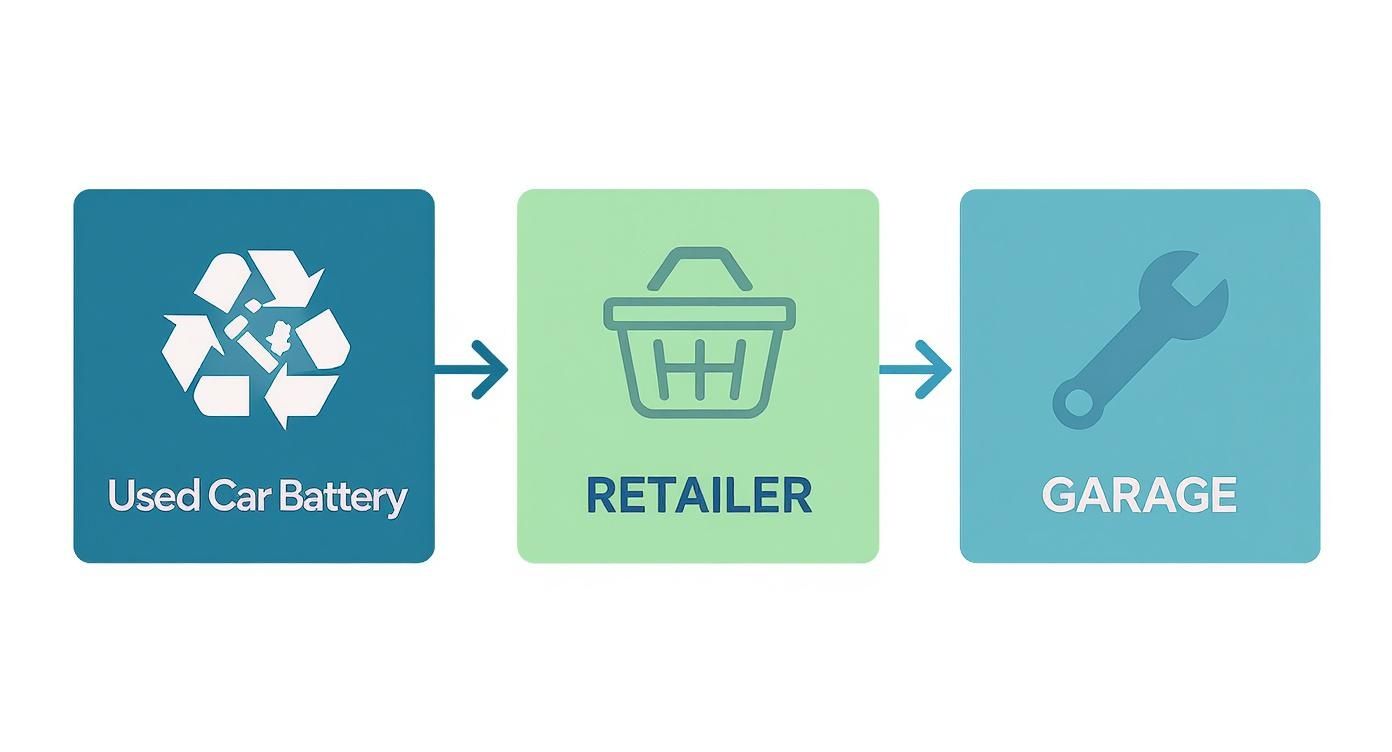
As you can see, whether it goes to a council centre, a shop, or a garage, the end game is always responsible recycling – and that process starts with you handling it safely.
Securing the Battery in Your Vehicle
Right, you’re ready to move it. Car batteries are deceptively heavy and can easily fall over if they aren’t secured. Always keep the battery perfectly upright while you're driving. This stops the acid from sloshing about and potentially leaking out of the vent caps on top.
Pop your contained battery in the boot or a footwell, somewhere flat. Then, use some old towels, blankets, or anything soft to wedge it in tightly so it can't slide around or tip over when you go around a corner or brake suddenly. Whatever you do, don't place anything metal on top of the battery. That could bridge the terminals and cause a short circuit.
A classic mistake is to assume an old battery is completely 'dead'. Even a battery that won’t start a car still holds a residual charge. If something metal, like a spanner, touches both terminals at the same time, it can create sparks. Those sparks could ignite hydrogen gas coming from the battery, causing a fire or even an explosion.
It’s also important to know your legal responsibilities. Car batteries are classified as hazardous waste, which means there are specific rules about how they must be disposed of. For a full breakdown, it's worth getting familiar with the UK's hazardous waste disposal regulations to make sure you're doing everything by the book.
By following these simple safety steps, you can transport your old battery with confidence, protecting yourself, your car, and the environment.
Using Your Local Council Recycling Centre
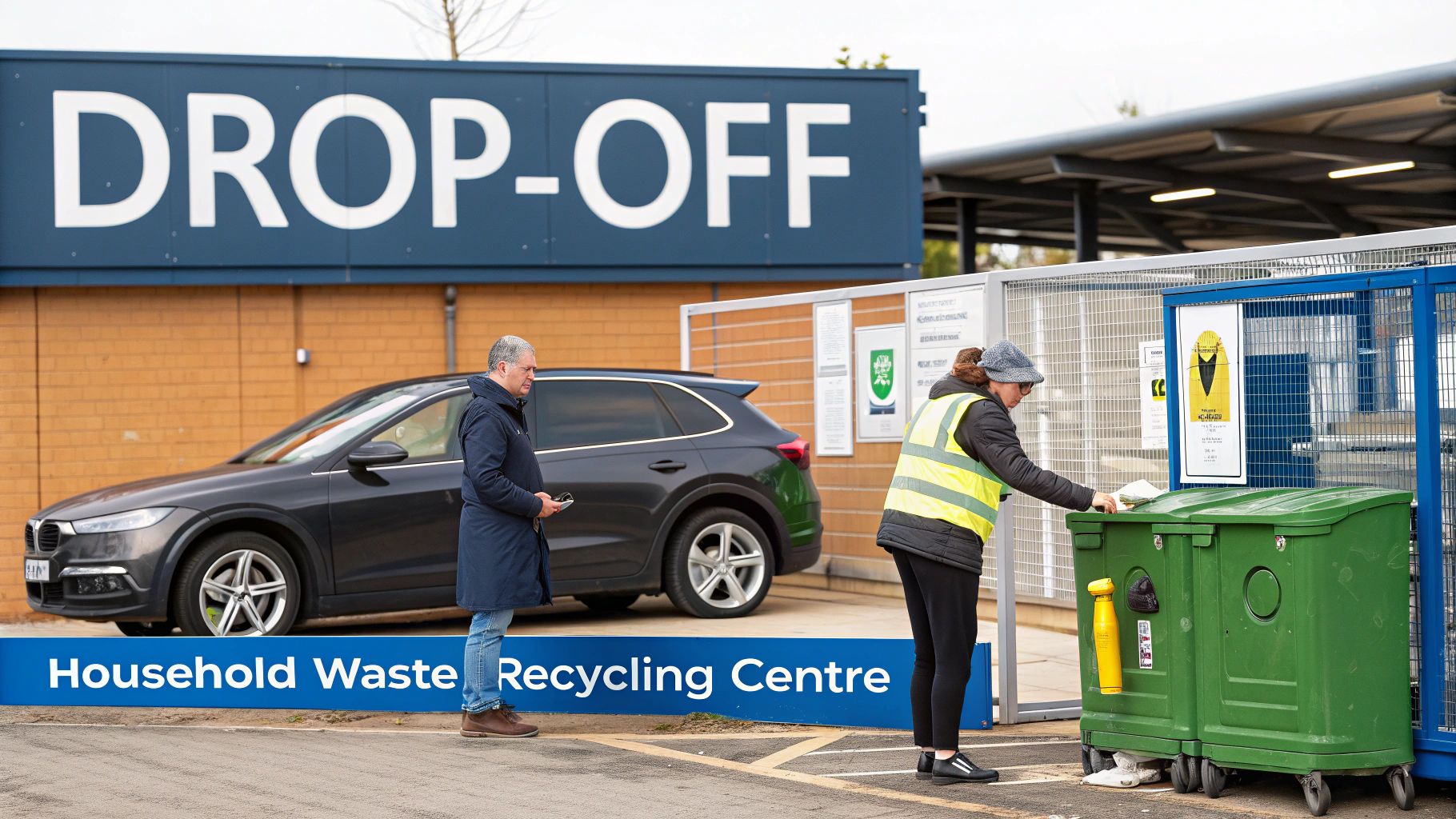
For most people in the UK wondering where to get rid of an old car battery, the first thought is usually the local tip. Officially known as a Household Waste Recycling Centre (HWRC), your council-run site is the go-to spot. They're properly set up to handle hazardous items like car batteries, which makes it a solid, reliable, and free choice.
That said, you can't always just rock up with a dead battery in the boot and hope for the best. Every council has its own quirks and rules, so a bit of prep work will save you from a wasted trip. A quick check online can make the whole process completely painless.
Before You Leave Home
The single most important thing you can do is check your local council's website. Seriously, just a quick search for something like "Dorset recycling centre" or "Poole HWRC" will point you in the right direction. This is where you'll find the make-or-break details for your visit.
Keep an eye out for these key bits of information:
- Opening Times: They often change with the seasons, and many centres shut for a day or two midweek. Don't get caught out by assuming they're always open.
- Booking Systems: A hangover from the pandemic, lots of councils have stuck with online booking systems to keep traffic flowing smoothly. You might need to book a specific time slot beforehand.
- Vehicle Restrictions: Some recycling centres have rules about vans, commercial vehicles, or trailers. If you’re planning to bring a van full of other stuff, you might need to apply for a permit first.
- Proof of Residency: You will almost definitely need to prove you live in the area. A recent council tax bill or your driving licence is usually all that’s needed.
A quick heads-up: these centres are free for your own household waste. If you’re a mechanic or tradesperson dropping off commercial waste, they will likely charge you. Make sure you state the battery is from your personal car to avoid any confusion or a surprise bill.
What to Expect When You Arrive
Once you get to the recycling centre, it's usually pretty straightforward. As you drive in, a staff member will probably greet you, check your ID or booking, and ask what you've brought with you. Just let them know you have an old car battery to dispose of.
They’ll then point you towards the designated hazardous waste area. This isn’t just a general skip you can lob things into; it's a specific, controlled section for items that can't go to landfill. The exact setup varies. Some sites have a big, caged container clearly marked for "Car Batteries," where you can place it yourself. Others might have a covered bay where an attendant takes it from you for safe storage.
Whatever you do, don't just leave it anywhere. The staff are there to help and make sure dangerous materials are handled correctly. If you're not sure where to go, just ask. By taking it to the right place, you're making sure it gets recycled properly – and with car batteries, over 95% of the components can be recovered and turned into something new.
Disposing of Batteries Through Retailers and Garages
While a trip to the local council tip is always a solid choice, it's not the only game in town. In fact, you often don’t need to make a special journey at all. Some of the easiest, most straightforward options for getting rid of an old car battery are right there in the automotive world. Retailers and garages offer simple, no-fuss ways to handle it responsibly.
Lots of places that provide car battery replacement services will also take your old one off your hands. It’s a convenient one-stop solution when you’re getting a new battery fitted anyway.
Taking Your Battery to Automotive Retailers
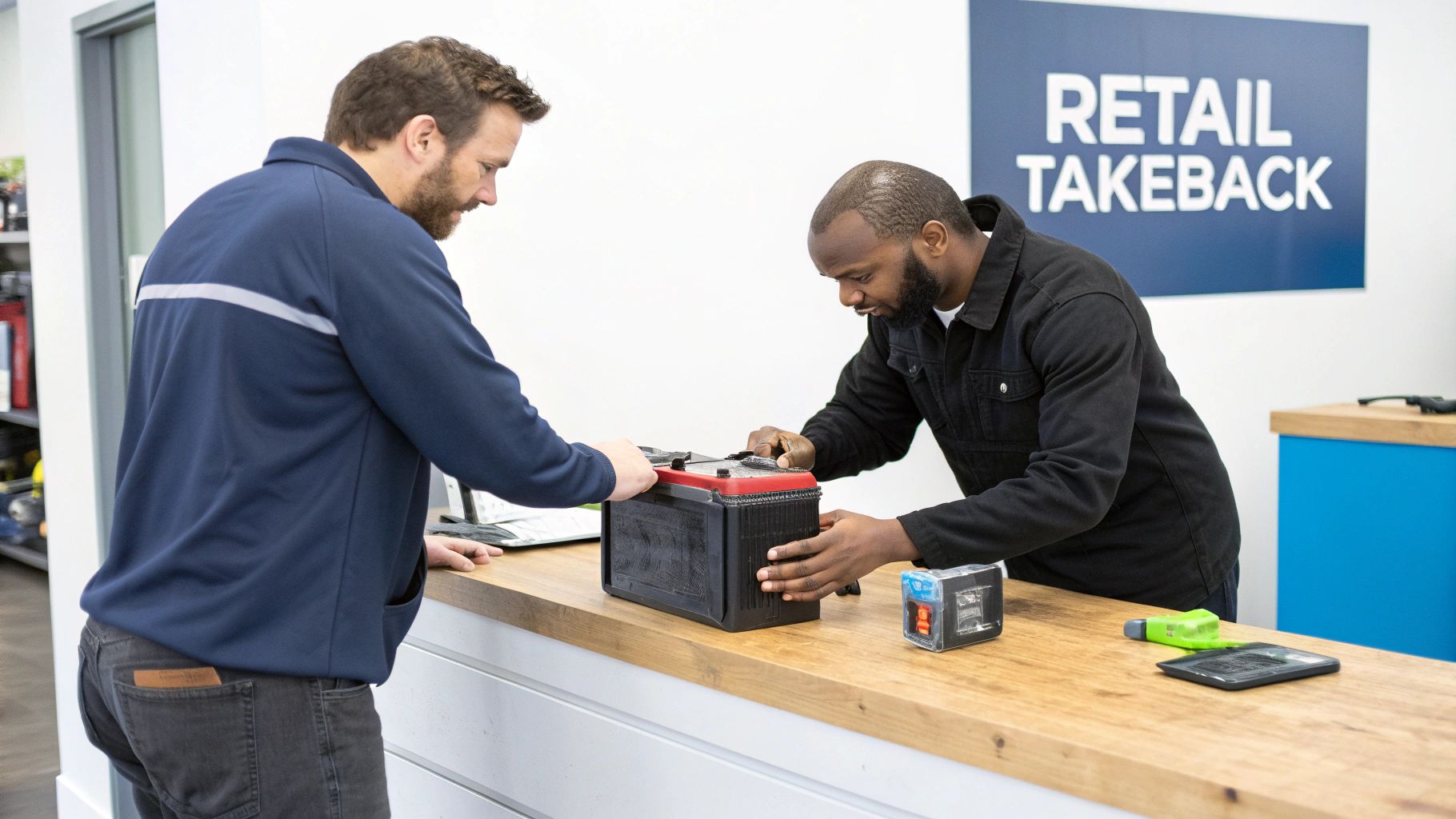
Big UK automotive chains often run "take-back" schemes, which makes dropping off an old battery incredibly simple. Think of high street names like Halfords or Euro Car Parts – they're well-known for this. You can usually just walk in with the old battery and hand it over the counter.
Best of all, this service is almost always free. You don't typically have to buy anything to use the service, though it's the perfect time to grab a new battery if you need one. Just make sure you transport it safely – upright and secured in your boot – before heading to the shop.
The Garage and Mechanic Option
If you're having a professional replace your battery, this is by far the easiest route. When a garage fits your new battery, they will almost always sort out the disposal of the old one as part of the job.
It’s a completely hands-off process for you. Garages have their own systems for storing old batteries and sending them off for recycling in bulk. That means you don’t have to think about safe transport or finding a drop-off point. It’s the ultimate in convenience.
When a garage takes your old battery, they become legally responsible for its correct disposal. This gives you peace of mind that it will be handled according to environmental regulations, contributing to the UK's circular economy for vehicle components.
Getting Paid at a Scrap Metal Yard
For those looking to get a few quid back for their trouble, taking your old battery to a licensed scrap metal dealer is another great option. Car batteries are valuable to these yards because of their high lead content. You won't get rich, but you can expect a small payment based on the battery's weight and the current market price for scrap lead.
This route does involve a few extra steps, though:
- Find a Licensed Dealer: Make sure the scrap yard is a licensed Authorised Treatment Facility (ATF). Unlicensed operators might not handle the acid and plastic casing correctly, which is bad news for the environment.
- Bring Identification: Because of the Scrap Metal Dealers Act 2013, you'll need to show a photo ID (like a driving licence) and a recent proof of address.
- Payment Method: Be aware that dealers are legally banned from paying cash for scrap metal. You’ll be paid by a bank transfer or cheque.
It requires a bit more effort than the other options, but if you've got a few batteries to get rid of, it can be worth your while.
The New Challenge of Electric Vehicle Battery Recycling
We’re all pretty used to dealing with the old lead-acid batteries from petrol and diesel cars. But the shift to electric vehicles (EVs) brings a whole new world of disposal challenges. The huge, complex lithium-ion packs that power modern EVs are a completely different beast.
You can't just treat them like their older cousins. They're much bigger, a lot heavier, and packed with a cocktail of materials that are both valuable and volatile.

Think of an EV battery less as a single block and more as an intricate system. It’s made up of hundreds, sometimes even thousands, of individual cells, all managed by a sophisticated electronic brain. This complexity means they need highly specialised facilities to be dismantled and recycled safely. Dropping one off at the local tip or a scrap yard just isn't an option.
The Growing Need For Specialist EV Recycling
The UK is bracing for the first big wave of EV power packs reaching the end of their life. As the government and car industry push towards an electric future, building the right infrastructure for lithium-ion battery recycling has become a top priority.
The numbers are staggering. Projections show we’ll go from needing to recycle 28,000 tonnes of EV batteries by 2030 to a colossal 235,000 tonnes by 2040. To keep up, UK facilities are facing tough targets, including the requirement to recycle at least 65% of a lithium-ion battery's weight by 2026.
This explosion in volume is fuelling some serious innovation in the recycling world. Cutting-edge methods are being developed to recover those precious materials locked inside, including:
- Cobalt: A critical and often expensive component in battery cathodes.
- Lithium: The key element that gives these batteries their power and name.
- Nickel: Another essential material for battery performance and stability.
To really get your head around the scale of the task, it helps to understand what’s going on inside the battery itself. You can find out more in this a comprehensive guide to electric vehicle battery technology. It makes it crystal clear why you need experts to handle them.
Second-Life Batteries and The Circular Economy
Just because an EV battery is no longer fit for a car doesn't mean it's ready for the scrap heap. Far from it. Many of these packs still hold 70-80% of their original charge capacity. While that’s not enough to guarantee a long driving range, it’s more than enough for other jobs. This has given rise to the brilliant concept of 'second-life' batteries.
This clever approach gives old EV battery packs a new purpose in less demanding roles, like storing solar energy for a home or providing backup power for a business. It's a fantastic real-world example of the circular economy.
This strategy extends a battery's useful life by years, pushing back the need for recycling and cutting down the demand for newly mined raw materials. It's a win for the environment and the economy. To see how these ideas fit into the bigger picture, check out our article on the role of the circular economy in waste management. As an EV owner, knowing about these options is all part of driving responsibly.
Common Questions About Car Battery Disposal
When you’re faced with an old car battery, a lot of questions can pop up. It’s a common situation, but since most of us only deal with it once every few years, there’s often a bit of uncertainty around the rules and what you’re actually supposed to do.
We’ve gathered the most frequent queries we hear to give you clear, direct answers. This should help you handle the disposal process correctly and with confidence.
Can I Put a Car Battery in a Skip or My Household Bin?
No, you absolutely can't. In the UK, car batteries are legally classified as hazardous waste. This is because they contain corrosive acid and toxic lead, making them a serious environmental threat if not handled properly.
Putting one in a skip or your general waste bin is illegal. If the battery casing were to crack open in a landfill, all those nasty materials could leak out, contaminating soil and groundwater for years. This is precisely why there are dedicated, safe ways to get rid of them.
A quick heads-up for anyone in Dorset: never place a car battery in a skip. Skip hire companies won't just refuse to collect it; they'll likely charge you a hefty fee to arrange for its safe removal. It's an expensive mistake to make.
How Much Does It Cost to Dispose of a Car Battery?
For most people, it costs absolutely nothing. The whole system is designed to make responsible recycling easy and accessible.
Here’s a quick rundown of what to expect:
- Council Recycling Centres: Completely free for household residents.
- Car Part Retailers: Big chains like Halfords will usually take your old battery off your hands for free, even if you're not buying a new one from them.
- Garages: If a garage is fitting your new battery, disposal of the old one is almost always rolled into the service cost.
- Scrap Metal Yards: You might even walk away with a few quid for the battery's lead content, though this is never guaranteed and depends on current metal prices.
What Should I Do if My Car Battery Is Leaking?
A leaking battery needs to be handled with extreme care, right away. That liquid is sulfuric acid, and it’s highly corrosive stuff that can cause serious chemical burns.
First things first: always wear protective gloves and safety glasses.
Carefully place the leaking battery upright inside a heavy-duty, leak-proof plastic container or bucket. This will stop any more acid from spilling out. If you're caught without one, wrapping it in several thick plastic bags can work as a temporary fix to get you to a disposal point.
When you arrive, it's crucial to tell the staff that the battery is leaking. They'll know exactly how to handle it safely from there.
Do I Need to Clean the Battery Terminals Before Disposal?
It’s not essential for the recycling process, but it’s a smart safety habit. Sometimes, the corrosion that builds up on the terminals can make the battery a bit awkward or unsafe to handle.
A quick wipe with a paste made from baking soda and water will neutralise any acid residue and make it safer to move. But honestly, the most important thing is simply making sure it's transported upright and secured so it can't tip over. The recycling facility will take care of the rest.
For any project, big or small, managing waste correctly is essential. If you're clearing out a garage or starting a renovation in Dorset, The Waste Group provides reliable skip hire and waste management solutions to keep your site clean and compliant. Find the right skip for your needs at https://www.thewastegroup.co.uk.