
Where to Dispose of Paint Cans A UK Guide for Homeowners
Where to Dispose of Paint Cans A UK Guide for Homeowners
So, you're left with a few half-empty paint cans and you're wondering where to dispose of them? The one place they almost never belong is in your regular household bin.
Proper disposal all comes down to one thing: whether your paint is water-based (like emulsion) or solvent-based (like gloss). Getting this right isn't just about being tidy; it's a legal must-do that keeps nasty chemicals out of our local environment.
The Right Way to Dispose of Leftover Paint
Let's be honest, figuring out the rules for paint disposal can feel like a bit of a headache. But it really just boils down to knowing what you're dealing with. When paint is chucked out incorrectly, it can seep into the ground, contaminating soil and water and posing a real threat to wildlife.
The scale of the problem is huge. In the UK, we generate an estimated 34 million litres of waste decorative paint every single year. A shocking amount of that risks ending up in domestic bins, creating a serious environmental hazard. This staggering figure, highlighted in data from the British Coatings Federation, really drives home why it’s so important for everyone in Dorset and beyond to know how to handle old paint cans properly.
Water-Based Versus Solvent-Based Paint
Your first job is to check the can and identify the paint type. This is the most crucial step and will tell you exactly what to do next.
-
Water-Based Paint (Emulsion): This is the stuff most of us use on interior walls. As its name suggests, it's water-based, which makes it less hazardous. You can often dispose of it with your household rubbish, but there's a catch – it has to be completely solid first.
-
Solvent-Based Paint (Gloss or Oil-Based): This category covers your glosses, varnishes, and many primers. These paints contain chemical solvents and are officially classed as hazardous waste. They must never be thrown in the bin or poured down the drain. They need specialist handling.
This simple flowchart makes it easy to see the two different paths you'll need to take.
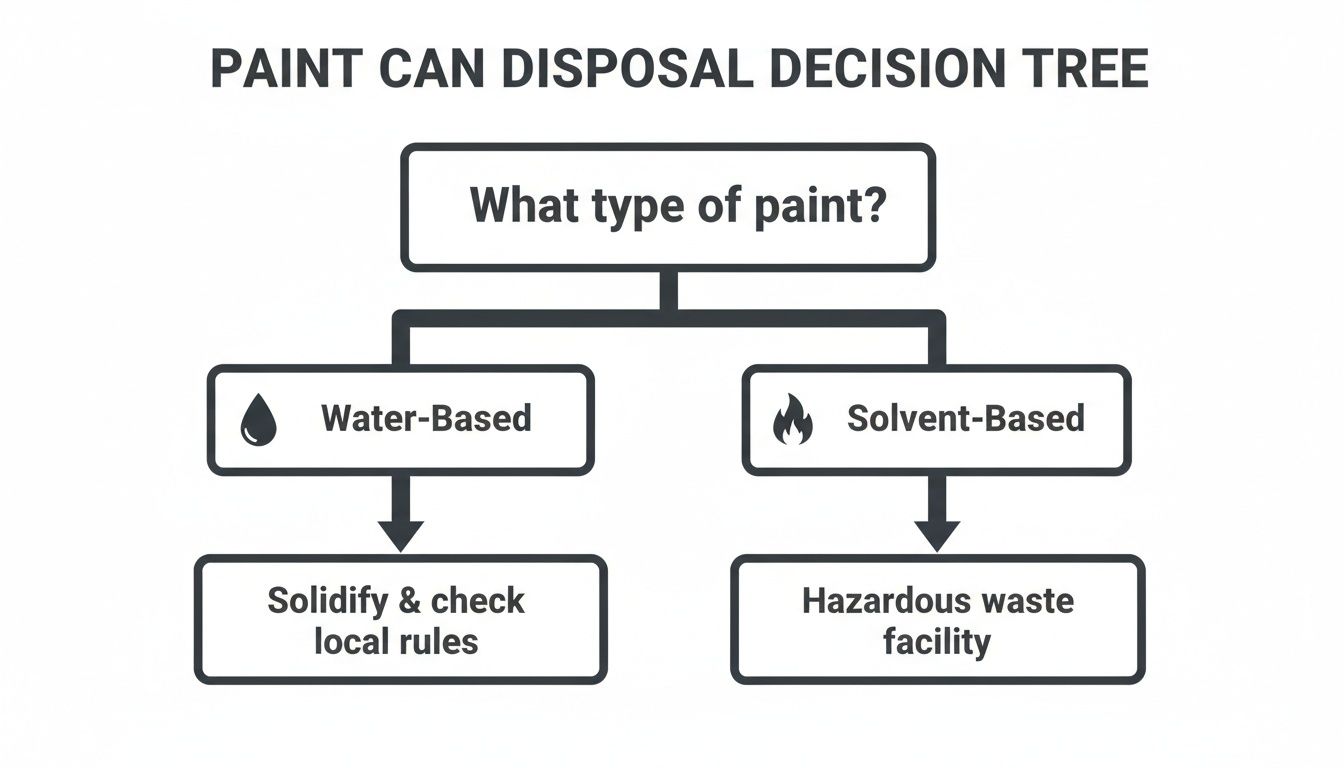
As you can see, the journey for water-based paint involves a bit of prep at home, while solvent-based paint needs a trip to a proper hazardous waste facility.
Key Disposal Routes
Once you've figured out what kind of paint you have, you can choose the right way to get rid of it. Here are the main options for homeowners:
- Household Waste Recycling Centres (HWRCs): Your local tip is usually the go-to. Most councils accept paint, but the rules can vary. Some have special areas for liquid paint, while others will only take water-based paint that has been completely hardened. Always check your local council's website first!
- Community Reuse Schemes: Got a decent amount of usable paint left? Donating it is by far the best and most sustainable option. Many charities and community projects are thrilled to take leftover paint to give it a second life.
- Specialist Hazardous Waste Collections: For nasty stuff like solvent-based paint, your council might offer a special collection service. It's worth checking, though be aware there's often a fee for this.
To make things clearer, here's a quick summary of your options.
Paint Disposal Options at a Glance
| Paint Type / Can Condition | Can It Go in Household Rubbish? | Can It Go in Recycling? | Best Disposal Method |
|---|---|---|---|
| Water-Based (Liquid) | No | No | Harden it first, or donate if usable. |
| Water-Based (Solidified) | Usually yes (check council rules) | No (paint contaminates the metal) | Household rubbish or HWRC. |
| Solvent-Based (Any) | Absolutely Not | Absolutely Not | Take to a licensed HWRC or use a hazardous waste collection. |
| Empty Metal Cans | No (due to residue) | Yes (check local recycling rules) | Scrape out residue, allow to dry, then place in metal recycling. |
| Empty Plastic Cans | No (due to residue) | Check locally | Clean thoroughly and check if your council accepts them. |
This table should help you make the right call quickly and safely.
Key Takeaway: If there's one thing to remember, it's this: never put liquid paint of any kind in your regular bin. It must either be hardened (if it's water-based and your council allows it), donated, or taken to a proper waste facility.
Getting Your Paint Cans Ready For Disposal
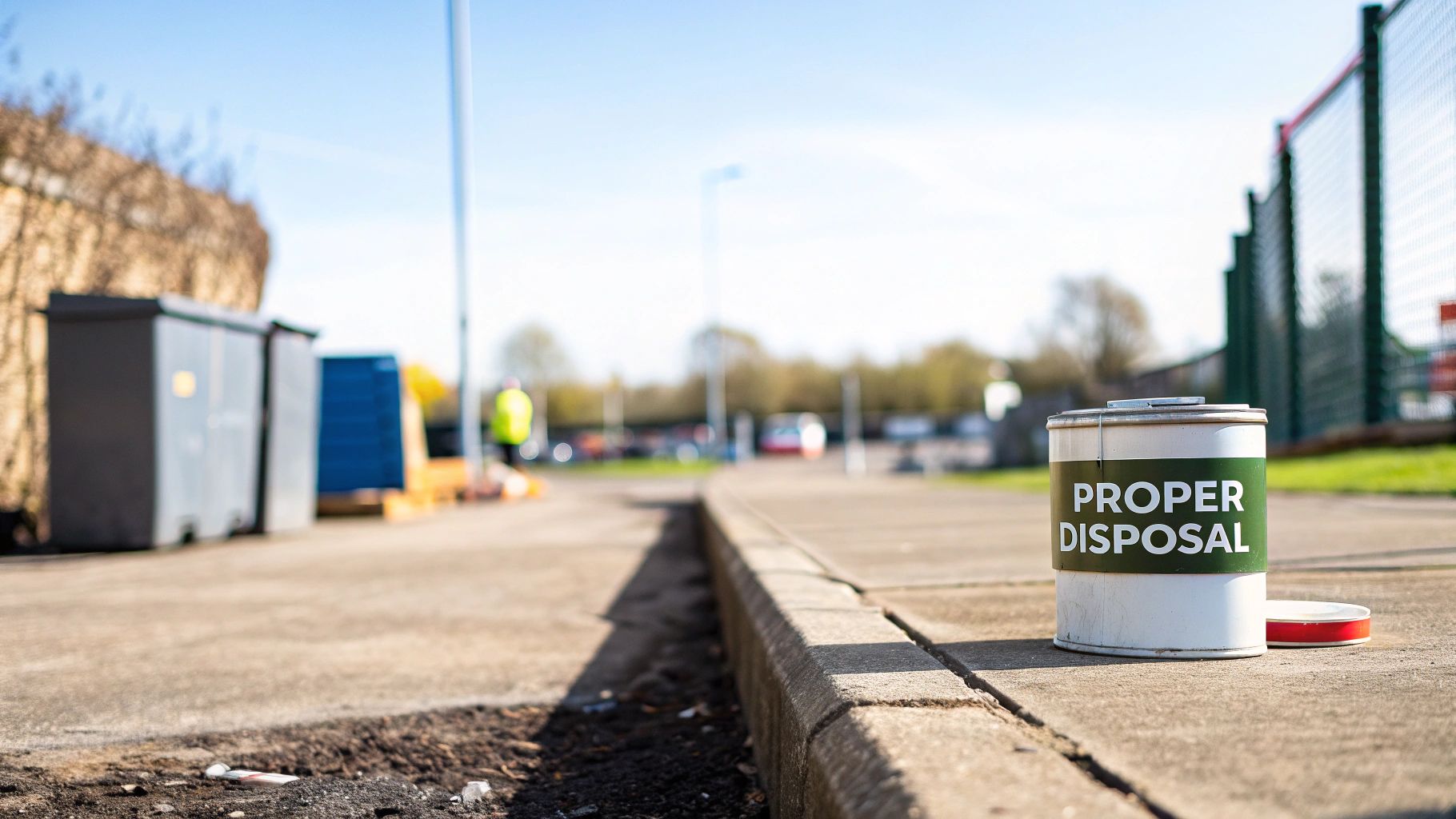
Before you can even think about where your old paint cans are going, there's a bit of prep work to do. This isn't just about ticking boxes; it's about making sure your waste is handled safely, legally, and in a way that’s kind to the environment. What you do now determines whether your cans get recycled or just end up in a landfill.
How you prepare a can all comes down to what kind of paint is inside. As we’ve mentioned, water-based (emulsion) paints are handled very differently from their hazardous solvent-based (gloss) cousins. Getting this right is absolutely crucial.
Dealing With Leftover Water-Based Paint
So, you've just finished painting a room and you're left with a quarter of a tin of emulsion. You can't just toss it in your household rubbish as-is – liquid paint can spill, creating a huge mess for the waste collectors. The main goal here is to solidify it first.
Many local councils are happy to take dried water-based paint in your general waste, but always double-check their specific rules before you do.
To dry the paint out, you’ll need to add a bulking agent to soak up the liquid. Chances are, you already have something suitable lying around the house.
- Cat Litter: A brilliant and super-absorbent option.
- Sawdust: If you've been doing any DIY woodwork, this is a great, free resource.
- Soil or Sand: A scoop from the garden will do the job perfectly well.
Just mix one of these materials into the leftover paint until it becomes thick and clumpy. Then, leave the lid off in a well-ventilated spot, safely away from any kids or pets. In a day or two, it should be a solid block, ready for disposal according to your council's guidelines.
Why You Must Not Dry Out Solvent-Based Paints
Now for the solvent-based stuff, like glosses and varnishes. The advice here is completely different, and it's vital for your safety. Never, ever attempt to dry out solvent-based paints.
These paints are packed with volatile organic compounds (VOCs) which are not only flammable but also release harmful fumes as they evaporate. Trying to air-dry them, especially indoors, is a serious fire hazard and is terrible for your health.
For all solvent-based or oil-based paints, the rule is simple: keep the lid on tight. The paint must stay in its original, sealed container to be taken to a licensed hazardous waste disposal point. You'll usually find one at your local Household Waste Recycling Centre (HWRC).
Preparing Empty Paint Cans For Recycling
What about the cans that are properly empty? This is where you can make a real difference to recycling rates. Metal paint tins are highly recyclable, but only if they're prepared correctly. Even a little bit of wet paint residue can contaminate an entire batch of metal recycling, meaning the whole lot gets sent to landfill.
Here’s what to do with your empty cans:
- Scrape It Out: Use an old spatula or scraper to get as much of the leftover paint out as you can.
- Wipe It Clean: Grab some old newspaper or a rag and give the inside of the can a good wipe. For water-based paints, a quick rinse might help, but make sure it’s completely dry afterwards.
- Let It Air Dry: Leave the lid off for a few hours to ensure every last drop of moisture has evaporated. The can needs to be bone-dry.
Once the can is clean and dry, it can usually go in with your other metal recycling. But again, it’s one of those things you must check with your local council, as some have their own specific instructions.
While you're sorting your paint cans, remember that other materials from your project also have strict disposal rules. To get a better idea of what else needs special attention, check out our detailed guide on what you can't put in a skip. It'll help you manage all your project waste responsibly.
Right, so you’ve prepped your paint cans. What’s next? Getting rid of them legally and safely is simpler than you might think, but the rules can change quite a bit from one council to the next. You'll generally have three routes to go down: the local tip, community donation schemes, or bringing in the professionals for bigger clear-outs.
Each option is designed for a different situation. Whether you’re dealing with a single tin of hardened emulsion or managing the aftermath of a massive renovation, picking the right one means you're handling waste responsibly and steering clear of any fines.
Visiting Your Household Waste Recycling Centre
For most of us, the local tip – or Household Waste Recycling Centre (HWRC) – is the go-to for anything that can't be tossed in the kerbside bins. The good news is that almost all of them accept paint. The catch? Their rules are anything but consistent.
This is the golden rule: always check your local council’s website before you load up the car.
You'll usually find a special area for hazardous waste where you can drop off any solvent-based paints. But for water-based stuff, things can get a bit more specific.
- Some centres insist that water-based paint is completely solid before they’ll take it.
- Others have dedicated containers for liquid paint, saving you the hassle of drying it out.
- A few might limit how much you can bring at once, often to around five litres.
Don't just turn up and hope for the best. The staff on-site can (and will) refuse anything that doesn’t meet their guidelines, leaving you with a car full of paint tins and a wasted trip. A quick search for "[your council name] paint disposal" should give you all the info you need.
Community Repaint Schemes A Greener Option
Before you automatically head for the tip, hold on a second. Could that leftover paint have a second life? If you've got a good amount of usable, quality paint, donating it is by far the most eco-friendly choice. That's where Community Repaint schemes are brilliant.
These networks collect leftover paint and pass it on to charities, community groups, and people who really need it. Your half-full tin of magnolia could end up brightening a village hall, helping a local theatre group with their stage set, or allowing a low-income family to decorate their home. It's a small act that makes a big difference, cutting down waste and helping your community.
Donating usable paint is a perfect example of the circular economy in action. It prevents a perfectly good product from becoming waste and channels it back into society where it has real value.
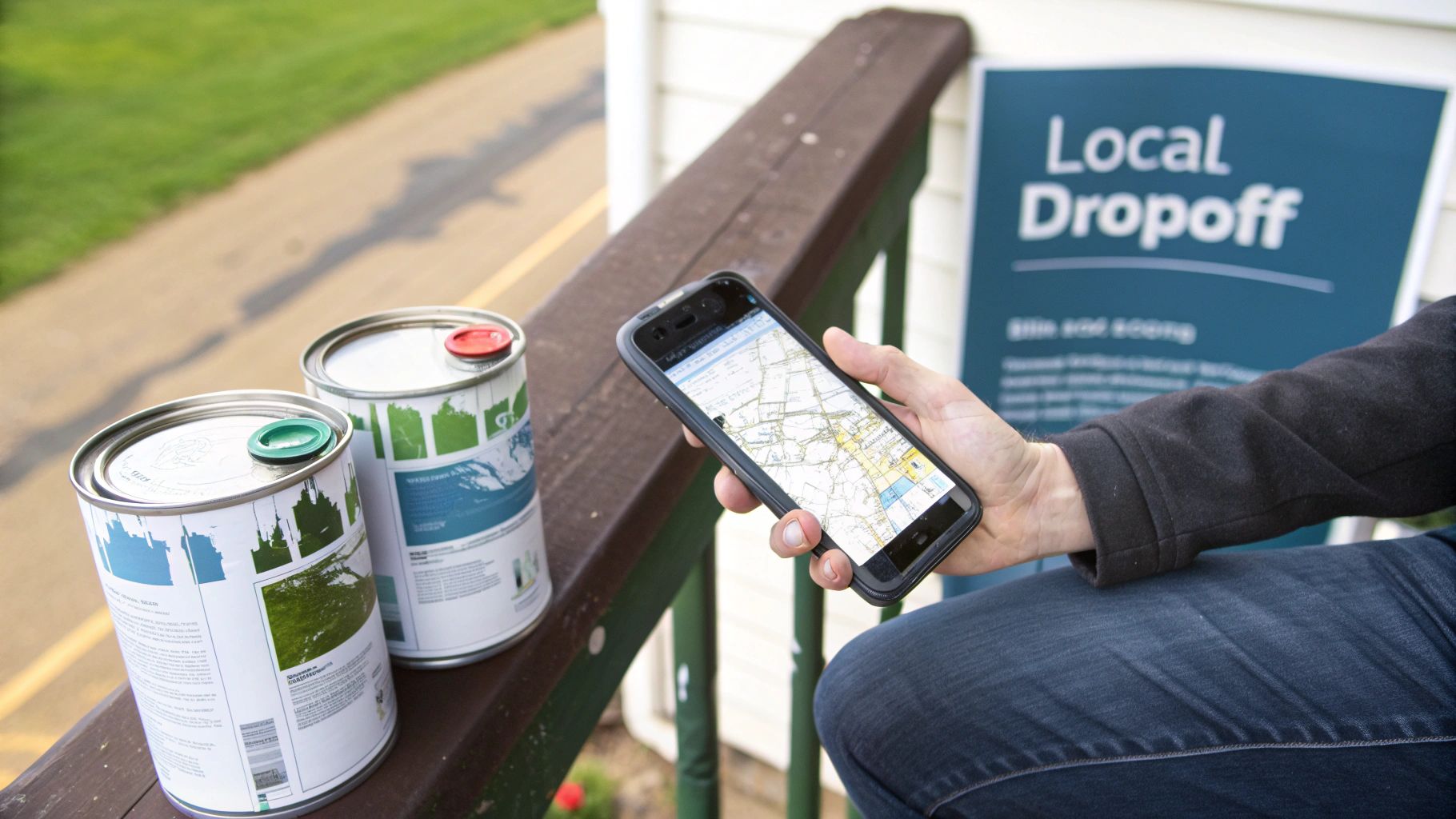
Finding a local scheme couldn't be easier. Just pop your postcode into the locator tool on the Community Repaint website to find your nearest drop-off point. Many HWRCs even have collection points now, so you might be able to donate and dispose of other waste in one go.
Commercial Services for Large Projects
What if you're dealing with more than just a couple of leftover cans? For decorators, landlords, or anyone in the middle of a huge renovation project, the sheer volume of paint waste can be overwhelming. In these cases, the local HWRC probably isn't an option, as they're set up for household waste, not commercial quantities.
This is when you need to call in the professionals.
- Hazardous Waste Contractors: If you've got a large amount of solvent-based paint, a licensed hazardous waste contractor is your only compliant option. They’ll provide the right containers and all the necessary paperwork, ensuring you meet your legal 'Duty of Care'.
- Skip Hire: Got stacks of empty, dried-out paint cans along with other building rubbish? Hiring a skip is a really efficient solution. You can chuck all the non-hazardous waste in together, saving you a lot of time and hassle. Our guide on finding waste disposal services near you has some great tips for finding reliable local companies for any size of project.
For any trade or large-scale job, using a registered waste carrier like The Waste Group is non-negotiable. It’s your guarantee that everything, including those paint cans, is handled and disposed of in line with UK environmental laws. It keeps you on the right side of the law and ensures your project's waste is managed as sustainably as possible.
Understanding Paint Disposal Rules and Regulations
Figuring out what to do with old paint cans isn't just a matter of having a good clear-out; it's about following the law. These rules aren’t there to make life difficult. They exist to protect our local environment from some pretty nasty chemicals. Getting to grips with your legal duties is the surest way to dodge a fine and know you're doing the right thing.
The main reason for all this is that certain paints, particularly solvent-based types like gloss, metal paint, or varnish, are officially classed as hazardous waste. This isn't just a scary-sounding label. It's a legal classification under UK environmental law that sets out exactly how they have to be handled.
That’s precisely why you can’t just chuck them in your household bin and be done with it.
The Legal View on Paint Waste
When paint is full of things like volatile organic compounds (VOCs) and other chemicals, it becomes a real problem if it ends up in a landfill. These substances can seep into the soil and eventually our groundwater, causing pollution that sticks around for years. The regulations are all about stopping this from happening by making sure there's a secure disposal route.
And it's a bigger issue than you might think. We generate an estimated 34 million litres of waste decorative paint in the UK every single year. That's a staggering amount of material needing proper management. In fact, the UK hazardous waste market is expected to grow by 5.8% annually between 2025 and 2030, partly because of the sheer volume of stuff like this.
For any business that handles various materials on-site, it’s vital to know what counts as a hazardous substance and how to manage it. This often involves keeping a detailed hazardous substance register to stay compliant.
Your Duty of Care Explained
If you're a painter and decorator, a landlord, or run any kind of business that produces waste, your legal obligations are a bit more formal. You're bound by something called a 'Duty of Care', which is a cornerstone of the Environmental Protection Act 1990.
This duty means you are legally required to ensure your waste is managed properly from the moment it’s created until it’s finally disposed of. A huge part of this is using a licensed waste carrier to collect and get rid of it. You can't just pay a 'man with a van' cash-in-hand to take it away. You have to check their credentials and get a Waste Transfer Note as proof.
Key Takeaway: Your Duty of Care means you are personally on the hook for your waste's entire journey. If that unlicensed carrier you hired ends up fly-tipping it, you could be the one facing prosecution and a massive fine.
The penalties for getting this wrong are no joke. Fly-tipping is a criminal offence that can result in an unlimited fine and even jail time. It’s a risk that’s just not worth taking. For a much deeper dive into the specific rules, check out our guide on hazardous waste disposal regulations.
UK Paint Disposal Regulations Summary
The rules change slightly depending on whether you're a homeowner tackling a DIY project or a business generating waste as part of your job. It’s crucial to know which category you fall into. This table breaks down the core responsibilities to help you stay on the right side of the law.
| User Type | Key Responsibility | Primary Disposal Route | Potential Penalty for Non-Compliance |
|---|---|---|---|
| Homeowner | Separate hazardous (solvent-based) from non-hazardous (water-based) paint. | Household Waste Recycling Centre (HWRC) or council collection. | Fines from the local council if disposed of improperly in general waste. |
| Business/Trade | Adhere to the 'Duty of Care' and use a licensed waste carrier. | Commercial hazardous waste contractor or licensed disposal facility. | Significant fines or prosecution under the Environmental Protection Act 1990. |
Whether you're a weekend DIY warrior with a couple of half-empty tins or a contractor with a van full, understanding these fundamental rules is the first step. It empowers you to make responsible, compliant decisions every time you finish a job.
Sustainable Alternatives to Throwing Paint Away
Before you even start figuring out how to get rid of leftover paint, it’s worth asking a simple question: could someone else use it? Thinking sustainably isn't just about ticking an eco-friendly box; it’s about reducing waste and supporting a circular economy where we keep resources in use for as long as possible. The greenest option is always to use up what you already have.
When you look at it this way, a disposal problem suddenly becomes a creative opportunity. That last inch of emulsion sitting in the can has more potential than you might think. Instead of going through the hassle of drying it out for disposal, take a moment to consider where it could be put to good use.
Putting Small Amounts of Paint to Good Use
Even a small dab of leftover paint can be surprisingly useful. It’s perfect for those little jobs you keep putting off, saving you from buying a whole new tin for a tiny task.
Here are a few practical ideas from our experience:
- Touch-Ups and Scuff Marks: We all get them. Keeping a small, well-sealed pot of the original wall colour is a lifesaver for touching up scuffs, chips, and marks that appear over time.
- Small Craft Projects: Got an old picture frame, a tired-looking plant pot, or some garden furniture that needs a splash of colour? Leftover paint is your best friend here.
- A Free Primer: A light-coloured emulsion can often double up as a fantastic primer for a future, smaller project. It gives you a solid base coat at zero extra cost.
By finding a new purpose for these leftovers, you can often sidestep the need for disposal entirely. It’s a simple shift in mindset that makes a real difference to how much waste your decorating project creates.
The Power of Donation: Community Repaint Schemes
If you’ve got a decent amount of good-quality, usable paint left, donation is easily the best way forward. You’d be surprised how many local organisations are crying out for paint and would be delighted to take it off your hands. This is where community repaint schemes are absolute game-changers.
These brilliant initiatives collect surplus paint from people and businesses, then get it into the hands of community groups, charities, and families on low incomes. Your leftover paint could end up on a set for a local theatre group, be used in a school art class, or help a family freshen up their home without breaking the bank.
Donating paint is a powerful act of community support. It directly contributes to the circular economy, turning what would be waste into a valuable resource for others while saving them money.
Finding a local donation point couldn't be easier. The Community Repaint network has drop-off locations all over the UK, and many are handily located at your local Household Waste Recycling Centre (HWRC). A quick search on their website will point you to the nearest place to give your paint a second life.
Ensuring Cans Are Ready for Recycling
Finally, let’s talk about the cans themselves. Whether you’ve used every last drop or donated the contents, preparing the empty can properly is the final piece of the puzzle. A metal paint can is 100% recyclable, but there's a catch—it has to be completely clean and dry.
Any wet paint left inside can contaminate a whole batch of metal recycling, meaning it all gets diverted to landfill. To avoid this, make sure you scrape out any residue, give the inside a quick wipe, and let it air dry completely before popping it in your metal recycling bin (always check your local council’s rules first).
Taking this kind of holistic view of waste is key. For anyone looking to go a step further, understanding how to manage waste from bigger projects is crucial. For more expert strategies, check out this excellent builder's guide to reducing construction waste.
Your Paint Disposal Questions Answered
Even with the best plan, you can still be left scratching your head over the little details. You’ve prepped your cans and you know the difference between emulsion and gloss, but a few practical questions always seem to pop up.
We get it. That's why we've put together answers to the most common queries we hear from customers, giving you clear, straightforward advice to handle those final details with confidence.
Can I Put Empty Paint Cans in My Household Recycling Bin?
This is a real point of confusion for many people, and the short answer is: it depends entirely on your local council.
As a golden rule, metal paint cans must be completely empty and bone-dry before they can even be considered for recycling. Any trace of wet paint can leak and contaminate an entire lorry-load of otherwise good recyclables, forcing it all to be sent to landfill instead. Nobody wants that.
Some councils are happy for you to pop clean, dry metal cans in your kerbside recycling bin. Others will insist you take them to a dedicated metal recycling point at your local Household Waste Recycling Centre (HWRC). Plastic paint pots are often even trickier, as not all types of plastic are accepted.
Our Top Tip: Never guess. Always check your local council’s website first. A quick search like "[your council] paint can recycling" will tell you exactly what to do and save you from making a simple mistake.
What Is the Fastest Way to Get Rid of Multiple Paint Cans?
If you're dealing with the aftermath of a full renovation or you're a decorator with a van full of half-used tins, a trip to the local tip isn't always practical—or even permitted for trade waste. For larger quantities, your best bet is to use a professional waste service.
Hiring a skip is a fantastic solution for a large number of empty, dry paint cans, especially when mixed with other non-hazardous renovation debris. It saves you countless trips to the tip and makes the clear-up process much smoother.
However, if your cans still contain paint—particularly solvent-based types—you're dealing with hazardous waste. A reputable waste management company can arrange a specialist collection. This ensures you meet your legal Duty of Care, saves you a massive amount of time, and guarantees full compliance.
How Do I Know If Old Paint Is Water-Based or Solvent-Based?
We’ve all been there. The label on an old can is peeled off, faded, or just covered in drips, making it impossible to read. Luckily, there are a couple of easy ways to figure out what you’re dealing with, which is crucial for correct disposal.
First, check for cleaning instructions.
- If the label mentions “clean brushes with water,” you’ve got water-based paint (like emulsion).
- If you see words like white spirit, turpentine, or any chemical solvent, it’s a solvent-based paint (like gloss or varnish).
If the label is no help at all, a quick test will do the trick. Dab a bit of the paint on some scrap cardboard. If you can wipe it away with a damp cloth, it's water-based. If it just smears, gets sticky, and needs a solvent to clean up, it’s solvent-based.
Is It Illegal to Pour Leftover Paint Down the Drain?
Yes, absolutely. You should never pour any type of paint down the drain or into a street gulley. It’s incredibly harmful to the environment and could even lead to prosecution by your local water authority.
Solvents from oil-based paints can wreck plumbing systems, kill the good bacteria needed at sewage treatment plants, and pollute our rivers and seas. Even water-based paint contains plastics and pigments that clog pipes and harm aquatic life. The only responsible ways to deal with leftover paint are to use it up, donate it, or prepare it for proper disposal as directed by your council.
Sorting out waste for a big project can feel like a job in itself. Whether you're juggling dozens of empty paint cans or need a compliant way to handle leftover hazardous materials, The Waste Group makes it simple. We offer a full range of skip hire and specialist waste services across Dorset to handle your project waste safely and responsibly. Get a fast, no-obligation quote online today!