Can You Put Soil in a Skip A Complete UK Disposal Guide
Can You Put Soil in a Skip A Complete UK Disposal Guide
So, you're mid-project, you've got a mountain of soil, and you're wondering, "Can I just chuck this in a skip?"
The short answer is yes, you absolutely can. But it’s not quite as simple as just heaving it over the side. Think of it like packing a suitcase for a flight – you can fill it up, but there are some pretty strict weight and size limits you need to know about.
The Simple Answer: Yes, But With Important Rules
Hiring a skip is hands-down one of the best ways to deal with waste from a garden makeover or a building site. But soil is a different beast compared to other rubbish. The reason? It’s officially classed as 'heavy waste' because of its incredible density, and that has big knock-on effects for transport and safety.
Getting your head around the rules from the start will save you a world of headaches, like a driver refusing to collect your skip or getting hit with surprise charges.
It all boils down to three main things:
- Weight Limits: Skip lorries have legal weight restrictions to keep them safe on UK roads. A skip packed with damp, heavy soil can easily tip the scales, making it unsafe and illegal for the lorry to lift.
- Skip Size Restrictions: Because of the weight, you generally can't hire the biggest skips (usually anything over 8 yards) for a full load of soil. Sticking to smaller skips keeps the total weight manageable.
- Waste Type: The soil needs to be 'clean'. This means it can't be mixed with any hazardous stuff like chemicals, asbestos, or oil. Contaminated waste needs specialist disposal and must never go into a standard skip.
The core principle is simple: a skip full of soil is significantly heavier than the same skip full of general household or garden waste. Adhering to the rules ensures a smooth, safe, and cost-effective disposal process for everyone involved.
These aren't just arbitrary company policies. They’re based on transport laws and environmental regulations designed to keep everyone safe and ensure waste is handled responsibly.
For a deeper dive into the best ways to manage excavated materials, this complete guide to soil disposal is a great resource. And while we're talking about what can go in, it's just as important to know what can't. You can find a full rundown on our guide to what you can't put in a skip.
Soil in a Skip: The Key Rules at a Glance
To make things even clearer, here's a quick summary of the main points to remember when you're dealing with soil disposal.
| Consideration | Key Rule or Guideline | Why It Matters |
|---|---|---|
| Weight | Soil is extremely heavy, especially when wet. Don't overfill the skip. | Skip lorries have legal weight limits for safe lifting and transport on public roads. An overweight skip won't be collected. |
| Skip Size | Typically, only skips up to 8 cubic yards are suitable for 100% soil loads. | Larger skips filled with soil would exceed the legal weight limits, making them impossible to transport safely. |
| Soil Purity | The soil must be 'clean' – free from contaminants like asbestos, chemicals, oil, or large amounts of turf/rubble. | Contaminated soil is classified as hazardous waste and requires specialist, legally compliant disposal methods to protect the environment. |
| Mixing Waste | Avoid mixing soil with other waste types unless you've confirmed it's acceptable. | Mixing heavy soil with bulky general waste can make the load unstable and difficult to process for recycling. |
Keeping these simple rules in mind will ensure your project runs smoothly without any unexpected delays or costs.
Why Are There Special Rules for Putting Soil in a Skip?
At first glance, the rules for putting soil in a skip can seem a bit over the top. It’s just dirt, right? But these guidelines are there for some very serious safety and legal reasons, and it all boils down to one simple thing: weight.
Soil is what we in the industry call ‘heavy waste’. It’s incredibly dense, far heavier than the general rubbish from your house or even other garden waste like hedge trimmings and leaves.
Think about it like this: picture trying to lift a shoebox filled with sand versus a big cardboard box stuffed with pillows. The shoebox is obviously much smaller, but its sheer density makes it a real challenge to move. Soil is exactly the same—its volume can be very deceptive. The real issue is its immense weight, especially after a classic British downpour has made it wet and even heavier.
The Problem with All That Weight
A skip lorry isn't just a truck with a big bucket on the back. It’s a complex piece of kit that uses a powerful hydraulic system to lift and shift thousands of kilograms. But even these heavy-duty systems have their breaking point. When you fill a skip with dense soil, its total weight can climb incredibly fast, pushing the lorry past its safe operational limits and, crucially, its legal road weight.
This isn't just a minor issue; it's a major safety hazard. An overloaded lorry becomes unstable, putting enormous strain on the chassis, tyres, and brakes. The hydraulic lifting arms can fail under the pressure, which is a massively dangerous situation for the driver and anyone else in the vicinity. This is why strict weight limits aren't just a company policy—they're enforced by UK transport laws like the Road Traffic Act 1988.
An overloaded skip isn’t just at risk of being left on your drive; it’s a genuine danger on public roads. Sticking to the weight restrictions is a non-negotiable part of doing things safely and responsibly.
How Legal Limits Affect Your Skip Choice
To avoid these dangerous situations, the waste industry has some practical rules of thumb. Generally, you can only put heavy materials like soil into skips up to 8 yards in size. If you were to fill a bigger skip to the top with dense, wet soil, it would almost certainly be too heavy for the lorry to lift safely. This would mean a refused collection at best, and a safety violation at worst.
This rule exists because of soil’s density—compacted soil can weigh around 1.6 to 2 tonnes per cubic metre. That adds up quickly and can easily push a lorry over the 7.5-tonne gross vehicle weight limit that many operate under. If you want to dive deeper into how this works, we've got more information on managing heavy waste safely.
At the end of the day, the special rules for soil disposal are all about making sure every collection is:
- Safe: Preventing equipment from failing and causing accidents on the road.
- Legal: Staying on the right side of national road transport laws.
- Efficient: Making sure your collection goes smoothly, without any hassle or unexpected extra charges.
Understanding the 'why' behind these rules is the key to planning your project properly and getting that soil shifted without a hitch.
Choosing the Right Skip for Your Soil Removal
Getting the right skip for a soil removal job is one of those things that’s easy to get wrong but a massive relief when you get it right. Pick one that's too small, and you'll be staring at a pile of leftover earth, facing the cost and hassle of hiring a second skip. Go too big, and you'll quickly learn that larger skips aren't even allowed for heavy waste.
Nailing this decision from the outset will save you a world of time, money, and frustration.
When you're dealing with heavy, dense materials like soil, rubble, or concrete, there's a golden rule in the skip hire world: you can only use skips up to 8 cubic yards. Anything bigger, like a 10 or 12-yarder, is strictly off-limits for a full load of soil. This isn't just red tape; it's a critical safety measure. The sheer weight of that much soil would make the skip lorry dangerously—and illegally—overloaded.
Finding the Perfect Skip Size for Your Project
So, which skip should you get? For most garden makeovers, landscaping jobs, or small building projects, you'll be looking at one of three standard sizes.
A good way to visualise it is to think about how many standard wheelbarrow loads each can hold.
Which Skip Size Do I Need for My Soil?
To make it even clearer, here's a quick comparison of the skips you can actually use for a full load of soil and what they're best suited for.
| Skip Size | Approximate Capacity (Cubic Metres) | Approximate Wheelbarrow Loads | Ideal For |
|---|---|---|---|
| 4-Yard 'Midi' Skip | 3 m³ | ~40 | Digging out new flowerbeds, levelling a base for a small shed, minor patio projects. |
| 6-Yard 'Small Builders' Skip | 4.6 m³ | ~60 | Medium-sized garden clearances, pathway excavations, small extension foundations. |
| 8-Yard 'Large Builders' Skip | 6.1 m³ | ~80 | Major garden redesigns, significant landscaping work, larger construction footings. |
Remember, the 8-yard skip is the absolute largest you can hire for a full load of heavy, inert waste like soil. Anything beyond that simply becomes too heavy for the lorry to lift safely and legally once filled.
If you're still scratching your head, don't worry. Our detailed guide on choosing the right skip size has even more advice to help you match a skip to your specific project.
This chart really puts the weight of soil into perspective against the legal limits for skips and lorries.
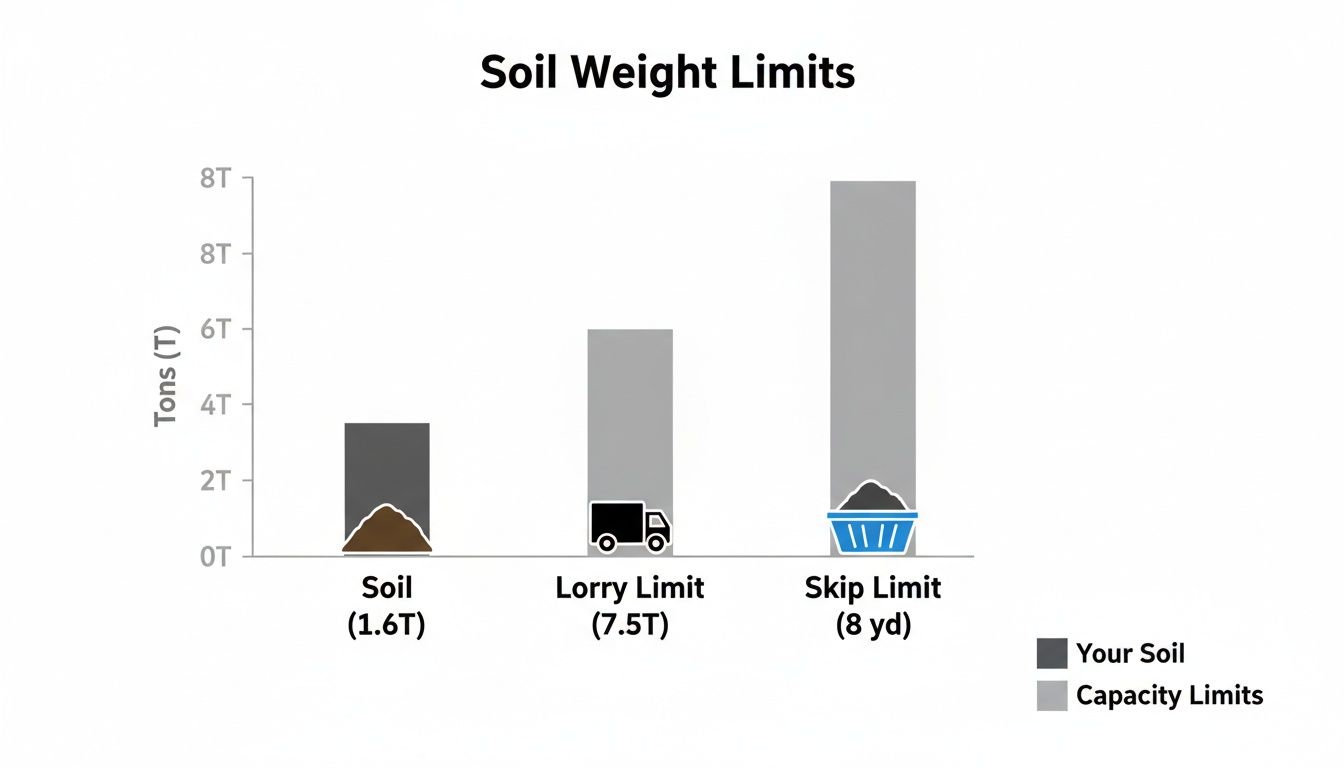
As you can see, even an 8-yard skip filled with soil is pushing the limits of what the lorry can safely handle.
Soil-Only vs Mixed-Waste Skips
One last, crucial decision is whether you need a skip just for soil or one for a mix of different waste types. This choice can make a real difference to your final bill.
A dedicated skip for 'inert' waste—which includes things like soil, clay, rubble, and concrete—is almost always cheaper than a mixed-waste skip. That’s because these clean, separated materials are much easier and less costly for us to process and recycle.
If your soil is going to be mixed in with other garden waste like turf, roots, branches, or any other general rubbish, it has to be classed as mixed waste. This is fine, and certainly convenient, but the extra sorting required on our end means the hire price is higher.
For the most cost-effective and environmentally friendly approach, always try to separate your soil from other types of waste before it goes in the skip. You'll get the best price, and you'll be helping us recycle as much as possible. It's a win-win.
How to Load Your Skip with Soil Safely
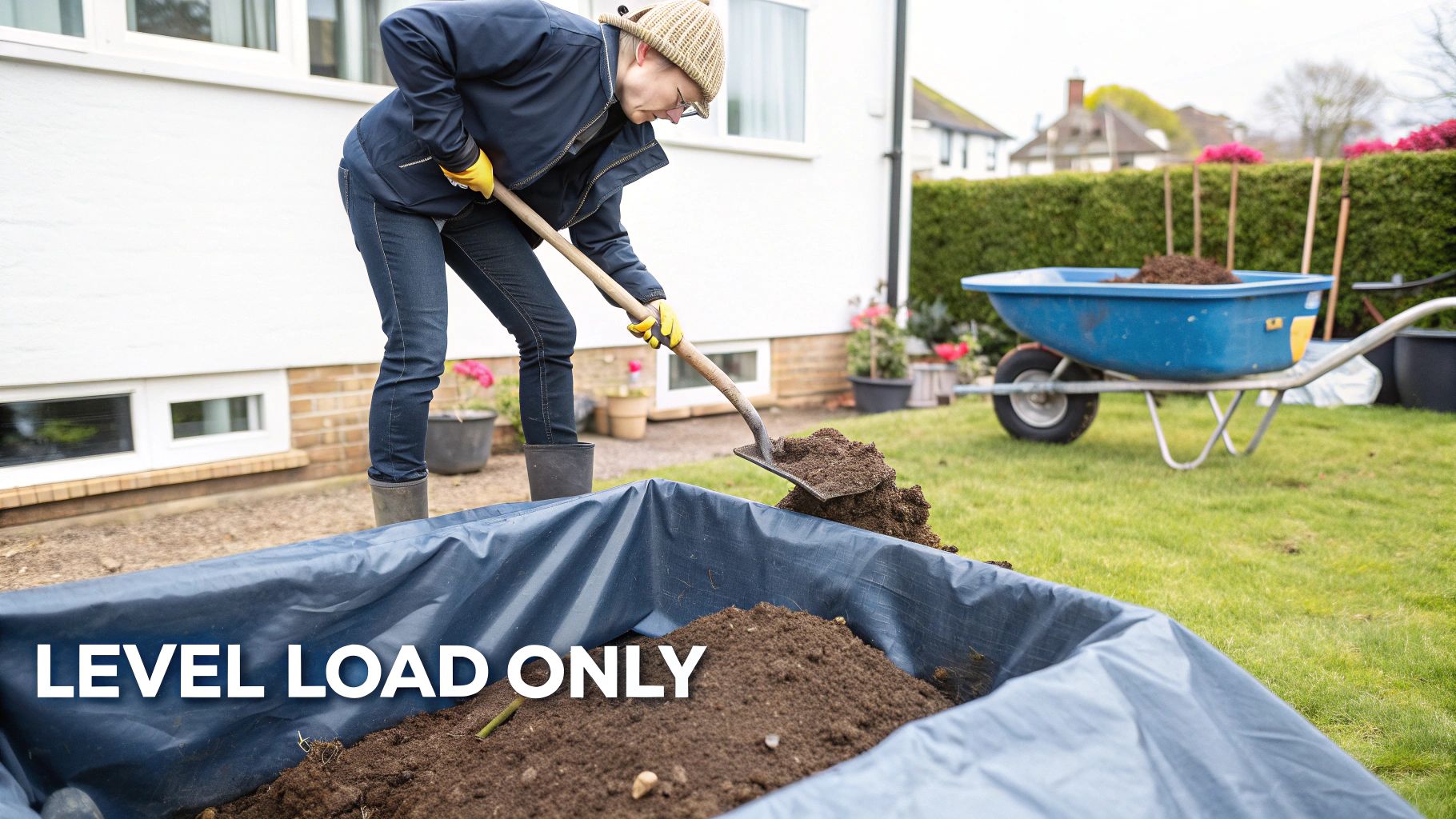
Getting the right skip is only half the battle; knowing how to load it properly is just as important. This isn't just about being tidy—it's a legal requirement that keeps our drivers and everyone else on the road safe. The golden rule, the one thing you absolutely must remember, is to create a level load.
A level load is exactly what it sounds like. Nothing should be sticking up over the sides of the skip. Imagine a flat, invisible lid sitting on top of the skip walls—your soil and any other waste needs to stay below that line. This is a UK road safety law, plain and simple. It’s there to stop bits of soil, rubble, or anything else from bouncing out onto the road and causing a serious accident.
Best Practices for Loading Soil
Shifting heavy soil into a skip needs a bit of thought. If you just chuck it all in one corner, you can make the skip unstable and difficult to load properly. A bit of strategy goes a long way.
Here’s a simple, practical approach:
- Distribute Weight Evenly: Don't just dump everything in the middle. Start by putting the first few loads into the corners, then gradually fill in the space between. Spreading each wheelbarrow of soil across the base keeps the skip balanced.
- Break Up Large Clumps: If you’re digging up dense, heavy clay, you’ll probably have some massive, solid chunks. Break these up before they go in the skip. They’ll settle much better, and you’ll find it easier to keep the load level.
- Heaviest at the Bottom: Got a mix of soil and rubble? Get the heavy stuff like bricks and concrete in first. They create a solid, stable base for the lighter soil to sit on top of.
The Dangers of Overfilling
Let’s be blunt: an overfilled skip will not be collected. Our drivers are legally forbidden from transporting a load that isn’t level and safe. This means a wasted journey, delays to your project, and potentially an extra charge for the trouble.
Overfilling is one of the most common reasons we have to refuse a collection. In fact, some industry reports suggest that overloading accounts for up to 42% of failed collections for garden waste in major UK cities. You can discover more insights about skip loading best practices on easyskip.uk to make sure you get it right.
Here’s another tip. If it looks like rain, cover your skip with a tarpaulin overnight. A skip full of dry soil is one thing, but that same soil can soak up a huge amount of water, making it incredibly heavy—sometimes too heavy for our lorry to even lift.
Following these simple steps is the best way to guarantee your skip collection goes off without a hitch.
What Happens to Your Soil After Collection

Ever wondered what happens to your soil after the skip lorry drives off down the road? It's easy to picture it all getting dumped in a massive hole somewhere, but for any responsible waste company, that couldn't be further from the truth.
In reality, your soil is just starting its journey. Once we collect your skip, it’s taken straight to a licensed waste transfer station. Think of this as a sorting hub, where all the materials we collect are expertly separated, processed, and prepared for a second life. This is where the real recycling work begins.
The Screening and Sorting Process
The first stop for your soil is a rigorous screening process. Imagine a giant, industrial-sized sieve. The soil is carefully passed through machinery designed to filter out anything that isn’t, well, soil.
This process removes all sorts of common contaminants, including:
- Stones and larger chunks of rubble
- Roots, turf, and other green waste
- Any stray bits of timber or metal that might have snuck in
The goal is to produce what we call ‘clean’ soil, free from impurities and ready to be used again. Everything else that was mixed in gets separated and sent down its own recycling stream, making sure as little as possible ends up in a landfill. In fact, professional waste services like ours aim to recycle over 90% of the material we handle.
The journey of your soil doesn’t end when it leaves your property; it’s just the beginning. By choosing a licensed carrier, you ensure it is treated as a resource, not just as waste, which is a world away from the environmental damage caused by illegal fly-tipping.
From Your Garden to a New Project
Once the soil has been cleaned up and graded, it’s ready for a new home. High-quality, screened soil is a sought-after material with plenty of practical uses, all of which contribute to a more sustainable, circular economy.
It can be repurposed as:
- High-Grade Topsoil: Perfect for big landscaping projects, creating new garden beds, or improving the ground quality in public parks and green spaces.
- Engineering Fill: Used in construction to build up ground levels, create embankments, or provide a solid, stable foundation for new developments.
- Recycled Aggregates: Sometimes it's blended with other materials like crushed concrete and brick to create aggregates for road bases and other construction essentials.
This whole process gives your old garden soil a second chance to be useful. It reduces the need to quarry for new materials and helps protect our natural landscapes. So, when you ask, “can you put soil in a skip,” you’re also helping to support a system that turns waste into a valuable commodity.
Exploring Alternatives to Skip Hire for Soil
While a skip is often the go-to choice for getting rid of soil, it's definitely not the only game in town. Depending on the size of your project, the access you have, and just how much you fancy shifting with a shovel, other options can sometimes be quicker, easier, or just plain cheaper.
When You've Got a Mountain of Muck
Got a serious amount of soil to move? We're talking tonnes and tonnes. In that case, a grab lorry is your best friend.
Unlike a skip that you have to painstakingly load yourself, one wheelbarrow at a time, a grab lorry simply turns up and uses its powerful hydraulic crane to scoop the soil right up. It's a total game-changer for big jobs or sites with tricky access. The crane's long reach means it can often lift waste over fences, walls, or other obstacles. If this sounds like what you need, our guide on grab lorry waste removal breaks down exactly how they work.
Smaller Jobs and Greener Options
On the flip side, if you've only got a small amount of soil from digging a new flower bed or pond, hiring a whole skip can feel like using a sledgehammer to crack a nut. A "man and van" service can be a great alternative for smaller loads. They turn up, do all the lifting for you, and take it away – job done.
For truly tiny amounts, it's always worth checking with your local council tip or recycling centre. Many will accept soil, but they all have their own rules on quantities, so give them a ring before you load up the car.
Of course, the cheapest and most eco-friendly option is to not get rid of it at all. Good quality soil is a precious resource in any garden!
Before you pay a penny for disposal, think about how you could use it. Could you:
- Build some new raised beds for veggies?
- Level out a bumpy, uneven patch of lawn?
- Create interesting mounds or banks to add character to your landscaping?
Reusing soil on-site is a huge win. It saves you a significant amount on disposal costs and is far better for the environment. Always ask yourself: "Can this soil find a new home in my own garden?"
Looking beyond simple reuse, good site management can stop you from creating excess waste in the first place. If you're working on a slope, for instance, learning how to prevent soil erosion on slopes can help you keep that valuable topsoil where it belongs. By weighing up all these alternatives, you can make the smartest choice for your project, your back, and your wallet.
Common Questions About Putting Soil in Skips
Even when you’ve got everything planned out, a few practical questions always come up when it’s time to actually get rid of the soil. Here are the straight-up answers to the queries we hear most often from both homeowners and professionals on site.
Can I Mix Soil with Other Garden Waste in a Skip?
Technically, yes, you can. But it’s almost always cheaper to hire a skip specifically for ‘inert’ waste like soil, rubble, and concrete.
When you start mixing heavy soil with general rubbish or green waste like turf and branches, the whole lot gets classified as mixed waste. This makes the sorting and recycling process far more complicated for us, which unfortunately bumps up the price for you.
For the best value and the greenest solution, separating your soil is always the way to go.
What if My Soil Is Contaminated with Chemicals?
You absolutely cannot put contaminated soil in a standard skip. It's a huge no-go. Soil that contains hazardous materials like asbestos, oil, paint, or chemical spills needs specialist handling to comply with UK environmental law. These substances can cause serious harm to people and the planet if they're not managed correctly.
If you have even the slightest suspicion that your soil is contaminated, stop what you're doing and get in touch with a licensed hazardous waste removal service for advice.
Don’t take a chance with potentially hazardous materials. The legal and environmental fallout can be severe. If you're in any doubt about the state of your soil, always get a professional assessment.
How Do I Estimate the Amount of Soil I Have?
There's a simple trick for getting a pretty good estimate. Just measure the length, width, and depth of the area you're digging out, making sure to use metres for all three. Multiply these numbers together, and you'll have the volume in cubic metres (m³).
For example, a patch of garden that is 5 metres long, 2 metres wide, and 0.5 metres deep gives you 2.5 m³ of soil.
One thing to keep in mind is that soil 'bulks up' or expands when it's excavated. Because of this, it’s always a smart move to order a skip with a little more room than your calculation suggests.
Ready to clear that soil without any hassle? The team at The Waste Group can help you choose the perfect skip and arrange fast, reliable delivery. Get your project sorted today by visiting https://www.thewastegroup.co.uk.