Disposal of Confidential Waste: Legal Duties and Best Practices
Disposal of Confidential Waste: Legal Duties and Best Practices
Proper disposal of confidential waste is all about securely destroying sensitive information. It’s a critical process that stops data breaches, identity theft, and legal headaches before they start. For both households and businesses, getting this right protects personal data, company secrets, and the trust you’ve built with your clients.
Understanding Confidential Waste and Its Risks
Think of confidential waste like your online banking password or a personal diary—you wouldn't just leave it lying around for anyone to see. In simple terms, it's any material, whether physical or digital, that contains sensitive information. If this information got out, it could cause real harm. And it’s not just about top-secret corporate files; this covers everyday items, too.
For you at home, this could be old bank statements, utility bills, expired credit cards, or medical records. For a business, the scope is much wider. It covers everything from client invoices and employee records to financial reports and strategic plans.
The Dangers Hiding in Your Bin
Tossing these items into your standard recycling or general waste bin is like leaving your front door unlocked. Once that bin leaves your control, you have no idea who might get their hands on its contents. The risks are huge and go way beyond a minor inconvenience. Getting it wrong can lead directly to:
- Identity Theft: Criminals are experts at piecing together information from discarded documents to open accounts or commit fraud in your name.
- Corporate Espionage: Competitors could get hold of trade secrets, client lists, or financial data, seriously damaging your competitive edge.
- Legal Penalties: In the UK, laws like the Data Protection Act 2018 come with severe fines for failing to protect personal data.
These consequences show why professional disposal of confidential waste isn't just a box-ticking exercise but a fundamental security measure. The damage from a single data breach can ripple outwards, hitting your finances, reputation, and customer loyalty for years to come. It's vital to know the difference between proper disposal and careless dumping, a topic we cover in our guide on illegal dumping vs legal tipping.
Beyond Paper: Physical and Digital Threats
Confidential waste isn’t just about paper. Your digital media needs just as much attention. Simply dragging files to the recycle bin on your computer is nowhere near enough to permanently erase them. Secure disposal has to cover:
- Old hard drives (HDDs) and solid-state drives (SSDs)
- USB sticks and memory cards
- CDs, DVDs, and outdated backup tapes
Beyond documents, it's key to understand digital vulnerabilities, including the risks associated with outdated office equipment. Every single piece of data, whether it's on a piece of paper or a hard drive, needs a secure end-of-life plan.
Navigating Your Legal Duties for Waste Disposal
Getting your head around the legal side of confidential waste disposal can feel like a headache, but it’s actually more straightforward than you might think. The core idea behind UK laws like the Data Protection Act 2018 and GDPR is simple: if you handle someone’s personal data, you have a duty to protect it, right up until the moment it’s completely destroyed.
And this isn’t just a rule for big corporations. Whether you're a freelancer with client invoices, a small business managing staff records, or even just a homeowner clearing out old bank statements, these duties apply. The law treats personal data as something you’re borrowing – you’re responsible for its safekeeping until it’s either returned or, in this case, permanently wiped out.
The Real Cost of Getting It Wrong
Failing to manage this process properly isn’t a minor slip-up; the consequences can be genuinely severe. The Information Commissioner's Office (ICO) has the power to hand out some pretty hefty fines for data protection failures. These penalties are there to make sure everyone takes their responsibilities seriously, making proper disposal a non-negotiable part of handling sensitive information.
The financial risks are massive. In the UK, the average cost of a data breach is around £4 million, and a shocking 21% of these breaches are caused by simple human error. Under the Data Protection Act 2018, which brought GDPR into UK law, fines can rocket up to £17.5 million or 4% of a company's annual turnover. UK businesses have already been hit with over £39 million in penalties for mishandling data, which shows the ICO isn't messing about. You can read more about the financial implications of confidential waste mismanagement on BusinessWaste.co.uk.
Your Duty of Care Explained
A key legal idea you need to know is the 'duty of care'. In plain English, this means you are legally responsible for your waste from the second you create it until it's finally, securely disposed of. You can’t just pass it to any old collection service and wash your hands of the matter.
This responsibility means you must ensure that anyone handling your confidential waste is authorised to do so and will manage it correctly. Proving you have met this duty often comes down to proper documentation.
This is where the paperwork comes in. For every single collection of business waste, confidential materials included, you need the right documents. A crucial piece of this puzzle is the Waste Transfer Note, which acts as both a receipt and a legal record of the handover. To get a better grasp of this, you can check out our detailed guide on what is a Waste Transfer Note and why it's so vital for staying compliant.
Ultimately, these legal duties are all about building trust and security, helping everyone handle personal data responsibly and steer clear of costly mistakes.
Comparing Secure Disposal Methods That Fit Your Kneeds
When it comes to the disposal of confidential waste, picking the right approach can feel like a bit of a minefield. Really, it all boils down to finding the right balance between security, cost, and pure convenience. There are three main ways to go about it, and each one is suited to different scenarios – from a one-off clear-out at a home office to the constant demands of a busy company.
Getting your head around these options is the first step. It helps you build a process that not only keeps sensitive information locked down but also slots neatly into your day-to-day operations. Let's break down each method and see which one feels like the best fit for you.
In-House Office Shredding
This is the one we all know. You buy a standard office shredder, and your team feeds documents into it as they go. On the surface, it seems like a straightforward, low-cost solution. Easy, right?
Well, not always. This method has a few hidden snags. Every minute your staff spend shredding is a minute they're not focused on their actual jobs, which creates a very real, indirect cost. On top of that, most consumer-grade shredders only do a basic strip-shred, and with a bit of patience, those strips can be put back together. They also choke on large volumes and can't touch things like old hard drives, making them a pretty incomplete solution for total data security.
This simple flowchart can help you figure out if your waste handling falls under strict regulations.
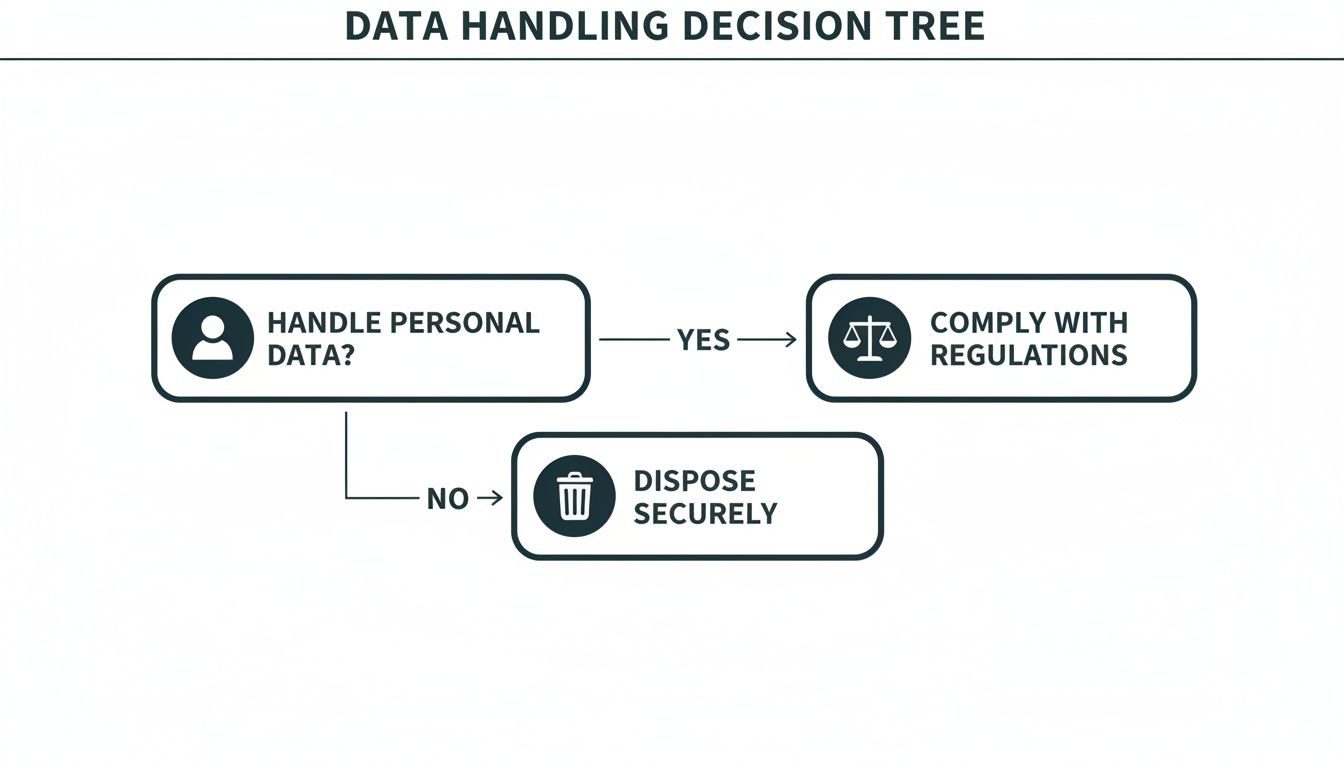
As you can see, the moment you handle personal data, you're legally on the hook to comply with data protection laws.
On-Site Mobile Shredding Services
For a serious upgrade in both security and convenience, on-site shredding is a fantastic choice. With this service, a specialised mobile shredding truck comes right to your doorstep to destroy your documents then and there, right in front of you.
It’s the perfect blend of transparency and efficiency. You get to witness the entire process, which offers complete peace of mind. It cuts out all that wasted staff time spent feeding a little shredder and guarantees your documents are cross-cut to a much higher security standard than any office machine could manage.
On-site shredding is ideal for businesses handling highly sensitive information. It's for anyone who needs absolute certainty that their data is destroyed before it even thinks about leaving the premises. It provides a clear, verifiable end to the data lifecycle.
Off-Site Shredding Services
Your third option is off-site shredding. This is where a professional service collects your confidential waste in secure, locked consoles or bins. These materials are then taken in a GPS-tracked vehicle to a specialised, secure facility to be destroyed.
For organisations dealing with a high volume of confidential waste, this is often the most cost-effective and efficient solution out there. By handing over the entire process, you free up valuable space and your team’s time. Reputable providers will maintain a strict chain of custody from the moment they collect to the final destruction, and they’ll give you a Certificate of Destruction as legal proof that you’ve done everything by the book.
Choosing Your Confidential Waste Disposal Method
Deciding between these options really comes down to your specific circumstances, volume, and security needs. This table breaks down the key differences to help you make an informed choice.
| Disposal Method | Best For | Security Level | Pros | Cons |
|---|---|---|---|---|
| In-House Shredding | Very low volumes of non-critical documents. | Low | Immediate disposal; low initial cost for the machine. | Time-consuming for staff; basic shredders are not fully secure; can't handle digital media. |
| On-Site Mobile Shredding | Businesses needing high security and visible proof of destruction. | High | You can watch the shredding happen; very secure; convenient and fast. | More expensive than off-site or in-house shredding. |
| Off-Site Shredding | Regular, high-volume needs where cost and efficiency are key. | High | Most cost-effective for large amounts; frees up staff time; provides full audit trail. | You don't witness the destruction personally. |
At the end of the day, a professional service, whether on-site or off-site, is designed to take the burden and risk of disposal of confidential waste off your shoulders. It's the simplest way to ensure you stay secure and fully compliant with all data protection laws.
Implementing a Secure Waste Management Process

Turning your legal duties into everyday practice doesn't have to be a headache. A solid strategy for the disposal of confidential waste is really just a clear, step-by-step process. This blueprint gives you control and peace of mind, making sure your sensitive information is handled securely from the moment it's created to the second it's destroyed.
By breaking it down into four simple stages, you can build a robust system that protects data and keeps you compliant. This approach works just as well for a household sorting through old bank statements as it does for a business with a constant stream of documents. The goal is to make secure disposal an easy, repeatable habit.
Step 1: Identify and Segregate
First things first, you can’t protect what you don’t recognise. This is the most crucial step. Train yourself and your team to spot confidential materials instantly—think client contracts, employee payroll details, financial statements, and medical records. Basically, if it contains personally identifiable information (PII), it's confidential.
Once you’ve identified these documents, they must be kept completely separate from your general waste and standard recycling. A common slip-up is tossing sensitive papers in with the regular office recycling, which completely defeats the purpose of your security efforts. It's also worth remembering that physical document security goes hand-in-hand with digital protection; implementing robust Cloud Data Loss Prevention strategies is essential for preventing data leaks in the digital realm.
Step 2: Establish Secure Storage
You can't just leave a pile of sensitive documents sitting in a corner. The next step is to put them in dedicated, secure containers while they're waiting for disposal. This simple action prevents prying eyes and stops important papers from getting lost in the shuffle.
For businesses, this usually involves:
- Locked Consoles: These are secure, slotted bins placed in handy spots around the office. Staff can easily pop documents in, but only an authorised person with a key can get them out.
- Secure Wheelie Bins: For larger amounts of confidential waste, locked wheelie bins offer a secure and mobile solution before collection day.
Think of these containers as a secure holding bay for your data, forming a vital link in your chain of custody.
Step 3: Partner with a Vetted Disposal Expert
Your responsibility doesn't stop once the waste leaves your building. You are legally on the hook for it until it’s properly destroyed, which is why choosing the right partner is so important. Don't just go for the cheapest quote you can find; do your homework and check their credentials.
Look for a provider who can prove they take compliance and security seriously. Ask them about their shredding standards, whether their vehicles are tracked, and how they screen their staff. A professional service will be upfront about their procedures and more than happy to show you their accreditations.
A trustworthy disposal partner isn't just a collector; they're an extension of your own data security team. Their processes need to be just as tight as yours.
Step 4: Verify Destruction with a Certificate
This final step closes the loop and gives you the legal proof you need to show you’ve done everything correctly. After your confidential materials have been destroyed, your chosen company must provide you with a Certificate of Destruction.
This official document confirms the what, when, and how of the destruction process. It’s your evidence that you’ve met your obligations under GDPR and the Data Protection Act 2018. Always file this certificate away safely—it's a critical part of your compliance trail if you ever get audited.
How to Choose a Professional Disposal Service
Picking a partner for your disposal of confidential waste is a huge decision. It's about so much more than just getting someone to take away your old paperwork. You're literally handing over your most sensitive information, a choice that has a direct impact on your security and your legal compliance.
To get it right, you need to look past the price tag and dig into the nitty-gritty of how a provider actually protects your data. A genuinely professional service will give you complete confidence that every single document is handled securely, from the moment it leaves your premises to its final destruction. They should be totally transparent about their processes, offering you verifiable proof and, most importantly, peace of mind.

Look for a Clear Chain of Custody
If there's one concept you need to understand, it's the chain of custody. Think of it as an unbroken, documented trail that follows your waste every step of the way. It starts the second your provider collects your materials and only ends once they've been completely destroyed. This is your guarantee that nothing gets lost, misplaced, or peeked at along the way.
A reputable company will always use:
- Secure, locked containers for both collection and transport.
- GPS-tracked vehicles so the journey to their facility is always monitored.
- Screened, uniformed staff who are authorised to handle sensitive documents.
When you're vetting a potential provider, ask them to walk you through their chain of custody. If they can't give you a clear, step-by-step rundown, that’s a massive red flag.
Demand a Certificate of Destruction
Once the shredding is done, the job isn't over. The last, crucial piece of the puzzle is the Certificate of Destruction. This is not just a receipt; it's a legally recognised document that acts as your proof of compliance with data protection laws like GDPR.
This certificate is vital because it officially transfers liability from your business to the disposal company. It confirms the exact date, time, and method of destruction, creating a solid audit trail that will protect you if you ever face legal scrutiny. Never, ever work with a service that doesn't provide one as standard.
Check for Key Accreditations
Accreditations are your shortcut to verifying that a company is serious about security and professionalism. In the UK, the gold standard to look for is BS EN 15713. This certification lays down strict rules for the secure destruction of confidential material, covering everything from vetting staff to the final size of the shredded paper particles.
Choosing a provider with BS EN 15713 accreditation means you’re partnering with a company that has been independently audited and proven to follow best practices. It’s a powerful symbol of trust and reliability, ensuring your disposal of confidential waste is in safe hands. This kind of diligence is a hallmark of high-quality commercial waste collection services that put client security first.
Your Confidential Waste Questions Answered
Even when you have a solid plan in place, questions always crop up when you’re dealing with the disposal of confidential waste. This final section tackles some of the most common queries we hear from both households and businesses, giving you quick, clear answers to keep you compliant and secure.
How Long Should I Keep Confidential Documents?
Knowing when to shred is just as important as knowing how. There isn't a single, one-size-fits-all rule; the right time really depends on the type of document you're holding. Hanging onto records for too long creates unnecessary risk, but getting rid of them too early can land you in some serious legal hot water.
For UK businesses, HMRC sets a key guideline. You must keep financial records—that includes invoices, expenses, and VAT records—for at least 6 years from the end of the last company financial year they relate to. Other documents, like old employee records, have their own specific retention periods under employment law.
The rules are a bit more relaxed for individuals, but they still matter. As a general guide, you should keep any tax-related documents for at least 22 months after the end of the tax year they apply to. Once a document serves no further legal, financial, or personal purpose, it’s time to arrange for its secure disposal.
Can I Put Shredded Paper in My Home Recycling Bin?
This is a really common mistake, but the answer is nearly always no. Most local councils across the UK specifically ask residents not to put shredded paper into their household recycling bins. The problem is that the tiny, loose strips of paper are a nightmare for the sorting machines at recycling facilities.
These small fibres jam the machinery and can easily contaminate other perfectly good recyclables like cardboard and plastic. Some councils might make an exception if you contain the shredded paper inside a paper bag or a small cardboard box, but you absolutely must check their specific guidelines first.
For guaranteed security and proper recycling, a professional service is your best bet. They compress the shredded paper into large bales before sending it directly to paper mills, making sure it gets recycled without causing chaos at the local sorting plant.
What Is a Certificate of Destruction?
A Certificate of Destruction is a formal document you receive from a professional shredding company. It's your official proof that your confidential waste has been securely and permanently destroyed. Think of it as the final, crucial piece of your compliance puzzle.
This document is absolutely essential for businesses. It provides a clear audit trail and proves you’ve done your due diligence under data protection laws like GDPR. It formally records key details about the destruction process, including:
- The exact date the destruction took place.
- The method of destruction used.
- A unique serial number for tracking purposes.
- Confirmation that the process met all relevant legal standards.
Holding onto this certificate is non-negotiable. It’s your protection if you ever face a data protection audit or investigation.
Is Professional Shredding Too Expensive for a Small Business?
It’s easy to assume that professional shredding is a service only big corporations can afford, but it's often far more affordable than people realise. When you weigh up the cost against the potential fallout from a data breach—which can include massive fines, legal fees, and lasting damage to your reputation—it’s a remarkably cost-effective investment.
Many providers offer flexible options designed for different needs and budgets. You can arrange one-off collections for a big annual clear-out or set up regular, scheduled services if you produce sensitive waste all year round. When you factor in the time your employees save by not having to feed a small office shredder, plus the guaranteed security and complete peace of mind, professional disposal of confidential waste offers excellent value for any size of business.
Ready to ensure your confidential waste is handled securely, affordably, and in full compliance with UK law? The Waste Group offers professional, reliable shredding and disposal services tailored to your needs. Visit https://www.thewastegroup.co.uk to get a quote and protect your sensitive information today.