Decoding Grab Hire Cost for UK Waste Removal
Decoding Grab Hire Cost for UK Waste Removal
So, you're wondering about the cost of grab hire? It's a common question we get. As a ballpark figure, a standard grab hire cost in the UK usually falls somewhere between £250 and £450, but this can shift depending on where you are and what you're getting rid of.
Think of it like calling a taxi for your waste – it’s fast, incredibly efficient, and perfectly suited for those big piles of stuff you need gone without any fuss.
Understanding the Value of Grab Hire
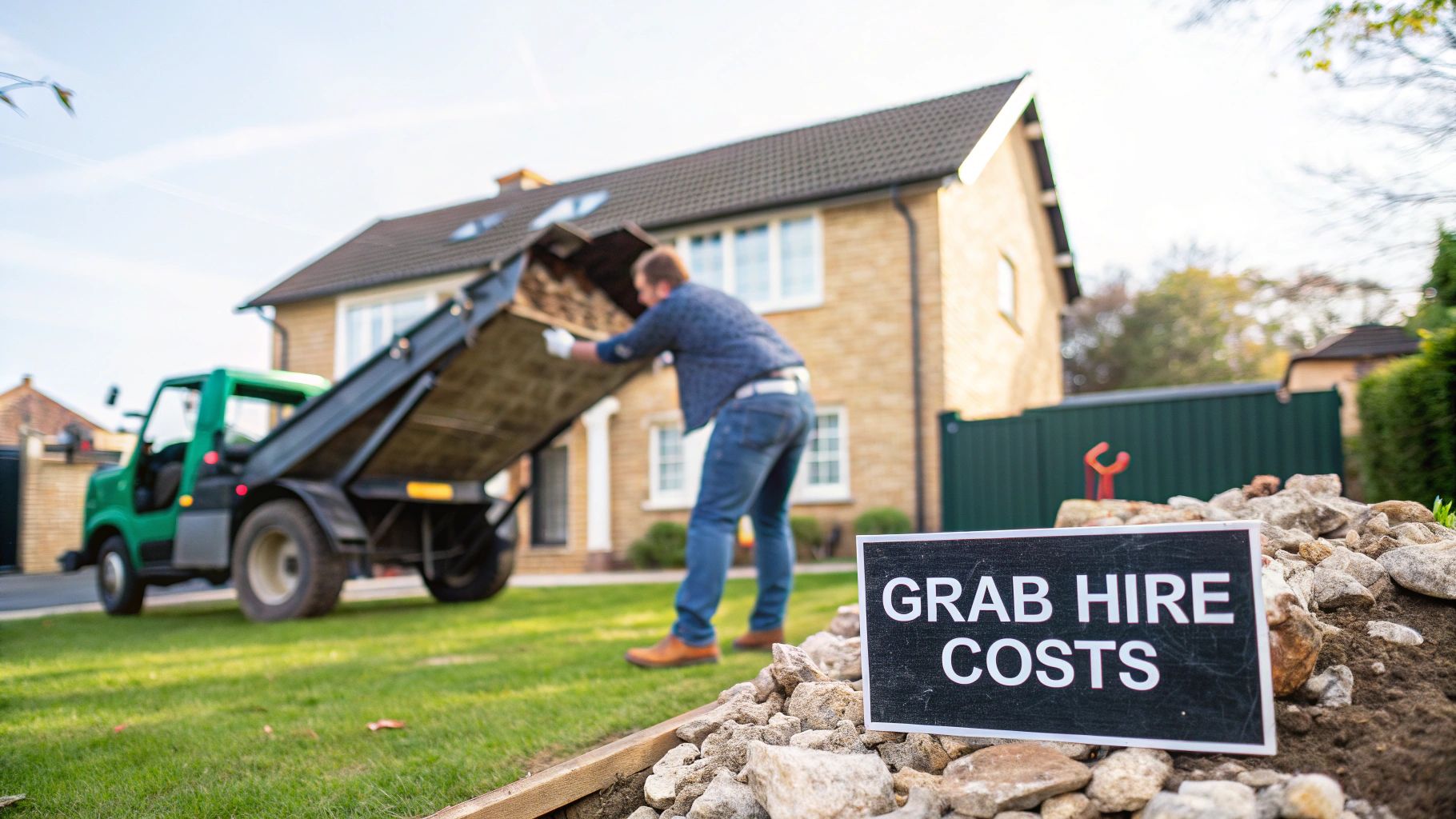
When you're staring at a mountain of soil from a new patio, rubble from a knocked-down wall, or just a huge amount of garden debris, you need a solution that’s straightforward and makes financial sense. Grab hire ticks both boxes.
It's a completely different beast to skip hire. A skip is more like a long-term rental you have to fill yourself and live with on your drive. A grab lorry, on the other hand, is a swift, one-and-done service.
The truck, equipped with its own hydraulic crane, simply rolls up, scoops your waste, and disappears. The whole process often takes less than 30 minutes. This makes it a lifesaver for projects where you're tight on space or need to clear waste from an awkward spot, like over a garden fence.
Why Choose Grab Hire for Waste Removal?
The biggest draws are its sheer convenience and massive capacity. A standard 8-wheel grab lorry can haul away up to 16 tonnes of waste in one go. That’s about the same as two large skips, but without any of the hassle.
This level of efficiency makes it the perfect partner for:
- Large-scale garden clearances: Getting rid of huge amounts of soil, turf, and other green waste.
- Construction and demolition jobs: Clearing away rubble, concrete, bricks, and other hardcore materials.
- Driveway or patio installations: Disposing of all the earth and old paving you've dug up.
Here in the UK, a smaller 4-wheeler grab lorry – which can handle a respectable 7-9 tonnes of waste – will set you back around £275 per load (excluding VAT). It's a hugely popular choice for homeowners and DIYers across Dorset tackling garden makeovers or smaller renovations. This price is a good reflection of what you'll find from local providers like us at The Waste Group, serving areas like Poole, Bournemouth, and Weymouth, where things like site access and waste type influence the final quote.
Budgeting for Your Project
Figuring out where grab hire fits into your overall project spend is crucial. If you're planning a big renovation, a comprehensive guide to the cost of renovating a house can give you the bigger picture.
Choosing a grab hire company that offers a price-match promise and next-day service is a smart move. It means you’re not just keeping costs down, but you’re also keeping your project timeline firmly on track. This blend of speed, capacity, and real value is precisely why grab hire often comes out on top.
What Goes Into Your Grab Hire Quote?
Trying to pin down the exact cost of a grab hire can feel a lot like getting a taxi quote; the final fare depends on a whole lot more than just the vehicle turning up. Several key things come together to shape the price, and getting your head around them is the best way to make sure you’re getting a fair deal.
Grab hire isn't a one-price-fits-all service. The quote is built around the unique demands of your job, which is great because it means you only pay for what you actually need. Let's break down the main ingredients of your final price.
The Type of Waste You're Getting Rid Of
This is the big one. What you're throwing away has the single biggest impact on your grab hire cost. Waste generally gets split into two main camps, and the price difference between them can be pretty substantial.
- Inert Waste: This is all the clean, non-reactive stuff. Think soil, clay, hardcore, concrete, rubble, and bricks. Because it's easy to process and recycle – often getting a new life as hardcore or aggregate – it’s much cheaper to dispose of.
- Mixed Waste: This is basically everything else. It could be a jumble of inert materials mixed with general rubbish, green waste (like branches and turf), wood, metal, or plasterboard. This kind of load needs a lot more sorting back at the recycling centre, and that extra work bumps up the disposal cost.
Here's a top tip: if you can, separate your waste into different piles before the lorry arrives. If you've got a massive pile of soil and a smaller heap of mixed rubbish, getting separate quotes for each can often save you a good bit of money.
How Much Waste You Have (Volume and Weight)
The next piece of the puzzle is simply how much stuff you need shifting. Grab lorries come in different sizes, but the most common are 4-wheelers and 8-wheelers, each with a set carrying capacity. A full 8-wheel lorry can take around 16 tonnes, while its smaller 4-wheel sibling handles about 8 tonnes.
You’ll be quoted on a "per load" basis. If all your waste fits in one go, you pay for one load. Simple. But if your pile is bigger than the lorry can handle, you'll need to book (and pay for) a second trip. Getting a decent estimate of your waste volume is key to getting an accurate quote and avoiding any nasty surprises on the day.
Your Location and the Haulage Distance
Where your site is located plays a big part in the final price. Every grab hire cost has to account for the fuel and driver's time to get from their depot to you, and then on to the nearest suitable recycling or disposal facility.
As a rule of thumb, the further you are from the grab company's base and the waste transfer station, the higher the quote will be. It just has to cover that extra travel time and fuel. This is why choosing a genuinely local provider like The Waste Group here in Dorset is such a smart move to keep those travel costs down.
It’s why a job in central Bournemouth might be priced differently from a project out in the rural sticks. Sticking with a company that serves your local area is the easiest way to get the most competitive price.
Site Access and Loading Time
Finally, we need to think about how easy it is to actually get to your waste. Grab lorries are big, heavy machines that need a fair bit of room to move around safely. The hydraulic crane also needs enough clear space above it to operate without tangling with overhead cables or low-hanging tree branches.
If your site has a tight entrance, is down a narrow lane, or sits on a busy road, things can get a bit tricky. While the grab crane is brilliant for reaching over walls and fences, the lorry itself still needs to get close enough. Any hold-ups or difficulties getting to the waste pile can add to the cost, as a standard collection is usually priced on the assumption of a quick, hassle-free pickup that takes just 20-30 minutes. Making sure your waste pile is in an easy-to-reach spot is a simple step that helps keep the whole process running smoothly and your costs in check.
Grab Hire vs Skip Hire: A Detailed Cost Comparison
Deciding between grab hire and skip hire is one of those crucial choices that can really affect your project's budget and how smoothly things run. At first glance, it seems straightforward, but when you look past the initial price tag, the true grab hire cost often comes out on top. The hidden expenses and sheer hassle of skip hire can quickly add up.
Let's walk through a common scenario. Imagine you're doing a massive garden clear-out, ending up with about 12 tonnes of soil, turf, and rubble. Your first thought might be to order a couple of big skips. But this can be a false economy, getting you tangled up in permits, back-breaking labour, and logistical headaches.
Uncovering the Hidden Costs of Skip Hire
When you book a skip, you're paying for more than just the big yellow box. If that skip has to sit on a public road or pavement, you'll almost certainly need a permit from the council. These permit costs vary wildly across the UK, but they can easily tack on an extra £30 to £200 to your bill before a single bit of rubbish goes in.
And then there's the labour. A skip won't fill itself. You, or your team, have to physically load every wheelbarrow of soil, every broken slab, every bit of waste. This is time-consuming, tough work that can add hours, if not days, to your project.
One of the biggest pitfalls is getting the volume wrong. If you underestimate how much waste you have, you'll need a second skip. That means you've effectively doubled your hire costs, delivery fees, and possibly even paid for another permit.
The Grab Hire Advantage: A Scenario
Now, let's replay that same 12-tonne garden clearance, but this time with a grab lorry. The lorry arrives at an agreed time, its powerful hydraulic arm reaches over your fence or wall, and it scoops up the entire pile of waste. The whole job is usually done and dusted in under 30 minutes.
This is where the savings really start to show:
- No Permit Fees: The lorry parks, loads up, and drives away. There’s no need for a council permit, which is an instant saving.
- No Manual Labour: You don’t lift a thing. The crane does all the heavy work, saving you precious time and a sore back.
- Greater Capacity: A standard 6-wheeler grab lorry can take what would need two separate 8-yard skips to clear. That kind of efficiency is a game-changer on bigger jobs.
For builders and contractors, the value is even clearer. In fact, projections for 2025 show that grab hire is often 25-40% cheaper than using the equivalent number of skips for mixed heavy waste. A single 6-wheeler grab, costing around £300-£450, can remove 11-13 tonnes. To do the same job with skips, you'd need two large ones at £250-£350 each, plus those potential permit fees.
To help you picture it, this flowchart shows how to pick the right service based on what your project involves.
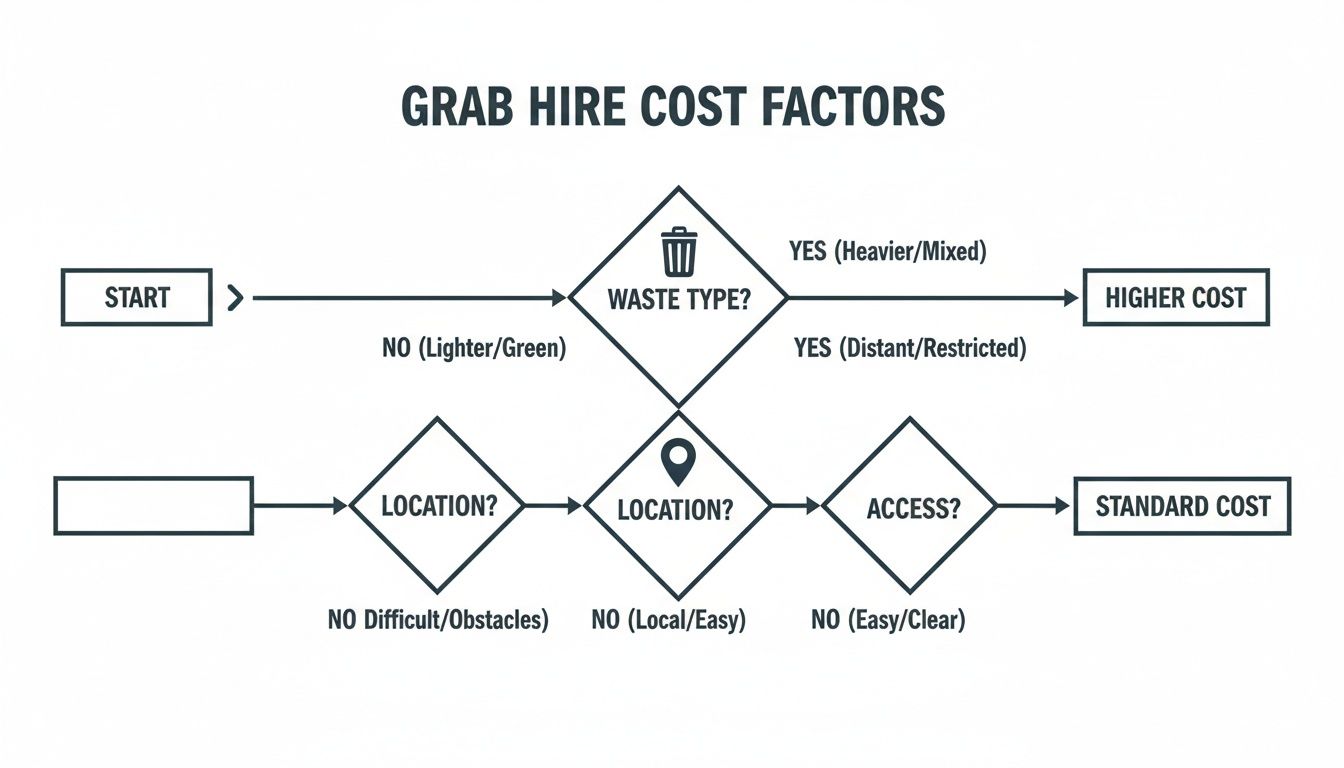
As you can see, things like the type of waste you have and the access to your site quickly point you towards the most practical and wallet-friendly choice.
Grab Hire vs Skip Hire: Which Offers Better Value?
To make the decision even simpler, let's put the two services head-to-head on the factors that matter most to your schedule and your budget. This isn't just about the upfront quote; it's about the total value you get.
| Feature | Grab Hire | Skip Hire |
|---|---|---|
| Typical Cost | Per load (approx. £250-£450) | Per hire period + potential permit fees |
| Permit Required | No (for on-the-spot collections) | Yes (if placed on public land) |
| Loading Method | Mechanical crane does all the work | Manual labour required (you do the work) |
| Speed of Removal | Very fast (often under 30 minutes) | Slow (can take days or weeks to fill) |
| Capacity | High (up to 16 tonnes in one load) | Limited (max 10-12 tonnes per skip) |
| Site Access | Needs lorry access but can reach over obstacles | Needs clear space for the skip to be dropped |
| Ideal For | Large volumes of heavy, inert waste | Smaller jobs with mixed waste over time |
At the end of the day, the right choice really depends on the scale of your project. For smaller, slower jobs where you want a container on-site for a few days, a skip can still be a good option.
However, for any project generating a serious amount of heavy waste, the speed, convenience, and lower overall grab hire cost make it the clear winner. If you're still weighing your options, you can find a full comparison of skips, grabs, and other waste removal methods in our detailed guide.
How to Accurately Calculate Your Waste Volume

One of the biggest factors in your final grab hire cost is the sheer volume of waste you need shifting. Getting this wrong can be a real headache. Underestimate, and you could end up paying for a second collection. Overestimate, and you might book a lorry that’s far bigger than you need.
Think of it like packing for a holiday. If you just guess how much you need to take, you’ll either end up with a half-empty bag or have to pay for extra luggage at the airport. It’s much smarter to lay everything out first. The same idea applies to your waste pile.
Simple Methods for Estimating Your Pile
You don’t need any complex tools to get a decent idea of your waste volume. For a typical cone-shaped pile of soil or rubble, a few simple measurements will give you a solid working estimate.
- Measure the Base: Pace out the diameter (the widest part of the pile) in metres.
- Measure the Height: Estimate how tall the pile is at its highest point, again, in metres.
- Apply a Simple Formula: Use this quick calculation: (Diameter x Diameter x Height) x 0.4. This will give you a rough volume in cubic metres (m³).
For instance, a pile of soil that's 4 metres wide and 1.5 metres high would be roughly (4 x 4 x 1.5) x 0.4 = 9.6 m³. This is exactly the kind of information a grab hire company needs to give you an accurate price.
Another really practical way to visualise it is by thinking in terms of builder's skips. A standard large skip holds about 6 cubic metres. If you reckon your pile would fill two of those, you’re looking at around 12 cubic metres of waste.
From Volume to Weight: What to Expect
Once you've got the volume sorted, you need to think about weight. This is crucial because it determines which size of lorry is right for the job. Different materials have wildly different densities, and it’s easy to get caught out.
A key thing to remember is that a grab lorry’s capacity is limited by weight, not just how full it looks. A lorry might seem half-empty with dense material like wet clay, but it could already be at its maximum legal weight limit of 16 tonnes.
Here’s a quick guide to help you turn your volume estimate into a rough weight:
- Soil and Clay: This stuff is incredibly heavy, especially when it’s wet. One cubic metre can weigh anywhere between 1.4 and 1.8 tonnes.
- Bricks and Rubble: A cubic metre of broken-up brickwork or old concrete typically weighs around 1.5 tonnes.
- Hardcore: This mix of stone and crushed concrete is also very dense, weighing in at approximately 1.6 tonnes per cubic metre.
Going back to our example, that 9.6 m³ pile of soil could weigh as much as 17 tonnes (9.6 x 1.8). That means you'd definitely need an 8-wheel grab lorry to clear it all in one go. You can find more details on how much a grab lorry can take in our helpful guide.
Information to Have Ready for Your Quote
To get the most accurate grab hire cost, it really helps to have a few details ready when you call. This checklist helps avoid any back-and-forth and gets you a firm price much faster.
- Waste Type: What is it? Is it inert waste (like soil and rubble) or mixed general waste?
- Estimated Volume/Weight: Use the methods above to get a good idea.
- Site Postcode: This is essential for us to calculate the travel distance.
- Access Details: Are there any narrow lanes, low bridges, or overhead power lines we need to know about?
- Pile Location: Is the waste easy to get to from the road, or is it tucked away behind a fence?
Having this information prepared makes the whole booking process smooth and efficient, ensuring the price you’re quoted is the price you pay. No surprises.
Smart Tips to Reduce Your Grab Hire Expenses
Getting a grip on your grab hire cost doesn't have to be complicated. With a few smart preparations, you can bring your final bill down quite a bit without compromising on the quality of service. It’s all about working smarter, not harder, to make the collection process as efficient as possible for the grab lorry operator.
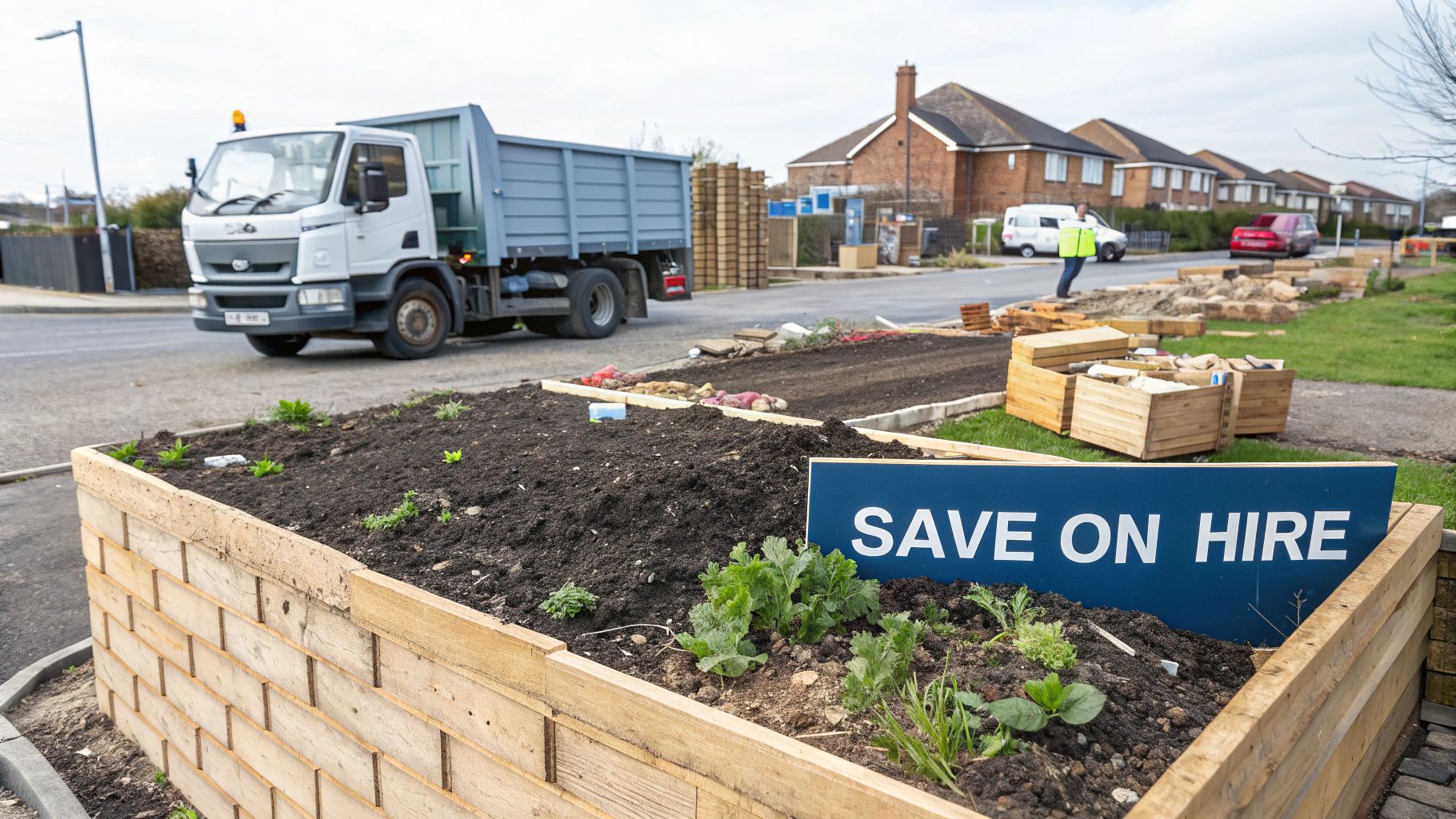
Think of it like prepping your ingredients before you start cooking; a little bit of organisation beforehand makes the whole process smoother and faster. These simple, practical tips are designed to put you back in control of your budget.
Sort Your Waste Before Collection
One of the most effective ways to save money is to separate your waste before we arrive. As we've touched on, inert waste (like soil, rubble, and concrete) is cheaper for us to process than mixed general waste. If you've got both, it really pays to create two separate piles.
This simple step allows the grab hire company to handle the inert materials more efficiently, and those savings get passed straight on to you. A few minutes of sorting can genuinely lead to a noticeable drop in your quote.
By separating materials, you're not just saving money; you're also helping to streamline the recycling process. It's a small effort that delivers both financial and environmental benefits, ensuring more of your waste can be repurposed efficiently.
Ensure Clear and Easy Access
Time really is money in the world of grab hire. A standard collection is priced on the assumption that our lorry can pull up, load your waste, and be on its way within about 20-30 minutes. Anything that slows this down can add to your costs.
Before the lorry is due, take a quick look and make sure the path is clear.
- Move any parked cars that might block the way.
- Check for low-hanging branches or overhead cables that could get in the way of the crane.
- Make sure the ground where the lorry will need to park is firm and stable.
A clear, accessible site means the operator can get the job done quickly and safely, which helps keep your costs exactly where you want them.
Pile Your Waste Strategically
How and where you pile up your waste also makes a big difference. A well-placed pile can be cleared in one swift, clean operation. The best thing you can do is place your waste as close to the kerbside as possible, well within the crane's reach (which is typically around 6-7 metres).
Try to avoid piling it right up against walls or fences, as this can make it much trickier for the grab to scoop everything up cleanly. A single, large heap is always better than several small, scattered piles. This approach helps the grab collect as much as possible in each scoop, ensuring you get the full value out of the load and avoid needing a second trip.
Choose a Truly Local Provider
Finally, one of the easiest wins for managing your grab hire cost is to choose a local company. Haulage is a significant part of the price, covering the driver's time and fuel to get to your site and then on to the recycling facility.
By picking a provider with a depot nearby, like The Waste Group right here in Dorset, you automatically cut down on these travel expenses. While you're focusing on your project's budget, it's also worth considering broader strategies for comprehensive business cost reduction to ensure efficiency across your entire operation.
Choosing the Right Grab Hire Service for Your Project
Picking the right grab hire company is about more than just finding the lowest price. While the grab hire cost is obviously a big part of the decision, the cheapest quote isn't always the best value for your project. Real value is a mix of fair pricing, rock-solid reliability, great service, and knowing your waste is being handled correctly.
Think of it like hiring any other tradesperson for a job at home. You wouldn't just go for the cheapest plasterer without looking at their reviews or checking if they turn up on time. The same principle applies here. You're trusting a company with a vital part of your project's logistics and expecting them to dispose of your waste legally and responsibly.
Hallmarks of a Top-Tier Provider
When you're weighing up your options, a few things really make a professional, customer-focused company stand out. These are the green flags that show a business is confident in its service and wants to give you a hassle-free experience.
Keep an eye out for these key features:
- A Price-Match Guarantee: This tells you the company is keeping a close watch on market rates and is committed to giving you a fair deal without you having to compromise on quality.
- Next-Day Service Commitment: Projects can create waste a lot faster than you might expect. A provider that can offer next-day availability is a lifesaver, helping to prevent delays and keep your site clear and safe.
- Flexible Booking Options: A simple online booking system and clear, straightforward communication are signs of a modern, efficient company that puts its customers first.
These aren't just nice-to-haves; they show you're dealing with a well-run operation that respects your time and aims to make waste removal as smooth as possible. You can get a better idea of what to expect from a professional service in our detailed overview of grab lorry waste removal.
Environmental Credentials and Compliance
These days, how a company gets rid of your waste is just as important as how they collect it. A reputable firm will be completely open about its environmental policies and fully compliant with all waste management regulations. This isn't just about being green; it’s about your own peace of mind.
Choosing a compliant provider protects you. If your waste gets fly-tipped by an unlicensed operator, you could be the one facing a fine. Always check that your chosen company holds a valid Waste Carrier Licence.
A company's commitment to sustainability is a massive indicator of its professionalism. At The Waste Group, for example, we don't just aim to recycle a high percentage of the material we collect – we also plant a tree for every single hire. It's this kind of proactive approach that separates the good from the great. It’s also becoming more important as the UK pushes to divert 70% of construction waste from landfill by 2025.
Focusing on Proven Reliability
At the end of the day, your decision should boil down to trust and reliability. A slightly lower grab hire cost means nothing if the lorry doesn’t turn up when you need it or the company is a nightmare to deal with. This is where customer reviews and testimonials are worth their weight in gold. Look for consistent, positive feedback on punctuality, professionalism, and communication.
A strong local reputation, like The Waste Group's 4.9-star rating across Dorset, is earned through years of dependable service. For any commercial business, that kind of reliability is non-negotiable. Grab lorry hire is already cost-effective, with UK prices typically ranging from £150-£500 per load, and the fact you don’t need a skip permit (which can cost up to £200) is an instant saving. If you want to dig deeper, this guide to grabber lorry costs is a great resource.
By making a company with a proven track record your priority, you’re ensuring your project runs smoothly and your waste is managed responsibly from start to finish.
Your Grab Hire Questions Answered
Even after crunching the numbers, you probably still have a few practical questions knocking around. That’s completely normal. Think of this section as a quick chat over the bonnet of the lorry, where we iron out those last few details before the job gets underway.
We'll cover the most common queries we get, from timings and site access to what happens if you’ve got a bit more waste than you first thought.
How Quickly Can I Get A Grab Lorry?
This is easily one of the most common questions, especially when you're up against a tight deadline. The great news is that many professional grab hire firms, including us, can offer a next-day service if you book before the cut-off time. This is a massive plus compared to hiring a skip, where you can sometimes be left waiting, particularly during busy seasons.
It's always best to confirm when you call for a quote, but you can generally expect a lorry on your site, ready to clear your waste, within 24-48 hours.
Do I Need to Be on Site for the Collection?
Not always, which is a huge relief for many people. As long as the waste is in a clear, accessible pile that the lorry can reach from the road, you don't need to hang around. Our operators are pros at manoeuvring the grab arm to get the job done efficiently.
All you need to do is give clear instructions beforehand and make sure there are no parked cars or other obstacles in the way. We’ll handle the rest.
One of the best things about grab hire is just how fast it is. A typical collection is often done and dusted in under 30 minutes. That means minimal disruption to your day, your neighbours, and your project – whether you’re there to watch or not.
What Happens If My Waste Is Heavier Than Estimated?
It's a fair question, and one you don't need to stress over. We get it – estimating the weight of a pile of soil or rubble isn't something you do every day. If the load is a bit heavier than you guessed but still under the lorry's legal limit, the job will go ahead with no problems.
The issue arises if the load is way over the maximum capacity (around 16 tonnes for an 8-wheeler). The operator legally can’t take it all. They'll load up to the legal limit, and you'll need to book another collection for what's left. This is exactly why getting your volume estimate as close as possible really helps keep your grab hire costs predictable.
Is Grab Hire Suitable for Smaller Domestic Projects?
Absolutely. While you’ll see grab lorries on massive building sites, they are an incredibly smart and cost-effective choice for jobs around the home, too. If you’re giving the garden a complete overhaul, putting in a new driveway, or just having a huge clear-out that generates heavy waste, grab hire is perfect.
It saves you the back-breaking work of loading a skip yourself and you can often avoid the faff and cost of a skip permit. For any project that produces more than a few wheelie bins' worth of rubble, soil, or green waste, it’s a brilliant solution.
Ready to clear your site with minimal fuss and maximum efficiency? At The Waste Group, we offer a price-match guarantee and next-day service to keep your project on schedule and on budget. Get your free, no-obligation quote online today and see how easy waste removal can be. https://www.thewastegroup.co.uk