Hippo Bag vs Skip Choosing Your Best UK Waste Solution
Hippo Bag vs Skip Choosing Your Best UK Waste Solution
So, your project is generating more rubbish than the wheelie bin can handle. Now you're facing a classic UK dilemma: do you go for a hippo bag or a traditional skip? Both are great for clearing out everything from garden trimmings to the debris from a full-on renovation, but they’re built for very different jobs.
Getting this choice right from the start can save you a lot of time, money, and hassle. It all comes down to understanding what each one does best.
Hippo Bag vs Skip: The Quick Answer
At its heart, the decision boils down to a trade-off. For small to medium-sized projects, especially where access is tricky, a hippo bag (or builder's bag) offers fantastic flexibility. But when you’re dealing with a mountain of waste from a large-scale job, nothing beats the sheer volume and value of a skip.

Think of a hippo bag as a super-tough, foldable bag you can buy, fill up whenever you want, and then simply book a collection. A skip, on the other hand, is a big metal container you hire for a fixed period. A lorry drops it off and picks it up, all as part of the service. The real difference is flexibility versus capacity.
Hippo Bag vs Skip At a Glance
To help you see the differences clearly, here’s a quick-reference table. It covers the main points to help you make an initial decision before we get into the nitty-gritty details.
| Feature | Hippo Bag (Builder's Bag) | Traditional Skip |
|---|---|---|
| Best For | Small to medium jobs, tight spaces, and projects with an uncertain timeline. | Medium to large jobs, heavy debris, and projects with a clear start and end date. |
| Typical Capacity | 1 to 1.5 cubic yards (up to 1.5 tonnes). | 4 to 12 cubic yards (up to 8-10 tonnes). |
| Placement | Flexible; can be placed in gardens or on driveways, must be within crane reach of the road. | Requires a driveway or a council permit for on-street placement. |
| Cost Structure | Pay for the bag upfront, then pay a separate fee for collection. | All-in-one hire price that includes delivery, a set rental period, and collection. |
| Convenience | Highly convenient; buy in-store or online and fill over several months if needed. | Less flexible; requires scheduled delivery and collection, with potential fees for extra time. |
This table should give you a solid idea of which option might be a better fit. Now, let’s look at the real-world situations where one clearly beats the other.
Key Deciding Factors
Often, it's the logistics that make the choice for you. A skip bag is a lifesaver for terraced houses with no driveway. You can pop it in a front garden, and the collection lorry's crane can just lift it over the wall. This completely sidesteps the cost and admin of getting a council permit, which is a must if you put a skip on a public road.
The core advantage of a hippo bag is its ability to bypass the need for a council permit in many urban settings. If a skip cannot fit on your private property, the bag becomes the default solution for compliant waste removal.
This convenience is making a real impact. In regions like Southern England, covering areas such as Poole and Bournemouth, we've seen a 19% spike in demand for flexible waste solutions, especially for commercial refits. Skip bags are collected by grab lorries, which avoids the permit headaches that plague skips in busy urban spots.
You can read more about UK construction trends and their impact on waste management to see how the industry is adapting. It all points to the same conclusion: for smaller jobs where convenience and compliance are key, bags are fast becoming the smarter choice.
Analysing Capacity Size and Weight Limits
When you’re weighing up a hippo bag vs skip, one of the first things you need to get your head around is their true capacity. It’s not just about the dimensions you see on the packaging, but what they can actually hold, both in terms of space and, more importantly, weight. Getting this right is crucial for a smooth waste removal.

Hippo bags generally come in three sizes. The biggest and most common one you'll see is the Megabag, which can hold about 1.5 cubic yards of waste. It’s rated for a maximum weight of 1.5 tonnes (1,500 kg). While that sounds like a lot, you'd be surprised how quickly it fills up, especially with heavy stuff like soil, broken bricks, or concrete.
A traditional skip, on the other hand, gives you a much bigger playground of sizes. In fact, even the smallest "mini" skip picks up right where the largest hippo bag finishes.
Comparing Volume in Real Terms
It’s easy to get lost in numbers like "cubic yards," so let's think about what this means for your actual project. Thinking in terms of bin bags or wheelbarrow loads is far more useful.
- Hippo Megabag (1.5 cubic yards): This is good for about 20-25 standard rubble sacks or roughly 15-20 full wheelbarrow loads. It’s spot-on for a small bathroom refit or a proper garden clear-out.
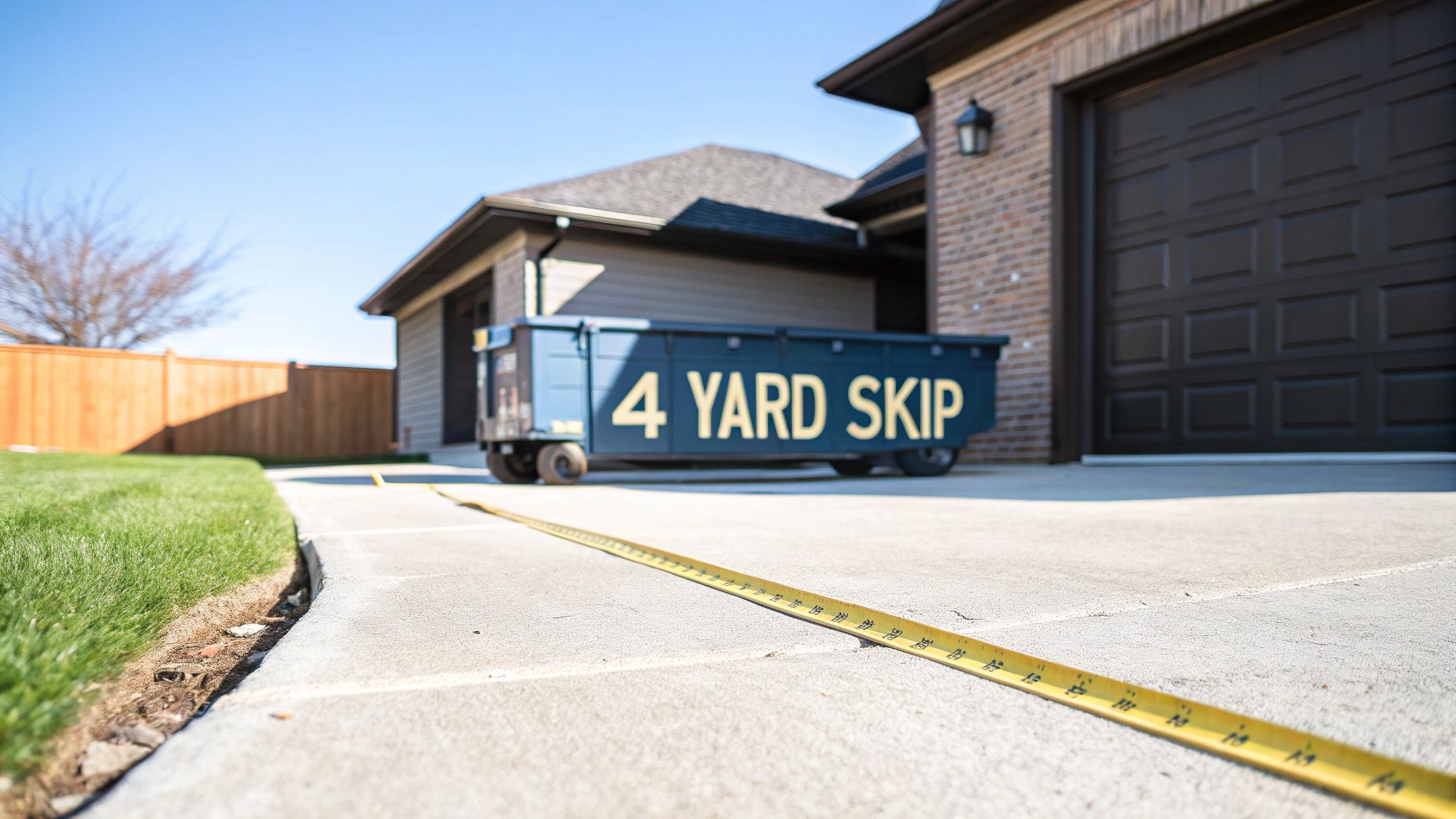
- 4-Yard 'Mini' Skip (4 cubic yards): This will take around 40-45 rubble sacks. It’s ideal for a small kitchen renovation or emptying out a packed garage and has more than double the space of the largest hippo bag.
- 6-Yard 'Builder's' Skip (6 cubic yards): As the name suggests, this is the go-to for many building jobs, holding about 60-65 rubble sacks. It’s what you’d want for a small house extension or a big landscaping project.
If you need more help picturing the right container for your job, you might find our detailed breakdown of skip sizes and their uses helpful.
The Critical Role of Weight Limits
Volume is only half the story. When it comes to heavy waste, weight is the real decider. Hippo bags are collected by a lorry-mounted crane, which has a very strict safe lifting limit. If your Megabag goes over its 1.5-tonne limit, the driver will likely have to refuse the collection. That leaves you stuck with a full bag you can't move.
A single cubic metre of wet soil can weigh between 1.6 and 1.7 tonnes. This means you could technically overload a Megabag’s weight limit while it’s still only two-thirds full of soil—a very common mistake in garden clearance projects.
Skips are a different beast entirely. As rigid steel boxes collected by specialist lorries, they are far more forgiving with weight. While they also have limits (an 8-yard skip is usually the biggest you can get for heavy waste like pure soil or rubble), their design is built for it. You can fill a 6-yard skip to the level line with bricks or soil and not have to stress about structural failure or a refused collection.
This makes skips the undisputed champion for projects involving any kind of digging or demolition, where your waste is both bulky and incredibly heavy. For many people, the hippo bag vs skip debate is settled on this point alone.
Hippo Bag vs Skip: Understanding the Real Costs
When you’re weighing up a hippo bag against a skip, the price you see first isn't always the price you pay. To really know which is best for your wallet, you need to look past the initial quote and understand the full cost, so there are no nasty surprises later on.
The two options are paid for in completely different ways. With a hippo bag, you make two payments: one for the bag itself from a DIY shop or online, and a second, larger payment for collection once it’s full. A skip, on the other hand, is usually an all-in-one package price covering delivery, a rental period (often 1-2 weeks), and collection.
Breaking Down Upfront and Variable Costs
The hippo bag's payment structure gives you a lot of flexibility. You buy the bag and can fill it at your own pace, which is ideal for those weekend projects that spill into the next week or for slow-and-steady renovations where you're creating waste over time.
Where skips can catch you out is with variable costs. The big one is the council permit. If you don’t have a private drive and the skip has to go on a public road, you’ll need one. Depending on your local council, this can add anywhere from £30 to over £100 to your final bill. You might also face extra charges if you need the skip for longer than the standard hire period.
For smaller jobs with a fluid timeline, the hippo bag’s pay-as-you-go approach is often the smarter financial choice. You avoid the time pressure and potential extra fees of a fixed hire period, only paying for collection when you’re ready.
Real-World Cost Scenarios
Let's look at how this plays out with a couple of common projects. Say you're doing a small garden clear-out that creates about a cubic yard of waste.
- Hippo Bag: A Megabag might cost you £30-£40. The collection fee could then be around £150-£190, bringing your total to roughly £180-£230.
- 4-Yard Skip: A small skip could be £200-£250. If it sits on your driveway, that's it. But if you need a road permit, the total could easily jump to £250-£350.
Now, let’s scale up. For a bigger project like a full kitchen rip-out, the numbers tell a different story. A 6-yard builder's skip might cost between £280-£340. To match that volume, you'd need four separate Megabags, which could end up costing over £700 once you’ve paid for four individual collections. When you're budgeting for a major project, waste removal is a key line item; many guides on the cost of a home extension will factor this in.
The Bigger Financial Picture
For businesses and regular users, it’s also worth watching market trends. Rising landfill taxes and fuel costs are pushing skip prices up. In Dorset, for example, data suggests a 4-yard skip could hit £263 by 2026, a sharp increase from £215 in 2024. The fixed rates of hippo bags offer a bit more price stability. Local audits in Dorset have even shown that for smaller commercial jobs, using bags could cut waste costs by up to 15% compared to hiring multiple small skips.
Ultimately, your choice boils down to how much waste you have. If you’re struggling to estimate the volume, our guide on how much skips cost offers more detailed pricing to help you make the right call.
When you look at the cost per cubic yard, larger skips almost always win for big jobs. The upfront hire cost is higher, but it quickly becomes the cheaper route for major renovations, house clearances, or commercial waste.
Navigating Access, Placement and Logistics
Where you put your waste container is just as important as what you put in it. In fact, the practicalities of delivery and collection often settle the hippo bag vs skip debate before you’ve even looked at prices.
Getting this wrong can lead to a refused collection or even unexpected legal headaches. It’s a crucial first step.

Hippo bags are collected by a special lorry fitted with a crane. This means there are some non-negotiable rules about where you can place the bag for a successful pickup. Think of the crane as an arm reaching out from the road – it needs a clear, easy path.
This single logistical point is the most important factor for hippo bag placement. If you can't meet the requirements, your waste simply isn’t going anywhere.
Hippo Bag Placement Rules
For a collection to go smoothly, your filled hippo bag must meet a few key conditions linked to that collection crane:
- Crane Reach: The bag has to be placed within 4 metres (13 feet) of the public highway. This is the maximum reach for the lorry's crane to safely lift it.
- Overhead Clearance: You need clear sky above the bag. Any overhanging trees, power lines, or low-hanging telephone cables are a no-go. The crane needs space to operate vertically.
- Vehicle Access: The collection lorry is a large HGV. It needs enough room to pull up near your property without blocking the entire road or getting stuck on a tight turn.
These rules actually make hippo bags a fantastic choice for properties where space is tight. A front garden, a small driveway, or even a patch of ground right next to the pavement can work perfectly, as long as it meets those conditions.
A classic scenario that favours the hippo bag is a terraced house with no driveway. You can pop the bag in your front garden, easily within the crane's reach, and completely avoid the hassle and cost of a road permit.
Skip Delivery and Placement Constraints
Skips, on the other hand, arrive on large, heavy lorries that need a lot more space to manoeuvre. While they hold more waste, their placement is far less flexible. If you have a big, solid driveway with a wide entrance, dropping a skip is usually no problem.
But that delivery lorry has a significant turning circle and can be too heavy for some surfaces. It can easily damage block-paved or tarmac driveways, which is why many people lay down wooden planks to protect them. The real headache for skips comes when you don't have a private driveway at all.
If a skip needs to go on a public road, pavement, or verge, you are legally required to get a skip permit from your local council. This involves an application, a waiting period, and a fee that can vary quite a bit depending on where you live.
Our team can help you figure out the rules in your area; have a look at our guide on how to hire a skip for more details on the permit process.
This permit requirement is often the single biggest reason people choose a hippo bag instead. It adds a layer of cost and admin that you just don't get with a bag placed on your own land. The choice often boils down to one simple question: do you have a suitable, accessible spot on your private property?
What Can You Throw Away? A Guide To Waste Types
Getting your head around what you can and can't chuck out is a massive part of the hippo bag vs skip decision. It’s what keeps you on the right side of the law and ensures all that rubbish from your project is handled responsibly. While both options are built for general, non-hazardous stuff, there are strict rules you absolutely have to follow.
For the most part, standard skips and skip bags are happy to take the same kinds of waste. We’re talking about the common, bulky debris that comes from clearing out a house, giving the garden a makeover, or a bit of light construction.
What You Can Dispose Of
Both are perfect for a huge range of materials. If you’re tackling a household clear-out, landscaping project, or minor building work, you're in good hands.
Accepted items typically include:
- Mixed Household Waste: This is your general clutter – old furniture (so long as it’s broken down), kids' toys, and old carpets.
- Garden and Green Waste: Soil, grass cuttings, leaves, branches, and old bits of turf are all fine to go in.
- Inert Waste: This is the heavy stuff. Think bricks, rubble, concrete, and stones from any demolition or landscaping jobs.
Because there's so much overlap here, the type of general waste you have probably won't be the deciding factor. The real choice will boil down to how much you've got, what it'll cost, and where you can put the container.
What Is Strictly Prohibited
The list of what you cannot put in a standard hippo bag or skip is arguably more important. These are items that need special handling because they’re either hazardous or have very specific recycling rules. Getting this wrong can mean your collection is refused, or worse, you could face some hefty fines.
Here’s a look at what must be kept out of your general waste collection:
- Plasterboard: Because of its gypsum content, plasterboard can create a nasty hydrogen sulphide gas if it gets mixed with other waste in a landfill. It always needs to be kept separate for proper disposal.
- WEEE (Waste Electrical and Electronic Equipment): A simple rule of thumb: if it has a plug or a battery, it’s a no-go. This means old fridges, microwaves, TVs, and computers are all forbidden.
- Hazardous Materials: This covers things like paint tins (unless they are bone dry with no residue), solvents, oils, chemicals, and gas cylinders.
- Other Banned Items: Tyres, asbestos, and any kind of medical waste are also on the banned list for any general waste collection.
To make this crystal clear, here’s a quick-glance table comparing what you can and can't dispose of in a standard collection.
Waste Disposal Guide: Hippo Bag vs Skip
This table breaks down the common types of waste and whether they're allowed in a standard Hippo Bag or skip. Always remember that hazardous items require specialist collection, no matter what.
| Waste Type | Hippo Bag Allowance | Skip Allowance | Special Notes |
|---|---|---|---|
| General Household Waste | ✅ Yes | ✅ Yes | Includes furniture, toys, and carpets. |
| Garden & Green Waste | ✅ Yes | ✅ Yes | Soil, grass, leaves, and branches are fine. |
| Bricks, Rubble, Concrete | ✅ Yes | ✅ Yes | Perfect for heavy inert waste. |
| Wood, Metal, Plastics | ✅ Yes | ✅ Yes | Ideal for construction and renovation debris. |
| Plasterboard | ❌ No | ❌ No | Must be segregated and disposed of separately. |
| WEEE (Electricals) | ❌ No | ❌ No | Anything with a plug or battery is prohibited. |
| Hazardous Materials | ❌ No | ❌ No | Includes paint, chemicals, solvents, and oils. |
| Asbestos | ❌ No | ❌ No | Never place in a bag or skip. Requires specialist removal. |
| Tyres & Gas Cylinders | ❌ No | ❌ No | These items require their own specific disposal routes. |
The most important rule of all? The absolute ban on asbestos. This stuff is seriously dangerous to your health and has to be handled by licensed specialists using specific, sealed containers. Never, ever try to put asbestos in a standard skip or hippo bag.
Sometimes your project waste falls outside the norm. For example, if you're ripping out an old kitchen or laundry room, it's worth checking a dedicated guide to recycling old domestic appliances to make sure you're doing things by the book.
Environmental Considerations And Recycling
Your choice has a real impact on the planet, too. Any decent waste management provider, whether they offer bags or skips, is focused on diverting as much waste from landfill as they can. The aim is to hit very high recycling rates, often over 90%, by sorting everything at a licensed waste transfer station.
Materials like wood, metal, soil, and rubble get separated out and sent off to be reprocessed. This commitment to a circular economy means your old project debris can get a new life as new products or building aggregates. Before you book, it's always worth asking about a provider's recycling policies to make sure your waste is being handled as sustainably as possible.
On top of this, waste regulations are always evolving. New mandatory waste segregation rules are starting to challenge the old skip hire model, with some in the industry estimating it could push vehicle trips up by 180% and costs by as much as 40%. For single-stream, non-hazardous waste, skip bags are a much more streamlined and efficient alternative. You can learn more about how new regulations are impacting the skip hire market and see why this shift makes bags an attractive choice from a logistics point of view.
Making the Right Choice for Your Project
We’ve pulled apart the nitty-gritty of hippo bags vs skips, looking at everything from cost and capacity to site access and what you’re allowed to throw in them. Now, it’s time to put all that theory into practice.
The truth is, there's no single "better" option. The right choice is always the one that’s perfectly suited to the specific job you have in front of you. By walking through a few common, real-world scenarios, you can see exactly how these factors stack up and which solution comes out on top.
Scenario 1: The Weekend Garden Clear-Out
Let’s say you’re finally tackling that overgrown garden at your suburban semi-detached home. You're pulling out old shrubs, cutting back trees, and digging up a tired patch of lawn. The result is going to be a mix of soil, green waste, and old turf.
- The Job: You’re looking at a small to moderate amount of waste, probably around 1 to 1.5 cubic yards. You've got a driveway, but it's a bit of a tight squeeze, and you're worried about a heavy skip damaging the surface. You plan to do it over a weekend, but with the British weather, it could easily spill into the next week.
Recommendation: A Hippo Bag is your best bet here. A Megabag, with its 1.5-tonne capacity, is tailor-made for this kind of mixed garden waste. The real win is the flexibility. You can buy the bag ahead of time, fill it at your own pace without a fixed hire period looming over you, and just pop it at the end of your drive for a hassle-free collection. It completely sidesteps any risk to your driveway and the need for a council permit.
Scenario 2: The City Centre Bathroom Renovation
Now, imagine you're ripping out a bathroom in a city centre apartment or a terraced house where parking is permit-only. You’ll be getting rid of old tiles, a toilet, a basin, and maybe some old flooring.
- The Job: The volume of waste is pretty low, likely less than one cubic yard. Crucially, there's no driveway or private land to place a skip. The street is busy, and parking attendants are always on patrol. The work itself will only take a few days.
Recommendation: A Hippo Bag is really the only sensible choice. Trying to get a skip permit for a busy city street can be a slow, frustrating, and expensive process. A hippo bag, on the other hand, can be carried through the property and left in a small front garden or a designated spot, ready for a crane lift. This neatly bypasses the entire permit headache.
This flowchart is a great visual guide for figuring out what can go in a standard collection, which is a vital part of your decision.

As you can see, while things like soil and rubble are fine, items such as plasterboard and electrical appliances are a definite no-no for both standard skips and bags.
Scenario 3: The Major House Extension
Finally, let's look at a much bigger project: a single-storey house extension. You’ve got a building contractor on-site, and the job involves digging foundations, some demolition, and a continuous stream of mixed construction waste over several weeks.
- The Job: The waste volume here is high and constant, likely 15-20 cubic yards or more over the entire project. Thankfully, there’s great site access with a large driveway or yard. The project is scheduled to run for a couple of months.
Recommendation: A series of large skips is the only way to go. The sheer volume and weight of the spoil from digging foundations and the general construction debris make hippo bags completely impractical and far too expensive. A 6 or 8-yard skip offers fantastic value-per-yard, handles the heavy loads with ease, and can be swapped for an empty one whenever it's full. This keeps the site clear, safe, and running efficiently.
Still Got Questions?
Even after a side-by-side comparison, you might have a few specific questions swimming around. That's completely normal. Let's tackle some of the most common queries we hear from customers to help you settle on the right choice with confidence.
Can I Put a Hippo Bag on the Pavement?
Absolutely not. You should never place a hippo bag on a public pavement, verge, or the road itself. It must be kept on your own private property, like a driveway or front garden.
The critical thing to remember is that the collection lorry’s crane needs to be able to reach it. This means the bag must be within 4 metres of the road, with no overhead obstructions like cables or tree branches. If you put it on public land, you risk a fine from the council and the collection company will likely refuse to pick it up.
How Long Can I Keep a Skip For?
A standard skip hire usually gives you 7 to 14 days. Most projects fit comfortably within this window, but if yours looks like it might overrun, don't worry. You can almost always extend the hire period for an extra fee.
It’s a good idea to chat about this with your provider before you book, just so you know the costs. If your timeline is completely up in the air, the flexibility of a hippo bag—with no set collection date—could be a better fit.
Remember, while a hippo bag offers timeline flexibility, a skip provides volume efficiency. The "better" option depends entirely on whether your project's main constraint is time or the amount of waste you need to clear.
Is It Cheaper to Get a Skip or a Hippo Bag?
This really boils down to how much waste you have. For a small clear-out generating about one cubic yard of light to medium-weight rubbish, a hippo bag is often the cheaper option.
But for anything bigger, a skip almost always wins on cost-per-yard. This is especially true for projects with heavy materials like soil, brick, or rubble. For instance, a 4-yard skip holds more than double the waste of the largest hippo bag but often costs only a little more than a single bag collection.
For a reliable, transparent, and environmentally-conscious waste solution in Dorset, look no further than The Waste Group. We offer a full range of skip sizes and services to match your exact project needs. Get your instant quote and book online today at https://www.thewastegroup.co.uk.