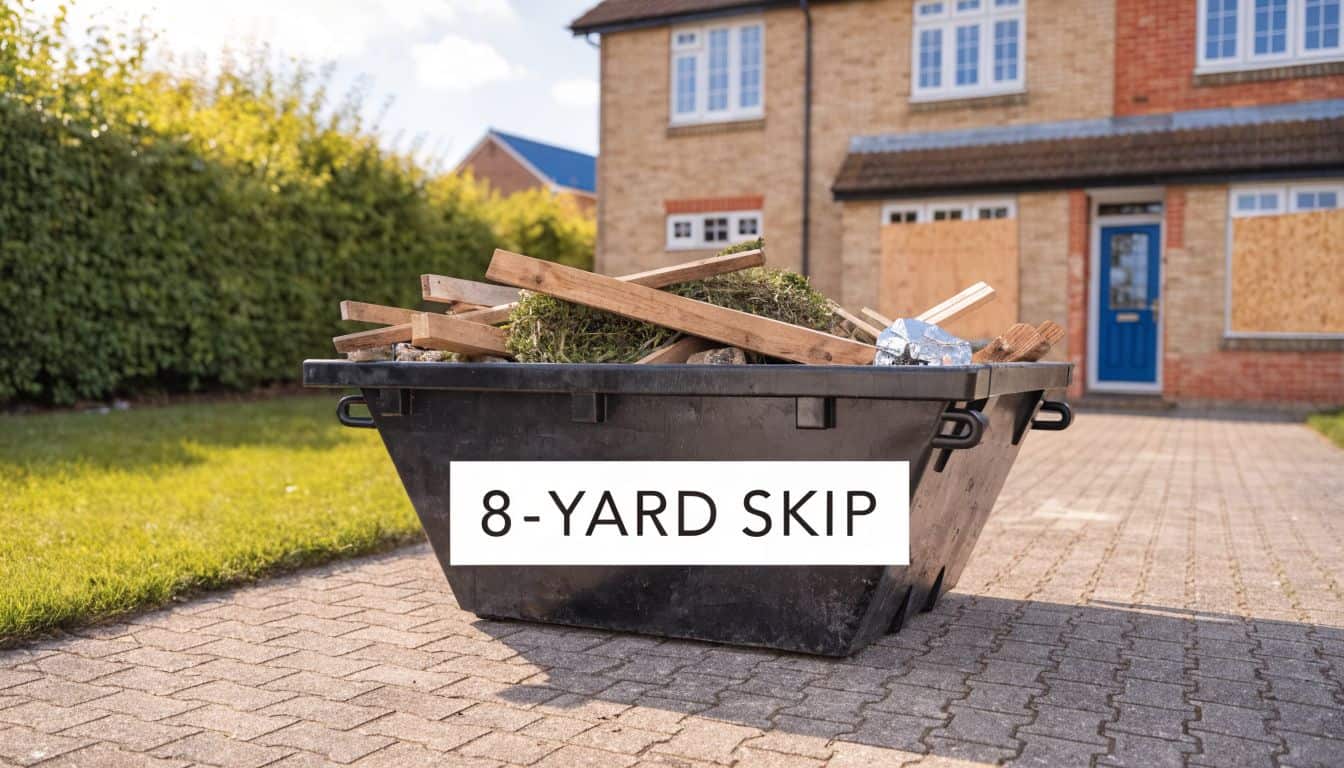
You’re usually not asking “how big is 8 yard skip” out of curiosity. You’re asking because the old kitchen is coming out, the garden is halfway stripped back, or a job is already producing more waste than the van can sensibly shift. At that point, getting the size wrong causes the usual problems. Too small, and you’re booking a second collection. Too big for the wrong material, and collection can be refused.
An 8-yard skip sits in the middle of typical jobs. It’s big enough for substantial renovation and clearance work, but still practical for a house, driveway, or building site where space matters.
Planning a Project Sizing Up the 8-Yard Skip
A typical example is a kitchen refit. Units come out quickly. Then you add worktops, plasterboard, packaging, flooring, broken tiles, timber offcuts, and the bits nobody counted at the start. That’s when an 8-yard skip usually becomes the sensible choice rather than the optimistic one.

The reason it’s so common is simple. The 8-yard skip is the most popular builder’s skip for medium-scale projects, with room for 70 to 80 standard black bin bags, and it makes up over 40% of UK skip hires annually according to this 8 cubic yard skip guide. For homeowners, that usually means one container can cope with a serious clear-out. For trades, it’s often the point where site waste stays manageable without taking up too much room.
Why the first choice matters
If you undersize the skip, the job slows down. Waste starts piling beside the work area, labour gets wasted moving it twice, and you often end up paying more overall. If you oversize without thinking about the material, you can run into weight problems even if the skip still looks only partly full.
A skip should match both the volume of waste and the type of waste. Most people only think about one of those.
If you’re still weighing up the options, a practical way to narrow it down is to compare project type, waste type, and available space before ordering. That’s the same logic behind this skip size guide from The Waste Group, which helps sort straightforward domestic jobs from heavier trade waste.
Visualising the Space an 8-Yard Skip Actually Offers
The phrase “8 cubic yards” doesn’t help much when you’re standing in a driveway with rubble and timber everywhere. Physical size is what matters.

A standard 8-yard skip measures about 12 feet long, 5.6 feet wide, and 4 feet high. In metric terms, that’s roughly 3.66m x 1.67m x 1.22m. Its capacity is about 6.1 cubic metres. In everyday terms, that’s often easier to picture as a skip that takes up about a single parking space and gives you enough room for a proper renovation or clearance load.
What that looks like on site
For most homes, the footprint is the first issue. If you can fit one family car on the drive with room to open the doors, an 8-yarder is often the size people can accommodate without major rearranging. It’s not small, but it isn’t an oversized commercial container either.
Another useful way to picture it is by what goes into it:
- Black bags. Around 70 to 80 standard black bin bags.
- Wheelie-bin thinking. Roughly 25 wheelie bins worth of waste.
- Builder’s view. Enough for a medium strip-out, a heavy garden clearance, or a mixed load from a few days of active work.
That’s why this size gets chosen so often. It’s the point where capacity becomes useful.
For a quick visual reference, this short clip helps show the shape and footprint in real terms.
What people often misjudge
People usually underestimate bulk before they underestimate weight. Old fence panels, cabinet carcasses, plasterboard sheets, and awkward furniture fill air space fast. Once those go in, the skip starts looking smaller than it sounded on paper.
Practical rule: If your waste includes long, awkward, or bulky items, break them down before loading. You use the cubic space far more efficiently.
An 8-yard skip gives a lot of usable room, but only if you load it sensibly. Flat items against the sides, dense materials spread evenly, and bulky objects broken down where possible. That’s what makes the stated size work in practice rather than just in theory.
Common Waste Types and What an 8-Yard Skip Can Hold
An 8-yard skip works well when the waste is mixed and the project has some scale to it. That includes domestic refits, site clearances, landscaping work, and many commercial tidy-ups. The key is to think in waste streams, not just in square footage of the job.
Typical jobs that suit this size
For a bathroom renovation, an 8-yarder can usually take old sanitaryware, tiles, timber framing, pipework, packaging, and general building debris. For a garden clearance, it’s often used for turf, branches, soil in controlled quantities, shrubs, and old timber structures. For a house clearance or room strip-out, it handles wardrobes, broken furniture, carpets, underlay, and bagged rubbish more effectively if larger items are dismantled first.
A practical check is whether your waste is mostly bulky, mostly dense, or a genuine mix. Mixed renovation waste is where this skip size tends to earn its keep.
If you need a clearer list of acceptable materials before loading, this guide to what can go in a skip is a useful reference point.
Volume isn’t the same as weight
This is the part many people miss. The skip may have the room, but the load still has to be lifted and carried legally.
The weight of waste varies sharply by material. A cubic metre of soil can weigh 1.6 tonnes, while mixed construction waste is closer to 0.5 tonnes, according to this builders skip guide. In practice, that means an 8-yard skip can often take its full volume of mixed waste, but can hit its weight limit when only partly full with dense materials such as soil or rubble.
That’s why a skip full of timber and packaging behaves very differently from a skip half full of hardcore.
If your load is mainly soil, concrete, bricks, or rubble, judge the skip by weight first and space second.
Items you shouldn’t throw in without checking
Some materials need separate handling, specialist disposal, or prior approval.
Don’t assume these can go straight in: asbestos, tyres, fridges, freezers, and other items that require special handling.
The safest approach is to flag unusual waste before delivery rather than after loading. That avoids contamination issues, rejected collections, and awkward delays when the site needs to keep moving.
Staying Legal The Rules on Skip Weight and Fill Levels
Most loading problems happen because people look at the top edge of the skip and assume that if there’s still visible space, more can go in. That isn’t how collections work in practice.

The maximum payload for an 8-yard skip is typically 8 tonnes for heavy waste, but collection is still restricted by the lorry’s legal gross weight limit of 26 to 32 tonnes. If that limit is exceeded, the load can be refused, and overload fees of £300+ can follow, as set out in this skip size overview.
The level load rule matters
Waste needs to sit level with the sides of the skip. Not above them. Not heaped in the middle. Not with timber, metal, or plasterboard sticking over the top.
That’s partly about road safety and partly about transport law. The lorry has to move that container on public roads, and an unstable or protruding load creates an immediate problem.
A practical loading order helps:
- Dense waste first. Put rubble, broken slabs, or bricks at the bottom.
- Lighter waste above. Timber, plastic, packaging, and general mixed waste should sit on top.
- Break bulky items down. This keeps the load level rather than peaked.
A skip can look only three-quarters full and still be too heavy. It can also look full enough to collect but still be rejected because the load rises above the sides.
What doesn’t work
What fails most often is cramming the last bits in by force. Trades know the temptation. Homeowners do it too. A few extra bags, one more broken unit, a sheet balanced across the top. That’s exactly how a straightforward collection turns into a delay.
If there’s any doubt, stop loading and ask the hire company before collection day. That’s cheaper than a wasted journey and easier than unloading the skip by hand to bring it back into line.
Placement Essentials Driveway Access and Council Permits
A skip can be the right size and still be the wrong booking if nobody has thought about where it’s going to sit. Access and permits cause as many problems as loading does.
On a driveway or private land
Private placement is usually the simpler option. You avoid the council permit process and you keep the skip closer to the work. That makes a difference on refits, garden jobs, and trade work where waste is being moved steadily through the day.
What matters here is clear access for the delivery vehicle. Check for parked cars, gates, low branches, and tight turns. Also think about the working area once the skip has landed. If it blocks doors, garages, or site access, the convenience disappears quickly.
On the road in Dorset
If the skip can’t go fully on private land and has to sit on the road, permit rules apply. In the UK, a council permit is required for a skip placed on a public road, and in areas such as Dorset it can cost £20 to £50 and take up to 5 days to process. Failing to secure that permit can lead to fines of up to £1,000 under the Skip Regulations 1984, according to this Dorset-focused skip permit guide.
That matters because people often book on the assumption that a road placement can happen tomorrow. Sometimes it can’t.
What to check before you book
Use a quick checklist before ordering:
- Private or public land. If any part of the skip sits on the road, start with permit questions.
- Lead time. Don’t leave road placement to the day before if council approval is needed.
- Safe siting. Street placement usually needs proper positioning and safety measures arranged through the provider.
- Neighbour impact. On narrow roads, a skip in the wrong place causes access trouble fast.
For Dorset homeowners and contractors, this is one of the most commonly overlooked parts of the whole job. The waste itself gets planned in detail. The legal placement often doesn’t.
Road permits aren’t admin for admin’s sake. If the skip is on the highway, the paperwork needs to be right before delivery.
The easiest jobs are the ones where placement is settled early. Driveway if possible. Road only when necessary, and only once timings are clear.
Is an 8-Yard Skip Right for You A Size Comparison
By the time sizes are properly compared, a guess has often already been made. A better way is to decide based on waste type first, then project scale.

The practical comparison
A 6-yard skip usually suits smaller refits, minor garden work, or jobs where waste is dense but the total amount is modest. An 8-yard skip is the common middle ground for medium domestic and trade projects. 10- and 12-yard skips are more often chosen for larger volumes of lighter, bulkier waste where physical space matters more than density.
That last point matters. If you’re dealing with heavy spoil, rubble, or soil, bigger isn’t always better. Larger skips can be the wrong tool for dense material, while an 8-yarder is often the more practical upper limit for that kind of load. If the heavy waste volume goes beyond what a skip can sensibly handle, grab lorry hire is often the better route.
Skip size quick comparison
| Skip Size | Capacity (Bin Bags) | Ideal For | Handles Heavy Waste? |
|---|---|---|---|
| 6-yard | Smaller than an 8-yard skip | Small bathroom refits, minor garden jobs, limited rubble | Yes, for smaller quantities |
| 8-yard | 70-80 | Medium kitchen renovations, mixed building waste, larger clearances | Yes, often the practical choice for heavy waste |
| 10/12-yard | Larger than an 8-yard skip | Bulky house clearances, lighter large-volume waste | Usually better for lighter bulky waste than dense loads |
A simple rule of thumb
Choose an 8-yard skip if your project is too big for a small domestic skip but not so large that you’re into multiple-container or grab-lorry territory. It’s the size suitable for the broadest range of real jobs without becoming awkward to place or risky to overload.
For Dorset projects where waste volume, access, and disposal type all need lining up, providers such as The Waste Group also offer skip hire alongside grab lorry hire, which is useful when a site produces more heavy material than a standard skip setup can handle efficiently.
Ready to Book Your 8-Yard Skip in Dorset
An 8-yard skip is big enough for a serious amount of waste, but the useful answer isn’t just its dimensions. It’s whether the material is light or heavy, whether the load will stay level, and whether the skip is going on private land or the road.
Get those three points right and the job tends to run cleanly. Get them wrong and the usual trouble follows. Delays, refused collections, permit issues, or extra cost that could’ve been avoided.
If you’re booking in Dorset, it helps to start with the practical side rather than the sales pitch. Measure the space, identify the waste, and check placement early. This Dorset skip hire guide is a good place to sort the local basics before ordering.
If you need a skip for a home project, site job, or garden clearance, The Waste Group offers skip hire across Dorset with online booking, flexible delivery, and support with the practical details that often trip people up.