How to dispose of a tv: how to dispose of a tv safely and responsibly
How to dispose of a tv: how to dispose of a tv safely and responsibly
That old TV gathering dust in the corner can't just be chucked out with your weekly rubbish. In the UK, you have a few clear options: recycle your TV at a designated facility, book a council bulky waste collection, or use a retailer take-back scheme. It's actually illegal to send it to a landfill because of the hazardous materials packed inside.
Why You Can't Just Bin Your Old Television
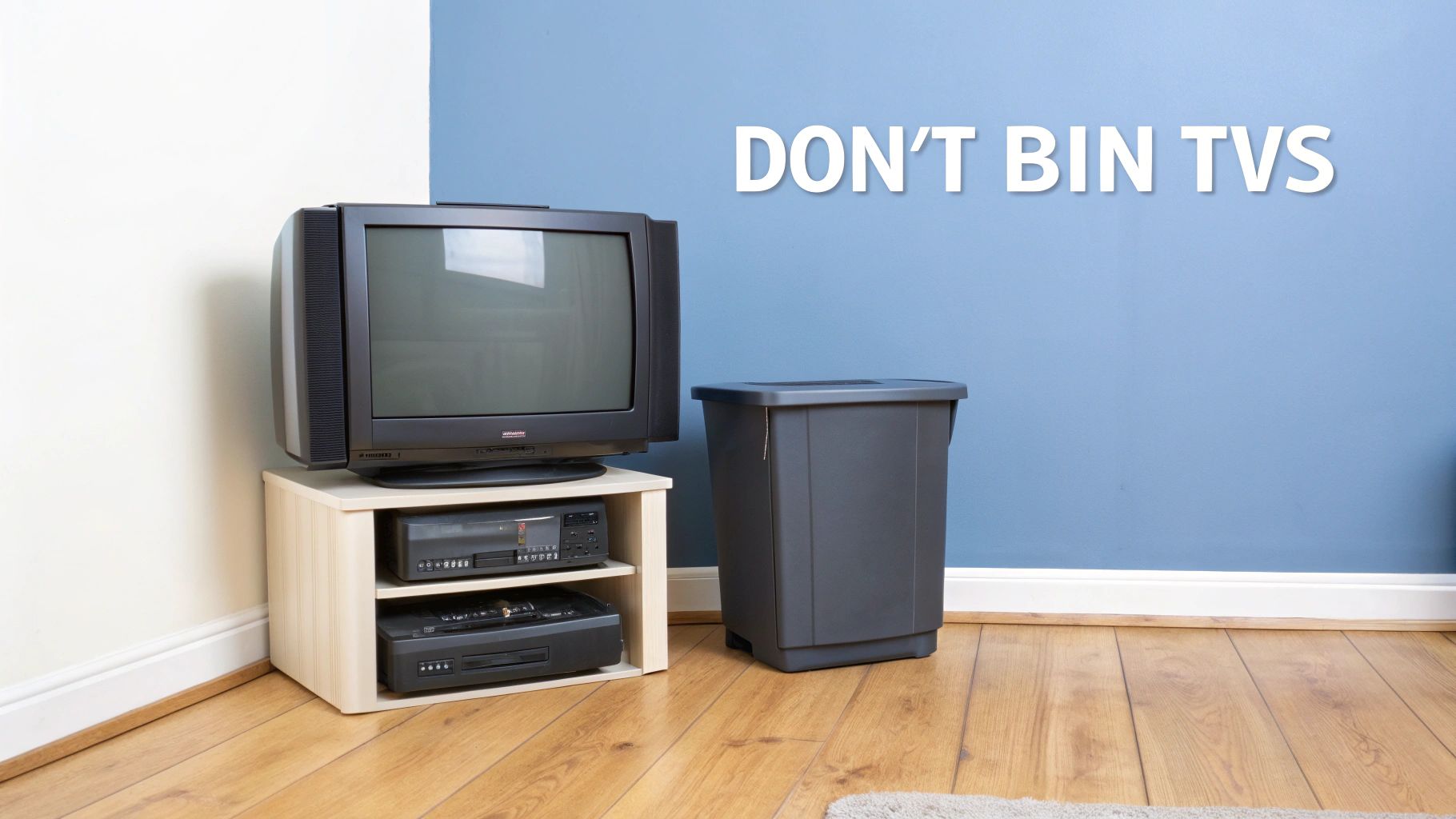
Tempting as it might be, just dropping an old television in your wheelie bin or leaving it on the pavement is a big no-no. It’s not just bad for the environment; it’s against the law. TVs fall into a special category of waste that needs to be handled with care.
The Problem With E-Waste
Here in the UK, all televisions are classed as Waste Electrical and Electronic Equipment (WEEE). This isn't just jargon – it's a crucial classification because TVs contain a cocktail of components that can be pretty dangerous if they aren't managed properly.
Think of it like this: your TV is a complex gadget filled with both valuable materials worth recovering and some nasty, toxic substances.
When a TV gets dumped in a landfill, those harmful elements can seep into the ground, contaminating soil and even our water supplies. It’s a genuine risk to local wildlife and public health. The scale of this problem is huge; the UK collected a mind-boggling 493,000 tonnes of e-waste through official routes, and TVs and monitors alone accounted for 47,095 tonnes of that.
Hazardous Materials Hiding Inside
Different types of TVs contain their own unique mix of hazardous materials, which is exactly why they need specialist disposal.
- Older CRT TVs: Remember those bulky, deep-backed sets? Their cathode ray tubes are made with leaded glass. A single one can contain several kilograms of lead, which was used to shield you from X-rays.
- LCD and Plasma Screens: Modern flat-screens are an improvement, but they have their own issues. LCD screens have mercury in their backlights, while the circuit boards in all modern electronics can contain things like cadmium and flame retardants.
These materials are perfectly safe while the TV is sat in your living room, but they become a real liability once the unit is broken or thrown away. The whole point of the WEEE framework is to stop these toxins from ever reaching the environment.
The law on this is crystal clear. The WEEE Regulations 2013 place a "duty of care" on every household to make sure their electrical waste goes to an authorised collector. For a proper look at your responsibilities, it’s worth reading up on the UK's hazardous waste disposal regulations. This is how we ensure every old telly is dismantled safely, with valuable bits recovered and hazardous parts neutralised.
Getting Your Old TV Ready for Disposal
Before your TV starts its next journey—whether that's to a new home or a recycling plant—a few key prep steps are a must. Taking a moment to get your old telly ready isn't just about making the process smoother; it's about protecting yourself and your personal information.
First off, think about the sheer physicality of moving the thing. Modern flat screens are deceptively light but can be awkward to grip and are surprisingly fragile. Older CRT televisions, on the other hand, are notoriously heavy beasts, often needing two people to lift safely. Always bend at the knees and get a proper hold to avoid a strained back or a dropped TV.
Wiping Your Smart TV Clean
If you're getting rid of a smart TV, this is the most critical step. These devices are treasure troves of your personal data, storing everything from Wi-Fi passwords to login details for apps like Netflix, Amazon Prime, and Disney+. Simply leaving that information on there is a huge security risk.
The surefire way to erase everything is to perform a factory reset. This wipes the slate clean, restoring the TV to its original out-of-the-box state and kicking all your accounts and settings to the curb.
Here’s a quick guide, though menus can vary a bit depending on the model:
- Samsung TVs: Head to Settings > General > Reset. You’ll probably be asked for your security PIN (the default is usually 0000 if you never changed it).
- LG TVs: Navigate through Settings > All Settings > General > Reset to Initial Settings.
- Sony TVs: Find the Settings menu, then look for Storage & Reset > Factory data reset > Erase everything.
You’ll almost always find the reset function lurking in the 'General' or 'System' settings. If the screen is broken and you can't access the menu, you have to assume your data is still on there. In that case, make sure you choose a certified recycler who guarantees secure data destruction as part of their service.
Gathering All the Components
Once the TV is data-free and ready to go, have a final scout around for all its bits and pieces. Any recycler or charity will be grateful to receive the complete package. It makes their job of testing, refurbishing, or dismantling it so much easier.
It's a classic mistake: the TV goes, but the remote control and power cable get left behind. For a charity, that can be the difference between a TV being reused or immediately stripped for parts.
Try to gather everything that came in the original box. This usually includes:
- The remote control (pop the batteries out—they need to be recycled separately)
- The power lead and any other crucial cables
- The stand or base, even if you had it mounted on the wall
- The original instruction manual, if you can still find it
Keeping it all together gives a functional TV the best possible chance of finding a second home. For recycling facilities, it just helps them process the entire unit in one go. With these steps sorted, you're ready to figure out the best disposal route.
Your Main TV Disposal Options in the UK
So, you've prepped your television, wiped your data, and now it's ready for its final journey. The big question is, where to? Knowing how to dispose of a TV correctly in the UK comes down to picking the right path for your situation. It all depends on the TV's condition, what services are available locally, and frankly, how much time and effort you can spare.
Let's break down the most common and responsible routes you can take.
This simple flowchart is a great way to visualise that first crucial step for any TV you're getting rid of.
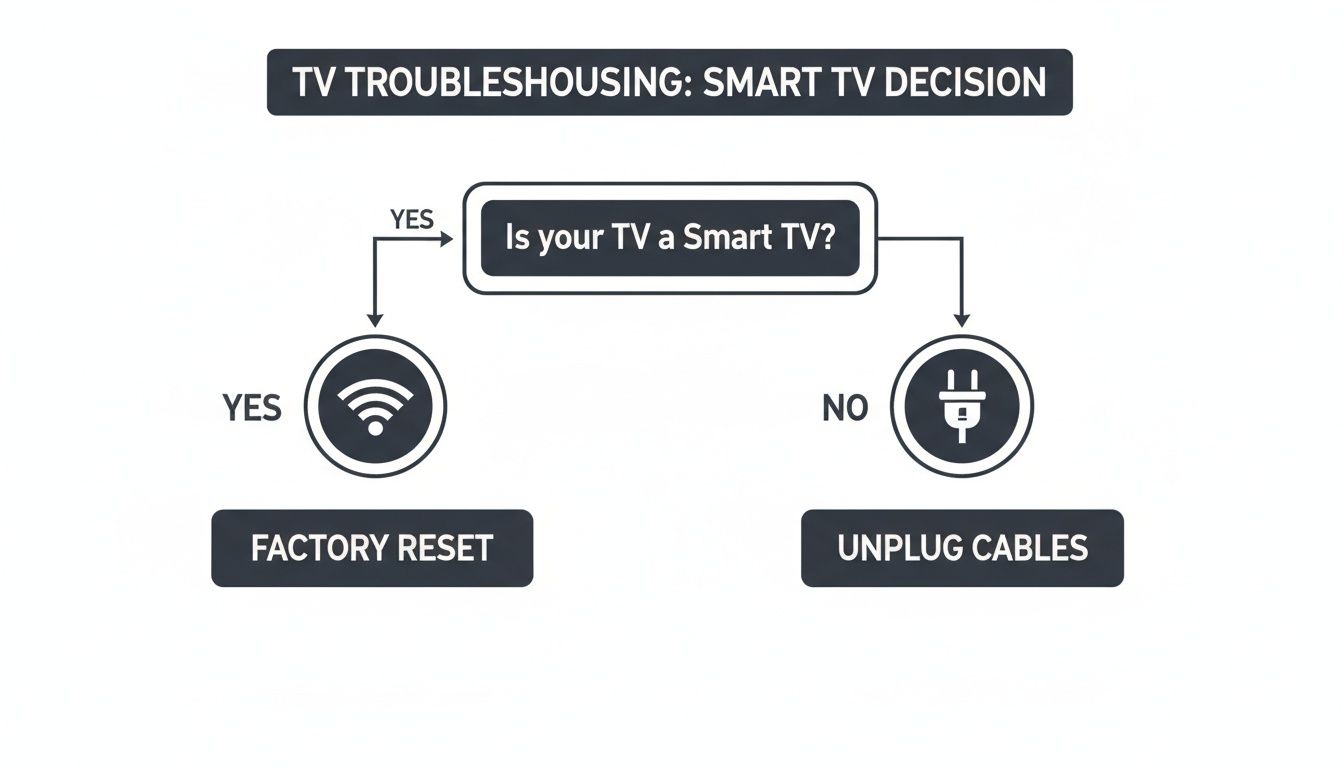
The takeaway here is crystal clear: if your TV has ever been connected to the internet, a factory reset isn't just a suggestion—it's an absolute must to protect your personal data before that screen leaves your home.
Choosing the right disposal route can be tricky, so let's compare the main options head-to-head.
Comparing TV Disposal Methods in the UK
| Disposal Method | Best For | Typical Cost | Effort Level |
|---|---|---|---|
| Local Council Tip (HWRC) | Broken TVs you can transport yourself | Free | Medium |
| Council Bulky Collection | Large or heavy TVs you can't move | £10 – £50 | Low |
| Retailer Take-Back Scheme | Getting rid of the old TV when buying a new one | Free – £30 | Very Low |
| Charity Donation | Fully working, modern flat-screen TVs | Free | Medium |
| Professional Waste Collection | Multiple items, urgent removals, or large clearances | Varies | Very Low |
This table gives you a quick snapshot, but let's dive into what each option really involves.
Head to Your Local Council Recycling Centre
For many people, the most straightforward option is a trip to the local Household Waste Recycling Centre (HWRC), or what most of us just call 'the tip'. Every council has one, and they are set up specifically to handle Waste Electrical and Electronic Equipment (WEEE) items, including your old television.
It’s usually free for residents, though it’s worth checking your council’s website first. Many now require you to book a slot online and you'll almost certainly need proof of address, like a council tax bill or your driving licence. Once you get there, the staff will point you to the right container for electricals. It’s a great choice for a broken 32-inch set that you can easily pop in the back of the car.
Book a Council Bulky Waste Collection
But what if you’re dealing with a massive 65-inch monster that you can’t possibly lift, let alone fit in your vehicle? This is exactly what your local council's bulky waste collection service is for. It’s a convenient 'doorstep' service designed for exactly these kinds of large household items.
Nearly every council offers this service, but it does come with a fee. You can expect to pay anywhere from £10 to £50, depending on your area and how many items you have. You book a collection day, and the council's team will collect the TV from an agreed spot outside your home. If you're having a bigger clear-out, you might find our guide on how to dispose of bulky waste locally helpful for planning.
Use a Retailer Take-Back Scheme
If you're buying a shiny new TV, don't forget that the retailer has a legal obligation to help you with the old one. Under the WEEE regulations, they must offer a take-back service, usually on a like-for-like basis.
This is often the path of least resistance. When they deliver your new TV, they can take the old one away at the very same time. Some shops do this for free as part of the service, while others might charge a small fee for the collection. It solves the entire problem in one go, so always make sure you ask about it when you're at the checkout.
Donate a Working TV to Charity
If your TV is still in perfect working order, sending it to be recycled should be your absolute last resort. By far the most environmentally friendly option is to give it a second life. A working flat-screen can be a fantastic donation for local charities, community hubs, or even larger organisations like the British Heart Foundation.
Before you start loading up the car, always ring the charity first. Many have specific rules about electrical donations. They’ll need to know it’s a modern flat-screen, it's fully functional, and that you have the remote control and power cable.
Just be aware, they almost certainly won't take old, heavy CRT televisions. There’s simply no demand for them, and they are too difficult to handle. But for a modern set, your unwanted TV could make a huge difference to someone else.
What Really Happens When Your TV Is Recycled
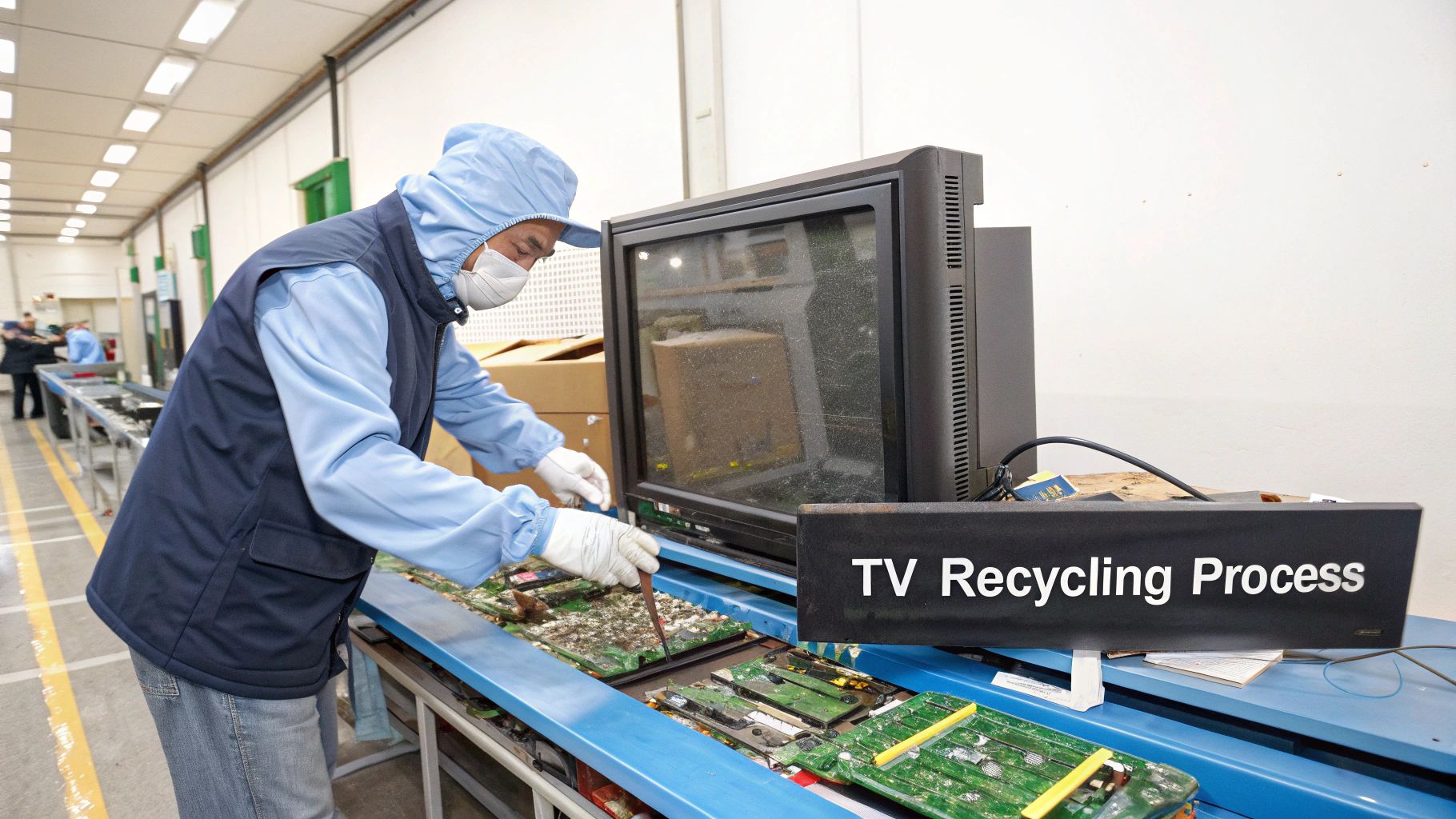
When you drop off your old television at the local tip or have it collected, you’re not just getting rid of clutter. You're kicking off a surprisingly complex and vital process. The TV doesn’t just get crushed; it begins a journey through a specialised recycling facility where it’s carefully broken down into its core components. This isn't just about waste reduction; it's a careful harvest of resources.
The first step on this journey involves separating televisions by type. Old, bulky CRT sets are handled very differently from modern LCD or LED screens because of the materials hiding inside. Once sorted, the process of dismantling begins, which is a meticulous blend of manual labour and powerful machinery.
The Careful Dismantling Process
Highly trained technicians start by manually removing the most hazardous parts first. This is a critical safety step, as many components require special handling to prevent contamination.
For example, the fluorescent lamps that provide the backlight in LCD screens contain small amounts of mercury. These are carefully extracted and sent to a specialist facility where the mercury is safely recovered. Similarly, the powerful capacitors on the circuit boards are removed by hand to avoid any risk of electric shock.
The most challenging part of this process often involves the leaded glass from old CRT televisions. A single CRT screen can contain several kilograms of lead, which must be managed in a closed-loop system to prevent it from ever reaching the environment.
Once these hazardous elements are secured, the rest of the TV can be processed.
Recovering Valuable Materials
After the dangerous bits are gone, the TV is fed into powerful shredders that break it down into smaller, more manageable fragments. This shredded material then passes through a series of advanced sorting technologies designed to separate the different materials.
Powerful magnets pull out all the steel components, while clever machines called eddy current separators are used to isolate non-ferrous metals like aluminium and copper. These recovered metals are incredibly valuable and can be melted down and repurposed to make all sorts of new products, from car parts to drink cans.
The remaining materials, primarily plastics and circuit boards, undergo even more separation.
- Plastics: The plastic casings are sorted by type and colour, then cleaned and shredded into pellets. These can be sold back to manufacturers to create new electronic housings or other plastic goods.
- Circuit Boards: These are the real treasure troves. They are sent for further processing where precious metals, including small amounts of gold, silver, and palladium, are extracted through a complex chemical process.
- Glass: Leaded glass from CRT screens is often used to create new CRT tubes or is repurposed in construction and industrial applications where its properties are useful.
This whole process ensures that up to 98% of the materials from your old television are recovered and put back into the circular economy. Knowing how to dispose of a TV properly doesn’t just declutter your home; it feeds a critical supply chain that reduces our reliance on mining new resources and protects the environment from harmful waste.
When to Hire a Professional Waste Service

Sometimes, the DIY routes just don't add up. Lugging a heavy television to the local tip or waiting for a council collection slot isn't always practical, especially if you're dealing with more than just the one item.
That’s exactly when calling in a professional waste service becomes the smartest, safest, and frankly, the simplest choice.
Imagine you're clearing out a relative's house. Suddenly, you're faced with not just an old TV but a whole room full of unwanted furniture and electronics. Or perhaps you've just upgraded your home cinema, leaving you with a huge, awkward 75-inch screen that you have no chance of lifting or fitting into your car. In common scenarios like these, the convenience of a professional team is a real lifesaver.
Reasons to Call the Professionals
Hiring a licensed waste carrier isn't just about avoiding heavy lifting; it's also about speed and getting your peace of mind back. While council collections can be a good option, they often have waiting lists, which is no help if you need the space cleared quickly.
Think about these situations:
- Large or Multiple Items: A full house clearance is a big job. If you're tackling more than just a TV, looking into professional house cleanout services or junk removal will save you a massive amount of time and effort.
- Accessibility Issues: Is the TV stuck up in a loft or down in a basement? A professional crew has the right equipment and experience to remove it safely without scuffing your walls or putting their backs out.
- Urgent Removal Needs: Need that old telly gone by the weekend? A private service can often offer next-day collection, fitting into your schedule rather than the other way around.
The biggest advantage of using a reputable service is the guarantee of legal and ethical disposal. Unlicensed "man with a van" operators are a major cause of fly-tipping, which can land you with a hefty fine if the waste is traced back to your doorstep.
Ensuring Compliant and Responsible Disposal
A professional, licensed waste carrier like The Waste Group provides one crucial document: a Waste Transfer Note. This is your legal proof that your television has been handed over to an authorised person and is on its way to a proper recycling facility.
This note officially transfers the responsibility from you to the collection company. It gives you complete confidence that your old tech won't end up dumped in a field somewhere.
This piece of paper is essential. It confirms you've fulfilled your 'duty of care' under UK law, ensuring every component of your TV is recycled correctly. For anyone searching for reliable waste disposal near me, choosing a company that provides this paperwork is non-negotiable. It’s the difference between a job done right and a potential legal nightmare.
Common Questions About TV Disposal
When you're trying to figure out how to get rid of an old TV, the same few questions always seem to come up. People worry about the cost, the hassle, or what on earth to do with a big, bulky older model. We've pulled together the most common queries to give you clear, straight-to-the-point answers.
This should help clear up any nagging doubts so you can get that old telly sorted with confidence.
Can I Just Put My Old TV on the Pavement for Collection?
In a word: no. Leaving any electrical item, including a television, on the pavement or next to a public bin is classed as fly-tipping here in the UK. This is a serious offence, and if the item is traced back to you, it can result in some hefty fines.
It’s your responsibility to make sure the TV gets to an authorised disposal point. That means you either need to take it to a designated recycling centre yourself, use a retailer’s take-back scheme, or arrange a proper collection with your local council or a licensed waste company.
Do Charity Shops Still Take Old CRT Televisions?
The answer to this one is almost always a firm "no". Most charities, from big national names like the British Heart Foundation right down to your local high street shop, stopped accepting old-style CRT televisions years ago.
There are a few solid reasons for this policy:
- No Demand: There’s practically zero second-hand market for these heavy, outdated sets.
- Safety & Handling: They are incredibly heavy and awkward, making them a safety risk for volunteers to move around.
- Hazardous Materials: CRTs contain leaded glass, which makes them expensive and complicated for a charity to dispose of if they can't sell them.
While charities are often very happy to take donations of modern, working flat-screen TVs (as long as you have the remote and cables!), you should always phone ahead to check their policy before you load up the car.
How Much Does It Cost to Get Rid of a TV?
The cost of getting rid of a TV can be anything from completely free to a noticeable expense – it all comes down to the method you choose.
Here’s a quick breakdown of what you can expect to pay:
- Local Council Tip (HWRC): Taking a TV to your local Household Waste Recycling Centre is usually free for residents. You'll just need to get it there yourself.
- Council Bulky Waste Collection: This is a much easier option, but it comes with a fee. This typically ranges from £10 to £50, depending on your local council's charges.
- Retailer Take-Back Scheme: If you're buying a new TV, many retailers will take your old one away for a small fee (often around £15 to £30), and sometimes they even offer this for free as part of the deal.
- Professional Waste Service: Hiring a private company like ours is the most convenient and fastest route. Prices will vary depending on your location and the service you need.
Ultimately, picking the right option is a balancing act between your budget, how much effort you want to put in, and how quickly you need the television gone. The most important thing is to choose a legal and responsible route that works for you.
For a completely hassle-free solution that ensures your old TV is recycled responsibly and legally, let The Waste Group handle it. We provide professional waste collection services across Dorset, taking the problem off your hands. Book your collection online today.