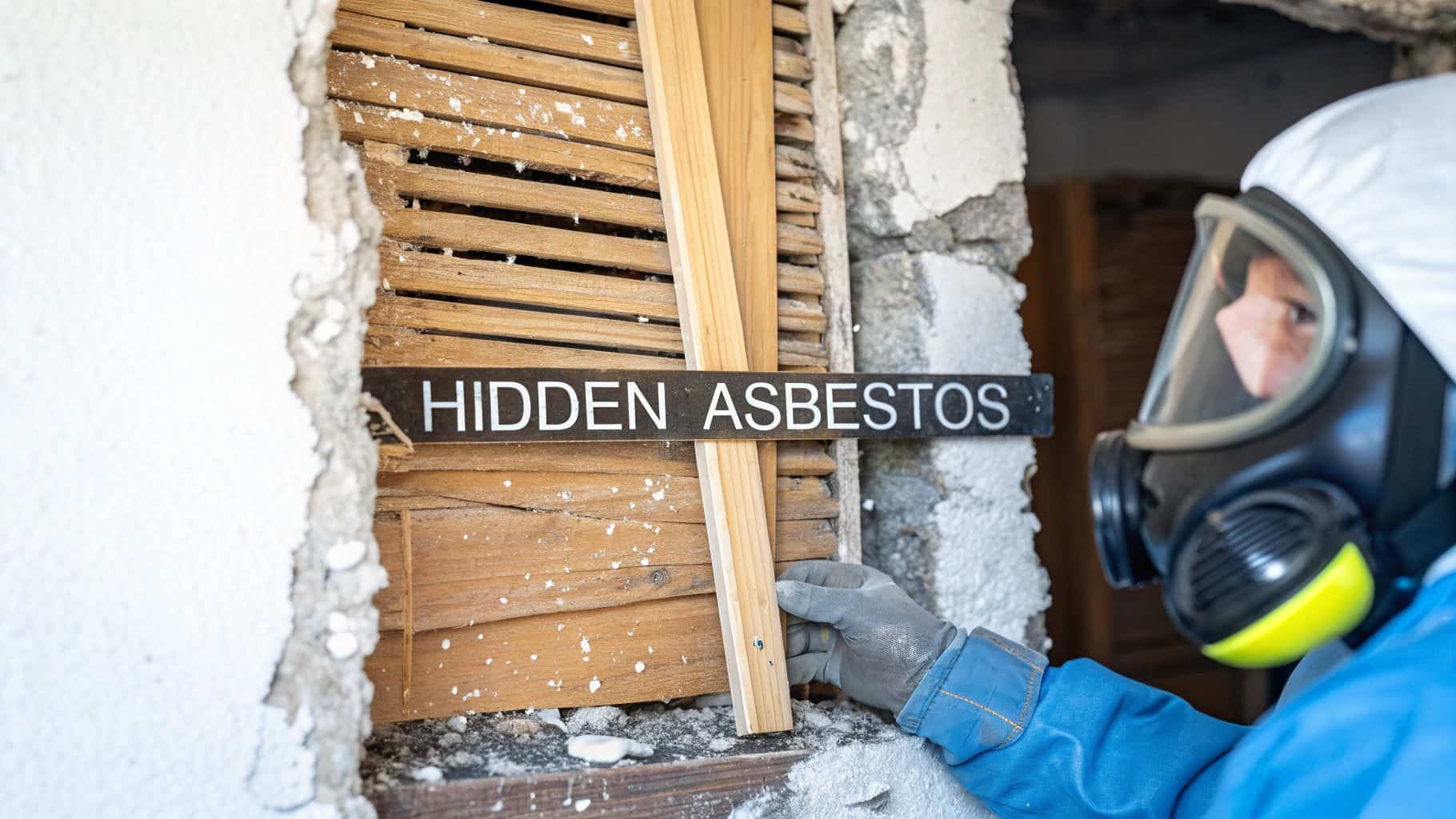
Short answer: traditional lath and plaster — timber laths nailed to the studs or joists, covered in lime plaster and horsehair — very rarely contains asbestos. The construction method largely predates the widespread use of asbestos in building materials, and the original ingredients are lime, sand, hair and wood.
The risk is almost never the lath and plaster itself. It is what somebody put on top of it later, and what happens when you pull it down.
Why the original material is usually fine
Lath and plaster was the standard wall and ceiling build in British homes from roughly the Georgian period until the 1930s, when plasterboard began to replace it. A genuine lath and plaster wall of that age is lime-based. There is no reason for asbestos to be in it.
Asbestos entered plaster products later. From around the 1930s some gypsum plasters, renders and fire-protection boards had asbestos fibre added for strength and fire resistance, and that continued until the UK ban. So the question is really about age and layers, not about lath and plaster as a category.
Where the asbestos usually is
The textured coating. This is the common one. If a lath and plaster ceiling was later given a swirled or stippled finish — Artex and similar textured coatings — that coating can contain chrysotile asbestos if it was applied before 2000. The ceiling underneath can be perfectly ordinary lime plaster while the thin skim over it is the problem.
Later repairs and skims. A lath and plaster wall patched or re-skimmed in the mid-20th century may have been repaired with an asbestos-containing plaster.
Adjacent materials. Asbestos insulating board (AIB) was often used alongside lath and plaster — in ceiling panels, around fireplaces, in airing cupboards and behind heaters. A room can have original lath and plaster walls and an AIB ceiling.
Is it dangerous?
Undisturbed and in good condition, no — and that is the point most guidance buries. Asbestos in a bonded material only becomes a health risk when fibres are released into the air. A sound textured ceiling you are not touching is not releasing fibres.
The danger is in the demolition. Pulling down a lath and plaster ceiling is one of the dustiest jobs in domestic renovation. Decades of dust sit on top of the laths, and the whole lot comes down at once. If there is a textured coating on the underside, you have just put it into the air throughout the room. That is why lath and plaster removal deserves a test first — not because the plaster is likely to be asbestos, but because the job is aggressive enough that if anything in that ceiling does contain asbestos, you will be breathing it.
How to find out before you start
Do not sand, scrape or drill it to find out. That is the one action that turns a non-problem into a problem.
Get a sample tested by a UKAS-accredited laboratory. A single sample is inexpensive relative to a renovation budget, and it tells you which of two very different jobs you are about to do. If you are having an asbestos survey done for a mortgage, refurbishment or demolition, ask that the textured coating be sampled specifically — it is easy to overlook when the visible surface looks like ordinary plaster.
If it does contain asbestos
Textured coatings are non-licensed work in most domestic situations, which means a competent contractor can remove them without an HSE licence — but that is a judgement about the specific material and its condition, and it is one for a qualified person, not a homeowner with a scraper. Asbestos insulating board is a different matter and is usually licensed work.
Whatever route you take, the waste is the same problem at the end: asbestos-containing material cannot go in a normal skip, cannot go in the household bin, and cannot go to most tips. It must travel under a hazardous waste consignment note to a permitted facility.
What disposal costs
The Waste Group is a licensed asbestos waste carrier (CBDU113405, Environmental Permit EPR/EB3308GT). We broker and manage the collection and disposal; we are not a removal contractor.
Disposal is priced as a fixed transport charge for your zone, plus a one-off consignment-note admin charge, plus a per-item charge by weight band — bags, sheets or wrapped panels, and heavier items like doors and tanks. You pay for what you actually have rather than a flat call-out.
For a typical domestic ceiling strip-out, the bagged debris from one room usually falls into the small-load band. Get a fixed asbestos disposal quote and we will price it properly before anyone books a date.
Frequently asked questions
Does lath and plaster contain asbestos?
Traditional lath and plaster — timber laths with lime plaster — very rarely does. The construction method largely predates asbestos use in plaster. The risk is usually a later textured coating applied over it, or asbestos insulating board used nearby.
Is lath and plaster dangerous to live with?
Not in itself. Lath and plaster in sound condition presents no asbestos risk, and even where a textured coating does contain asbestos, an undisturbed coating in good condition is not releasing fibres.
How can I tell if my ceiling coating contains asbestos?
Only by testing. Age is a guide — textured coatings applied before 2000 may contain chrysotile — but you cannot tell by looking. Have a sample analysed by a UKAS-accredited laboratory, and do not disturb it to take a look first.
Can I take down a lath and plaster ceiling myself?
If it has been tested and is asbestos-free, it is a normal, extremely dusty demolition job. If it has not been tested, find out first. Bringing down an untested textured ceiling is the worst way to handle it.
Why is removal riskier than the material itself?
Because the risk is airborne fibres, not the presence of asbestos. Lath and plaster removal creates an enormous amount of dust in a confined space, so if anything in that ceiling contains asbestos it goes straight into the air you are breathing.
Does asbestos in plaster need a licensed contractor?
Textured coatings are usually non-licensed work, meaning a competent contractor can remove them without an HSE licence. Asbestos insulating board usually is licensed work. Which applies depends on the material and its condition, and that assessment should come from a qualified person.
Can asbestos plaster go in a skip?
No. Asbestos waste cannot go in a standard skip, a household bin, or most household waste recycling centres. It must be collected by a licensed carrier and moved under a hazardous waste consignment note to a permitted disposal site.
What does asbestos disposal cost?
It is priced as transport for your zone, plus a one-off consignment-note admin charge, plus a per-item charge by weight band, so a small domestic load costs considerably less than a full container. Request a fixed written quote and we will price your load exactly.
Related guides
- Asbestos in plaster walls — the wider question of asbestos in plaster and plasterboard
- Removal of asbestos ceilings — if your ceiling tests positive
- How to remove Artex safely — textured coatings specifically
- Asbestos skip hire — for larger loads
The Waste Group are licensed asbestos disposal specialists — we cover the whole of Dorset
Call us: 0800 652 0160
Fully licensed, fast and safe asbestos collection and disposal across Dorset