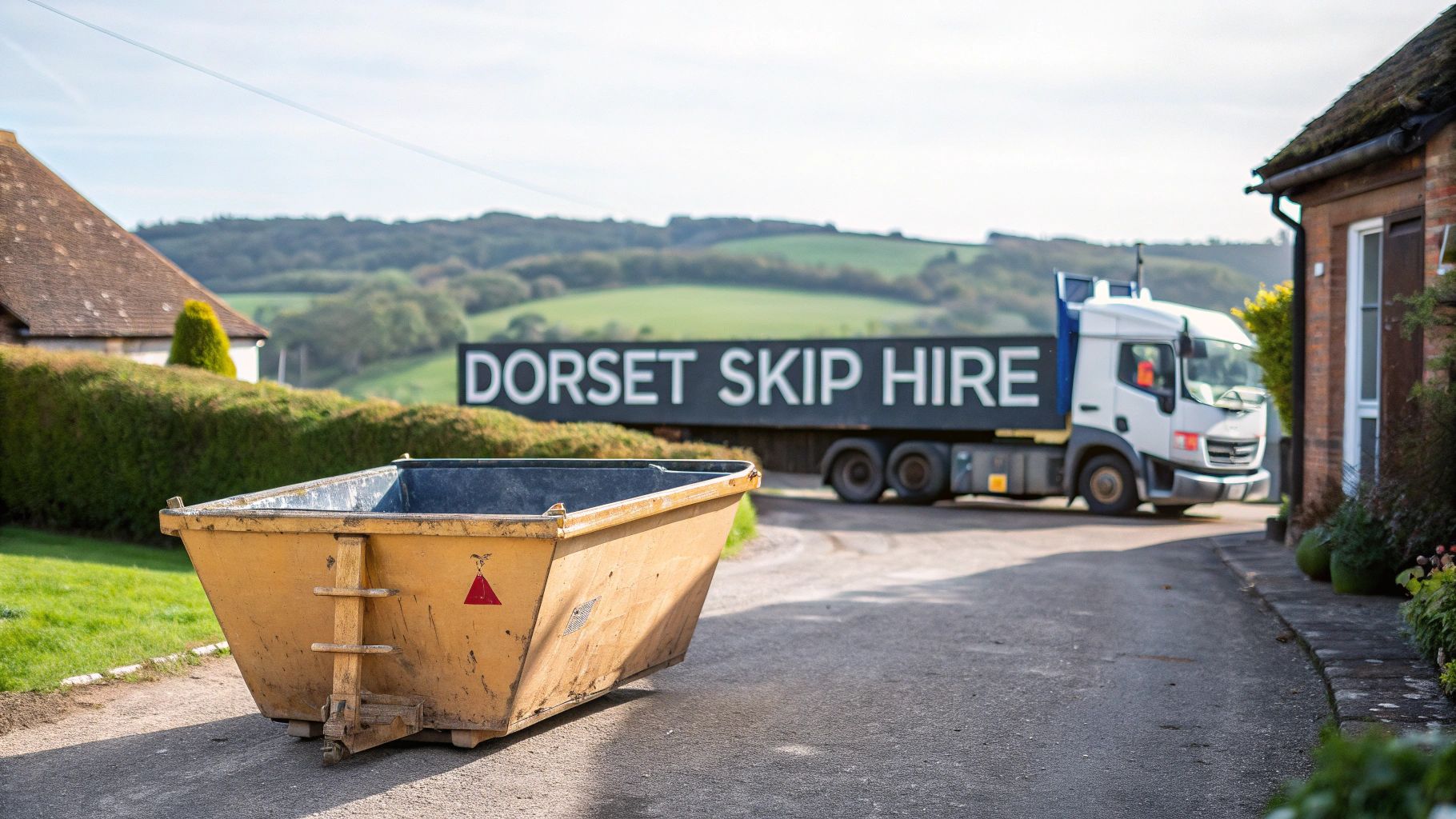
Your Ultimate Guide to Skip Hire Sizes in Dorset
Your Ultimate Guide to Skip Hire Sizes in Dorset
Picking the right skip can feel like a bit of a guessing game, but it really doesn't have to be. The size of your project, whether it’s a small garden clear-out or a massive home renovation, is what will guide you to the right skip hire size.
To make it easier, we’ve put together a quick guide to give you a confident starting point.
How to Instantly Choose the Right Skip Size
Think of it this way: ordering a skip is all about volume, measured in cubic yards. A higher number means more space for your waste. Getting this first step right is crucial for keeping your project on time and, more importantly, on budget.
Order one that's too small, and you're looking at the hassle and extra cost of getting a second one. Go too big, and you've simply wasted money. It's a bit like choosing a self-storage unit; you wouldn't rent a huge space for a few boxes. Checking a UK Storage Unit Sizes Guide helps you visualise space for belongings, and we want to do the same for your waste.
Skip Size Quick Selector
This table is your fast track to an informed decision. It breaks down the most popular skip sizes, gives a relatable capacity in bin bags, and matches them to the kinds of jobs we see every day across Dorset.
| Skip Size (Cubic Yards) | Capacity (Approx. Bin Bags) | Perfect For | Average Cost (2026) |
|---|---|---|---|
| 4-Yard 'Midi' Skip | 30 – 40 Bags | Small kitchen/bathroom refits, garden clearances | £180 – £260 |
| 6-Yard 'Small Builders' Skip | 50 – 60 Bags | Bulky waste, soil and rubble, larger DIY projects | £230 – £330 |
| 8-Yard 'Builders' Skip' | 60 – 80 Bags | Full house clearances, major renovation projects | £270 – £380 |
| 12-Yard 'Maxi' Skip | 100 – 120 Bags | Large but light waste, e.g., wood, metal, furniture | £350 – £480+ |
This should give you a solid idea of where to start. Choosing the right skip from the outset saves a lot of headaches later on.
Understanding Popular Skip Options
Here in the UK, you’ll find that the 4-yard, 6-yard, and 8-yard skips are the real workhorses of the industry. They’re perfectly suited for homeowners, DIY jobs, and smaller construction projects.
A 4-yard ‘midi’ skip is your go-to for a garden tidy-up or a small bathroom rip-out, holding about 40 bin bags. Need something bigger? The 6-yard ‘small builders’ skip is brilliant for heavier stuff like soil and rubble from bigger DIY tasks, fitting around 60 bin bags.
You'll often hear the 6-yard and 8-yard skips called 'builders skips', and for good reason. They are the backbone of the trade, tough enough to handle the waste from most residential jobs and small-scale commercial work.
This table and our quick breakdown should give you a strong foundation for making your choice. As we go through this guide, we’ll dive deeper into each size.
If you’re keen to learn even more right now, have a look at our detailed article on what size skip you might need for more project-specific examples.
Picking The Right Skip: A Visual Guide From Mini to Maxi
Let's be honest, trying to picture what a 'cubic yard' of waste looks like can feel a bit like guesswork. It’s an abstract term, and getting it wrong can mean paying for a skip that's half-empty or, even worse, ordering one that’s too small.
To make things easier, we're going to break down the most common skip sizes, from the handy ‘midi’ to the hefty ‘maxi’, using real-world examples you can actually visualise. No more abstract numbers, just practical advice to help you choose the perfect skip for your job.
This simple flowchart is a great place to start. It walks you through the process of matching your project to the right size and capacity.

As you can see, it all comes down to connecting the job you're doing with a specific skip size and its equivalent bin bag capacity. A little bit of planning here really does go a long way and saves you money in the long run.
The 4-Yard Midi Skip: The Compact Clearer
The 4-yard skip, often called a 'midi', is our smallest and one of our most popular choices for home projects. It’s the perfect solution for those jobs that create just a bit too much waste for your weekly wheelie bin collection but don't need a massive industrial container.
To give you an idea of its size, a 4-yard skip can hold around 30 to 40 bin bags. Think of it as the go-to for small-scale clear-outs.
Perfect for jobs like:
- A Weekend Garden Blitz: Clearing out hedge trimmings, old turf, or that tired garden furniture after a weekend tidy-up in Poole.
- Small DIY Projects: Got waste from redecorating a single room? This skip will easily take the old wallpaper and carpet.
- Minor Bathroom Updates: It’s big enough to hold an old loo, sink, tiles, and flooring from a small bathroom job.
The 6-Yard Small Builders Skip: The Versatile Workhorse
Moving up a notch, we have the 6-yard skip. This is arguably the most common skip hired across the UK and is often known as a 'small builders skip'. It hits that sweet spot between capacity and a compact footprint, making it a firm favourite for homeowners and tradespeople alike.
It holds roughly 50 to 60 bin bags and, importantly, it's built to handle heavy, dense waste like soil, rubble, and concrete.
The 6-yard skip is the top choice for many builders because it’s the largest size you can typically fill completely with heavy materials like soil, brick, and concrete. Any bigger, and you’re usually restricted to lighter waste only.
This makes it the ideal partner for a slightly bigger home improvement. For instance, if you're ripping out a whole bathroom in your Bournemouth home—suite, tiles, plasterboard and all—it would fit comfortably in a 6-yarder.
The 8-Yard Builders Skip: The Renovation Favourite
When your project graduates from a simple clear-out to a full-blown renovation, the 8-yard skip is what you need. As the largest of the 'builders skips', it gives you a huge amount of space for mixed construction and household waste.
With space for about 60 to 80 bin bags, it provides plenty of room for the debris from a major home overhaul.
Ideal projects for an 8-yard skip:
- Complete Kitchen Rip-Outs: It’ll swallow up old kitchen units, worktops, appliances, flooring, and all the packaging without a problem.
- Large Garden Landscaping: Perfect for big garden jobs that involve digging up lots of soil, turf, and old paving slabs.
- Small House Extensions: All the waste from building a small conservatory or a single-storey extension in Dorchester would be a great fit for an 8-yard skip.
This size is usually the biggest you can comfortably fit on a domestic driveway and represents some serious disposal space.
The 12-Yard Maxi Skip: For Bulky, Light Waste
Finally, we come to the 12-yard skip, or the 'maxi' skip. Now, this is where the rules change a bit. Because of their sheer size, these skips are not designed for heavy waste like soil or rubble. A full one would simply be too heavy for the lorry to legally lift.
Instead, the 12-yard skip is purely for large volumes of bulky yet lightweight materials. It's the perfect answer for a full house clearance where you’re getting rid of furniture, wood, and other big, awkward items. It can hold a massive 100 to 120 bin bags.
It's the go-to choice when you need to empty a house of its contents, perhaps during an end-of-tenancy clear-out or when prepping a property for sale. By matching your waste to one of these descriptions, you can make sure you’re hiring the most cost-effective skip for your needs.
When to Hire a Roll-On Roll-Off (RORO) Bin

Sometimes, a project is just too big for a standard skip. Even our largest maxi skips can be dwarfed by the sheer amount of waste coming from major commercial and industrial sites. When you’re dealing with waste on that kind of scale, you need to bring in the heavyweights: Roll-On Roll-Off (RORO) bins.
These aren’t your typical household skips. As the name suggests, ROROs are huge containers that are rolled off the back of a specialised lorry, rather than being lifted by chains. This design allows for massive capacities, making them the only sensible option for sites generating enormous quantities of waste.
Because of their sheer size, you won’t see these on a residential driveway. ROROs are almost exclusively used for commercial work, found on major construction sites, demolition jobs, and large business premises across Dorset.
Who Needs a RORO Bin?
RORO bins are the workhorses for large-scale operations that produce a constant, high volume of waste—the kind that would quickly fill up an entire fleet of smaller skips.
Picture a major demolition in Bournemouth, where an old office block is being taken down. The amount of concrete, steel, and rubble is immense. Or think of a large manufacturing plant in Poole that needs to get rid of packaging, industrial offcuts, and other by-products day in, day out.
You'll typically find ROROs being used by:
- Major Construction Sites: For handling everything from excavated soil and hardcore to timber and structural steel.
- Demolition Projects: To clear huge volumes of brick, concrete, and other rubble.
- Manufacturing Facilities: For managing a continuous stream of industrial or packaging waste.
- Large-Scale Clearances: Perfect for stripping out shopping centres, warehouses, or large office buildings.
The main difference is the scale. If your project’s waste is measured in tonnes rather than bin bags, a RORO is almost certainly what you need. We cover how these containers are used in more detail in our guide to roll-on roll-off skip sizes.
Understanding RORO Sizes and Their Uses
Just like standard skips, ROROs are measured in cubic yards, but the numbers are in a different league. They typically start at 20 yards and go all the way up to 40 yards. Choosing the right one isn’t just about getting the most space, though—it’s about matching the bin to the type of waste.
One of the most important things to get right with a RORO is the weight. A 40-yard bin has a massive volume, but it’s strictly for light, bulky items. If you were to fill it with heavy waste like soil or concrete, it would be far too heavy for our lorry to lift and transport legally and safely.
This is why different sizes have very distinct jobs.
The 20-yard RORO is the go-to choice for heavy construction and demolition waste. It offers a huge amount of space but remains a manageable weight when filled with dense materials like soil, hardcore, bricks, and concrete.
The 40-yard RORO, on the other hand, is the undisputed king of high-volume, low-weight clearances. It’s ideal for getting rid of enormous quantities of wood, light metal, plastics, packaging, and general mixed waste from a big factory clear-out or site refurbishment. Getting this right helps businesses manage their waste far more efficiently, keeping their Dorset operations running smoothly and cost-effectively.
Understanding Skip Hire Costs and How You Can Save Money

When you get a quote for a skip, you might wonder what goes into that final price. It’s a fair question. You’re not just paying for a big metal box to land on your drive. The cost is a careful blend of logistics, labour, and, crucially, the responsible handling of whatever you throw in it.
A huge chunk of what you pay covers things that happen long after we’ve collected the skip. Understanding these moving parts is the key to getting the most value and making your budget stretch further. Let’s pull back the curtain on how it all adds up.
What Really Shapes Your Skip Hire Price
The price of hiring a skip isn’t just plucked out of thin air. It’s calculated based on a few core factors: the disposal fees for your waste, the logistics of getting the skip to you and back, and any permits required.
One of the biggest drivers behind the cost is the government’s landfill tax. This has been climbing steeply for years, directly pushing up the price of waste disposal for everyone. It’s a major reason why sorting your waste is more important than ever.
A key factor is the landfill tax, which is set to hit £130.75 per tonne for standard waste from 1 April 2026. This is exactly why we work so hard to recycle as much as we can – it diverts waste from landfill and helps keep your costs down.
On top of taxes, your final bill also includes:
- Delivery and Collection: This covers the fuel and our driver's time to get the skip to your Dorset site and pick it up once it’s full.
- Permit Fees: If your skip needs to go on a public road, the council requires a permit. We sort all the paperwork, and the council's fee is simply passed on.
- Waste Sorting and Recycling: Once collected, your waste is brought back to our licensed facility. Here, our team gets to work meticulously sorting it all by hand to separate every recyclable material possible.
Smart Tips to Save Money on Your Skip Hire
Knowing what goes into the price is half the battle. Now you can use that knowledge to make some savvy moves and lower the overall cost of your project. It really comes down to good planning and being a bit strategic with how you use the skip.
The most effective way to save money, without a doubt, is to choose the right skip size from the start. It’s always cheaper to get one correctly-sized skip than to order a small one, fill it, and then realise you need another. Take a look at the guidance in our earlier sections to perfectly match your project to a skip.
Here are a few more tried-and-tested ways to keep your costs in check:
1. Don't Overfill Your Skip
It’s not just a rule; it’s the law. Transporting an overfilled skip is dangerous and illegal. All our skips have a "level load" line on the side. If your waste is piled up above this, our driver will have to ask you to remove the excess before they can safely take it, which can cause delays and extra hassle.
2. Sort Your Waste If You Can
Certain materials, like plasterboard, can’t be mixed with general waste due to disposal regulations. By keeping items like this separate, you prevent contamination and make the recycling process at our end quicker and more efficient.
3. Book in Advance
While we’re proud to offer next-day delivery across Dorset, booking a little further ahead gives you complete peace of mind. It guarantees you’ll get the exact size you need, right on the day you need it, especially during our busiest times.
By following these simple tips, you can make sure your project stays on track and on budget. For a closer look at local pricing, have a read of our guide to skip hire prices in Dorset.
Dorset Skip Permits and Regulations Explained

Knowing the rules around where you can put a skip is every bit as important as picking the right size. While the size is all about how much waste you have, the regulations are about location, safety, and keeping things legal. Getting this part wrong can lead to some nasty surprises, like fines and frustrating delays.
There’s one golden rule to remember: if your skip has to go on any public land, you’ll need a permit from the local council. That includes public roads, pavements, and even the grass verge outside your house.
If you’ve got a private driveway, a front garden, or another patch of off-road private land with enough room, you’re in luck. You can pop your skip there without needing a permit at all, which is always the easiest and cheapest way to go.
When You Need a Dorset Skip Permit
For any job in Dorset where the skip must sit on a public highway, a permit is completely non-negotiable. It’s a legal requirement from both Dorset Council and BCP Council (covering Bournemouth, Christchurch, and Poole) to keep the public safe and make sure traffic can still get by.
The good news is, you don’t have to get bogged down in council paperwork. As your registered skip hire company, we handle the entire application for you. We know exactly what information the councils need and will get it all sorted, simply passing the council's fee on to you as part of your quote.
A skip permit is your proof that the skip is placed legally and safely, with official conditions attached to protect pedestrians and drivers. Trying to stick a skip on a public road without one can land you with significant fines and an order to have it removed immediately.
It’s always smart to plan ahead. Councils usually need a few working days to process a permit application, so factoring this into your project timeline will save you from any last-minute headaches.
Other Critical Rules to Remember
Beyond the permit, a few other crucial rules are in place to make sure your skip hire is safe and above board. These are here to protect you, the public, and our drivers when it's time for collection.
- Safety Lighting: Any skip on a public road must have safety lights and cones to make it visible, especially at night. Don’t worry – we provide and fit these as part of our service so you’re fully compliant.
- Level Loads Only: You absolutely cannot fill your skip above the height of its sides. An overfilled skip is dangerous, and it’s illegal for us to transport. Our drivers have to refuse collection if it isn't a level load, so please stick to this to avoid any delays.
- Weight Restrictions: We’ve talked about which sizes work for different materials, but it’s vital to respect weight limits. Big skips like the 12-yarder are strictly for light, bulky waste. Filling one with heavy stuff like soil or bricks would make it dangerously overweight and impossible to lift safely.
What You Must Not Put in Your Skip
Finally, there's a list of items that are strictly banned from any general waste skip. These materials are either classed as hazardous or need a special disposal route for environmental and safety reasons.
Prohibited items include:
- Asbestos
- Plasterboard (unless it’s going in a dedicated plasterboard-only skip)
- Tyres
- Batteries
- Fridges and freezers
- Gas cylinders
- Paint tins (unless they are completely empty and dry)
- Fluorescent tubes
- Medical waste
- Solvents, oils, and other liquids
Getting rid of these items correctly is essential. By following these guidelines, you can make sure your project in Dorset runs smoothly, safely, and without any legal hiccups.
So, Why Choose Us for Your Skip Hire in Dorset?
Choosing the right company for your skip hire in Dorset goes far beyond just picking a size and getting a price. It’s about finding a local partner you can genuinely count on—someone who makes the whole process straightforward, from the first click to the final collection. We get it. You just want a service that works, without any faff or fuss.
That’s exactly what we’ve built our service around. From our simple online booking system and next-day delivery across Poole, Bournemouth, and Weymouth to our price-match guarantee, we’ve made sure every step is designed with you in mind.
A Reputation Built on Doing What We Say We’ll Do
After more than a decade serving the Dorset community, we’ve earned a 4.9-star reputation for one simple reason: we keep our promises. Whether you're clearing out the garden or managing a full-scale building site, you need things to happen on time, and our whole approach is built on that reliability.
We’ve seen the industry change over the years. The demand for efficient, tech-driven services like easy online booking has grown, and we’ve always made sure to stay ahead of the curve for our customers. Our deep local knowledge also gives you a real advantage. We know the streets, the tricky access roads, and the specific council rules, so we can help you navigate everything without a headache.
Our Promise on Value and Transparency
We believe fair pricing is non-negotiable. That’s why we offer a simple price-match guarantee. If you get a like-for-like quote from another provider, we’ll match it. You get a great price without ever having to compromise on the reliable service we’re known for.
What you see is what you get. Our quotes are crystal clear, with no hidden surprises. Your price covers everything:
- Delivery and Collection: We'll drop off and pick up the skip at a time that works for you.
- Flexible Hire: We offer standard hire periods, but if you finish early or need a bit more time, just let us know. We’re flexible.
- Council Permits: If the skip has to go on a public road, we’ll sort out the entire permit process with the council for you.
- Responsible Recycling: Your price includes the peace of mind that your waste is being handled properly.
Helping to Keep Dorset Green
Being a responsible local business is at the very heart of what we do. We’re not just in the business of waste collection; we’re committed to protecting the beautiful Dorset environment we all share. That's why we work so hard to divert over 90% of the waste we collect away from landfill.
For every single skip you hire from us, we plant a tree. It’s our small way of giving back, and with thousands of hires, it all adds up to a greener, healthier community for everyone.
When you choose us, you're not just getting a skip. You’re partnering with a local company that shows up on time, gives you a fair price, and genuinely cares about making a positive impact right here in Dorset.
Your Skip Hire Questions, Answered
Hiring a skip is pretty straightforward, but we find our customers often have a few questions, especially if it's their first time. To make sure your project goes off without a hitch, we’ve put together answers to the queries we hear most often.
What Can’t I Put in My Skip?
This is a big one. For safety and environmental reasons, there are strict rules on what can go into a general waste skip, as some items need to be handled by specialists.
Here’s a quick list of things you can’t put in your skip:
- Asbestos
- Batteries and car tyres
- Fridges and freezers
- Gas cylinders and paint tins (unless they’re totally empty)
- Plasterboard (this always needs to be collected separately)
These materials are classed as hazardous waste or require a specific recycling journey. Popping them in with your general rubbish can lead to extra charges or even the driver having to refuse the collection, so it’s best to keep them separate.
How Full Can I Load the Skip?
This is probably the most important rule of all. You must never fill a skip higher than its sides. You’ll see a ‘level load’ line on every skip, and that’s your absolute limit.
Think of it like putting an invisible, flat lid on top of the skip. Nothing can poke through it. An overloaded skip isn't just illegal to transport; it’s a real danger if debris falls onto the road.
Our drivers are legally not allowed to collect an overfilled skip, so sticking to the level load rule means no frustrating delays for you.
How Long Can I Keep the Skip?
Our standard hire period is typically one to two weeks, which is usually more than enough time for most garden clearances, renovations, or clear-outs. But we know that projects don't always go to plan.
If you get the job done early, just give us a ring, and we can arrange to collect the skip ahead of schedule. On the flip side, if things are taking a bit longer than you thought, extending the hire is no problem at all. We’re always happy to be flexible to fit your timeline.
For a reliable, customer-focused service that handles all the details for you, trust The Waste Group. Book your Dorset skip online today and let us take care of the rest.