
Where can i dispose of soil: UK guide to reuse options, skips and disposal costs
Where can i dispose of soil: UK guide to reuse options, skips and disposal costs
So, you’ve just wrapped up a garden project and now you’re staring at a big pile of earth, wondering, "where on earth do I put all this soil?" In the UK, your main options boil down to reusing it on-site, offering it free to local gardeners, taking a small amount to the council tip, or hiring a skip or grab lorry for the big stuff. The right choice really hinges on how much soil you have and how fast you need it gone.
Understanding Your Soil Disposal Options
Whether you’re digging out a small patch for a new patio or excavating foundations for an extension, you’ll always end up with a surplus of soil. Even seemingly simple jobs, like preparing ground for artificial turf, can create a surprisingly large mound of earth that needs a new home. Trying to figure out the rules and options can feel a bit overwhelming at first.
But don't worry, it’s much simpler than it looks. The trick is to match the amount and type of soil you have with the most sensible disposal method. You wouldn't use a thimble to empty a bathtub, and you wouldn't hire a massive grab lorry for a couple of wheelbarrows of dirt. Getting to grips with the pros and cons of each route is the first step to a stress-free clear-up.
This guide is here to give you a clear, straightforward rundown of your choices, helping you make the right decision quickly. To kick things off, we’ve put together a simple comparison table so you can see the most common methods at a glance.
Comparing Soil Disposal Methods at a Glance
This table is your quick-start guide, breaking down the most common ways to get rid of soil. It covers what each method is best for, the typical costs involved, and how convenient they are, helping you find the perfect fit for your project.
| Disposal Method | Best For | Typical Cost | Convenience Level |
|---|---|---|---|
| On-Site Reuse | Small quantities; garden projects like raised beds | Free | High |
| Local Reuse/Giveaway | Small to medium amounts of clean topsoil | Free | Medium |
| Council Recycling Centre | Very small, car-boot sized amounts (check rules) | Free | Low to Medium |
| Skip Hire | Medium projects (2-10 tonnes) | ££ – £££ | High |
| Grab Lorry | Large projects with accessible piles (10+ tonnes) | £££ – ££££ | Very High |
| Licensed Tipping Facility | DIY transport of medium to large volumes | £ – ££ | Low |
By weighing up these factors—cost, convenience, and volume—you can confidently choose the best path forward. This makes sure your project stays on schedule and your waste is handled responsibly, without any nasty surprises or fines down the line.
Why Can't I Just Dump Soil Anywhere?
Before you sink a spade into the ground for that new extension or garden project, it's worth knowing why you can't just get rid of the leftover earth wherever you fancy. Disposing of soil isn't like finding a new home for an old sofa; it's a process wrapped up in some pretty important environmental rules. These regulations are there for a good reason: to protect our local environment and keep the public safe.
At the core of these rules is a simple idea: not all soil is the same. The authorities classify it based on what's in it, and that classification dictates exactly how and where you can legally dispose of it. Getting your head around this is the first, and most important, step to getting the job done right.
Inert vs. Hazardous: What's the Difference?
Think of clean, natural topsoil as an inert building block. In the waste world, inert waste is material that doesn’t really react or change over time. It won't break down, release nasty gases, or leach chemicals into the groundwater if it ends up in a landfill.
Because it’s so stable, inert waste like clean soil, rubble, bricks, and concrete is fairly simple and much cheaper to dispose of. It poses very little risk.
Contaminated soil, however, is a completely different beast. Imagine that building block is now covered in something toxic. This is what's known as hazardous waste. It could be contaminated with all sorts of things, like:
- Asbestos from old garage roofs or insulation
- Heavy metals like lead from old paint or industrial activity
- Oils, diesel, or petrol from spills
- Pesticides and other chemicals from past land use
This kind of soil requires specialist testing, handling, and disposal at a licensed facility built to contain these harmful substances. Trying to mix hazardous soil with clean soil is illegal, and for good reason – it can cause serious environmental harm and land you with a massive fine.
The Landfill Tax: A Big Incentive to Get it Right
So, why all the fuss? A huge factor is the UK's Landfill Tax. It’s an environmental tax designed to make burying rubbish incredibly expensive, pushing everyone towards recycling and reusing materials instead. The amount of tax you pay depends entirely on what you're throwing away.
Clean, inert waste like soil gets a much lower tax rate, which was £3.30 per tonne for 2024/25. In stark contrast, the standard rate for most other waste is a wallet-thumping £103.70 per tonne. That price gap gives you a powerful financial reason to separate your waste properly.
These rules are genuinely changing things. Thanks to the tax and a wider push for sustainability, dumping waste in a hole in the ground is becoming a last resort. For example, in 2023/24, the amount of waste sent to landfill by local authorities in the UK dropped to just 5.5%, a massive 22% reduction from the year before. You can dig into the numbers yourself by checking out the latest official statistics on landfill disposals and tax.
Ultimately, these regulations are in place to stop our countryside from being polluted and to save precious landfill space for waste that has no other home. By understanding the difference between clean and contaminated soil, you’re not just dodging a penalty – you're doing your bit for responsible waste management. With this knowledge, you're ready to pick the perfect disposal method for your project.
Exploring Free and Low-Cost Disposal Options
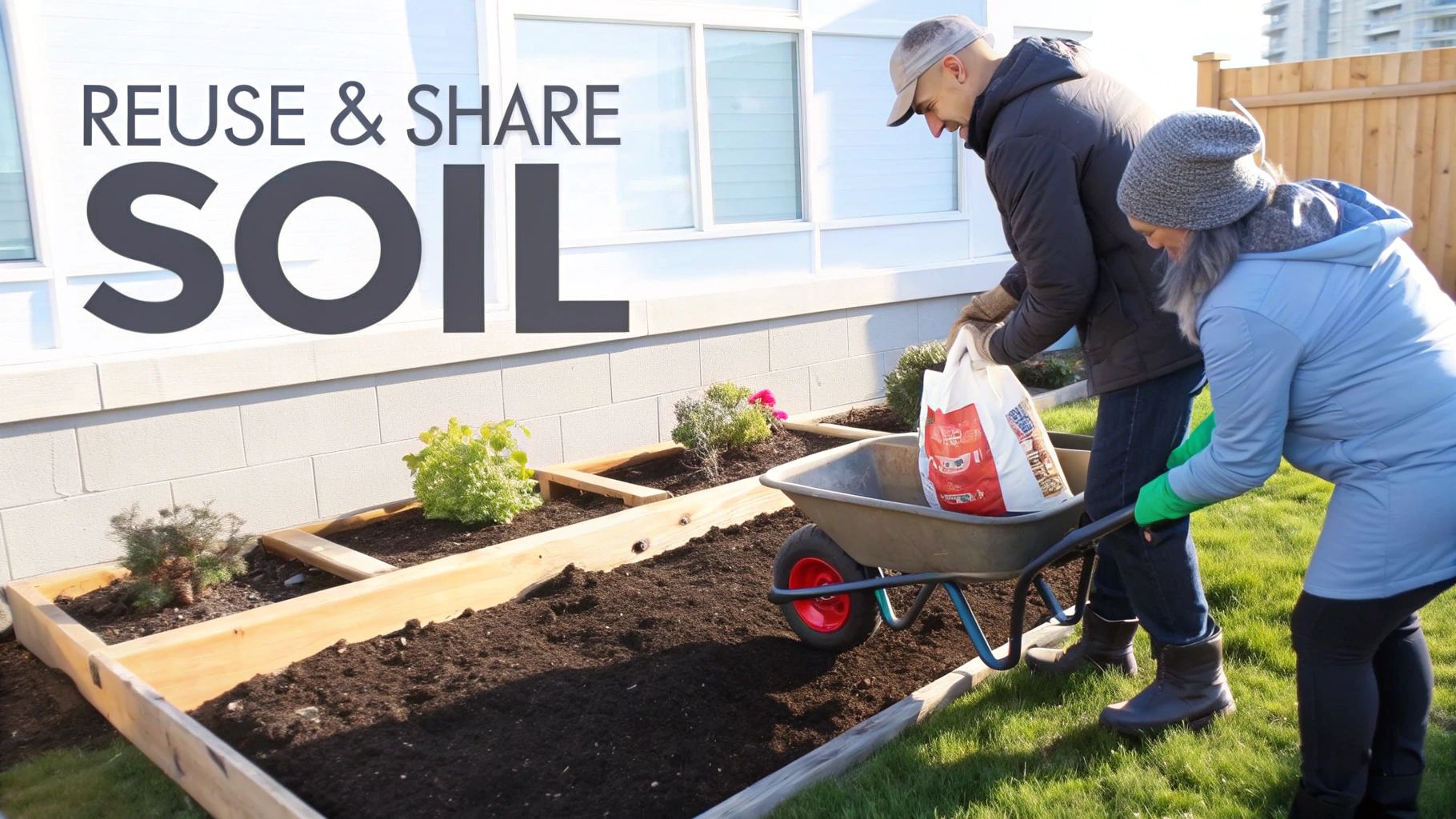
When your project leaves you with a small mound of soil rather than a whole mountain range, hiring a skip or a grab lorry can feel like using a sledgehammer to crack a nut. Thankfully, for smaller domestic jobs, there are plenty of practical and wallet-friendly ways to get rid of it.
The best place to start is right in your own garden. Think of your excess soil not as waste, but as a valuable landscaping resource you've just unearthed. A simple shift in perspective can make all the difference.
Reuse Soil on Your Own Property
Before you even think about hauling it away, take a good look around your own property. You'd be surprised how useful even a modest amount of earth can be for all sorts of common garden improvements.
Here are a few ideas to get you started:
- Levelling Uneven Lawns: Got any annoying dips or hollows in your lawn? Use the soil to fill them in for a much smoother, more attractive finish.
- Building Raised Garden Beds: That spare soil is the perfect filler for new raised beds, saving you the expense of buying bags of topsoil from the garden centre.
- Creating Landscape Features: You can build gentle mounds (often called berms) to add a bit of height and visual interest to a flat garden.
- Improving Existing Flowerbeds: Give your plants a boost by topping up any sunken flowerbeds with a fresh, nutrient-rich layer of soil.
This approach costs absolutely nothing and saves you the back-breaking work of moving heavy material off-site. It’s a win-win for your bank account and your garden.
Offer It to Your Local Community
If you simply can’t use all the soil yourself, your next best bet is finding someone nearby who can. Good quality, clean topsoil is almost always in demand with fellow gardeners and people with allotments.
To make your soil attractive to others, make sure it’s "clean" – that means it’s free from big stones, weeds, rubble, or any other junk. Popping it into bags or just creating a neat pile can make it much more appealing.
When you're offering soil for free, being clear is crucial. A good post should have a decent photo, an honest description (e.g., "mostly clay," "sandy loam"), a rough idea of the quantity, and a polite note that it's for collection only.
You can advertise your free soil on a few different platforms:
- Local Facebook Groups: Have a search for your town's gardening, community, or "freecycle" groups.
- Gumtree: The "Freebies" section is a go-to for people looking for free materials.
- Allotment Associations: Get in touch with your local allotment society. They often have a noticeboard or newsletter where you can post an offer.
Doing this turns your disposal problem into a solution for a neighbour, all while keeping good material from ending up in a landfill.
Your Local Household Waste Recycling Centre
For really small amounts, your local council's Household Waste Recycling Centre (HWRC) – or 'the tip' as most of us call it – might seem like an obvious choice. But hold your horses, because this route has some important strings attached.
Most tips class soil, rubble, and hardcore as "DIY waste," and they usually have strict limits. You might only be allowed a couple of bags per visit, and some councils even charge a small fee. The rules can be wildly different from one area to the next, so always check your local council's website before you load up the car. It’ll save you a wasted journey and the frustration of being turned away at the gate. If you're getting rid of other green waste, you can find out more in our guide on how to dispose of garden waste.
Using Skips and Grab Lorries For Larger Projects
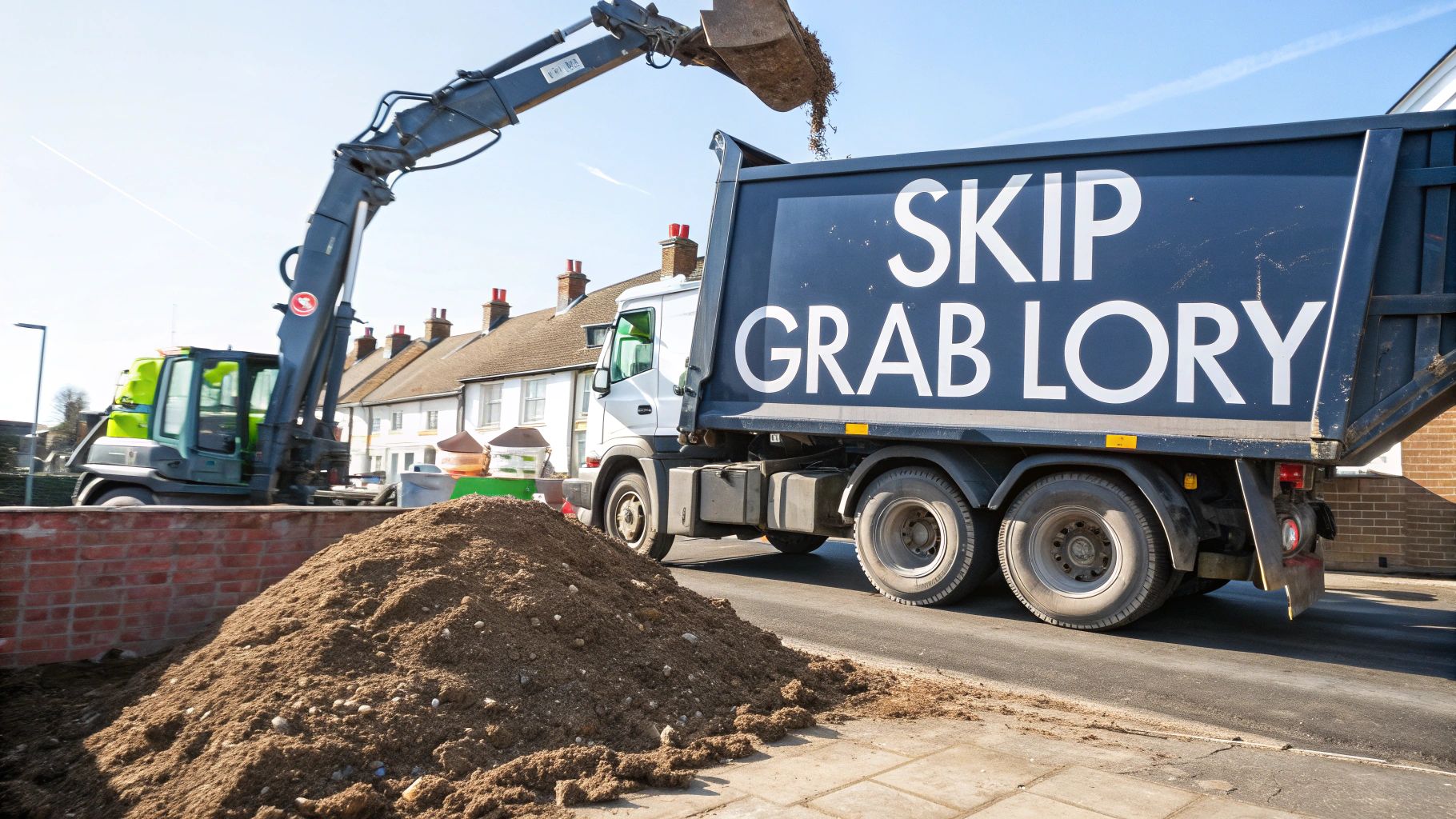
When your garden renovation, extension, or construction project kicks up more soil than you can possibly reuse or give away, it's time to bring in the heavy hitters. For any medium to large-scale job, hiring a skip or a grab lorry isn't just a matter of convenience—it’s often the only practical, legal, and cost-effective way to get your site clear.
These professional services take all the headaches out of soil disposal. They handle everything from the transport to the tipping, making sure your soil gets to a properly licensed facility. This approach means you’re meeting your legal duties without the back-breaking work and endless trips to the local tip.
Skip Hire: The On-Site Solution
Think of a skip as your personal waste container, dropped right on your property. It stays put for a set time, so you can fill it up as you go. This makes it the perfect partner for projects where waste is generated bit by bit over several days or weeks.
Skips are incredibly useful, but getting the right one is the key to not wasting money. They come in a whole range of sizes, measured in cubic yards, and picking the correct capacity is crucial. Get it wrong and you're either paying for empty space or, even worse, having to order a second one.
A few things to remember with skip hire:
- Sizing is Critical: A small 4-yard skip is ideal for a decent garden clearance, holding around 40-50 wheelbarrow loads. For bigger excavation jobs, you’ll want to look at something like an 8-yard skip.
- Permits May Be Needed: If the skip has to live on a public road because you don’t have a driveway, you'll need a permit from your local council. Don't worry, your skip hire company can almost always sort this out for you.
- Mind the Fill Level: You absolutely cannot overfill a skip. Soil is incredibly heavy, and for safety during transport, it must only be filled to the marked level line on the side.
Skips are the workhorses of waste management for good reason. They offer a straightforward, contained solution for dealing with waste over time, making them a go-to for countless renovation and landscaping projects across the UK.
Grab Lorries: The Rapid Removal Specialist
If a skip is your patient, stationary container, a grab lorry is the rapid response team. It’s a massive truck armed with a hydraulic crane and a clamshell bucket. The whole point of a grab lorry is to show up, grab a huge pile of waste, and be gone—often in under 30 minutes.
This service is hands-down the best choice when you’ve already got a large amount of soil dug up and piled in one accessible spot. Its biggest advantage is sheer efficiency. A standard grab lorry can haul away the equivalent of two large skips, roughly 16 tonnes, making it far more effective for big volumes. You can get more details in our complete guide covering the benefits of grab lorry waste removal.
Think about a grab lorry if:
- You Have a Large Volume: For shifting big mounds of soil quickly, it’s the undisputed champion.
- Access is Good: The lorry needs to get fairly close to the pile, but its long-reach crane means it can often pluck soil from over fences, walls, or other obstacles.
- Time is of the Essence: It’s the fastest method out there for clearing a huge amount of waste, getting you your space back almost instantly.
Choosing between these two excellent services really boils down to the pace and scale of your project. For a slow-and-steady job that produces waste gradually, a skip gives you the flexibility you need. For a large, one-off clearance where speed is everything, a grab lorry is simply unbeatable.
Handling Contaminated Soil and Your Legal Duty of Care
What happens when the soil you’ve dug up contains more than just dirt and stones? This is where a simple disposal job can turn into a serious legal issue. Contaminated soil isn't just unwanted earth; it’s officially classed as hazardous waste, and getting it wrong poses a real risk to the environment and public health.
The reality is that soil, particularly in built-up areas or on old industrial sites, can be hiding all sorts of nasty stuff. The tricky part is that these substances often aren't visible, making it hard to know what you’re dealing with just by looking.
Common Soil Contaminants in the UK
You might find your soil is mixed with materials that need a specialist to handle them properly. Some of the most common culprits include:
- Asbestos: Often lurks near old garages, sheds, or industrial buildings where asbestos cement was once used.
- Heavy Metals: Things like lead, arsenic, and cadmium can stick around for decades from old industrial processes or even flakes of old lead-based paint.
- Hydrocarbons: This covers oil, diesel, and petrol spills, which are pretty common on sites where vehicles were kept or repaired.
- Japanese Knotweed: Although it’s a plant, its roots (rhizomes) are legally classed as controlled waste. It must go to a licensed facility to stop its aggressive spread.
Finding any of these means you can't just chuck the soil in a standard skip or haul it to the local tip. That’s not just bad practice; it’s illegal and could land you with some hefty penalties.
Understanding Your Duty of Care
Here in the UK, a legal rule called the Duty of Care applies to absolutely everyone who produces, carries, or gets rid of waste. This isn't just for big companies; it applies to you doing a DIY project at home, too. It means you are legally on the hook for making sure your waste is managed correctly, from the second you dig it up right through to its final, safe disposal.
Put simply, your responsibility doesn’t end when the waste leaves your property. You have to make sure it’s handed over to a licensed waste carrier who will take it to an authorised site. Pleading ignorance won’t get you off the hook, and failing to do this right can result in substantial fines.
This legal duty is the bedrock of UK waste management. With landfill space getting tighter, handling potentially hazardous stuff like contaminated soil correctly is more important than ever. While local councils managed 25.1 million tonnes of waste recently, our reliance on landfill has dropped to just 5.5%, which is a 22% decrease from the year before. This big shift shows how serious the country is about finding responsible waste solutions.
Steps for Disposing of Contaminated Soil
If you even suspect your soil might be contaminated, you need to follow a strict process.
- Do Not Disturb It: If you uncover something that looks or smells suspicious, stop digging immediately. The last thing you want is to release harmful particles into the air.
- Arrange for Professional Testing: The only way to be certain what you’re dealing with is to get a sample professionally tested by a UKAS-accredited lab.
- Find a Specialist Disposal Facility: Once the soil has been identified and classified, you must use a waste carrier and a disposal site that hold the specific permits needed to handle that type of hazardous material.
- Complete the Paperwork: Every single movement of hazardous waste has to be tracked with a Consignment Note. This document creates a clear, legal paper trail from start to finish.
When you’re up against contaminated soil, getting to grips with local hazardous waste rules is vital. While the principles of safe handling are the same everywhere, you can see a detailed example in this City of Chicago Hazardous Waste Disposal guide. Most importantly, make sure you get the right paperwork, like a Waste Transfer Note, to prove you’ve met your legal duties. You can learn more by reading our guide on what is a Waste Transfer Note.
Choosing the Right Soil Disposal Method
So, you've got a pile of soil and a list of disposal options. Picking the right one can feel like trying to solve a puzzle, but it doesn't have to be complicated. By asking a few simple questions about your project, you can quickly figure out the best way forward.
Think of it as a quick checklist. We'll run through everything we've covered and turn it into a practical decision-making process. By looking at how much soil you have, what state it's in, and what your budget looks like, you'll be able to confidently choose the most suitable route – whether that’s a free giveaway or a professional skip hire service.
Key Questions to Guide Your Choice
Let's start by working through these four critical factors. Your answers will immediately narrow down the options and point you toward the most logical disposal method for your situation.
1. How much soil do you have?
The sheer volume of your soil pile is the biggest factor in determining your best option.
- A few bags or a wheelbarrow: For small amounts like this, reusing it in your own garden or taking it to your local council tip (your Household Waste Recycling Centre) are your best bets. Simple and effective.
- A small trailer or van load (1-2 tonnes): If the soil is decent quality, offering it for free on local online groups is a great way to get rid of it. If you have the transport, a licensed tipping facility is another solid choice.
- A large, consolidated pile (2-10 tonnes): This is the sweet spot for skip hire. Hiring the right-sized skip provides the perfect balance of cost and convenience for most medium-sized projects.
- A huge amount (10+ tonnes): For truly massive volumes, a grab lorry is almost always the most efficient and cost-effective solution.
2. What is the quality of the soil?
Next, you need to be honest about what's actually in your soil. Is it pristine topsoil or a mix of everything?
- Clean, high-quality topsoil: This stuff is gold dust to gardeners. Prioritise reusing it yourself or offering it to local gardeners and allotment holders. Don't let good topsoil go to waste.
- Mixed soil with rubble, turf, and stones: This is classed as "inert waste" and is perfect for a skip, grab lorry, or a trip to a licensed tipping facility. It can't be given away for garden use as it's not suitable for growing.
- Potentially contaminated soil: Stop right there. If the soil looks discoloured, has a strange chemical smell, or comes from an old industrial site, you must treat it with caution. Contamination is a serious issue that needs a specialist approach.
This flowchart shows the critical steps to take if you even suspect your soil might be contaminated.
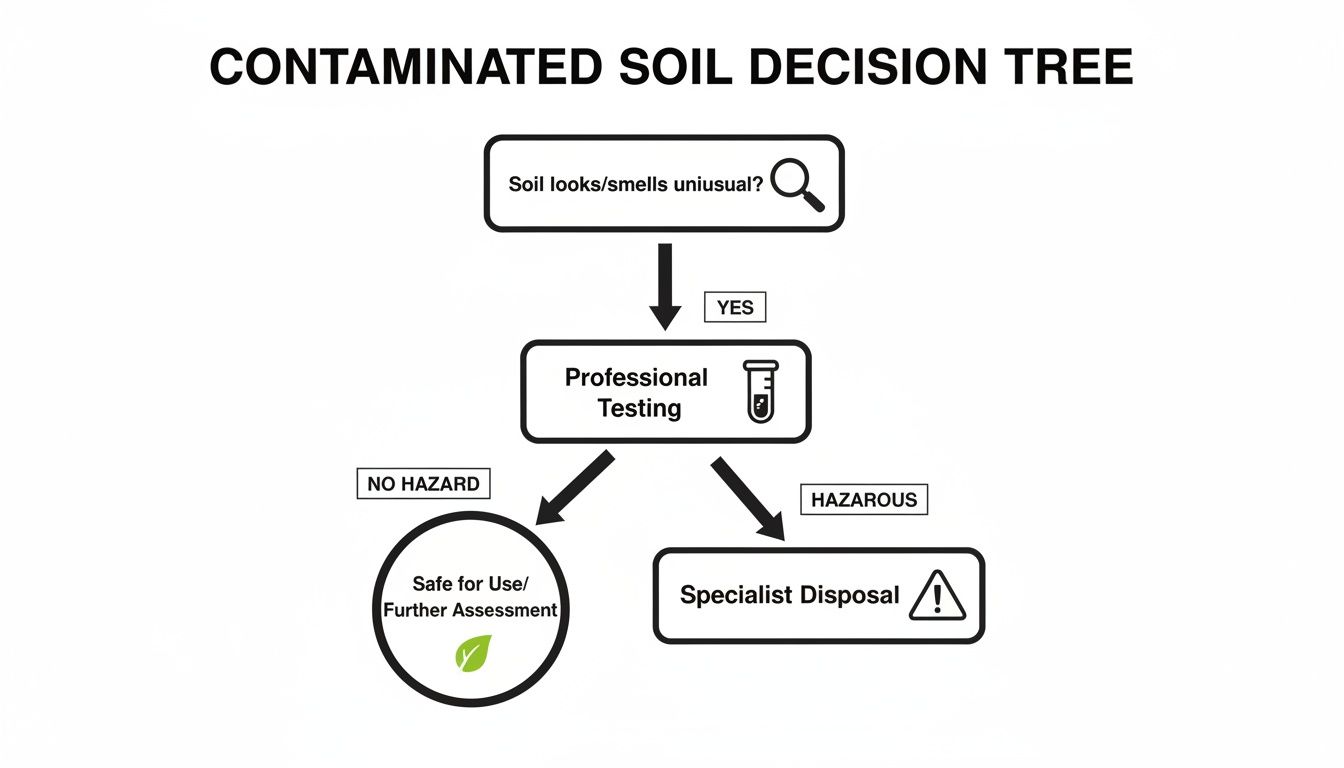
The key takeaway is simple: any hint of contamination takes your soil out of the usual disposal channels. It puts you on a path that involves professional testing and licensed removal services. Don't take the risk.
Finalising Your Decision
Finally, weigh up your budget and your timeline. Free options like online giveaways require more of your time and effort to manage. On the other hand, professional services like skip hire offer speed and convenience for a clear price.
By balancing these factors, you'll find the perfect answer to the question "where can I dispose of my soil?" for your specific project.
Soil Disposal: Your Questions Answered
Even with the best-laid plans, a few questions can pop up when you're faced with a mountain of soil. To make sure you're completely clear on the process and there are no nasty surprises, we've tackled some of the most common queries we hear from customers during their garden and DIY projects.
How Much Does It Cost to Get Rid of Soil in the UK?
The price tag for soil disposal can swing quite a bit, depending on how much you have, where you are, and which method you go for. If you're clever, you can get it done for free by reusing it in another part of your garden or finding a local allotment holder who's happy to take it off your hands. Popping a very small amount in your car for a trip to the council tip is usually free, too.
Once you get into larger volumes, you'll need to look at professional services.
- A 6-yard skip just for soil is a popular choice and will likely set you back somewhere between £200 and £300.
- A grab lorry can feel like a bigger investment at £250 to £400 per load, but it carries a whole lot more, often making it the cheaper option for really big jobs.
Whatever you do, always double-check that your quote covers everything – delivery, collection, and all the disposal fees. And just a heads-up: if your soil is contaminated, that's a whole different ball game. It requires specialist testing and handling, so expect the costs to be significantly higher.
Can I Put Soil in My Garden Waste Bin?
In a word, no. You should never, ever put soil, turf, or any kind of rubble into the green garden waste bin your council provides. Those bins are designed purely for light, compostable material like grass clippings, hedge trimmings, and leaves.
Soil is incredibly heavy and dense. It can easily break the bin or the lifting arms on the collection truck. On top of that, it messes up the council's composting process entirely. While it’s always worth a quick check of your local council's website, the rule is pretty much universal: keep soil out of your green bin, or you'll likely find it hasn't been collected.
What Is the Difference Between Topsoil and Subsoil?
Knowing the difference here is really important, especially if you're planning to give your soil away.
Topsoil is the good stuff. It's the dark, crumbly, nutrient-rich layer at the surface, usually the top 5 to 10 inches. This is what gardeners dream of, as it’s full of the organic matter plants need to thrive.
Subsoil, on the other hand, is what you find underneath. It’s much denser, often full of clay and stones, and has a lighter colour. It contains very little organic matter and isn't much good for growing things in.
For a skip company or a licensed tip, both are simply classed as 'inert waste' as long as they're clean. But if you’re advertising it on Facebook Marketplace, be honest! Only genuine, clean topsoil will get any takers.
Do I Need a Permit to Put a Skip on the Road?
Yes. If the skip needs to sit on any part of a public road, pavement, or grass verge, you absolutely must have a skip permit from your local council. If you have space to place it entirely on your own private land, like a driveway, then you're fine – no permit is needed.
Any good skip hire company will be able to sort the permit out for you as part of the service, though it will add to the final bill. It's something you definitely need to factor into your plans if you don't have a suitable off-road spot.
For straightforward, compliant, and competitively priced waste management here in Dorset, you're in the right place. Whether you need a skip dropped off tomorrow, a grab lorry to clear a big site, or just some honest advice on your legal duties, The Waste Group team is here to help. Get your project cleared the right way by visiting us at https://www.thewastegroup.co.uk.