Skip Hire Prices Bournemouth Explained

Skip Hire Prices Bournemouth Explained
When you’re looking to hire a skip in Bournemouth, the price can swing from about £120 + VAT for a little 4-yarder to roughly £320 + VAT for a standard 8-yard builder’s skip. What you’ll actually pay depends on a few key things: the size you need, how long you’ll have it for, and whether it needs to sit on a public road (which means a permit).
A Quick Guide to Skip Hire Prices in Bournemouth
Getting a handle on the costs from the get-go is the smartest way to plan any project, whether it’s a weekend garden clear-out or a major home renovation. The price you see isn’t just a random number; it’s a bundle that covers the delivery of the skip, its collection, and the responsible sorting and disposal of everything you put inside.
Think of it a bit like ordering a taxi. A smaller car for a short trip costs less than a minibus for a long journey. In the same way, a mini skip for a couple of days will be much easier on the wallet than a massive builder’s skip needed for a week-long job.
To give you a clearer idea of what to expect, we’ve put together a simple breakdown of the typical skip hire prices you’ll find around Bournemouth. It’s the perfect starting point for budgeting your waste removal.
Understanding the Price Tiers
The biggest factor driving the cost is, without a doubt, the skip’s size, which we measure in cubic yards. Each size is built for different jobs, so you’re not left paying for a huge amount of empty space you simply don’t need.
The prices usually include delivery, collection, and disposal for a standard hire period, which is often around one to two weeks.
Below is a handy table showing the estimated costs for the most popular skip sizes in the Bournemouth area. It should help you line up your project’s needs with the right skip, making sure you get the best bang for your buck.
Just a heads-up, these prices are a guide. The final figure can shift based on exactly what you’re throwing away, if you need a permit from the BCP Council, and your specific postcode in the area.
This table is your quick reference guide. It lays out not just the costs but also how much each skip can realistically hold and what jobs they’re best suited for. Use it to get a solid idea of your initial budget and pick the most efficient option.
Estimated Skip Hire Prices in Bournemouth
| Skip Size | Typical Dimensions (Approx.) | Capacity (Bin Bags) | Estimated Price Range (£) | Best For |
|---|---|---|---|---|
| 4 Yard ‘Mini’ Skip | 1.8m L x 1.3m W x 0.9m H | 30-40 | £120 – £160 | Small kitchen/bathroom refits, garden clearances, minor DIY jobs. |
| 6 Yard ‘Small Builder’s’ Skip | 2.6m L x 1.5m W x 1.2m H | 50-60 | £220 – £270 | Ideal for bulky waste from home renovations, moderate construction projects. |
| 8 Yard ‘Large Builder’s’ Skip | 3.6m L x 1.7m W x 1.2m H | 70-80 | £280 – £340 | Perfect for major renovation projects, large house clearances, and construction site waste. |
| 12 Yard ‘Maxi’ Skip | 3.7m L x 1.8m W x 1.7m H | 100-120 | £380 – £450 | Suitable for large volumes of light, bulky waste like furniture or shop fittings. Not for heavy soil/rubble. |
This quick overview should give you a much clearer picture of what to expect, helping you choose the right skip without any guesswork.
What Really Determines Your Skip Hire Cost?
Ever wondered why two seemingly identical projects in Bournemouth end up with completely different skip hire quotes? It’s a common question, and the final price isn’t just plucked out of thin air. It’s actually a carefully calculated sum based on a handful of core factors. Getting your head around these is the key to mastering your budget and making sure you only pay for what you actually need.
Think of it like ordering a pizza. The base price is set by the size you choose—small, medium, or large. Then, you add costs for the “toppings” (different waste types), any special delivery instructions (like needing a permit), and how long you need it (the rental period). Each one of these choices adjusts the final bill.
This section will break down that “menu” of skip hire costs, showing you exactly how your project’s details translate into the price you’ll pay. Once you grasp these key drivers, you can make smarter decisions that stop you from overspending and keep your project running smoothly.
The Foundation of Your Quote Is Skip Size
The single biggest influence on your skip hire price is its size. Simple as that.
It’s a straightforward equation: a larger skip needs a bigger lorry for delivery and collection, it holds more waste (which costs more for us to process), and it takes up more space at the recycling facility.
Choosing the right size is like picking the right tool for the job. You wouldn’t use a sledgehammer to hang a picture frame, and you definitely shouldn’t hire a huge 12-yard skip for a small garden tidy-up. If you overestimate, you’re literally paying for empty space. But underestimating is even worse—it often means you have to order a second skip, effectively doubling your delivery and collection costs.
This diagram shows the main pillars that build up your final skip hire price.
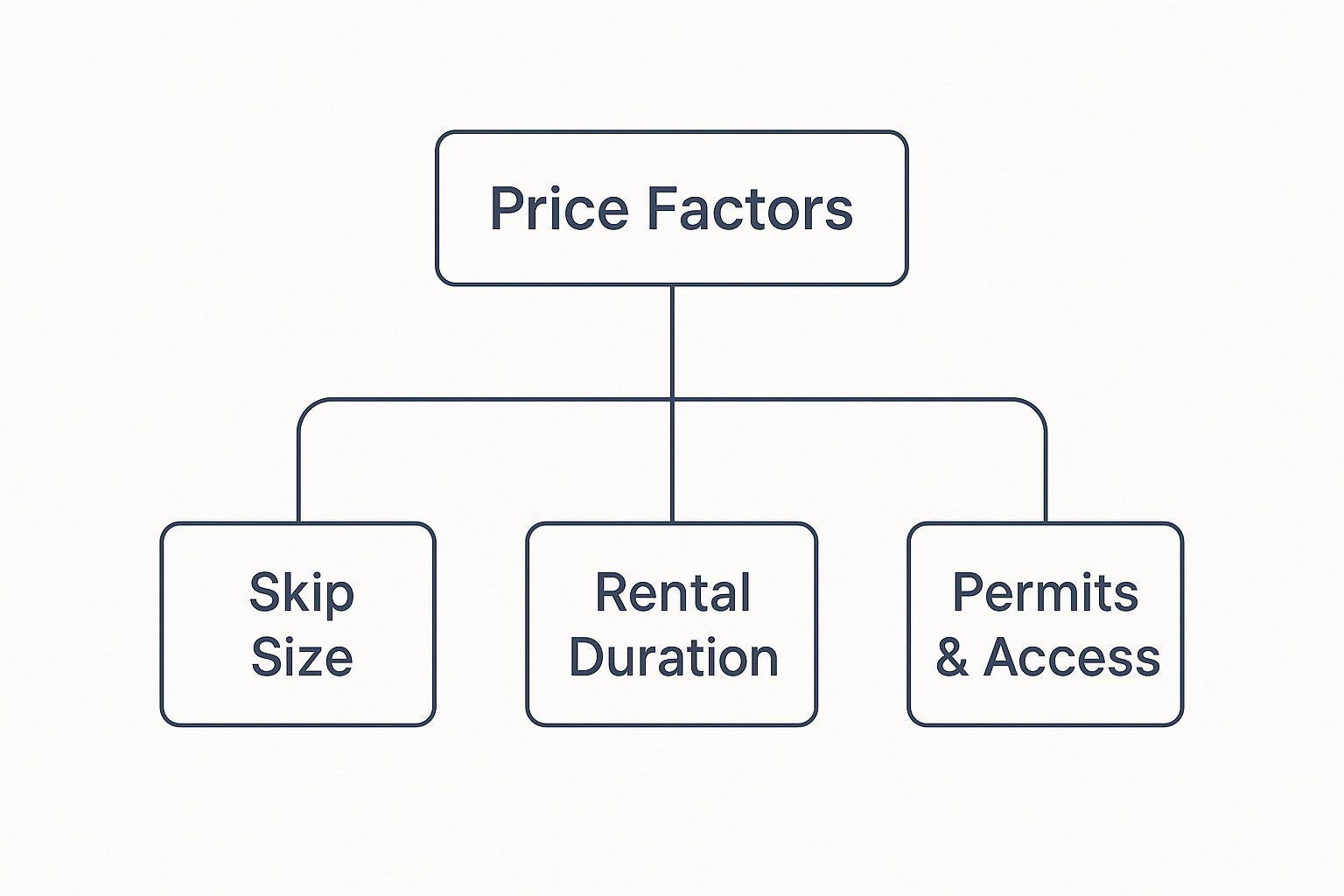
As you can see, the skip size, how long you need it, and whether you need a permit are the foundational elements that dictate your initial quote.
Rental Duration and Waste Type Surcharges
While size sets the base price, how long you need the skip and what you throw in it can add to the total. Standard hire periods are typically around one to two weeks, which is usually baked into the initial quote. But if your project drags on longer than planned, you’ll likely face extra weekly or daily charges.
The type of waste you’re getting rid of is another critical factor. A skip filled with uniform, easily recyclable “inert” waste like soil, bricks, and concrete is cheaper to process than one filled with mixed general waste. On top of that, certain items will always incur surcharges because they require specialised, careful disposal.
Common items that can increase your quote include:
- Mattresses: They’re bulky, a nightmare to compress, and don’t play well with the machinery at recycling facilities.
- Plasterboard: This has to be kept separate from other waste streams by law to prevent contamination.
- Tyres: These require a specific recycling process and can’t just be chucked into a landfill.
Always be upfront with your skip hire company about the types of waste you’ll be generating. This transparency ensures you get an accurate quote from the start and avoid unexpected fees or, worse, a refusal of collection later on.
The Impact of Location and Accessibility
Finally, your specific location within the Bournemouth, Christchurch, and Poole (BCP) area plays a role. While many companies offer a flat rate across a wide area, some might tweak prices based on fuel costs and travel time to more remote postcodes. For a deeper look into how geography affects costs, our guide on understanding local skip hire prices provides some great insights.
Accessibility matters, too. If delivering the skip means our driver has to navigate a very narrow lane or a tricky-to-access site, that could influence the cost.
The most significant location-based charge, however, is the skip permit. If you don’t have a private driveway or land and need to place the skip on a public road or pavement, a permit from the BCP council is mandatory. This adds a fixed cost directly to your bill, and there’s no way around it.
What If the Skip Has to Go on a Public Road?
This is one of the most common questions we get, and it definitely impacts the total price of hiring a skip in Bournemouth. If you’ve got a private driveway or a bit of garden you can use, you’re golden. No permit needed.
But what if the only spot is on the pavement or the road right outside your house? That’s when you’ll need a skip permit.
Think of it as official permission from the Bournemouth, Christchurch, and Poole (BCP) Council. It’s a legal must-have that ensures your skip is placed safely, doesn’t block traffic, and is lit up properly so people can see it at night. Trying to skip this step is a bad idea – it can lead to some pretty hefty fines and an order to remove the skip immediately, which can throw a real spanner in the works for your project.
Basically, if any part of the skip touches public land like a road, verge, or pavement, it needs a licence. The good news? You don’t have to wade through the council paperwork yourself.
Who Sorts Out the Permit?
Your skip hire company handles everything. They’ll apply for the permit on your behalf because they have established relationships with the BCP Council and know exactly what’s needed, from traffic management rules to having the right safety cones and lights.
You actually can’t apply for a permit as an individual homeowner or builder. It has to be a registered and insured skip hire provider. This is a smart system, really. It makes sure only reputable companies that meet the council’s public liability insurance and safety standards can place skips on public highways, protecting both you and the general public.
When you book, just tell the company it needs to go on the road. They’ll handle the rest and simply add the council’s fee to your final bill.
The most important thing to remember here is time. The BCP Council needs a few working days to process a permit application. To be safe, you should plan to book your skip at least 5-7 days before you need it to avoid any frustrating delays.
Breaking Down Permit Costs and Timings
The price of the permit is a fixed fee set by the BCP Council, not your skip hire company. They just pass this cost directly on to you, and it will be clearly itemised on your invoice. It’s a key extra charge to factor into your budget when you’re pricing up skip hire in Bournemouth.
A standard permit is usually valid for a set period, often 7 to 14 days. If your project takes a bit longer than expected and you need the skip for more time, the permit will need to be renewed, and that means another fee.
Here’s how the process usually goes:
- You tell the skip company: When you book, you let them know the skip is going on a public road.
- They apply to the BCP Council: Your hire company submits all the paperwork and their credentials.
- The permit gets approved: Once it’s granted, they have the green light to deliver your skip.
- Safety gear is put in place: The skip will be delivered with all the legally required reflective markings, traffic cones, and safety lamps for nighttime.
It’s a straightforward process that makes sure every skip on a public highway in the Bournemouth area is safe and fully compliant. It might add a small cost and a bit of planning, but it’s a vital step that keeps you on the right side of local regulations and saves you from a world of potential legal trouble.
The Hidden Costs of Waste Disposal and Landfill Tax
When you hire a skip, it’s easy to think the price is just for a big metal box and a driver to drop it off. But there’s a lot more going on behind the scenes. A hefty chunk of your bill is actually decided by complex national policies, things completely out of your local skip company’s hands. These are the “hidden” costs, driven mainly by UK waste regulations and ever-rising landfill taxes.
Think of it like the price of petrol. The number you see at the pump isn’t just set by the local station; it’s massively influenced by global oil prices and government fuel duty. In the same way, the skip hire prices in Bournemouth are directly shaped by national environmental charges that every single waste management company has to pay. Knowing this gives you a much clearer picture of what you’re really paying for.
This section pulls back the curtain on these costs, connecting the dots between government policy and the final invoice you see. Once you get how landfill tax and recycling rules work, you’ll understand why responsible waste disposal is such a key part of the price.
The Landfill Tax Explained
The government’s main weapon for encouraging recycling is the Landfill Tax. It’s a straightforward tax slapped on every tonne of waste that gets buried in the ground. The logic is simple: make it expensive to dump rubbish, and people will find smarter, greener ways to deal with it.
And this isn’t some minor fee; it’s a big, constantly climbing cost. Skip hire companies that have to take waste to landfill sites must pay this tax, and they have no choice but to pass it on to you, the customer. So, when the government puts the tax up, skip hire prices all over the country are sure to follow.
The standard rate has been on a steep climb, going from £91.35 per tonne in 2019 to an expected £126.15 per tonne by April 2025. That’s a sharp 38% increase. This tax hike directly pumps up operating costs for skip firms, a financial squeeze that gets reflected in the prices customers pay in places like Bournemouth and Dorset. You can explore more data on how these tax changes affect pricing across the UK to see the bigger picture.
The Ripple Effect of Environmental Regulations
On top of direct taxes, strict environmental laws add another layer of cost. The old days of just taking a skip’s contents and tipping them into a hole are long gone. Modern waste management is a complex, heavily regulated operation.
UK rules now demand that waste is thoroughly segregated and recycled. When your full skip is collected, it doesn’t go straight to a landfill. First, it’s taken to a licensed Waste Transfer Station where everything inside is meticulously sorted.
This sorting process is crucial. It’s where materials like wood, metal, soil, plastics, and cardboard are separated from non-recyclable waste. It’s labour-intensive work, but it ensures as much material as possible is diverted from landfill and given a second life.
This whole operation requires serious investment from waste companies. They have to pay for:
- Advanced Sorting Facilities: Huge industrial sites with specialised machinery like conveyor belts, giant magnets, and air classifiers.
- Skilled Labour: A trained team is needed to manually sort materials and operate all the machinery safely and effectively.
- Compliance and Licensing: Meeting the strict standards of the Environment Agency means ongoing costs for permits, monitoring, and detailed reporting.
These investments in equipment and people are absolutely essential for disposing of waste legally and responsibly. But they’re also a massive operational expense that naturally gets factored into the price of hiring a skip.
What This Means for Bournemouth
In a place like Bournemouth, which generates a lot of waste, the impact of these national policies is clear to see. With a recycling rate of 45%, the Bournemouth, Christchurch, and Poole (BCP) area is doing better than the national average, but it still sends a huge amount of waste for disposal.
In fact, almost 10% of BCP’s waste was sent to landfill in the year ending March 2024, which is one of the highest rates in the South West. This reliance on landfill means that any increase in the tax has a direct and very noticeable effect on local disposal costs.
Ultimately, the price you’re quoted for a skip reflects these wider economic and environmental pressures. The fee doesn’t just cover the convenience of having a skip at your door; it covers the complex, costly, and legally-required process of making sure your rubbish is managed responsibly, with as little impact on our environment as possible.
Smart Strategies to Lower Your Skip Hire Bill
Getting the best skip hire prices in Bournemouth isn’t about some secret trick; it’s just about making a few smart, practical decisions. With a bit of forward planning, you can shave a surprising amount off your final bill without cutting corners on service. It all starts before you even think about picking up the phone.
The most common—and expensive—mistake people make is getting the size wrong. It’s like packing for a holiday: choose a suitcase that’s too small and you’re forced to buy another one at the airport. Ordering a skip that’s too small often means paying for a second one later, which doubles your delivery costs and can grind your whole project to a halt.
On the flip side, hiring a skip that’s way too big means you’re just paying for empty space. Before you book, try to pile all your waste in one spot. This gives you a much better visual idea of the volume, making it easier to judge if you need a little 4-yarder or something more like a 6-yard skip.
Maximise Your Skip Space
Once the skip is on your drive, how you fill it makes a huge difference. Don’t just start chucking things in at random. A well-packed skip can hold far more than you’d think, helping you squeeze every last drop of value out of what you’ve paid for.
Start by laying flat items like old doors or large panels along the bottom to create a solid base. Then, get to work breaking down anything bulky – take apart that old wardrobe, flatten every cardboard box, and snap long branches into smaller, manageable pieces. It’s a simple step, but it frees up a massive amount of usable space.
A well-packed skip is an efficient skip. By placing heavier, denser materials at the bottom and filling the gaps with smaller debris, you create a stable, level load that uses every available inch of space you’ve paid for.
Segregate Your Waste and Get Multiple Quotes
Here’s another great tactic: separate your waste before it even goes near the skip. If your project is generating a lot of one specific material, like soil and rubble from digging new foundations, ask your skip company about an ‘inert waste’ skip. Because this waste is so much easier and cheaper to process, you can often get a much lower rate.
You can apply the same logic to other materials, too:
- Metal: Keep any scrap metal to one side. Some local scrap yards might even pay you for it.
- Wood: Clean, untreated wood is often simpler to recycle than mixed general waste.
- Garden Waste: A load of pure green waste can sometimes be disposed of more cheaply.
Finally, never, ever take the first price you’re given. The skip hire market in Bournemouth is competitive, so spend five minutes calling two or three reputable local firms. This lets you compare not just the price, but the service they offer. A word of warning, though: be wary of any quote that seems too good to be true. It can be a red flag for hidden charges or unreliable service. To get a better handle on this, it’s worth understanding why the lowest price isn’t always the best choice.
If you’ve only got a small job on the go, why not team up with a neighbour? If you’re both clearing out the garden or doing a spot of DIY, sharing the cost of a single mini skip is far more budget-friendly than hiring one each. This simple bit of teamwork could easily cut your disposal bill in half.
Common Questions About Hiring a Skip in Bournemouth
Hiring a skip, especially for the first time, can throw up a few questions. Getting straight answers is the key to making sure your project runs smoothly, without any hitches. This final section cuts through the noise and tackles the most common queries we get from customers, so you can book with total confidence.
Think of it as your pre-hire checklist. We’ll cover the absolute essentials, from what you can and can’t chuck in your skip to the real-world headache of overfilling it.

What Items Are Prohibited in a Skip
This is probably the most important rule of skip hire: knowing what you absolutely cannot put inside. Tossing a prohibited item into a skip isn’t just bending the rules; it can lead to the driver refusing collection or hitting you with significant extra charges.
Why the strict rules? It’s because certain materials are officially classed as hazardous. They pose a real risk to the environment and the people handling the waste, so they need specialised, legally-compliant disposal. Putting them in with general waste can contaminate an entire lorry-load of otherwise recyclable stuff.
So, what needs to stay out? The list is pretty specific:
- Asbestos: A seriously dangerous material that must only ever be touched by licensed specialists.
- Plasterboard: This has to be kept separate to prevent it from contaminating other waste streams.
- Electricals (WEEE): This is anything with a plug or a battery, from old tellies and fridges to toasters and tablets.
- Batteries: Both car and household batteries contain nasty chemicals and have to be recycled at proper collection points.
- Paint Tins & Solvents: Unless the tins are bone dry with no residue, these liquids are a hazardous no-go.
- Gas Cylinders: They’re pressurised and are a serious explosion risk at waste facilities.
- Tyres: These require a special recycling process and can’t just be buried in a landfill.
Before you even start your clear-out, have a quick chat with your chosen Bournemouth skip hire company. Ask for their complete list of prohibited items—it’s a five-minute conversation that can save you a world of hassle down the line.
Are There Weight Limits for Skips
Yes, absolutely. Every skip has a maximum weight it can safely hold. But just as importantly, every skip also has a “level load” line. You’ll see it clearly painted on the side—that line is your absolute limit.
Overfilling a skip, even a little bit, makes it unsafe and illegal to transport on the road. The nets that drivers use are only there to stop light debris from blowing out; they aren’t designed to restrain a mountain of overflowing waste. A driver is legally required to refuse collection of an overloaded skip, and they won’t take it. Period.
If that happens, you’ll be asked to remove all the excess waste yourself until it’s level. This can grind your project to a halt. To add insult to injury, you might also get charged a “wasted journey” fee for the driver’s time and fuel. It’s always cheaper and far less stressful to just get the right size skip from the start.
How Far in Advance Should I Book a Skip
A little bit of planning makes all the difference. As a general rule of thumb, it’s wise to book your skip at least 24-48 hours ahead of time. This gives the company a decent window to schedule your delivery, particularly during busy spells like spring clean weekends and summer holidays when everyone in Bournemouth seems to want a skip.
But, that timeframe goes out the window if you need the skip placed on a public road or pavement. If it’s going on public land, you’ll need a permit from BCP Council. The skip company sorts this out for you, but it’s not an instant process and can take several working days for the council to approve.
To dodge any frustrating delays, you should book your skip at least a week in advance if you know a permit is needed. This builds in plenty of buffer time for the paperwork to clear, ensuring your skip turns up right on schedule.
Can I Put Soil and Rubble in Any Skip
You can definitely put soil and rubble into a standard mixed waste skip, no problem. However, if your project involves getting rid of a lot of this stuff—think digging foundations, landscaping the garden, or knocking down a brick wall—you could be missing a trick and paying more than you need to.
This heavy material is known in the trade as “inert waste.” It’s basically things like:
- Soil and clay
- Bricks and concrete
- Rubble and hardcore
- Ceramic tiles
Because inert waste is non-reactive and easy to recycle into aggregate, the disposal costs are much lower. Many skip hire firms pass this saving on by offering a cheaper rate for a skip that will only contain inert waste. For a more detailed look at how different factors shape the final price, our guide on what to expect when hiring a skip is a great resource.
So, if you’re shifting a large amount of soil and rubble, always ask your Bournemouth skip provider if they offer a discounted rate for an inert waste skip. It’s one simple question that could trim your final bill.
Ready to book your skip with a team you can trust? The Waste Group offers reliable, transparent, and competitively priced skip hire across Bournemouth and Dorset. Get your instant online quote today!